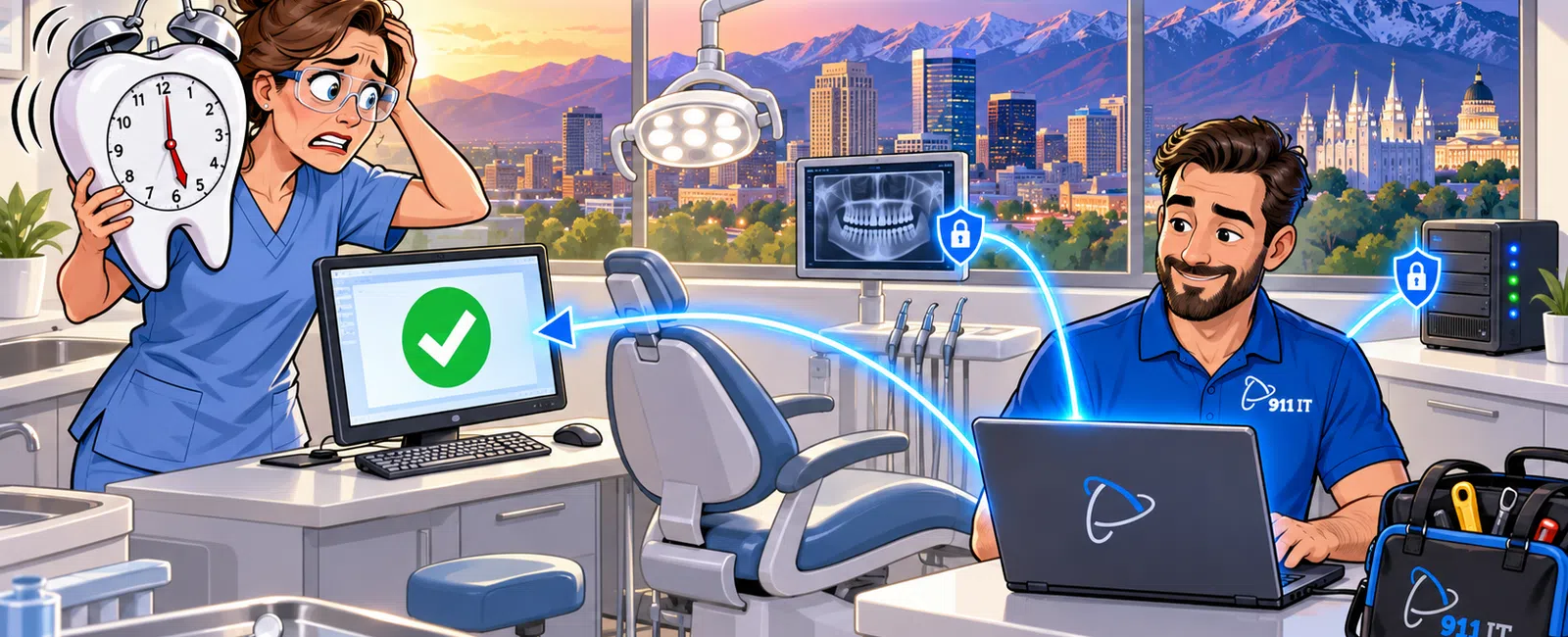
After-hours IT emergencies for dental practices with extended patient hours require 24-7 live monitoring, immediate escalation protocols, and remote-first response capabilities. 911 IT provides round-the-clock helpdesk support with technicians monitoring your systems continuously, ensuring practice management software, digital radiography, and chair-side technology receive immediate attention when failures occur during early morning or evening appointments - typically responding within 15 minutes of alert detection.
What Happens When Your Practice Management System Crashes at 6:30 AM With Patients Waiting?
The first patient arrives at 7:00 AM, but your Dentrix or Eaglesoft system won't load. Your front desk can't access schedules, treatment plans, or insurance information. Without immediate IT intervention, you face appointment cancellations, revenue loss, and frustrated patients who took time off work for their visit.
24-7 monitoring systems detect server issues, application failures, and network outages before your team notices them. Automated alerts trigger immediately when critical dental software stops responding, database connections fail, or backup systems show corruption.
Remote access tools enable technicians to diagnose and resolve most issues without traveling to your office. Database recovery, application restarts, network reconfiguration, and user access restoration happen within minutes rather than hours. For Salt Lake City practices, this means a technician based locally can also arrive on-site quickly when hardware replacement becomes necessary.
Waiting until 8:00 AM for a help desk to open means turning away patients, rescheduling procedures, and losing thousands in daily revenue. One morning of downtime in a busy practice can cost $5,000 to $15,000 in lost production.
How Do You Ensure HIPAA-Compliant Remote Access During Emergency Response?
After-hours emergency support for dental practices requires strict HIPAA compliance even during crisis response. Every remote connection must maintain encryption, authentication, and audit logging to protect patient health information.
Secure remote access platforms use multi-factor authentication and encrypted tunnels to connect technicians to your systems. All sessions are logged with timestamps, user identification, and actions taken - creating the audit trail required for HIPAA compliance and OCR investigations.
Business Associate Agreements (BAAs) establish legal responsibility for PHI protection during support activities. Your IT provider becomes a business associate under HIPAA regulations, accepting liability for any breaches occurring during their access to your systems.
Every after-hours support session must generate documentation showing who accessed what data, when, and why - essential for Security Risk Assessments.
Emergency access protocols balance speed with security. Pre-authorized technicians with background checks and HIPAA training can connect immediately without waiting for approval, while maintaining full compliance with federal regulations. This approach prevents the dangerous shortcut of bypassing security controls during emergencies.
For Salt Lake City dental practices, HIPAA compliance services include 24-7 support protocols that protect patient data even during urgent after-hours incidents.
What Response Time Can You Actually Expect at 6:00 PM on Friday?
Response time commitments often deteriorate outside business hours when providers rely on on-call rotations, overseas help desks, or ticket queues that wait until Monday morning. A dental practice with evening patients needs the same rapid response at 7:00 PM as at 10:00 AM.
True 24-7 support means live technicians monitoring systems continuously, not an answering service taking messages. When alerts trigger or staff call with emergencies, a qualified technician responds immediately - not a tier-one operator reading scripts and creating tickets for callback.
Rhonda from a construction firm shared her experience: "911 IT has been a godsend to our company, especially to me. They are always available and can take care of any need we have right away. I never panic anymore when something isn't working right, I just call anyone on the team, and they pleasantly take over, and the problem is gone."
Large national MSPs often route after-hours calls to offshore help desks with limited authority to take action. Small businesses become ticket numbers in queues managed by junior technicians who must escalate every decision. Your Friday evening emergency might not reach a senior engineer until Monday morning.
Regional providers like 911 IT maintain the sweet spot - large enough to staff 24-7 monitoring and support, small enough that every client is known by name and genuinely matters. When your practice management system fails at 6:30 PM, the technician who answers knows your environment, your software configuration, and your backup procedures without reading through ticket history.
Response time expectations should be explicit: acknowledgment within 5 minutes, initial diagnosis within 15 minutes, and resolution or escalation plan within 30 minutes for critical systems affecting patient care.
Which IT Issues Can Be Resolved Remotely Versus Requiring On-Site Response?
Understanding which emergencies require physical presence helps set realistic expectations and enables faster resolution for remote-fixable issues. Most dental practice IT emergencies fall into categories with predictable response patterns.
Remote-resolvable issues include software crashes, database corruption, network configuration problems, user access restoration, application performance degradation, backup failures, and security incidents. These represent approximately 80-85% of after-hours emergencies in dental practices.
On-site required issues include hardware failures (servers, switches, workstations), physical network damage, power or environmental problems, peripheral device failures (scanners, printers, intraoral cameras), and situations where remote access itself has failed.
A hybrid approach resolves most issues remotely while maintaining rapid on-site response capability for hardware problems. For Salt Lake City practices, having a provider with local presence means on-site arrival within 60-90 minutes when necessary, rather than waiting for next-business-day service or a technician flying in from another state.
Digital radiography failures illustrate this distinction. If the imaging software crashes but the sensor hardware works, remote technicians can restart services, rebuild configurations, or restore from backup. If the sensor itself fails or the workstation dies, someone must physically replace hardware - but remote diagnosis determines this before dispatching a technician.
Proactive monitoring reduces on-site emergencies by predicting hardware failures before they occur. Drive health monitoring, temperature alerts, and performance degradation tracking enable planned replacement during business hours rather than emergency response at 7:00 PM.
How Do You Prioritize Multiple Simultaneous Issues During Peak Patient Hours?
A realistic after-hours emergency plan acknowledges that multiple issues can occur simultaneously. When your practice management system, digital radiography, and patient portal all experience problems during evening appointments, triage protocols determine response sequence.
Patient-facing systems receive highest priority. Issues preventing treatment delivery, blocking patient check-in, or compromising clinical decision-making demand immediate attention. A crashed PMS system that prevents accessing treatment plans outranks a slow administrative workstation.
Revenue-impacting systems come second. Problems affecting billing, insurance verification, or payment processing matter urgently but can tolerate brief delays if clinical systems need attention first. A dental practice can reschedule billing tasks but cannot reschedule a patient sitting in the chair.
Administrative and back-office systems rank third. Email delays, file sharing issues, or reporting problems matter but rarely constitute true emergencies during patient hours. These issues can often wait for resolution during slower periods or next business day.
Security incidents override normal prioritization. Ransomware detection, unauthorized access attempts, or data breach indicators demand immediate response regardless of other issues, because delayed action multiplies damage exponentially.
Transparent communication during triage prevents frustration. When your front desk reports three problems simultaneously, knowing which receives attention first and why - along with estimated timelines for each - reduces anxiety and enables workaround planning.
For comprehensive protection of dental practice technology, managed IT services include defined escalation procedures and priority matrices that guide response during complex multi-issue scenarios.
What Local Salt Lake City Providers Offer True 24-7 Dental Practice Support?
Salt Lake City dental practices evaluating after-hours IT support options should compare providers based on actual capabilities rather than marketing claims. "24-7 support" can mean anything from an answering service to full monitoring and response.
Local providers with verified 24-7 capabilities for dental practices include:
- 911 IT - Provides continuous monitoring, live helpdesk support, and rapid response for dental practices with extended hours. Specializes in practice management software support, HIPAA compliance, and chair-side technology. Based in South Jordan with coverage across Salt Lake metro, enabling quick on-site response when needed. Offers flat-rate transparent pricing and 100% satisfaction guarantee.
- Executech - Established Utah MSP with healthcare IT experience and multiple service locations enabling local response.
- Wasatch I.T. - Regional provider with managed services and support capabilities for medical and dental practices.
- Nexus IT Consultants - Salt Lake City-based MSP offering managed services with healthcare sector experience.
National dental-specific IT providers exist but often lack local presence for rapid on-site response. A provider based in another state can handle remote issues effectively but cannot quickly replace failed hardware or address physical problems during evening patient hours.
One-person break-fix shops cannot provide true 24-7 coverage. When the sole technician is unavailable, asleep, or handling another emergency, your practice waits. Growing dental practices need team-based support where multiple technicians can respond simultaneously.
Large enterprise-focused MSPs often deprioritize small and mid-sized dental practices. A five-provider practice represents one account among thousands, receiving standardized service rather than the specialized dental technology expertise and personal attention that regional providers deliver.
Janet, an attorney who has worked with 911 IT for years, noted: "911 IT is the absolute BEST company I have ever worked with. As a tech-impaired geezer, I struggle with most computer and online functions... Being computer literate is not my strong suit, but 911 IT has never made me feel like a bother." This patient, explanatory approach matters especially during stressful after-hours emergencies.
The right provider combines technical depth with local presence - large enough to maintain 24-7 staffing and specialized dental software expertise, small enough that your practice is genuinely important and receives personalized attention during emergencies.
How Much Does 24-7 IT Support Cost for a Dental Practice?
After-hours IT support costs vary based on service model, practice size, and technology complexity. Understanding pricing structures helps dental practices budget appropriately and avoid surprise bills during emergencies.
Fully managed IT services with 24-7 monitoring and support typically cost $100 - $250 per user per month industry-wide. This includes continuous system monitoring, unlimited help desk access, proactive maintenance, security management, and emergency response - eliminating per-incident charges during after-hours crises.
HIPAA compliance services add $50 - $200 per user per month depending on requirements, covering Security Risk Assessments, policy development, audit logging, encryption management, and compliance monitoring essential for dental practices handling protected health information.
Ad-hoc or break-fix support models charge $150 - $300 per hour for help desk assistance. This approach seems economical until a Friday evening emergency generates a $1,200 bill for four hours of troubleshooting - and happens repeatedly throughout the year.
For a typical 5-provider dental practice with 12 total users (doctors, hygienists, assistants, front desk, office manager), fully managed services with HIPAA compliance might cost $1,800 - $5,400 monthly. This predictable expense prevents budget-destroying emergency bills and includes proactive prevention that reduces emergency frequency.
James from a manufacturing company experienced this value firsthand: "911 IT has been able to cut our IT expenditures by almost half and at the same time improve our systems reliability. Since moving to their IT Firm we have noticed that they are more knowledgeable than the other companies we have used in the past."
The cost of inadequate after-hours support exceeds any service fee. One evening of practice management system downtime costs $3,000 - $8,000 in lost production. A ransomware incident without immediate response can shut down operations for days or weeks, costing tens of thousands in lost revenue plus ransom and recovery expenses.
Flat-rate transparent pricing eliminates the hesitation to call for help during minor issues before they become major emergencies. When every call generates an hourly bill, staff delay reporting problems - turning 10-minute fixes into hour-long crises.
Frequently Asked Questions
What qualifies as an after-hours IT emergency for a dental practice?
After-hours IT emergencies include any technology failure preventing patient treatment, blocking access to clinical information, compromising patient data security, or stopping critical business functions during scheduled patient hours. Practice management system crashes, digital radiography failures, network outages, security incidents, and chair-side technology problems all qualify as emergencies requiring immediate response when patients are scheduled or being treated.
Can after-hours IT support handle issues with dental-specific software like Dentrix or Eaglesoft?
Yes, experienced dental IT providers maintain expertise in major practice management systems including Dentrix, Eaglesoft, Open Dental, and Curve. After-hours support includes database recovery, application troubleshooting, integration repairs, and performance optimization for dental-specific software. Technicians familiar with dental workflows understand which issues block patient care versus administrative inconveniences, enabling appropriate prioritization during emergencies outside business hours.
How quickly can a technician arrive on-site for hardware failures during evening appointments?
Response time for on-site emergencies depends on provider location and staffing. Salt Lake City-based providers like 911 IT typically arrive within 60-90 minutes for critical hardware failures during evening patient hours. Remote diagnosis occurs immediately while a technician travels, often identifying solutions before arrival. Providers without local presence may require next-business-day on-site service, making them unsuitable for practices with extended hours requiring same-day hardware resolution.
Does 24-7 IT monitoring prevent most after-hours emergencies?
Proactive monitoring significantly reduces emergency frequency by detecting issues before they cause failures. Continuous monitoring identifies failing hard drives, degrading performance, security threats, backup failures, and configuration problems - enabling resolution during business hours rather than patient appointments. While monitoring cannot prevent all emergencies (sudden hardware death, power failures, user errors), it typically reduces crisis incidents by 60-75% compared to reactive-only support models.
What happens if multiple dental offices in your practice group have simultaneous emergencies?
Multi-location dental practices need IT providers with sufficient staffing depth to handle simultaneous emergencies across offices. Team-based support enables parallel response - multiple technicians addressing different locations concurrently rather than queuing requests. Prioritization protocols triage based on patient impact, with offices actively treating patients receiving priority over administrative-only locations. Dental service organizations should verify provider capacity to support all locations simultaneously before committing to service agreements.
Are after-hours emergency calls included in managed IT service contracts?
Comprehensive managed IT service agreements include unlimited after-hours support without per-incident charges, providing predictable monthly costs regardless of emergency frequency. This flat-rate model encourages early problem reporting and eliminates hesitation to call during minor issues. Break-fix or hourly support models charge separately for after-hours calls - often at premium rates - creating unpredictable expenses and discouraging staff from seeking help promptly. Verify contract terms explicitly to understand whether 24-7 support is truly included or requires additional fees.