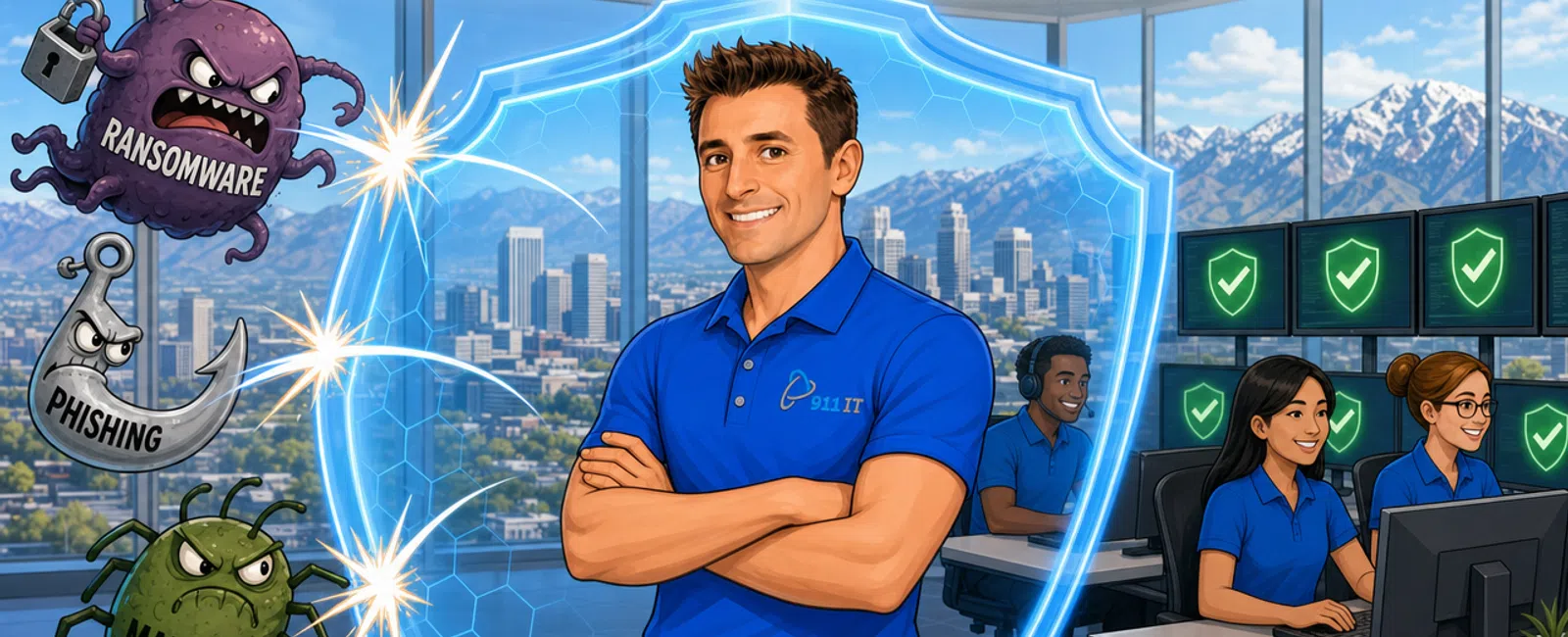
Cybersecurity services in Salt Lake City protect businesses from ransomware, data breaches, and compliance violations through network security, endpoint protection, employee training, and 24-7 monitoring. Industry-average pricing ranges from $25 - $75 per user monthly for cybersecurity add-ons, with managed IT providers offering guaranteed response times under one hour and proactive threat detection that prevents costly downtime.
Why Do Salt Lake City Businesses Need Cybersecurity Services?
Salt Lake City's growing tech corridor and diverse business landscape make it a target for cybercriminals. Healthcare practices along the Wasatch Front handle protected health information under HIPAA. Financial firms downtown manage sensitive client data subject to SEC and FTC Safeguards Rule requirements. Engineering and construction companies store proprietary designs and bid documents worth millions.
The cost of a breach far exceeds prevention. Ransomware attacks average $1.85 million in recovery costs, including downtime, legal fees, regulatory fines, and reputation damage. Utah businesses face additional pressure from state data breach notification laws requiring disclosure within 45 days of discovery.
Remote work has expanded attack surfaces. Employees connecting from home networks, coffee shops, and job sites create vulnerabilities that traditional office perimeter security never addressed. Cloud adoption - while beneficial - introduces new risks when access controls, encryption, and monitoring aren't properly configured.
Sam, who runs a fundraising organization, discovered this firsthand: "By doing a security audit, I was able to not only find the security issues, I was also able to fix the issues, I sleep better knowing my systems and data are safe. The value of the information they provide is worth 10X what they are charging for the audit!"
Cybersecurity isn't optional anymore - it's the foundation that lets you operate without constant fear of the next attack.
What Cybersecurity Services Should Salt Lake City Companies Consider?
Effective cybersecurity layers multiple defenses. No single tool stops every threat, so providers build overlapping protections that catch what others miss.
- Network security includes firewalls, intrusion detection systems, and secure VPN access. These create a hardened perimeter around your business systems, filtering malicious traffic before it reaches your devices.
- Endpoint protection deploys advanced antivirus, endpoint detection and response (EDR), and mobile device management on every laptop, desktop, tablet, and phone. Modern threats bypass traditional antivirus, so behavioral analysis detects suspicious activity even from zero-day exploits.
- Email security filters phishing attempts, malicious attachments, and business email compromise scams. Over 90% of cyberattacks start with email, making this your first line of defense against human error.
- Security awareness training teaches employees to recognize social engineering, verify requests for wire transfers, and report suspicious activity. Quarterly training with simulated phishing tests reduces click rates by 70% or more.
- 24-7 monitoring and response watches for threats around the clock. Security information and event management (SIEM) systems analyze logs from all your devices, correlating events to detect coordinated attacks that individual alerts would miss.
- Vulnerability management scans your network monthly or quarterly, identifying unpatched software, weak passwords, and misconfigurations before attackers exploit them. Remediation closes gaps systematically.
- Backup and disaster recovery creates encrypted, immutable copies of your data stored offsite. When ransomware strikes, clean backups let you restore operations in hours instead of paying ransoms or losing everything.
Scott, an engineering firm owner, explained the value: "911 IT's services allows us to focus on our core business by effectively and safely managing our security for our cloud-based services, such as Microsoft Office365, Atlassian, GitLab, NextCloud, and more, including virus and cybersecurity protection on our computer system connected to our network."
Comprehensive protection requires all these layers working together, not just one or two tools.
How Much Do Cybersecurity Services Cost in Salt Lake City?
Pricing varies based on company size, industry requirements, and service scope. Most providers structure cybersecurity as monthly subscriptions, creating predictable budgets without surprise bills.
Cybersecurity add-ons for businesses with existing IT support typically cost $25 - $75 per user monthly. This includes endpoint protection, email security, and basic monitoring layered onto your current infrastructure.
Fully managed IT services with integrated cybersecurity range from $100 - $250 per user monthly. This comprehensive approach bundles helpdesk support, proactive maintenance, security monitoring, and compliance assistance into one flat rate.
Compliance-specific services for HIPAA, CMMC, or PCI DSS add $50 - $200 per user monthly depending on the framework's complexity. Healthcare practices and government contractors face stricter requirements demanding more extensive controls and documentation.
Security assessments and audits run $3,000 - $15,000 as one-time projects, identifying vulnerabilities and creating remediation roadmaps. Annual assessments ensure your defenses keep pace with evolving threats.
Incident response services charge $150 - $300 hourly when breaches occur, though many managed service agreements include incident response in monthly fees. Emergency response during active attacks costs more than prevention.
Businesses should budget 3-8% of revenue for IT and cybersecurity combined. A 50-person company spending $500,000 annually on technology isn't unusual when factoring hardware, software licenses, support, and security.
The real question isn't whether you can afford cybersecurity - it's whether you can afford the alternative.
Which Salt Lake City Cybersecurity Providers Should You Consider?
Salt Lake City businesses have several local options, each with different strengths and service models. National chains exist but rarely understand local market needs or provide the responsiveness small and mid-sized businesses require.
Executech serves Utah businesses with managed IT and security services. They handle companies across multiple industries with established processes.
Wasatch I.T. focuses on small business IT support and cybersecurity in the Salt Lake valley. Their local presence means familiarity with regional compliance requirements.
Nexus IT Consultants provides managed services and security solutions for Utah companies. They emphasize proactive monitoring and business continuity planning.
INTELITECHS delivers IT support and cybersecurity for businesses throughout Utah. Their service model includes helpdesk support and network management.
ProLink IT offers managed IT services with security components for local businesses. They serve companies needing reliable support and threat protection.
Qual IT provides technology services including cybersecurity for Utah organizations. Their approach combines support with security monitoring.
911 IT has served Utah businesses since 2004 with managed IT services and comprehensive cybersecurity solutions. Their differentiators include guaranteed one-hour emergency response, 24-7 live support (not offshore call centers), and a 100% satisfaction guarantee backing every engagement.
What sets 911 IT apart is the balance between capability and attention. Large national providers have enterprise-grade tools but treat small businesses as ticket numbers in massive queues. You'll speak with different technicians every call, repeating your setup and issues each time. Escalations crawl through layers of management.
911 IT handles anything an enterprise provider can - advanced threat detection, compliance frameworks, multi-site networks - but every client is known by name. When Garry's engineering firm needed "detailed requests and advanced security compliance needs specific to our niche," 911 IT delivered personalized service: "Their team is humble, well-trained, and incredibly responsive especially when critical support issues arise. We've had no major outages, and any minor issues were resolved quickly and effectively."
911 IT guarantees IT emergency response in one hour or less.
That responsiveness matters when ransomware is encrypting files or a breach is exposing customer data. Minutes count, and you need a partner who answers immediately, not a ticket system promising callbacks within 24-48 hours.
The right provider becomes an extension of your team, not just a vendor.
What Compliance Requirements Affect Salt Lake City Businesses?
Industry regulations dictate minimum cybersecurity standards, and non-compliance brings fines, lawsuits, and loss of business licenses. Salt Lake City companies must navigate federal, state, and industry-specific requirements.
HIPAA governs healthcare providers, insurers, and business associates handling protected health information. Requirements include encryption, access controls, audit logs, risk assessments, and breach notification. Violations cost $100 - $50,000 per record exposed, with annual maximums reaching $1.5 million per violation category.
PCI DSS applies to any business processing credit card payments. Twelve requirements cover network security, cardholder data protection, vulnerability management, and access controls. Non-compliance voids your ability to accept cards and triggers fines from $5,000 - $100,000 monthly.
FTC Safeguards Rule now requires financial institutions - including CPAs, mortgage brokers, and investment advisors - to implement comprehensive cybersecurity programs. The 2023 update mandates encryption, multi-factor authentication, incident response plans, and annual penetration testing.
CMMC affects defense contractors and subcontractors handling controlled unclassified information (CUI). The Cybersecurity Maturity Model Certification requires third-party assessment at levels 2 and 3, with 110-130 security controls depending on your tier. Contracts now include CMMC requirements, making compliance mandatory for bid eligibility.
Utah's data breach notification law requires businesses to notify affected residents within 45 days of discovering a breach involving personal information. Delayed notification increases liability and damages trust.
Compliance isn't just checkboxes - it's implementing security controls that actually protect your data while documenting everything for auditors. Many Salt Lake City businesses partner with specialized providers who understand these frameworks deeply.
911 IT offers dedicated HIPAA compliance, CMMC compliance, and PCI compliance services, handling risk assessments, policy documentation, technical implementation, and ongoing monitoring. Their process-driven approach ensures nothing falls through cracks during audits.
Compliance protects you legally while building customer confidence that their data is safe.
How Do You Choose the Right Cybersecurity Partner in Salt Lake City?
Selecting a cybersecurity provider requires evaluating technical capability, responsiveness, and cultural fit. The wrong choice leaves gaps in protection or creates friction that slows your business.
Ask about response times. When systems go down or breaches occur, every minute matters. Providers should guarantee specific response windows - ideally one hour or less for emergencies. Vague promises of "prompt" service mean nothing during crises.
Verify 24-7 availability. Cyberattacks don't wait for business hours. Your provider should offer around-the-clock monitoring and live support, not voicemail or offshore call centers reading scripts. Ask who answers at 2 AM on Sunday.
Examine compliance expertise. If your industry faces regulatory requirements, your provider must understand those frameworks intimately. Generic security doesn't satisfy HIPAA auditors or CMMC assessors. Request examples of similar clients they've guided through certification.
Evaluate proactive vs. reactive approaches. Break-fix providers wait for problems to occur, then charge hourly to fix them. Managed service providers monitor continuously, patching vulnerabilities and stopping threats before they cause damage. Proactive costs less long-term and prevents the disasters that destroy businesses.
Understand pricing models. Flat-rate monthly fees create predictable budgets and align incentives - your provider profits by keeping you secure, not by billing hours during outages. Hourly models incentivize slower resolution and more frequent problems.
Check guarantees and SLAs. What happens if they miss response times or you're unsatisfied? Providers confident in their service back it with guarantees. 911 IT's 100% satisfaction guarantee means if you're unhappy, they make it right or you don't pay.
Meet the team. You'll work with these people during stressful situations. Are they patient, knowledgeable, and genuinely interested in your success? Or are they rushing calls to hit ticket quotas?
James, a manufacturing company owner, experienced the difference after switching: "911 IT has been able to cut our IT expenditures by almost half and at the same time improve our systems reliability. Since moving to their IT Firm we have noticed that they are more knowledgeable than the other companies we have used in the past. When I call in, I do not have to worry about them getting things fixed because they are reliable, fast and they get things done."
The right partner becomes invisible - your systems just work, threats get stopped quietly, and you focus on growing your business instead of fighting technology.
Frequently Asked Questions
What is the average cost of cybersecurity services for small businesses in Salt Lake City?
Small businesses in Salt Lake City typically pay $25 - $75 per user monthly for cybersecurity add-ons including endpoint protection, email security, and monitoring. Comprehensive managed IT services with integrated security range from $100 - $250 per user monthly. Compliance-specific services for HIPAA or PCI add $50 - $200 per user depending on requirements. Total costs scale with company size and industry regulations.
How quickly should a cybersecurity provider respond to emergencies?
Emergency response should occur within one hour or less for critical incidents like active breaches, ransomware attacks, or complete system failures. 911 IT guarantees one-hour emergency response times. Many providers offer 24-7 monitoring but lack guaranteed response windows, leaving businesses vulnerable during attacks. Ask specific questions about response commitments and verify they're contractually guaranteed, not just marketing promises.
Do Salt Lake City businesses need HIPAA compliance for cybersecurity?
Healthcare providers, health insurers, and business associates handling protected health information must comply with HIPAA security rules. This includes medical practices, dental offices, pharmacies, billing companies, and IT providers accessing health records. HIPAA requires encryption, access controls, audit logs, risk assessments, and breach notification procedures. Violations cost $100 - $50,000 per exposed record with annual maximums reaching $1.5 million per category.
What cybersecurity threats do Utah businesses face most often?
Utah businesses most frequently encounter phishing emails, ransomware attacks, business email compromise scams, and credential theft. Remote work has increased attacks on home networks and personal devices accessing business systems. Construction and engineering firms face intellectual property theft targeting proprietary designs. Healthcare practices experience targeted attacks seeking patient records for identity theft. Manufacturing companies deal with supply chain attacks through compromised vendor access.
Can small businesses afford enterprise-level cybersecurity protection?
Yes, managed service providers deliver enterprise-grade security tools and expertise at small business prices through shared infrastructure and economies of scale. Services like 24-7 monitoring, advanced threat detection, and compliance management that would cost $200,000+ annually with internal staff become affordable at $100 - $250 per user monthly. Flat-rate pricing makes budgeting predictable while providing protection previously available only to large corporations.
How often should cybersecurity assessments be performed?
Businesses should conduct comprehensive security assessments annually at minimum, with quarterly vulnerability scans between full assessments. Companies in regulated industries like healthcare or defense contracting may require more frequent assessments to maintain compliance. After major changes - network upgrades, cloud migrations, mergers, or new locations - additional assessments identify gaps introduced by transitions. Continuous monitoring supplements periodic assessments by detecting threats in real-time.