
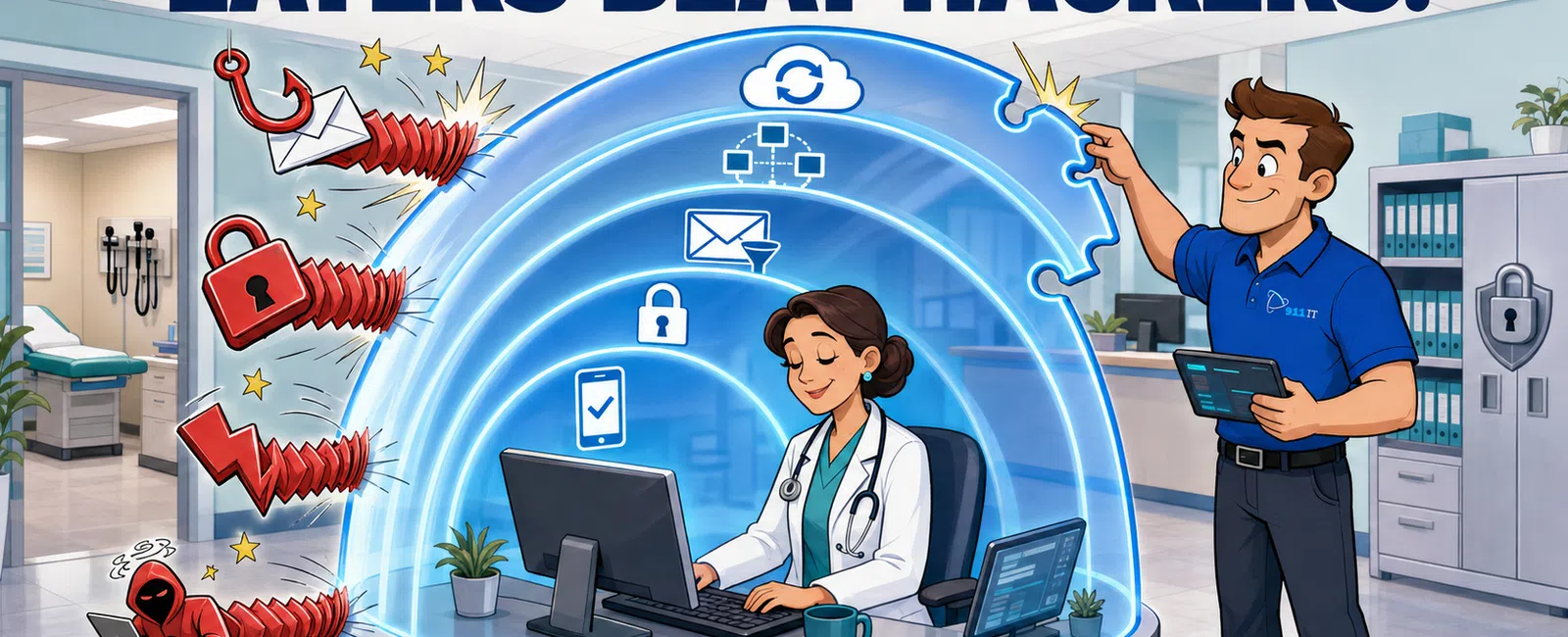
911 IT implements a seven-layer cybersecurity framework for healthcare practices including encrypted backups with 15-minute recovery point objectives, 24/7 network monitoring with threat detection, multi-factor authentication for all PHI access points, HIPAA-compliant firewall configurations, regular vulnerability assessments, employee security awareness training, and signed Business Associate Agreements ensuring full regulatory compliance across Utah, Wyoming, and Arizona.
How Do You Secure Electronic Protected Health Information at Rest and in Transit?
PHI encryption forms the foundation of healthcare cybersecurity. 911 IT implements AES-256 encryption for all stored patient data, ensuring that even if physical devices are stolen or breached, the information remains unreadable without proper decryption keys.
For data in transit, we enforce TLS 1.2 or higher protocols across all communications channels. This includes email systems, patient portals, telehealth platforms, and EHR synchronization between locations. Every transmission containing PHI travels through encrypted tunnels that meet HIPAA Technical Safeguard requirements.
Remote access receives particular attention in healthcare environments. We configure VPN solutions with certificate-based authentication, ensuring that staff accessing patient records from home or satellite clinics do so through secure, auditable connections. Sarah, a Salt Lake City healthcare practice administrator, experienced this firsthand when 911 IT came out within a few hours to fix critical phone line issues that other techs had failed to resolve, saving her practice thousands of dollars in potential downtime and lost patient communications.
Database-level encryption protects your practice management software and EHR systems. We work with platforms like Epic, Cerner, athenahealth, and eClinicalWorks to ensure encryption keys are properly managed and rotated according to compliance schedules.
Encrypted PHI at every layer prevents the catastrophic breaches that trigger OCR investigations and patient notification requirements.
What Network Security Controls Prevent Unauthorized Access to Patient Data?
Network segmentation creates isolated zones within your practice infrastructure. We separate clinical systems from administrative networks, guest WiFi from internal resources, and medical devices from general workstations. This containment strategy ensures that a compromised laptop in the billing department cannot access the EHR database.
Next-generation firewalls with deep packet inspection monitor every connection attempt. These systems analyze traffic patterns in real-time, blocking suspicious activity before it reaches sensitive systems. We configure rules specific to healthcare workflows, allowing legitimate clinical communications while denying unauthorized database queries.
Multi-factor authentication becomes mandatory for all systems touching PHI. Staff members must provide something they know (password), something they have (mobile device or security token), and in some cases something they are (biometric verification) before accessing patient records. This prevents credential theft from resulting in data breaches.
Intrusion detection and prevention systems run continuously, analyzing network behavior for anomalies. When a workstation suddenly attempts to access hundreds of patient records outside normal patterns, the system automatically blocks the activity and alerts our security operations center.
Healthcare practices face ransomware attacks every 11 seconds industry-wide, making layered network defenses essential for patient data protection.
Role-based access controls ensure staff members see only the PHI necessary for their job functions. Front desk personnel access scheduling and demographics but not clinical notes. Billing staff see procedure codes and insurance information but not detailed treatment records. This principle of least privilege minimizes exposure in the event of compromised credentials.
Layered network controls transform your practice from an easy target into a hardened environment that attackers bypass for softer victims.
How Do You Monitor and Respond to Cybersecurity Threats Around the Clock?
Continuous monitoring detects threats that emerge outside business hours. 911 IT's 24/7 security operations center watches your healthcare network every hour of every day, identifying suspicious login attempts, malware signatures, and unusual data transfers that could indicate a breach in progress.
Security Information and Event Management (SIEM) systems aggregate logs from every device, application, and access point. This centralized visibility allows our team to correlate events across your infrastructure, spotting attack patterns that individual systems might miss. When a user account shows failed login attempts from three different countries within minutes, we know credentials have been compromised.
Automated response protocols contain threats immediately. If ransomware behavior is detected on a workstation, the system automatically isolates that device from the network, preventing lateral movement to file servers or EHR databases. Your practice continues operating while we investigate and remediate the affected endpoint.
Endpoint detection and response (EDR) tools run on every workstation, server, and mobile device accessing your network. These agents monitor process behavior, file modifications, and network connections in real-time, catching zero-day threats that traditional antivirus misses. When a medical assistant's laptop attempts to encrypt files en masse, EDR stops the process within seconds.
Quarterly vulnerability scans identify security gaps before attackers exploit them. We test your external-facing systems, internal network devices, and application configurations against databases of known vulnerabilities. Patches and configuration changes address findings according to risk severity, with critical issues resolved within 48 hours.
Incident response plans specific to healthcare scenarios ensure rapid, compliant reactions to security events. Our playbooks address ransomware, phishing compromises, lost devices, and insider threats with step-by-step procedures that minimize patient impact and meet breach notification timelines.
Round-the-clock vigilance catches threats in their earliest stages, often before any PHI is accessed or exfiltrated.
What Employee Training and Access Controls Reduce Human-Factor Risks?
Phishing remains the top entry vector for healthcare breaches, making staff education critical. 911 IT delivers quarterly security awareness training tailored to clinical and administrative workflows. Staff learn to recognize patient-themed phishing emails, suspicious invoice requests, and fake vendor communications that target healthcare practices.
Simulated phishing campaigns test employee vigilance in realistic scenarios. We send safe but convincing phishing emails to your team, tracking who clicks suspicious links or enters credentials on fake login pages. Staff who fall for simulations receive immediate coaching, while practice-wide results guide additional training focus areas.
Access provisioning and de-provisioning follows documented procedures. When you hire a new medical assistant, we create accounts with appropriate permissions based on their role. When staff members leave, we immediately disable all access across every system, preventing former employees from retaining PHI access that violates HIPAA minimum necessary standards.
Password policies enforce complexity requirements and regular rotation schedules. We configure systems to reject weak passwords, require minimum lengths of 12 characters, and mandate changes every 90 days for privileged accounts. Password managers help staff maintain unique credentials across multiple clinical systems without resorting to sticky notes.
Amy, a healthcare practice manager, explained how outsourcing to 911 IT saved her time and money: "Having a dedicated IT team, not a tech person that does it 'on the side' has saved me time and money. Since outsourcing our IT to 911, the team setup our new location and everything was running great before we opened our doors."
Clean desk policies and physical security measures complement digital controls. We help implement procedures for locking workstations when stepping away, securing printed PHI, and restricting access to server rooms and network closets.
Training transforms your staff from security vulnerabilities into your first line of defense against social engineering and credential theft.
How Do Backup and Disaster Recovery Systems Protect Against Ransomware and Data Loss?
Immutable backups create recovery points that ransomware cannot encrypt or delete. 911 IT implements backup solutions with air-gapped storage and write-once-read-many technology, ensuring that even if attackers compromise your entire network, clean copies of patient data remain intact for restoration.
Continuous data protection captures changes every 15 minutes throughout the business day. This granular recovery capability means you can restore to a point just before a ransomware infection began, losing minutes of data instead of hours or days. For practices processing dozens of patient encounters daily, this minimizes the administrative burden of recreating lost documentation.
Backup encryption protects archived PHI with the same rigor as production systems. All backup data travels encrypted to storage locations and remains encrypted at rest, meeting HIPAA requirements for safeguarding ePHI throughout its lifecycle.
Regular restoration testing validates that backups actually work when needed. We perform quarterly recovery drills, restoring sample datasets to verify integrity and measure recovery time objectives. Many practices discover backup failures only when attempting emergency restoration; our testing catches problems during routine maintenance.
Geographic redundancy stores backup copies in multiple physical locations across Utah and beyond. If a fire, flood, or other disaster affects your primary practice location, patient data remains safe in geographically separated data centers. This supports business continuity planning and meets disaster recovery requirements for practices serving critical patient populations.
Version retention policies maintain historical backup copies for seven years or longer, supporting both regulatory compliance and medical-legal requirements. When a patient requests records from five years ago or a malpractice claim surfaces years after treatment, you can retrieve the necessary documentation from archived backups.
Tested, encrypted, and geographically distributed backups transform ransomware from a practice-ending catastrophe into a recoverable inconvenience.
What Compliance Documentation and Business Associate Agreements Ensure HIPAA Adherence?
Business Associate Agreements form the legal foundation for healthcare IT relationships. 911 IT signs comprehensive BAAs with every healthcare client, formally acknowledging our responsibilities for safeguarding PHI, reporting breaches, and complying with HIPAA Security Rule requirements. This contractual obligation ensures we're legally bound to the same standards as your practice.
Security risk assessments document your current cybersecurity posture against HIPAA Technical Safeguards. We evaluate administrative, physical, and technical controls across your infrastructure, identifying gaps and prioritizing remediation efforts. These assessments provide the documentation OCR expects during audits or breach investigations.
Policies and procedures documentation covers all required HIPAA elements. We help develop or review your practice's written security policies, ensuring they address access controls, audit controls, integrity controls, transmission security, and all other Security Rule standards. These documents demonstrate to regulators that you've implemented a comprehensive security program.
Audit logging captures every access to PHI across your systems. We configure EHR platforms, file servers, and databases to record who accessed which patient records, when, and from where. These logs support breach investigations, insider threat detection, and compliance with HIPAA's audit control requirements. Retention periods extend for six years to match regulatory expectations.
Incident response documentation tracks security events from detection through resolution. When we identify and contain a potential breach, detailed records capture the timeline, affected systems, PHI exposure, and remediation steps. This documentation supports breach notification decisions and demonstrates due diligence if OCR investigates.
Annual compliance reviews ensure your security program evolves with regulatory changes and emerging threats. We reassess controls, update risk assessments, and adjust security measures to address new vulnerabilities or practice changes like telehealth expansion or new office locations.
Comprehensive documentation transforms HIPAA compliance from a confusing regulatory burden into a manageable, evidence-based security program.
Which Salt Lake City IT Providers Specialize in Healthcare Cybersecurity?
Healthcare practices in Salt Lake City need IT partners who understand both cybersecurity and clinical workflows. Several local providers offer healthcare-focused services:
- 911 IT delivers comprehensive healthcare cybersecurity with 24/7 monitoring, HIPAA compliance services, and EHR support across Utah, Wyoming, and Arizona. The team signs Business Associate Agreements, implements seven-layer security frameworks, and provides proactive threat prevention with a 100% satisfaction guarantee.
- Executech serves healthcare clients with managed IT services and compliance support across the Intermountain West.
- Wasatch I.T. offers IT solutions for medical practices with a focus on Utah-based healthcare providers.
- Nexus IT Consultants provides cybersecurity and compliance services for various industries including healthcare.
- INTELITECHS delivers managed services with healthcare IT experience in the Salt Lake market.
Large national MSPs also operate in Salt Lake City, but healthcare practices often find themselves as one account among thousands. Ticket queues stretch longer, technicians rotate frequently, and escalations move slowly through corporate hierarchies. When your EHR goes down during patient hours, you need someone who answers immediately and knows your systems intimately.
The sweet spot for most healthcare practices is a provider large enough to maintain 24/7 security operations and deep technical expertise, yet small enough that every client is known by name. Ying, a healthcare practice owner, captured this balance: "911 IT has been transformative for our business. What really sets them apart is their proactive approach. They don't just fix problems; they prevent them, which gives us real confidence in our IT operations."
When evaluating healthcare IT providers, verify they sign Business Associate Agreements, maintain security certifications, and demonstrate experience with your specific EHR platform. Ask about their incident response procedures, backup testing frequency, and how quickly they patch critical vulnerabilities. The right partner becomes an extension of your practice, protecting patient data as carefully as you protect patient health.
For practices across Salt Lake City, Provo, and the broader Wasatch Front, healthcare IT support from 911 IT combines local responsiveness with enterprise-grade security capabilities. Our team understands Utah's healthcare landscape, from Intermountain Healthcare's Epic integration requirements to rural telehealth challenges in Wyoming and Arizona markets.
Frequently Asked Questions
What is a Business Associate Agreement and why does my practice need one?
A Business Associate Agreement is a HIPAA-required contract between your healthcare practice and any vendor who handles PHI on your behalf. Your IT provider, backup service, and other technology partners must sign BAAs acknowledging their legal responsibility to safeguard patient data, report breaches, and comply with Security Rule requirements. Without signed BAAs, your practice violates HIPAA regulations regardless of how secure your systems are.
How quickly can you detect and respond to a ransomware attack on our EHR system?
911 IT's endpoint detection and response systems identify ransomware behavior within seconds of execution, automatically isolating infected devices before encryption spreads to network shares or databases. Our 24/7 security operations center receives immediate alerts and begins containment procedures. Most ransomware incidents are contained within minutes, with full investigation and remediation completed within hours. Immutable backups enable complete data restoration without paying ransoms.
Do you support our specific EHR platform with your cybersecurity measures?
Yes, 911 IT implements security controls compatible with all major EHR platforms including Epic, Cerner, athenahealth, eClinicalWorks, Greenway, and specialty systems. We configure firewalls, encryption, and access controls according to each platform's technical requirements while maintaining HIPAA compliance. Our team has experience securing cloud-based and on-premise EHR deployments, ensuring security measures enhance rather than disrupt clinical workflows throughout your practice.
What happens if we experience a data breach despite your security measures?
911 IT maintains detailed incident response procedures that activate immediately upon breach detection. We contain the incident, preserve forensic evidence, assess PHI exposure, and document the timeline for regulatory reporting. Our team guides you through breach notification requirements, including OCR reporting and patient communications if thresholds are met. The Business Associate Agreement clarifies responsibilities, and our documentation demonstrates due diligence that often reduces regulatory penalties significantly.
How do your cybersecurity services integrate with our existing compliance efforts?
Our HIPAA compliance services complement your existing privacy and security programs. We provide technical safeguards that support your administrative policies, generate audit logs for compliance documentation, and conduct security risk assessments that identify gaps. Our team coordinates with your compliance officer or privacy officer, ensuring technical controls align with your policies and procedures. This integrated approach creates a comprehensive compliance program that satisfies both regulatory and operational requirements.


