
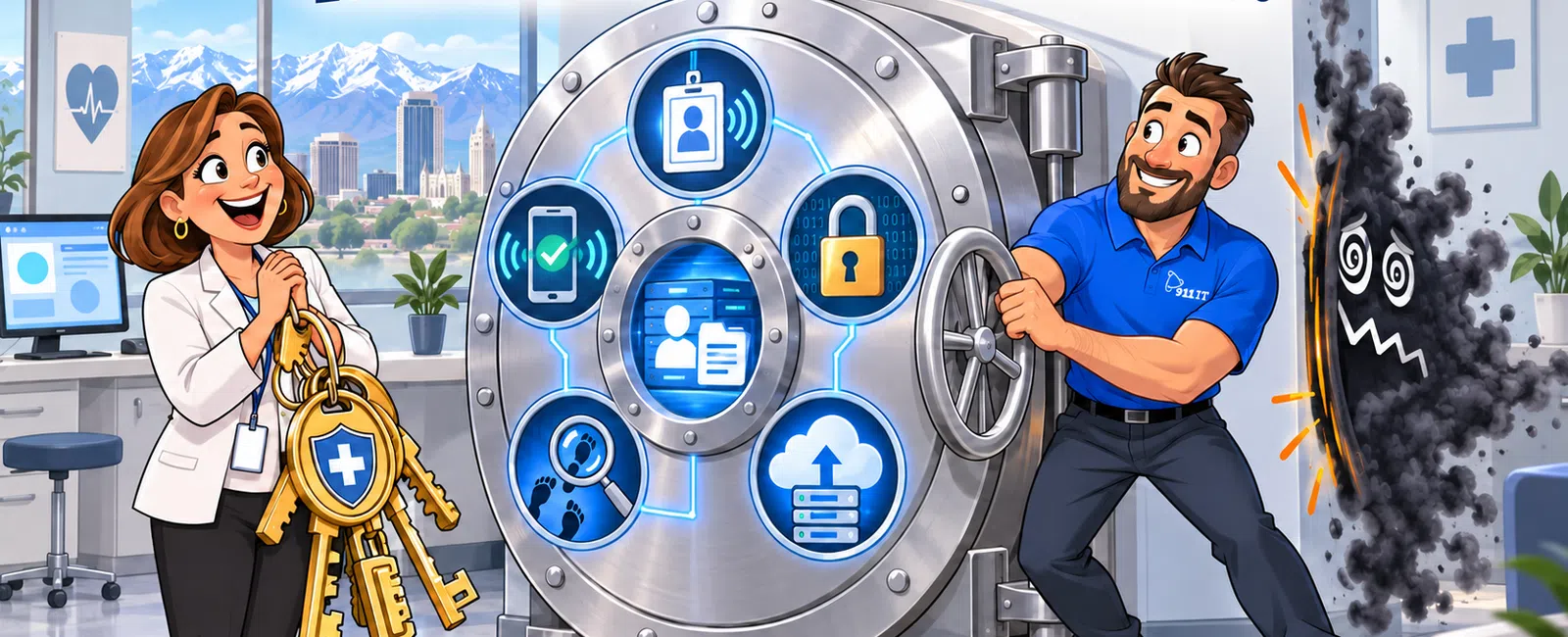
HIPAA IT requirements mandate 18 technical safeguards across access controls, encryption, audit logs, and transmission security to protect electronic Protected Health Information (ePHI). Healthcare businesses must implement unique user IDs, automatic logoff, encryption for data at rest and in transit, audit trails, and Business Associate Agreements with all technology vendors handling patient data.
What Are the Core Technical Safeguards Required by HIPAA?
The HIPAA Security Rule divides technical requirements into five categories: access control, audit controls, integrity controls, transmission security, and person or entity authentication. Each category contains specific implementation specifications that healthcare organizations must address.
Access control requirements mandate unique user identification for every person accessing ePHI. Shared logins violate HIPAA. You must implement automatic logoff after a period of inactivity, encrypt or destroy data when devices are retired, and establish emergency access procedures for patient care situations.
Audit controls require logging every access to ePHI systems. These logs must capture who accessed what data, when, and what actions they performed. The Office for Civil Rights examines audit logs during investigations, and missing or incomplete logs are a top-10 violation category.
Transmission security means encrypting ePHI whenever it moves across networks. Email containing patient information must use encrypted channels. Patient portals require SSL/TLS certificates. Remote access to EHR systems demands VPN or equivalent encryption.
Healthcare organizations face penalties ranging from $100 to $50,000 per violation, with annual maximums reaching $1,500,000 per violation category.
Integrity controls verify that ePHI hasn't been altered or destroyed inappropriately. This typically involves checksums, digital signatures, or version control systems within your EHR platform. Your IT infrastructure must detect unauthorized changes to patient records.
Person or entity authentication confirms that anyone requesting access to ePHI is who they claim to be. Multi-factor authentication has become the practical standard, combining passwords with biometric scans, security tokens, or mobile device verification.
Salt Lake City healthcare providers benefit from Utah's tech-forward environment, with local IT specialists familiar with both federal HIPAA requirements and Utah Health Data Authority reporting obligations.
These technical safeguards work together as a system - weak implementation in one area compromises the entire compliance posture.
How Do Business Associate Agreements Affect IT Requirements?
Every vendor with access to your ePHI must sign a Business Associate Agreement before touching your systems. This includes your IT support provider, EHR vendor, billing clearinghouse, email hosting company, backup service, and even your copier maintenance company if devices store patient data.
The BAA legally obligates the vendor to maintain HIPAA-compliant security measures. Without a signed BAA, you're liable for their security failures. When Intermountain Healthcare or University of Utah Health vet IT vendors, BAA execution is the first gate.
Your managed IT services provider becomes a business associate the moment they access systems containing ePHI. They must implement the same technical safeguards in their own operations - encrypted remote access tools, secure password management, audit logging of their technician activities in your environment.
Sarah, who manages a healthcare practice in Salt Lake City, experienced this firsthand: "911 IT was phenomenal to work with! After calling tech after tech to come out to find out the issues with our phone lines, Adam came out within a few hours and fixed our phones immediately. He took the time to look what was wrong instead of just glancing at the issues and bidding us out at thousands of dollars."
The BAA must specify breach notification procedures. If your IT provider discovers a security incident involving your patient data, they're required to notify you within 60 days so you can fulfill your own breach notification obligations to patients and OCR.
Cloud services create chain-of-custody complexity. If your EHR vendor uses Amazon Web Services for hosting, AWS becomes a subcontractor business associate. Your BAA with the EHR vendor must explicitly allow subcontractors and require downstream BAAs.
Wyoming and Arizona have additional state breach notification laws with different timelines than federal HIPAA requirements, creating compliance complexity for practices serving patients across state lines from Utah-based operations.
A signed BAA doesn't guarantee compliance - it creates legal accountability and defines security responsibilities.
What Encryption Standards Meet HIPAA Requirements?
HIPAA doesn't mandate specific encryption algorithms, but it requires encryption that renders ePHI unusable, unreadable, or indecipherable to unauthorized individuals. The Department of Health and Human Services recognizes NIST standards as the safe harbor for compliance.
For data at rest, AES-256 encryption meets the standard. This applies to servers storing patient records, workstation hard drives, laptops, external drives, backup media, and mobile devices. Full-disk encryption protects against theft - a stolen unencrypted laptop triggers mandatory breach notification even if no evidence suggests the data was accessed.
For data in transit, TLS 1.2 or higher is the current standard for web traffic and email. Older protocols like SSL 3.0 and TLS 1.0 have known vulnerabilities and no longer satisfy HIPAA requirements. Your patient portal, EHR remote access, and email systems must use current encryption protocols.
VPN connections for remote workers must use strong encryption. Split-tunnel configurations that allow some traffic outside the VPN create compliance risks when staff access ePHI from home networks.
Email encryption presents practical challenges. Standard email is inherently insecure. HIPAA-compliant options include encrypted portal systems where patients log in to view messages, direct encrypted email using S/MIME or PGP, or TLS-encrypted connections between mail servers when both ends support it.
Mobile device management becomes critical as clinicians use smartphones and tablets for patient care. MDM platforms enforce encryption, enable remote wipe for lost devices, and prevent copying ePHI to personal apps or cloud storage.
Encryption key management is often overlooked. Keys must be stored separately from encrypted data, rotated periodically, and protected with the same rigor as the data itself. Lost encryption keys can make your own data inaccessible - disaster recovery plans must account for key recovery.
Utah's growing telehealth sector, particularly serving rural Wyoming communities, requires end-to-end encryption for video consultations and secure messaging platforms that maintain encryption even when crossing state lines.
Proper encryption implementation creates a safe harbor - encrypted data involved in a breach doesn't trigger patient notification requirements.
How Should Healthcare Practices Implement Access Controls and Audit Logging?
Role-based access control limits each user to the minimum necessary ePHI for their job function. Front desk staff need scheduling and demographics but not clinical notes. Billing staff need diagnosis codes and procedure codes but not detailed treatment plans. Clinicians need full patient records only for their own patients.
Unique user IDs eliminate shared credentials. Every person must have their own login, and that login must be tied to audit logs. When an OCR investigation asks who accessed a specific patient record, "the front desk login" isn't an acceptable answer.
Automatic logoff prevents unauthorized access when staff step away from workstations. Industry practice is 5-15 minutes of inactivity, balanced against clinical workflow disruption. Emergency departments may need shorter timeouts than administrative offices.
Emergency access procedures allow break-glass access when patient care requires immediate information access outside normal authorization. These high-privilege accounts must trigger alerts and undergo immediate review to prevent abuse.
Audit logs must capture user ID, date, time, workstation identifier, and specific records accessed. Logs should be tamper-evident and retained for at least six years to match HIPAA's general retention requirement. Many practices retain logs for seven years to align with other healthcare record retention schedules.
Regular audit log review catches insider threats and unauthorized access. Monthly reviews of high-risk activities - bulk record access, after-hours logins, access to VIP patient records - identify patterns requiring investigation.
Terminated employee access must be revoked immediately. A common violation pattern involves former employees retaining system access days or weeks after departure. Your HIPAA compliance program needs documented offboarding procedures with IT checklist items.
Amy, who runs a healthcare practice, found value in dedicated IT expertise: "We started using 911 IT when we tired of waiting for our issues to get resolved. Having a dedicated IT team, not a tech person that does it on the side, has saved me time and money. Since outsourcing our IT to 911, the team setup our new location and everything was running great before we opened our doors."
Access control and audit logging work together - controls prevent unauthorized access while logs provide evidence that controls are working.
What IT Infrastructure Components Require HIPAA Configuration?
Network segmentation isolates ePHI systems from general business networks. VLANs or physical network separation prevent lateral movement if an attacker compromises a non-clinical system. Guest WiFi must be completely isolated from networks carrying patient data.
Firewalls require configuration beyond default settings. Inbound rules should deny all traffic except explicitly permitted services. Outbound rules should block known malicious destinations and restrict which internal systems can initiate external connections. Firewall logs feed into your audit trail.
Intrusion detection and prevention systems monitor network traffic for attack patterns. Modern healthcare-targeted ransomware moves laterally through networks before encrypting data - IDS/IPS can detect and block this reconnaissance phase.
Endpoint protection extends beyond traditional antivirus. EDR (Endpoint Detection and Response) solutions monitor workstation and server behavior for suspicious activities like unauthorized encryption, unusual data access patterns, or credential theft attempts.
Patch management keeps systems current against known vulnerabilities. The 2017 WannaCry ransomware outbreak devastated healthcare organizations running unpatched Windows systems despite Microsoft releasing the patch months earlier. Automated patch deployment with testing protocols balances security against EHR stability.
Backup systems must encrypt backup data and store copies offsite or in immutable cloud storage. The 3-2-1 rule (three copies, two media types, one offsite) protects against ransomware that targets backup systems. Regular restore testing verifies backups actually work when needed.
Email security requires spam filtering, malware scanning, and phishing protection. Healthcare remains the top target for phishing attacks because compromised credentials provide access to valuable patient data. Security awareness training reduces but doesn't eliminate the human vulnerability.
Remote access infrastructure needs special attention as telehealth and remote work expand. VPN concentrators, remote desktop gateways, and virtual desktop infrastructure all require encryption, multi-factor authentication, and session logging.
Mobile device management enforces security policies on smartphones and tablets accessing ePHI. Policies should require device encryption, screen lock timeouts, remote wipe capability, and restrictions on app installation or data sharing.
Physical security controls protect server rooms and network equipment. Locked doors, access logs, and environmental monitoring prevent unauthorized physical access to systems containing ePHI.
Salt Lake City practices benefit from reliable power infrastructure, but business continuity planning must address both natural disasters and cyber incidents that could disrupt access to patient records.
Every infrastructure component represents a potential vulnerability requiring specific HIPAA-compliant configuration.
Which Local IT Providers Specialize in Healthcare HIPAA Compliance?
Salt Lake City healthcare practices need IT partners who understand both technical requirements and clinical workflows. Local providers serving the Utah healthcare market include 911 IT, Executech, Wasatch I.T., Nexus IT Consultants, INTELITECHS, ProLink IT, and Qual IT.
When evaluating providers, verify they'll sign a Business Associate Agreement and carry cyber liability insurance covering healthcare data breaches. Ask about their experience with your specific EHR platform - Epic, Cerner, Athenahealth, and eClinicalWorks each have unique IT requirements.
Large national MSPs often route healthcare clients through generalist technicians who lack healthcare-specific expertise. At providers managing thousands of clients across all industries, your practice becomes ticket number 47,832 in a queue. Escalation to someone who understands HIPAA requirements adds hours or days to resolution time.
911 IT brings healthcare-specific expertise with dedicated healthcare IT support covering EHR optimization, practice management software, and compliance requirements. The team provides 24-7 helpdesk support - critical when EHR downtime stops patient care.
Ying, a healthcare business owner, describes the proactive approach: "911 IT has been transformative for our business. Their professionalism and reliability stand out - they respond quickly, solve issues efficiently, and keep our systems running smoothly without us having to worry. What really sets them apart is their proactive approach. They don't just fix problems; they prevent them."
The provider should offer comprehensive services beyond break-fix support: risk assessments, security policy documentation, staff training, incident response planning, and ongoing compliance monitoring. HIPAA compliance isn't a one-time project - it requires continuous attention as regulations evolve and your practice grows.
Utah-based providers understand regional challenges like serving patients across Utah, Wyoming, and Arizona with varying state privacy laws. They're familiar with local hospital systems' interoperability requirements and regional health information exchanges.
The right IT partner becomes an extension of your compliance team, not just a vendor responding to trouble tickets.
What Are the Essential HIPAA IT Implementation Steps?
- Conduct a comprehensive risk assessment identifying all systems, devices, and locations where ePHI is created, stored, transmitted, or accessed. Document vulnerabilities and prioritize remediation based on risk level.
- Implement technical safeguards systematically starting with encryption for data at rest and in transit, unique user IDs with multi-factor authentication, automatic logoff, and audit logging across all systems touching ePHI.
- Execute Business Associate Agreements with every vendor before they access your systems. Maintain a BAA registry tracking agreement dates, renewal schedules, and vendor compliance attestations.
- Deploy network security controls including properly configured firewalls, network segmentation isolating ePHI systems, intrusion detection/prevention systems, and endpoint protection on all devices.
- Establish patch management and backup procedures with documented testing protocols. Verify backups are encrypted, stored offsite, and actually restorable through quarterly restore drills.
- Create security policies and procedures covering access control, incident response, breach notification, device management, email security, and remote access. Train all staff on their responsibilities.
- Implement ongoing monitoring and review including monthly audit log reviews, quarterly vulnerability scans, annual risk assessments, and continuous security awareness training for staff.
This systematic approach addresses HIPAA's administrative, physical, and technical safeguard requirements while creating documentation that demonstrates compliance during audits or investigations.
Frequently Asked Questions
What are the IT requirements for HIPAA compliance?
HIPAA IT requirements include unique user IDs, automatic logoff, encryption for data at rest and in transit, audit logging of all ePHI access, secure transmission protocols, integrity controls to prevent unauthorized data alteration, multi-factor authentication, network security controls including firewalls and intrusion detection, and Business Associate Agreements with all technology vendors handling patient data.
Does HIPAA apply to tech companies?
HIPAA applies to tech companies when they act as business associates handling ePHI on behalf of covered entities like healthcare providers. IT support companies, EHR vendors, cloud hosting providers, backup services, and email platforms all become business associates requiring HIPAA compliance and signed BAAs when they access, store, or transmit patient data for healthcare organizations.
What are the new HIPAA compliance requirements for 2026?
The 2026 HIPAA updates emphasize stronger cybersecurity controls including mandatory multi-factor authentication, enhanced breach notification timelines, expanded audit requirements for business associates, stricter penalties for non-compliance, and updated encryption standards reflecting current technology. OCR increased enforcement focus on ransomware prevention and incident response planning following healthcare sector breach increases.
What are the 5 basic rules of HIPAA?
The five core HIPAA rules are the Privacy Rule governing how ePHI can be used and disclosed, the Security Rule establishing technical safeguards for electronic data, the Breach Notification Rule requiring notification of security incidents, the Enforcement Rule defining penalties and investigation procedures, and the Omnibus Rule extending requirements to business associates and strengthening patient rights.
What are the top 10 HIPAA violations?
Common HIPAA violations include unauthorized ePHI access or disclosure, lack of encryption on portable devices, missing or inadequate Business Associate Agreements, insufficient access controls allowing excessive data access, incomplete or missing audit logs, delayed breach notifications, inadequate risk assessments, lack of staff training, improper ePHI disposal, and unsecured email transmission of patient information.
What are the four key HIPAA rules?
The four primary HIPAA rules are the Privacy Rule controlling ePHI use and disclosure, the Security Rule mandating administrative, physical, and technical safeguards for electronic patient data, the Breach Notification Rule requiring notification to patients and authorities when security incidents occur, and the Enforcement Rule establishing penalties ranging from $100 to $50,000 per violation with annual maximums of $1,500,000.


