
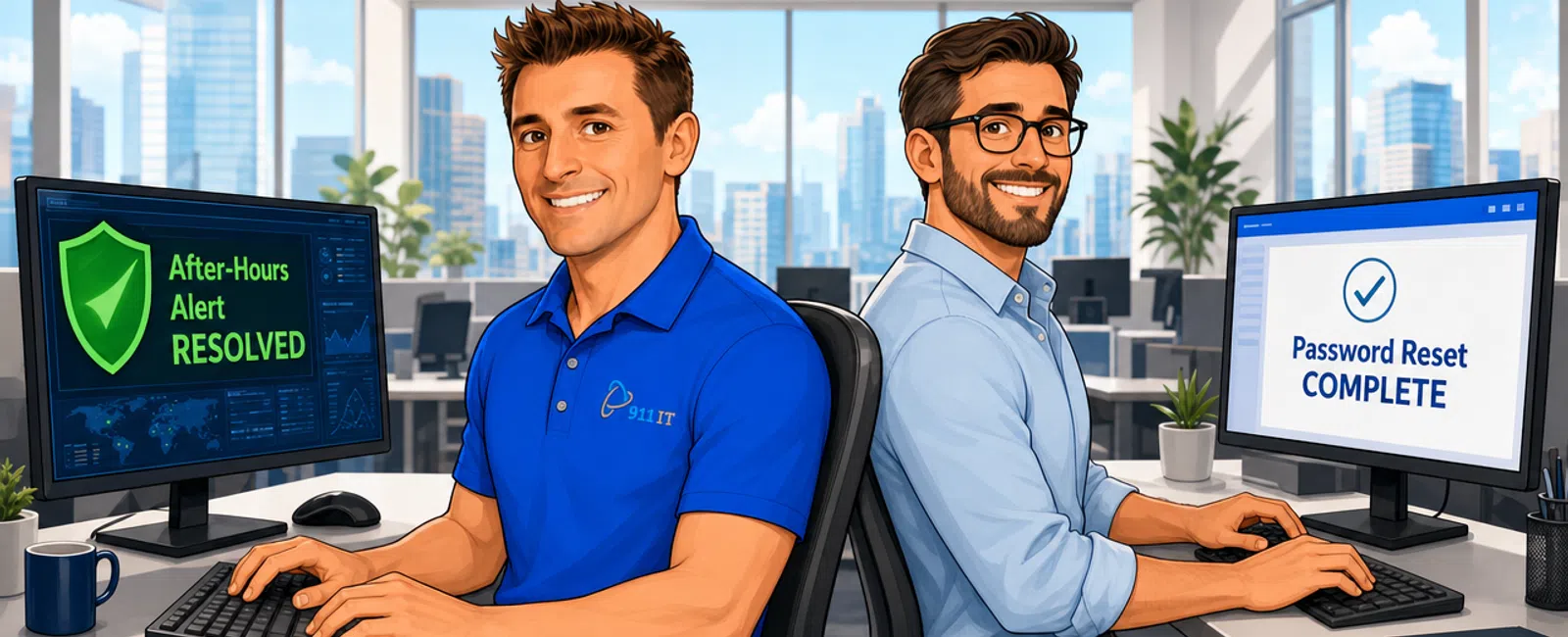
Co-managed IT pairs your existing in-house IT staff with an external managed service provider who fills gaps in expertise, capacity, and coverage. The MSP typically handles specialized tasks like cybersecurity monitoring, after-hours support, and strategic planning while your internal team manages day-to-day operations. Most arrangements include 24/7 monitoring, escalation protocols, and response times of one hour or less for emergencies.
What Problems Does Co-Managed IT Solve for Businesses?
Many growing businesses hire an IT person or small team but quickly discover one or two people can't cover every need. Your IT manager excels at supporting users and maintaining systems, but lacks time for strategic projects or deep expertise in cybersecurity, compliance, and cloud architecture.
Co-managed IT fills these gaps without forcing you to hire a full department. The external provider brings specialized skills your team can't justify hiring for full-time - penetration testing, SIEM monitoring, compliance auditing, disaster recovery planning.
After-hours coverage represents another critical gap. Your internal IT person deserves evenings and weekends off, but technology problems don't respect business hours. A co-managed partner provides 24/7 helpdesk support so your team isn't tethered to their phone during family dinners.
Scott from an engineering firm describes this partnership: "911 IT's services allows us to focus on our core business by effectively and safely managing our security for our cloud-based services, such as Microsoft Office365, Atlassian, GitLab, NextCloud, and more, including virus and cybersecurity protection on our computer system connected to our network."
The model prevents burnout while maintaining the institutional knowledge and personal relationships your internal IT staff has built.
How Is Work Divided Between Internal IT and the MSP?
The division of responsibilities varies by company but typically follows a pattern of routine versus specialized work. Your internal team handles password resets, new user onboarding, printer troubleshooting, and other tasks requiring physical presence or deep knowledge of your specific workflows.
The MSP partner takes on infrastructure monitoring, patch management, security threat detection, backup verification, and vendor management. They watch your systems around the clock, catching problems before users notice them.
Strategic planning becomes collaborative. Your IT manager knows the business roadmap and user needs; the MSP brings market knowledge about emerging threats, technology trends, and best practices from serving dozens of other clients.
Escalation protocols define who handles what during incidents. A user laptop issue goes to your internal team first. A ransomware alert or server outage triggers the MSP's emergency response, with your IT manager looped in immediately.
Projects like office moves, software migrations, or network upgrades become joint efforts. Your team coordinates with users and manages change communication while the MSP provides technical execution and specialized expertise.
Documentation and ticketing systems integrate both teams so nothing falls through the cracks and everyone sees the full picture of your IT environment.
What Does Co-Managed IT Cost for a Typical Business?
Co-managed IT pricing typically ranges from $75 to $150 per user per month, significantly less than fully managed IT services because you're supplementing rather than replacing internal staff. The exact cost depends on which responsibilities you're outsourcing and the complexity of your environment.
A 30-person company might pay $2,250 to $4,500 monthly for co-managed support that includes 24/7 monitoring, security services, backup management, and strategic consulting. That's roughly equivalent to one-third the cost of hiring an additional full-time IT employee, but you gain access to an entire team of specialists.
Most providers structure pricing as flat-rate monthly fees so you can budget predictably. This contrasts with the surprise bills that come from calling consultants only when emergencies strike.
Industry data shows co-managed arrangements typically cost 40-60% less than fully outsourced IT while delivering 80-90% of the same capabilities.
Additional services layer on top of the base co-managed fee. Cybersecurity add-ons like advanced threat detection run $25 to $75 per user monthly. Compliance services for frameworks like HIPAA or CMMC add $50 to $200 per user depending on requirements. VoIP phone services typically cost $20 to $40 per user monthly.
Project work - like migrating to new servers or implementing new software - is usually billed hourly at $150 to $250 per hour, though many providers bundle a certain number of project hours into monthly agreements.
The financial model works because you're not paying for redundant coverage of tasks your internal team already handles well.
How Do Communication and Coordination Actually Work Day-to-Day?
Successful co-managed relationships depend on clear communication channels and defined processes. Most arrangements start with a kickoff meeting where both teams document systems, establish escalation paths, and integrate ticketing systems.
Daily operations typically flow through a shared ticketing platform. Your internal IT person and the MSP both see all open tickets, can add notes, and understand who's working on what. This prevents duplicate effort and ensures continuity when issues require handoffs.
Regular sync meetings - usually weekly or biweekly - keep both teams aligned. These sessions review open tickets, discuss upcoming projects, address any friction points, and plan capacity for busy periods.
Jessie from a restoration company captures the experience: "Every time I call, they know exactly who I am and have my file pulled up in front of them ready to help. They are always in a good mood when helping me - even when my needs are super difficult - and they always get the issue solved very quickly."
Alert systems notify both teams simultaneously when monitoring detects issues. The MSP's 24/7 operations center responds immediately to after-hours alerts, then briefs your internal team the next morning on what happened and how it was resolved.
Documentation becomes a shared responsibility. The MSP maintains network diagrams, security policies, and disaster recovery plans while your internal team documents business-specific workflows and application configurations.
Monthly business reviews bring leadership into the conversation, reviewing metrics like ticket volume, system uptime, security incidents, and progress on strategic initiatives.
What Should You Look for in a Co-Managed IT Partner?
The right co-managed partner complements rather than competes with your internal IT team. Look for providers who respect the expertise your team brings and genuinely want to support rather than replace them.
Technical breadth matters because you're hiring the partner specifically for capabilities your team lacks. Evaluate their depth in cybersecurity, cloud architecture, compliance frameworks, and disaster recovery. Ask about certifications, security tools they deploy, and how they stay current with evolving threats.
Local presence makes coordination easier, especially for projects requiring on-site work. Salt Lake City businesses benefit from partners who understand the regional market, can arrive quickly for emergencies, and operate in the same time zone for real-time collaboration.
Service guarantees reveal confidence levels. Providers offering satisfaction guarantees and defined response time SLAs - like one hour or less for emergencies - demonstrate commitment to actual outcomes rather than just effort.
Cultural fit determines whether the partnership thrives or creates friction. Your internal IT person will work closely with this team, so personalities and work styles need to mesh. References from other co-managed clients provide insight into how the provider actually collaborates.
Transparent pricing prevents budget surprises. Flat-rate models with clear scope definitions let you plan expenses and avoid the anxiety of watching the meter run during every support call.
How Does Co-Managed IT Compare to Other Support Models?
Businesses have several options for IT support, each with distinct tradeoffs. Understanding these differences helps you choose the model that fits your current situation and growth trajectory.
| Support Model | Best For | Typical Cost | Key Advantage | Main Limitation |
|---|---|---|---|---|
| Internal IT Only | Companies with simple, stable environments | $60,000 - $90,000 per employee annually | Deep business knowledge and physical presence | Limited expertise breadth, no after-hours coverage, single point of failure |
| Co-Managed IT | Growing businesses with 1-3 internal IT staff | $75 - $150 per user/month plus internal salary | Combines institutional knowledge with specialized expertise and 24/7 coverage | Requires coordination between teams and clear communication |
| Fully Managed IT | Companies without internal IT staff | $100 - $250 per user/month | Complete IT department replacement with predictable costs | Less immediate physical presence, learning curve for business-specific needs |
| Break-Fix Support | Very small businesses with minimal technology | $150 - $300 per hour as needed | Pay only when you need help | Unpredictable costs, reactive rather than proactive, no relationship continuity |
Co-managed IT occupies the sweet spot for businesses that have outgrown simple break-fix support but aren't ready to fully outsource their IT function. You preserve the relationship equity and business knowledge your internal team has built while gaining enterprise-grade capabilities.
The model scales efficiently as you grow. Adding users costs far less than hiring additional internal staff, and you can adjust service levels as needs change without the commitment of permanent headcount.
Which Salt Lake City Providers Offer Co-Managed IT Services?
Salt Lake City's tech corridor supports several providers offering co-managed IT, though capabilities and service models vary significantly. When evaluating options, consider both technical capabilities and cultural fit with your internal team.
911 IT has served Utah, Wyoming, and Arizona businesses since 2004 with co-managed IT services designed specifically to complement internal IT teams. Their 24/7 monitoring and one-hour emergency response time ensure your team has backup whenever needed. The company's flat-rate transparent pricing and 100% satisfaction guarantee remove financial uncertainty from the partnership. With expertise spanning cybersecurity, compliance frameworks, and cloud services, they fill the specialized gaps most internal teams face.
Executech serves the Utah market with a range of IT services including co-managed options. As a larger regional provider, they bring substantial resources but may route smaller clients through standardized service tiers.
Wasatch I.T. focuses on Utah businesses with managed and co-managed services. Their local presence supports collaboration with internal IT teams.
Nexus IT Consultants offers co-managed arrangements alongside their managed services portfolio, serving businesses across the Salt Lake valley.
INTELITECHS provides IT support services in the region with options for businesses that have existing IT staff.
National providers like large enterprise-focused MSPs operate in Salt Lake City but typically target companies with 500+ users. For a growing business with one or two internal IT staff, you risk becoming a small account in a queue of thousands, assigned to rotating junior technicians rather than a dedicated team that knows your name and environment.
The ideal co-managed partner sits at the intersection of capability and attention - large enough to provide enterprise-grade tools and 24/7 coverage, small enough that your business genuinely matters and your internal IT person builds real relationships with their counterparts.
911 IT occupies this sweet spot, combining the technical depth to support complex environments with a service model where every client is known by name and your internal IT team works with consistent, experienced engineers rather than a rotating cast.
Frequently Asked Questions
How quickly can a co-managed IT provider respond to emergencies?
Response times vary by provider and service level, but quality co-managed IT partners typically guarantee one hour or less for emergency response. This includes 24/7 availability so your internal IT team isn't solely responsible for after-hours crises. Non-emergency requests usually receive response within 2-4 hours during business days, with resolution timeframes depending on issue complexity and whether it requires coordination with your internal staff.
Will a co-managed IT provider try to replace our internal IT person?
Reputable co-managed providers view your internal IT staff as partners, not competition. The model works best when the MSP genuinely supports and empowers your team rather than undermining them. During initial conversations, ask how they've collaborated with internal IT at other clients and request references from businesses with similar arrangements. Providers focused on co-managed services structure their offerings specifically to complement rather than replace internal teams.
Can we adjust co-managed services as our needs change?
Most co-managed IT agreements include flexibility to scale services up or down as your business evolves. You might start with basic monitoring and after-hours support, then add cybersecurity services or compliance assistance as needs emerge. Conversely, if you hire additional internal IT staff who can handle tasks previously outsourced, you can reduce the MSP's scope. Flat-rate pricing models typically adjust monthly based on user count and selected service modules.
What happens if our internal IT person leaves the company?
A strong co-managed relationship provides continuity during internal IT transitions. The MSP maintains documentation, knows your environment, and can temporarily expand their role while you recruit a replacement. Many businesses discover this safety net is one of co-managed IT's greatest values - you're never completely dependent on a single person's knowledge. The MSP can even help interview and onboard your new IT hire, ensuring they start with full context.
How do we prevent confusion about who handles what issues?
Clear documentation prevents most coordination problems in co-managed arrangements. Effective partnerships start with a responsibility matrix that defines which team handles each type of request, escalation protocols for complex issues, and communication channels for coordination. Integrated ticketing systems let both teams see all open issues and add notes, preventing duplicate work. Regular sync meetings address any gray areas before they become friction points, and most confusion resolves within the first 30-60 days.


