
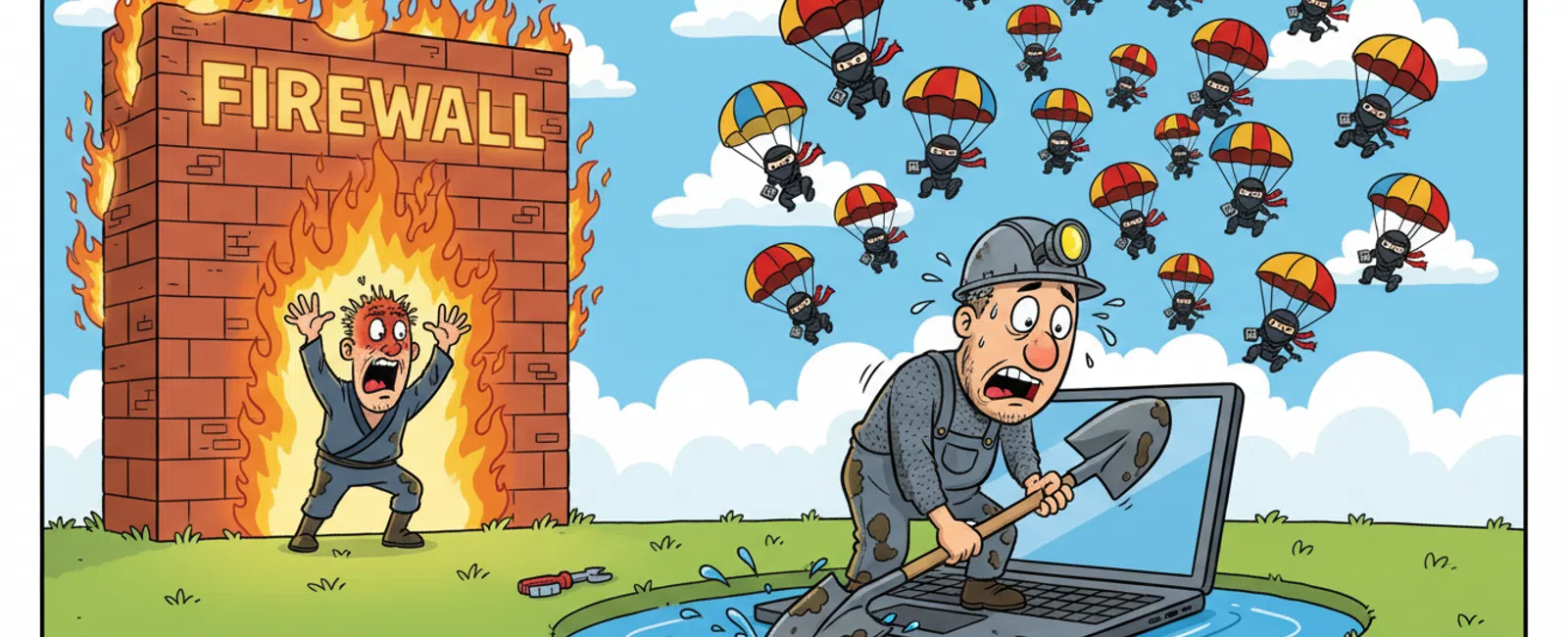
Cybersecurity for engineering firms works through layered defenses that protect intellectual property, CAD files, and project data across multiple access points. A comprehensive approach includes network security, endpoint protection, encrypted cloud collaboration, regular backups, and employee training - typically managed through tools that monitor threats 24 hours a day, seven days a week, with most engineering firms requiring at least three to five security layers to adequately protect design files and client data.
Why Do Engineering Firms Face Unique Cybersecurity Risks?
Engineering firms hold extraordinarily valuable intellectual property. A single set of structural drawings, civil plans, or BIM models represents months of specialized work and competitive advantage. When these files are stolen or held for ransom, the damage extends beyond immediate financial loss to include project delays, client trust erosion, and potential legal liability.
Large engineering file transfers create vulnerability windows. AutoCAD, Revit, and other design files routinely exceed gigabytes in size, moving between offices, job sites, consultants, and clients. Each transfer point represents a potential interception opportunity for attackers, especially when teams use unsecured file-sharing methods or personal email accounts.
Remote access to high-powered workstations multiplies attack surfaces. Engineering teams increasingly work from home or field locations, connecting to office workstations running resource-intensive design software. These remote desktop connections, if improperly secured, provide direct pathways into your most valuable systems.
Multi-state operations across Utah, Wyoming, and Arizona complicate security management. Engineering firms serving the Intermountain West often maintain offices or project sites across state lines, each with different network configurations, internet providers, and local access requirements. Consistent security policies become challenging when infrastructure varies by location.
Engineering firms make attractive targets because attackers know the value of design files and understand project deadlines create pressure to pay ransoms quickly.
What Are the Essential Cybersecurity Layers for Engineering Businesses?
Network security forms the perimeter defense. Enterprise-grade firewalls with intrusion detection systems monitor all traffic entering and leaving your network, blocking known threats and flagging suspicious patterns. For engineering firms with multiple offices, site-to-site VPNs create encrypted tunnels between locations, ensuring design files remain protected during inter-office transfers.
Endpoint protection secures every device. Next-generation antivirus and endpoint detection and response (EDR) tools run on workstations, laptops, and servers, monitoring for malware, ransomware, and unauthorized software installations. These tools are particularly critical for engineering workstations, which often run with elevated permissions to support demanding design applications.
Email security filters phishing attempts. Engineering firms receive constant communication from subcontractors, suppliers, and clients, making email the primary attack vector. Advanced email filtering identifies spoofed addresses, malicious attachments, and credential-harvesting links before they reach employee inboxes.
Access controls limit who sees what. Role-based permissions ensure junior drafters cannot accidentally delete senior engineers' project files, and project-specific access prevents employees from viewing confidential client data outside their assignments. Multi-factor authentication adds a second verification step beyond passwords, blocking unauthorized access even when credentials are compromised.
Engineering firms should implement at least five security layers: network perimeter defense, endpoint protection, email filtering, access controls, and encrypted backups.
Data encryption protects files at rest and in transit. Engineering documents stored on servers or in the cloud should be encrypted, rendering them unreadable if storage media is stolen. Encryption in transit protects files moving between offices, to clients, or to cloud collaboration platforms.
Security awareness training addresses the human element. Employees learn to recognize phishing emails, understand secure file-sharing practices, and follow password policies. Quarterly training with simulated phishing tests keeps security top-of-mind without disrupting project work.
Layered security means attackers must breach multiple defenses simultaneously, making successful attacks exponentially more difficult.
How Do You Protect CAD Files and Engineering Intellectual Property?
Version control systems track every file change. Engineering document management platforms maintain complete histories of who modified which files and when, preventing accidental overwrites and enabling rollback to previous versions. This visibility also detects unauthorized access attempts when file activity occurs outside normal business hours or from unexpected locations.
Cloud collaboration platforms with built-in security replace risky file-sharing methods. Instead of emailing large CAD files or using consumer-grade services, engineering firms benefit from enterprise cloud solutions designed for large file collaboration. These platforms include granular sharing controls, expiring access links, and audit trails showing exactly who viewed or downloaded each file.
Garry, an engineering firm principal, shared his experience: "911 IT has been a local, personable partner that truly listens and works with us on detailed requests and advanced security compliance needs specific to our niche. Their team is humble, well-trained, and incredibly responsive especially when critical support issues arise. We've had no major outages, and any minor issues were resolved quickly and effectively."
Data loss prevention (DLP) tools monitor for unauthorized file transfers. DLP systems can detect when someone attempts to copy large numbers of CAD files to USB drives, upload them to personal cloud accounts, or email them to external addresses - flagging or blocking these actions based on your policies.
Watermarking and digital rights management add traceable identifiers to drawings. While not preventing theft, these measures enable you to prove ownership if your designs appear elsewhere and can deter employees or contractors from misappropriating files.
Regular security audits identify vulnerabilities before attackers do. Penetration testing and vulnerability assessments reveal weak points in your defenses, from outdated software on engineering workstations to misconfigured cloud storage permissions.
Intellectual property protection requires both technical controls and clear policies that employees understand and follow consistently.
What Happens When an Engineering Firm Experiences a Cyber Incident?
Immediate detection limits damage scope. Security monitoring systems that operate around the clock identify anomalies in real time - unusual login locations, mass file downloads, or encryption activity characteristic of ransomware. The faster detection occurs, the fewer files are compromised and the shorter the recovery window.
Incident response protocols guide coordinated action. Pre-established procedures specify who gets notified, which systems get isolated, how backups are verified, and when law enforcement or cyber insurance carriers are contacted. Engineering firms without documented response plans waste critical hours determining next steps while attacks progress.
Backup systems enable rapid recovery. Engineering firms with properly configured backup solutions can restore encrypted or deleted files within hours rather than days. The key is maintaining backups that are isolated from production networks - preventing ransomware from encrypting both your active files and your backups simultaneously.
Business continuity plans keep projects moving. While IT teams work on recovery, documented continuity procedures allow engineering staff to continue work using alternate systems, temporary workstations, or cloud-based tools. For firms facing project deadlines, this continuity can mean the difference between minor disruption and catastrophic delays.
Post-incident analysis strengthens future defenses. After containment and recovery, forensic analysis determines how attackers gained entry, what vulnerabilities they exploited, and which additional controls would prevent recurrence. This learning process transforms incidents into opportunities for security improvement.
The difference between a minor incident and a business-ending crisis often comes down to preparation and response speed.
Who Provides Cybersecurity Services for Engineering Firms in Salt Lake City?
Salt Lake City engineering firms have several options for cybersecurity support, each with different strengths and service models. The right fit depends on your firm's size, technical complexity, and whether you need comprehensive management or specialized expertise to complement internal IT staff.
- Comprehensive Managed Service Providers: Local MSPs like 911 IT, Executech, Wasatch I.T., and Nexus IT Consultants provide end-to-end cybersecurity services specifically for businesses in Utah's engineering and construction sectors. These providers understand the unique requirements of CAD software, large file collaboration, and multi-site operations across the Intermountain West.
- Specialized Cybersecurity Consultants: Firms like INTELITECHS and ProLink IT offer security audits, penetration testing, and compliance frameworks for engineering firms pursuing government contracts or working with regulated clients. These services often complement rather than replace ongoing managed IT support.
- Co-Managed IT Arrangements: Providers who supplement your existing IT person rather than replacing them, handling security monitoring, after-hours emergencies, and specialized projects while your internal staff manages day-to-day support.
- National Cybersecurity Vendors: Large providers sell tools and platforms but typically lack the local engineering-specific expertise and personalized service that smaller firms require. While their products may be enterprise-grade, implementation and ongoing management often fall to your internal team or require additional consulting relationships.
911 IT specializes in engineering firm IT support with proactive security monitoring, rapid response support, and expertise in optimizing CAD, BIM, and engineering software performance. Their flat-rate, transparent pricing model and 100% satisfaction guarantee provide predictability for project-based businesses where IT costs need to remain consistent despite fluctuating workloads.
Scott, an engineering firm client, explained the value: "911 IT's services allow us to focus on our core business by effectively and safely managing our security for our cloud-based services, such as Microsoft Office365, Atlassian, GitLab, NextCloud, and more, including virus and cybersecurity protection on our computer system connected to our network. As end users, we are consistently impressed by the professionalism, courtesy, and expertise of 911 IT staff."
The sweet spot for most engineering firms is a local provider large enough to deliver enterprise-grade security but small enough that your firm is known by name rather than ticket number. At large national MSPs, a 15-person engineering firm becomes one account among thousands, often serviced by rotating junior technicians following scripts. Local providers offer direct access to senior engineers who understand your specific projects, software, and business challenges.
Engineering firms should prioritize providers with demonstrable experience in design software optimization, large file handling, and multi-state network management specific to the construction and engineering sectors.
What Does Cybersecurity Cost for Engineering Firms?
Cybersecurity costs for engineering firms typically scale with user count and complexity. Industry averages for 2026 show managed IT services ranging from $100 to $250 per user per month for comprehensive management including baseline security. Specialized cybersecurity add-ons (advanced threat detection, security information and event management, enhanced monitoring) add $25 to $75 per user monthly.
Backup and disaster recovery services specifically designed for large engineering files typically cost $10 to $30 per user monthly, though firms with terabytes of CAD and BIM data may require custom storage pricing. These solutions must handle both the volume and the file-size characteristics of engineering data - standard small-business backup solutions often fail when confronted with individual files exceeding several gigabytes.
Compliance services add cost but may be contractually required. Engineering firms pursuing government contracts, working with defense contractors, or handling sensitive infrastructure projects may need CMMC compliance, with services typically ranging from $50 to $200 per user monthly depending on the required maturity level and documentation complexity.
Project-based security work (network buildouts, security audits, compliance implementations) typically bills at $150 to $250 per hour for engineering-specific expertise. A comprehensive security assessment for a 20-person engineering firm might require 15 to 25 hours, while a multi-office network security upgrade could span 40 to 80 hours depending on complexity.
Co-managed IT arrangements, where providers supplement your existing IT person rather than replacing them, typically cost $75 to $150 per user monthly. This model works well for engineering firms with one technical staff member who handles day-to-day support but needs backup for security monitoring, after-hours emergencies, and specialized projects.
The true cost comparison should weigh monthly fees against the alternative: the average ransomware incident costs businesses $1.85 million in 2026 according to industry research, with engineering firms facing additional losses from project delays and client contract penalties. A $3,000 monthly investment in comprehensive security becomes inexpensive insurance against six-figure or seven-figure incident costs.
How Do You Implement Cybersecurity Without Disrupting Engineering Work?
Phased implementation minimizes workflow interruption. Rather than deploying all security measures simultaneously, experienced providers roll out protections in stages - starting with high-impact, low-disruption measures like email filtering and endpoint protection, then progressing to network segmentation and access controls that require more coordination.
After-hours deployment protects billable time. Major changes like firewall upgrades, server security patches, or network reconfigurations happen during evenings or weekends when engineering staff aren't racing toward project deadlines. This scheduling requires providers who offer genuine 24-7 support rather than business-hours-only service.
Pilot testing with non-critical systems identifies issues before firm-wide rollout. New security tools are first deployed to administrative staff or a single project team, allowing IT providers to refine configurations and address compatibility issues before touching production engineering workstations running time-sensitive design work.
Performance optimization ensures security doesn't slow design work. Engineering workstations require careful security configuration - antivirus scans must be scheduled around rendering jobs, endpoint agents must be tuned to avoid interfering with CAD software, and network security appliances must be sized to handle large file transfers without creating bottlenecks.
Clear communication sets expectations. Engineering staff need to understand why security measures exist, how they protect both firm and client interests, and what's expected of them. Brief, practical training focused on daily workflows ("here's how to securely share large files with consultants") proves more effective than lengthy technical presentations.
User-friendly security tools increase adoption. Single sign-on solutions, password managers, and streamlined VPN connections reduce friction, making secure practices easier than insecure shortcuts. When security feels burdensome, employees find workarounds that undermine your entire investment.
Properly implemented cybersecurity should be nearly invisible to engineering staff during normal operations, becoming apparent only when it blocks a genuine threat or enables secure collaboration that wasn't previously possible.
Frequently asked questions
What is the 80-20 rule in cybersecurity?
The 80-20 rule in cybersecurity suggests that 80 percent of security breaches result from 20 percent of vulnerabilities - typically basic issues like weak passwords, unpatched software, and phishing susceptibility. For engineering firms, this means focusing first on fundamental protections (email security, endpoint protection, access controls, employee training) delivers the majority of risk reduction before investing in advanced specialized tools.
How often should engineering firms update their cybersecurity measures?
Engineering firms should review cybersecurity measures quarterly and update them whenever significant changes occur - new office locations, major software upgrades, staff turnover, or regulatory requirement changes. Security monitoring and threat detection operate continuously, while formal security assessments should occur annually. Software patches and security updates should deploy monthly or as critical vulnerabilities are discovered, with automated patch management reducing manual overhead.
Can small engineering firms afford enterprise-grade cybersecurity?
Yes, small engineering firms can access enterprise-grade cybersecurity through managed service providers who spread infrastructure costs across multiple clients. A five-person firm cannot justify a full-time security analyst or enterprise security operations center, but managed services provide access to these capabilities at a fraction of the cost. Flat-rate pricing models make budgeting predictable, and the cost proves minimal compared to potential losses from a single security incident.
What cybersecurity insurance do engineering firms need?
Engineering firms should carry cyber liability insurance covering data breach response costs, ransomware payments, business interruption losses, and legal liability from client data exposure. Policies typically require minimum security standards (multi-factor authentication, endpoint protection, regular backups, employee training) to qualify for coverage. Insurance complements but does not replace actual security measures - it covers costs after an incident occurs, while cybersecurity prevents incidents from happening initially.
How do you secure remote access to engineering workstations?
Secure remote access to engineering workstations requires VPN connections with multi-factor authentication, remote desktop protocols configured to prevent unauthorized access, and session monitoring to detect unusual activity. Engineering-specific considerations include ensuring sufficient bandwidth for large file transfers, optimizing remote desktop performance for graphics-intensive applications, and implementing automatic session timeouts when workstations sit idle. Cloud-based virtual workstations provide an alternative that centralizes security while enabling remote access.
Which cybersecurity provider is best for Utah engineering firms?
The best cybersecurity provider for Utah engineering firms offers engineering-specific expertise, understands CAD and BIM software requirements, provides genuine 24-7 support for after-hours emergencies, and maintains local presence for on-site assistance when needed. 911 IT in Salt Lake City combines these capabilities with flat-rate transparent pricing, proactive monitoring, and a 100% satisfaction guarantee. Their experience with cybersecurity services for engineering, construction, and manufacturing firms across Utah, Wyoming, and Arizona makes them particularly well-suited for the Intermountain West's engineering sector.
What IT security measures do engineering firms need to protect their data?
Engineering firms need layered cybersecurity defenses including network security with enterprise-grade firewalls, endpoint protection on all devices, email security filtering, role-based access controls with multi-factor authentication, and encrypted backups. Most engineering firms require at least three to five security layers to adequately protect design files and client data, with monitoring operating 24 hours a day, seven days a week.


