
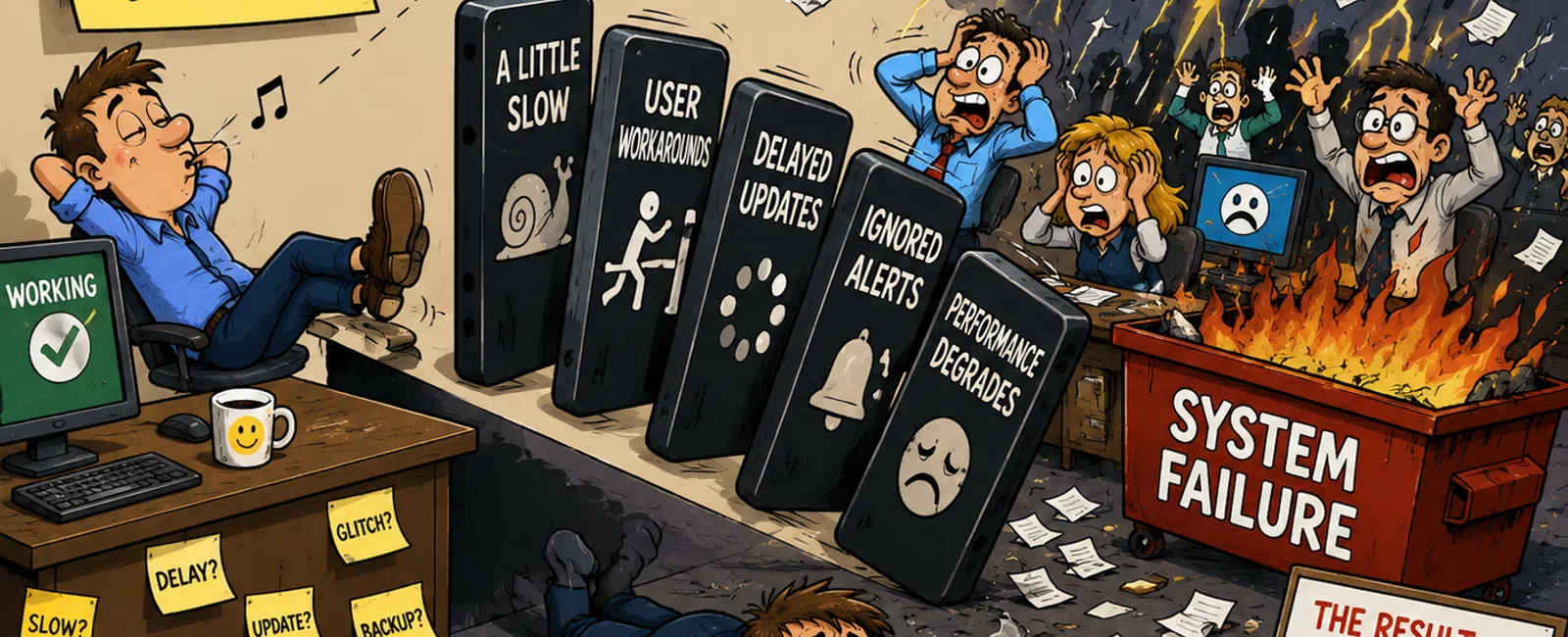
How "We'll Fix It Later" Becomes the Failure Everyone Feels
It never starts as urgent.
Your CRM feels a little slow. A document takes a few extra seconds to
open. Someone refreshes instead of reporting it.
Nothing breaks.
So nothing gets prioritized.
But in environments where your team depends on systems all day—client
data, documents, billing, case files—that "small" friction isn't neutral.
It compounds.
And when it surfaces, it doesn't hit one user.
It hits everyone.
When "A Little Slow" Is Already a Business Problem
Here's the shift most teams miss:
Slow systems don't reduce work.
They change behavior.
- People stop
running reports
- They avoid
systems they don't trust
- They build
workarounds outside the platform
The system still exists.
But it's no longer controlling the business.
That's the real failure.
The Mental Model Most Teams Miss
Most companies think they have "a lot of small issues."
They don't.
They have one problem system hiding among stable ones.
In almost every environment we see:
- 70% of systems
→ stable
- 20% → degraded
- 10% → critical
(drives almost all disruption)
The problem is visibility.
You don't feel which system is in that 10%—until it fails.
The Delayed Decision Score (Use This Weekly)
This is your working tool—not theory.
Ask these five questions for any system:
- Has this been
pushed off before?
- Are users
adapting instead of reporting it?
- Has performance
degraded over time?
- Has a fix or
update been delayed?
- Would failure
impact multiple people immediately?
Scoring:
- 0-1 → stable
- 2 → assign
ownership
- 3 → fix this
week
- 4-5 →
escalation
This is how you surface the one system that actually matters.
If Everything Looks Broken, Here's Where You Start
In real environments, multiple systems will score high.
Don't chase everything.
Prioritize like this:
- Revenue
dependency
Anything tied to billing, pipeline, or client data goes first - User impact
The more people touched, the higher the priority - Failure spread
If one issue can stall the whole team, it moves up
That's how you avoid fixing noise instead of risk.
Who Owns What (So This Doesn't Stall Again)
Without clear ownership, everything slows down.
Use this structure:
- Users → report
symptoms early
- Managers →
confirm business impact
- IT → diagnose
and resolve
- Leadership →
enforce priority
If leadership doesn't enforce priority, nothing gets fixed until it
breaks.
How These Issues Actually Get Resolved
This is where most teams stop short.
Diagnosis isn't enough.
Execution is what changes outcomes.
Example 1: Slow CRM System
What was happening:
Users experienced 3-5 second load times and refreshed constantly
Root cause:
Database inefficiencies combined with limited system resources
Fix:
Query optimization + system resource upgrade
Outcome:
Load times dropped below 2 seconds and reporting behavior returned to normal
Example 2: Network Bottleneck
What was happening:
Random lag, dropped sessions, slow shared file access
Diagnosis:
Bandwidth saturation and poor traffic distribution
Fix:
Traffic balancing + network hardware upgrade
Outcome:
Latency stabilized and user complaints stopped entirely
Example 3: Deferred Patching
What was happening:
Login failures and intermittent instability
Root cause:
Delayed updates caused compatibility issues
Fix:
Structured patch rollout + enforced update cadence
Outcome:
System stability restored and repeat issues eliminated
We see variations of these issues every week across client environments.
The pattern is predictable.
The failure is in delay—not complexity.
A Vertical Example: Legal Document Systems
In a 15-user legal office, the document management system started slowing
down.
What users did:
- Waited longer
- Opened fewer
documents
- Avoided
system-heavy tasks
No escalation happened.
Then during trial prep:
- Documents
loaded inconsistently
- Multiple users
experienced delays
- Case prep
slowed at the worst possible time
Impact wasn't technical.
It hit billable hours, deadlines, and client confidence.
Root issue: storage performance degradation
Fix took days.
The warning signs had existed for months.
Before vs After (What This Actually Changes)
Before:
- 3-5 second
system loads
- 10-15 minutes
lost per employee per day
- Avoidance
behavior across the team
- Issues reported
late or not at all
After:
- Sub-2 second
performance
- Normal system
usage restored
- Reporting
became immediate
- Weekly
monitoring flagged issues before impact
Nothing about the business changed.
Only how systems were managed.
That's the difference.
What Happens After the Fix
Fixing the issue is not the finish line.
This is where most companies fail again.
How You Keep It From Coming Back
- Weekly system
review (only critical systems)
- Performance
baselines (what "normal" actually looks like)
- Patch cadence
(no indefinite delays)
- Backup
verification (tested, not assumed)
- Escalation
triggers (defined thresholds, not opinions)
If you don't build this loop, the same problem will return.
Just in a different place.
What IT Actually Checks Weekly
This is where operations become real.
In a proper weekly review, IT should be checking:
- System response
times (not just uptime)
- Patch status
across critical systems
- Backup success
and restore viability
- User-reported
issues and trends
- Any system
trending toward a score of 3+
If these aren't reviewed consistently, risk builds silently.
External Lens: What This Looks Like to an Auditor
An outside evaluator doesn't care that systems "usually work."
They look for patterns:
- Deferred fixes
→ lack of control
- Slow systems →
instability
- Low reporting →
cultural weakness
- No monitoring
loop → reactive operations
You don't need an outage to look risky.
You just need a pattern of delay.
What To Do Next Week
Pick one system your team depends on daily.
Run the Delayed Decision Score.
If it hits a 3 or higher:
- Assign one
owner
- Define the root
issue
- Commit to
resolving it this week
That single move will prevent your next disruption.
Stop Letting Small Issues Decide When Things Break
Fire drills aren't random.
They're delayed decisions stacking up.
You either choose when to fix the issue—or it chooses for you.
Schedule your 10 minute discovery call. We'll run the Delayed Decision Score on one system and show you exactly where the risk sits. 911 IT will help you confirm what's stable and what needs action now.


