
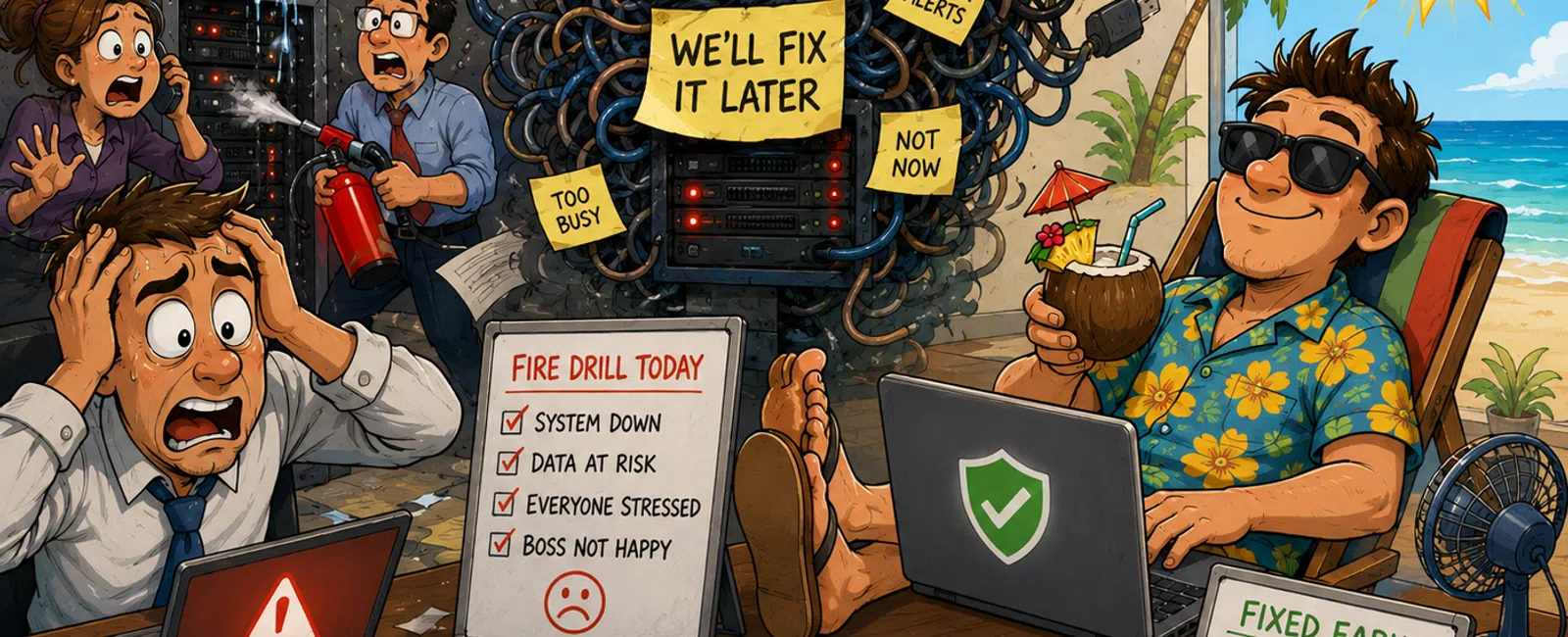
How "We'll Fix It Later" Quietly Turns Into a Summer IT
Fire Drill
And why it almost always hits when leadership coverage is
thinnest
Most operational IT failures don't start as failures.
They start as tolerated signals.
A system that's slower than it was last quarter.
An update that keeps getting pushed because timing never feels right.
A backup alert skimmed because nothing broke today.
None of this feels careless. It feels practical.
Responsible. Focused on real work.
Until "later" shows up. And it almost always shows up in
summer.
Coverage is thinner. Decision-makers are out. The one person
who knows how something works is unreachable. And the issues that were quietly
absorbed finally collide hard enough to stop operations.
That's how a normal Tuesday becomes a fire drill.
Where Summer Fire Drills Actually Come From
In growing organizations, the same breakdowns surface again
and again. Not because leaders ignore risk, but because risk rarely announces
itself clearly.
The "Still Working" Core System
This almost always involves a shared dependency. File
storage. A line-of-business application. A database multiple teams rely on.
There are no errors.
No alerts.
Just lag.
Because no one formally owns it, no one escalates it. Teams
adapt. They work around it.
Then one morning, it doesn't load at all.
Now multiple departments are blocked. Productivity stalls.
And if the one person who understands that system is on vacation, resolution
slows immediately.
What could have been a routine adjustment becomes visible
downtime.
The Update That Never Finds a Window
There is always an update that "should" be done.
Deadlines are tight. Projects are midstream. There's never a
perfect window. So it gets pushed again and again because everything still
works.
Until it doesn't.
Instead of a controlled change, you're managing disruption
during a low-coverage period when tolerance for surprises is lowest.
The Backup That Was Assumed to Be Fine
Backups feel safe because they're invisible.
They run quietly. Notifications blend into the background.
That assumption holds until data actually needs to be
restored and recovery takes far longer than expected.
This is one of the fastest ways leadership confidence erodes
under pressure.
What Early Reviews Consistently Reveal
When tolerated systems are reviewed before they fail, the
same findings surface with remarkable consistency.
Backups are running successfully but have never been tested
with a real restore.
"Slow systems" are traced to capacity or licensing limits, not hardware
failure.
Alerts are routed to inboxes no one actively monitors.
Updates are deferred because no single person owns scheduling them.
These findings aren't surprising. They're structural.
And none of them are emergencies when addressed early.
They become emergencies only after being tolerated.
How This Looks When Someone Outside Is Asking Questions
If a client, auditor, insurer, or board member asked:
"How do you prevent small IT issues from becoming
operational disruptions?"
Would the answer be documented and repeatable, or based on
confidence that nothing has gone wrong yet?
Internally, reactive IT can feel manageable.
Externally, it reads as unmanaged risk.
Same signal. Very different interpretation.
Same Signal, Two Outcomes
A 40-person office notices its shared file system feels "a
little slow."
Reactive path:
The slowdown is tolerated. During summer vacation season, performance degrades
further and the system fails outright. Multiple teams are blocked. Operations
lose two full business days.
Proactive path:
The slowdown triggers a review while the system is still functional. Capacity
limits are identified and corrected during a low-impact window. Users barely
notice, except that complaints stop.
Same signal.
Very different cost.
Who Owns This Inside the Organization?
In companies without a dedicated IT manager, responsibility
typically lands with operations, finance, or an external IT partner.
When ownership is shared or informal, tolerated issues
persist longer and surface later.
If no one can clearly say, "I own that system," risk is
already accumulating.
The Fire Drill Prevention Baseline
The minimum acceptable standard for a growing business
This is not aspirational. It's the floor.
Every core system has a named owner.
Performance degradation is actively monitored.
Alerts are reviewed on a set weekly cadence.
Updates are scheduled and documented.
Backups are verified with real restore tests.
There is a clear path to report "something feels off."
If you can't confidently check every box, you're relying on
luck.
A 60-Second Diagnostic You Can Use Today
Ask yourself:
Which system do people complain about without filing
tickets?
Which alerts arrive but don't trigger action?
Which backup has never been restored as a test?
Any hesitation is your starting point.
What "Have It Evaluated" Actually Means
An early review is intentionally contained and
non-disruptive. It includes:
A performance and capacity metrics review
A patch and update posture check
Backup restore verification
Ownership and alert routing confirmation
A short written risk summary with clear next steps
Handled early, these fixes are usually measured in hours.
Handled late, summer outages are measured in days.
One Thing to Do This Week
Identify one system that's still working but quietly
tolerated and address it before coverage thins.
Do This Now
Reach out to 911 IT right now and have that system reviewed
before a small issue turns into downtime. You'll get a clear, written answer on
whether it's safe to leave alone or needs to be fixed immediately.


