
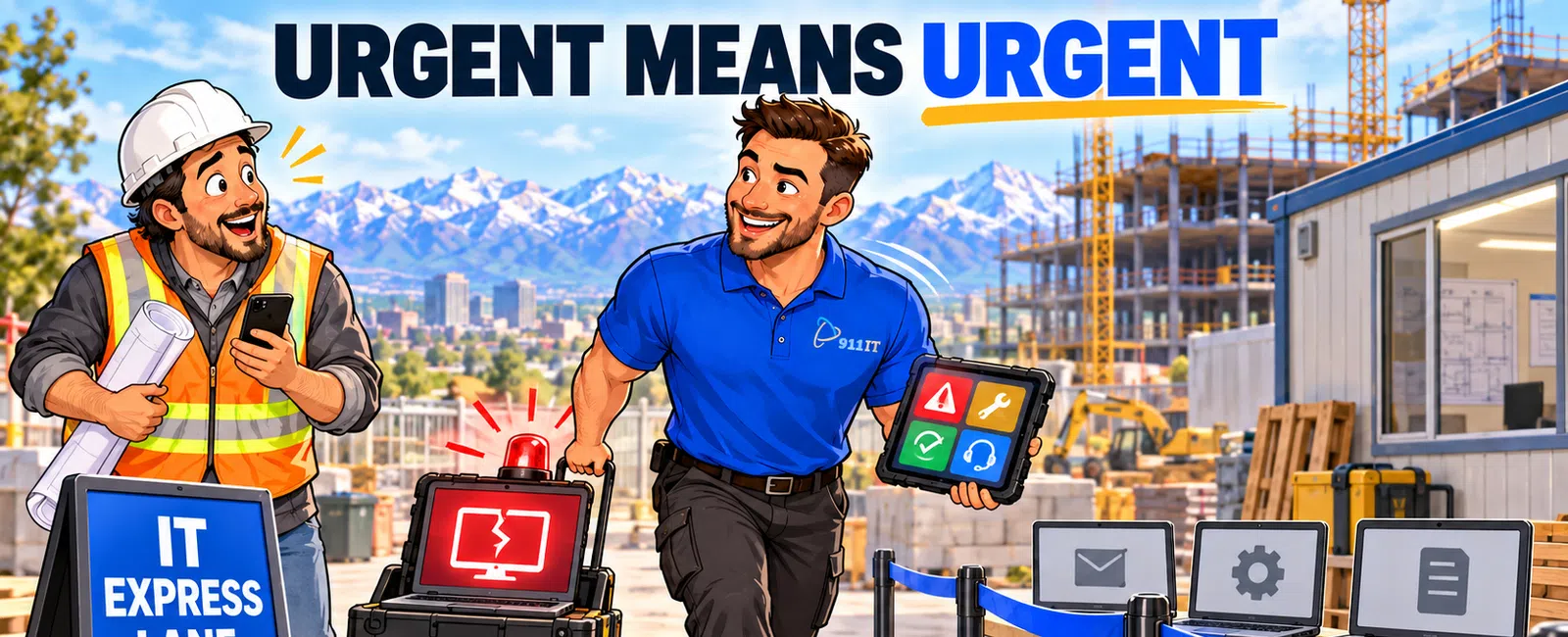
An IT Service Level Agreement (SLA) is a formal contract defining the response and resolution times your IT provider commits to when you experience technical issues. For construction firms in Salt Lake City, typical SLAs range from 15-minute critical response times with managed IT providers to 24-48 hour callbacks with break-fix services, directly impacting job site productivity and project timelines.
What exactly is an IT Service Level Agreement?
A Service Level Agreement is a documented commitment between your construction company and your IT provider that specifies exactly how quickly they'll respond when your CAD software crashes, your project management system goes offline, or your field crews lose connectivity.
The SLA defines three critical timeframes: acknowledgment time (when someone confirms they received your ticket), response time (when a technician begins working on your issue), and resolution time (when the problem is fixed). Each timeframe varies based on severity level.
Most IT SLAs categorize issues into priority tiers. Priority 1 (critical) covers complete system outages that stop work - like your entire office losing network access during bid submission. Priority 2 (high) includes issues affecting multiple users but with workarounds available. Priority 3 (medium) and Priority 4 (low) cover single-user problems and minor requests.
For construction companies managing blueprints, submittals, and change orders across multiple job sites, the SLA becomes your safety net when technology fails at the worst possible moment.
What response times should construction companies expect from IT providers?
Response time expectations vary dramatically based on your service model. Break-fix providers typically offer 24-48 hour response times with no guarantees, while managed service providers commit to much faster responses with contractual penalties if they miss targets.
For critical issues - server failures, complete network outages, or security breaches - managed IT providers in Salt Lake City typically guarantee 15-30 minute response times. This means a qualified technician acknowledges your ticket and begins diagnosis within that window, not that the problem is necessarily resolved.
High-priority issues affecting multiple users or critical software like Procore, Buildertrend, or AutoCAD usually carry 1-2 hour response SLAs. Medium-priority single-user problems typically see 4-8 hour responses, while low-priority requests might have same-day or next-business-day commitments.
Clay, who manages IT for a Salt Lake City construction firm, reports: "Most of the time they will resolve our issue before we hang up the phone."
The difference becomes stark when you're facing a deadline. A superintendent unable to access updated plans at a job site in Park City can't wait two days for a callback. Utah's construction market moves too fast, and weather windows are too narrow to tolerate slow IT response.
Resolution times are separate from response times. While a technician may respond in 15 minutes, complex issues like corrupted BIM models or failed server migrations might take hours or days to fully resolve, depending on the problem's scope.
How do break-fix and managed IT SLAs differ?
Break-fix IT support operates without formal SLAs in most cases. You call when something breaks, and the provider fits you into their schedule based on availability and who pays the highest hourly rate. There's no contractual obligation to respond within any specific timeframe.
This model creates unpredictability that's particularly painful for construction firms. When your estimating software crashes the morning bids are due, a break-fix provider might be tied up with other clients for hours or even days. You're essentially competing with their other customers for attention.
Managed IT services include formal SLAs as part of the monthly agreement. Providers like managed IT services commit to specific response and resolution windows with contractual accountability. If they miss the SLA, many providers offer service credits or other remedies.
The managed model also includes proactive monitoring that prevents many emergencies entirely. When 911 IT monitors a construction client's systems 24-7, they often detect and resolve issues - like failing hard drives or security threats - before they impact operations.
Jaren, who works in construction, notes the difference: "They are great at answering their phone and solving our problems quickly. I really like how quickly they respond to my questions and concerns."
For construction companies operating across Utah, Wyoming, and Arizona with job sites in remote locations, the guaranteed response times of managed IT become essential infrastructure.
What SLA terms matter most for construction firms?
Beyond response times, several SLA components directly impact construction operations. Coverage hours determine when support is available - business hours only, extended hours, or true 24-7 support for crews working night shifts or weekend emergency repairs.
Geographic coverage matters for firms with trailer offices at remote sites. Your SLA should specify whether on-site support is available at job locations throughout the Wasatch Front, rural Wyoming sites, or Arizona projects, and how quickly technicians can arrive.
Software-specific support belongs in construction IT SLAs. Your agreement should explicitly cover the specialized applications your teams depend on - Sage 300 Construction, Viewpoint Vista, Bluebeam, Autodesk Construction Cloud, and industry-specific tools that generic IT providers may not understand.
Escalation procedures outline what happens when frontline support can't resolve an issue. Construction firms need clear escalation paths to senior engineers or vendor specialists when dealing with complex problems affecting project management platforms or integrated accounting systems.
Communication protocols specify how you'll receive updates during outages. When your project managers are in the field, they need text or mobile app notifications, not just email updates they won't see until returning to the office.
Exclusions matter as much as inclusions. Read what's NOT covered - many SLAs exclude third-party software issues, hardware failures on equipment past warranty, or problems caused by unauthorized changes. For construction IT support, understanding these boundaries prevents surprise gaps.
How do Salt Lake City IT providers compare on SLA commitments?
Salt Lake City's construction IT landscape includes several established providers with varying SLA structures. When evaluating local options, construction firms should compare both the written commitments and the provider's capacity to deliver consistently.
| Provider Type | Typical Response Time (Critical) | Coverage Hours | Construction Experience |
|---|---|---|---|
| 911 IT | Immediate (often resolved on first call) | 24-7 live support | Specialized in construction software and job site connectivity |
| Executech | Varies by service tier | Business hours primary | Broad industry focus |
| Wasatch I.T. | Standard managed IT response | Extended business hours | General business IT |
| Enterprise-focused providers | Tiered by account size | 24-7 for premium tiers | Large GC focus, small firms may get slower service |
| Break-fix shops | No guaranteed response | Business hours | Varies widely |
Large national MSPs often provide impressive SLAs on paper but struggle with execution for smaller construction firms. When you're one account among thousands, you enter a ticket queue where a 15-minute SLA means 15 minutes until someone reads your ticket, not until someone who understands construction software begins solving your problem.
Regional providers like Nexus IT Consultants, INTELITECHS, ProLink IT, and Qual IT offer varying specializations. Some focus on specific industries or company sizes, affecting their familiarity with construction-specific challenges like job site connectivity or BIM software performance.
Kevin, a construction professional, describes the 911 IT difference: "When I call for assistance, the response is instantaneous. I'm on the phone with a real person right away, and they're able to assist me with whatever issue I'm having. I've never been told that I need to call back, talk to someone else, or find a different solution."
The sweet spot for construction firms lies with providers large enough to offer enterprise-grade capabilities and 24-7 coverage, yet small enough that your account receives personal attention from technicians who know your specific setup, software stack, and project cycles.
911 IT occupies this position in the Salt Lake City market - capable of handling everything from cybersecurity to complex multi-site networks, while maintaining the responsiveness where most issues resolve before you hang up the phone.
What should construction firms look for in an IT SLA?
Start by ensuring the SLA includes specific, measurable commitments rather than vague promises. "We strive for fast response" means nothing; "15-minute response for Priority 1 issues, 24-7-365" creates accountability.
Verify that construction-specific scenarios are covered. Your SLA should address job site connectivity issues, support for mobile workers accessing systems remotely, and assistance with construction software integration - not just generic office IT support.
Check for proactive maintenance commitments. The best SLAs include regular system health checks, patch management, security updates, and capacity planning that prevent emergencies rather than just responding to them. This proactive approach is particularly valuable during Utah's winter months when weather-related issues can compound technology problems.
Understand the measurement and reporting process. Quality IT providers track their SLA performance and share monthly reports showing response times, resolution rates, and any missed commitments. This transparency lets you verify you're receiving the service you're paying for.
Look for flexibility around seasonal demands. Construction firms in Salt Lake City experience volume fluctuations - busy spring and summer building seasons, slower winter periods. Your IT SLA should accommodate scaling support up or down without penalty.
Rhonda, who manages operations for a construction company, summarizes the impact: "911 IT has been a godsend to our company, especially to me. They are always available and can take care of any need we have right away. I never panic anymore when something isn't working right."
The elimination of panic - knowing someone will answer immediately and solve problems fast - represents the true value of a strong IT SLA for construction operations.
Why 911 IT delivers the SLA performance construction firms need
911 IT structures SLAs around construction reality, not generic IT service models. When a project manager loses access to Procore at a job site in Draper or a superintendent can't pull up plans in Park City, the 24-7 live support team responds immediately with technicians who understand construction workflows.
The company's process-driven approach ensures consistent SLA performance across all clients. Unlike large national providers where small construction firms compete for attention with enterprise accounts, or one-person IT shops where vacation means no coverage, 911 IT maintains the capacity to deliver rapid response without sacrificing the personal service where technicians know your specific setup.
Construction-specific expertise means faster resolution. When 911 IT technicians support your Sage 300, AutoCAD, or Bluebeam environment, they're not learning on your time. They've solved similar issues for other construction clients across Utah, Wyoming, and Arizona, bringing that experience to every support call.
The 100% Satisfaction Guarantee backs every SLA commitment. If 911 IT's service doesn't meet expectations, they make it right - a level of accountability that reflects confidence in their ability to deliver consistently.
For construction firms tired of IT providers who don't answer phones, don't understand construction software, or can't support remote job sites, 911 IT offers the SLA performance that keeps projects moving and eliminates the panic when technology fails.
Frequently asked questions
What's the difference between response time and resolution time in an IT SLA?
Response time measures how quickly an IT technician acknowledges your issue and begins diagnosis - typically 15 minutes to 2 hours for managed IT providers depending on severity. Resolution time measures how long until the problem is completely fixed, which varies based on complexity. A technician might respond in 15 minutes but need several hours to rebuild a corrupted database or replace failed hardware.
Do break-fix IT companies offer SLAs?
Most break-fix providers do not offer formal SLAs with guaranteed response times. You call when something breaks and they fit you into their schedule based on availability and workload. This creates unpredictability that's problematic for construction firms with tight project deadlines. Managed IT services include contractual SLAs with specific response commitments and accountability if they miss targets.
What response time should I expect for non-emergency IT issues?
For medium-priority issues affecting a single user - like one person unable to access shared files or email problems - managed IT providers typically commit to 4-8 hour response times during business hours. Low-priority requests like software installation requests or minor configuration changes usually receive same-day or next-business-day responses. Critical issues affecting multiple users or stopping work entirely warrant 15-30 minute response commitments.
How much does managed IT with strong SLAs cost for construction companies?
Managed IT services with comprehensive SLAs typically range from $100-$250 per user per month based on service level, company size, and complexity. This includes 24-7 monitoring, help desk support with guaranteed response times, proactive maintenance, and cybersecurity protections. For construction firms, this predictable monthly cost eliminates surprise emergency IT bills and ensures support is available when job site connectivity or project management software issues arise.
Can IT providers really resolve most issues on the first call?
Experienced managed IT providers with construction expertise resolve 60-80% of issues on the first call for clients whose systems they monitor and maintain. This high first-call resolution rate comes from proactive monitoring that catches problems early, deep familiarity with each client's specific setup and software, and technicians who understand construction workflows. Break-fix providers typically have lower first-call resolution because they lack this ongoing relationship and system knowledge.


