
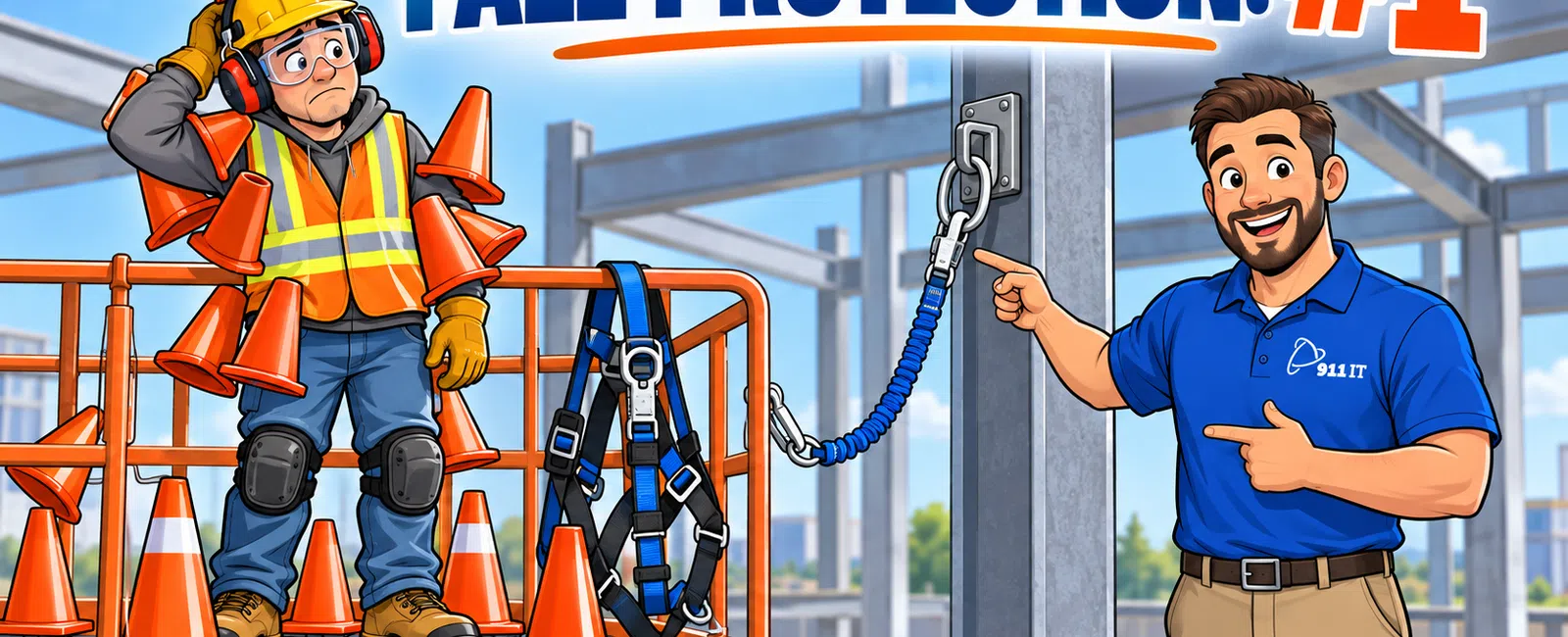
The most violated OSHA regulation is 29 CFR 1926.501, covering fall protection in construction. This standard has topped OSHA's annual Top 10 list for over a decade, with 6,985 violations cited in fiscal year 2023 alone. Fall hazards remain the leading cause of construction worker fatalities, accounting for approximately 33% of all deaths in the industry.
Why Does Fall Protection Lead OSHA Violations Every Year?
Construction sites present constant fall hazards. Workers operate on scaffolding, roofs, ladders, and elevated platforms daily. The regulation requires guardrails, safety nets, or personal fall arrest systems when workers face falls of six feet or more.
Many violations occur because contractors fail to provide adequate protection systems or workers bypass safety equipment to save time. Smaller firms often lack dedicated safety officers to monitor compliance across multiple job sites simultaneously.
The mountainous terrain common in Utah, Wyoming, and Arizona creates additional elevation challenges. Remote construction sites in these regions may lack immediate emergency response access, making fall prevention even more critical.
Documentation gaps compound the problem. Even when equipment exists on-site, companies struggle to prove workers received proper training or that inspections occurred on schedule. Digital record-keeping helps, but many construction firms still rely on paper systems that disappear when trailers move between projects.
Fall protection violations carry steep penalties - up to $15,625 per violation for serious citations and $156,259 for willful or repeated violations.
What Other OSHA Regulations Do Construction Companies Frequently Violate?
Hazard communication (1926.1200) ranks second, with 2,424 violations in 2023. This standard requires companies to maintain Safety Data Sheets and train workers on chemical hazards. Construction crews work with solvents, adhesives, coatings, and fuels daily, yet many lack current SDS libraries or documented training.
Respiratory protection (1926.103) generated 1,776 violations. Silica dust, paint fumes, and other airborne contaminants demand proper respirators and fit testing. Workers often use inadequate masks or skip protection entirely when grinding concrete or cutting treated lumber.
Scaffolding standards (1926.451) produced 1,694 violations. Improperly constructed scaffolds collapse or tip, causing falls and crush injuries. Requirements cover load capacity, planking, guardrails, and access - details that rushed crews sometimes overlook.
Ladders (1926.1053) accounted for 1,556 violations. Extension ladders must extend three feet above landing surfaces, maintain proper angles, and stay secured. Portable ladders seem simple but generate injuries when workers improvise or use damaged equipment.
The top five OSHA violations in construction represented over 14,400 citations in fiscal year 2023.
Eye and face protection (1926.102), powered industrial trucks (1910.178), lockout/tagout (1910.147), and machine guarding (1910.212) round out the top ten. Each reflects common job site hazards that companies inadequately address.
Top 10 OSHA Construction Violations (FY 2023)
- Fall Protection (1926.501) - 6,985 violations
- Hazard Communication (1926.1200) - 2,424 violations
- Respiratory Protection (1926.103) - 1,776 violations
- Scaffolding (1926.451) - 1,694 violations
- Ladders (1926.1053) - 1,556 violations
- Eye and Face Protection (1926.102) - 1,304 violations
- Powered Industrial Trucks (1910.178) - 1,010 violations
- Lockout/Tagout (1910.147) - 972 violations
- Machine Guarding (1910.212) - 865 violations
- Fall Protection Training (1926.503) - 839 violations
How Do OSHA Violations Impact Construction Firms in Salt Lake City?
Utah's growing construction market means more job sites and increased OSHA scrutiny. The state's population growth drives commercial development, but rapid expansion can pressure contractors to cut corners on safety protocols.
Financial penalties represent just the starting point. A serious violation triggers project delays while you implement corrective actions. Stop-work orders halt revenue completely until you demonstrate compliance.
Insurance costs spike after violations. Carriers raise premiums or drop coverage entirely for repeat offenders. Workers' compensation rates increase when injury frequency rises, directly impacting your bottom line on every bid.
Reputation damage spreads quickly in regional markets. General contractors review safety records before awarding subcontracts. Public projects require clean OSHA histories. One violation can disqualify your firm from lucrative opportunities.
Jaren, who works in construction, shared: "We have loved the peace of mind using 911 IT has given us. They are great at answering their phone and solving our problems quickly. We are upgrading our machines with them now. They help us with backup services and with virus protection." Reliable technology systems ensure safety documentation stays accessible during inspections and training records remain current across all job sites.
Multi-state operations across Utah, Wyoming, and Arizona complicate compliance. Each state enforces federal OSHA standards differently, and Wyoming operates its own state plan with unique requirements. Your construction IT systems must track varying regulations across jurisdictions.
What Technology Helps Construction Companies Maintain OSHA Compliance?
Cloud-based safety management platforms centralize training records, equipment inspections, and incident reports. Field crews access checklists and SDS libraries from mobile devices at remote job sites. Supervisors verify completion in real-time rather than discovering missing documentation during audits.
Digital forms replace paper clipboards that get lost, damaged, or left in trailer offices. Workers photograph hazards and submit reports instantly. Time-stamped records prove when you identified and corrected unsafe conditions.
Automated reminders prevent expired certifications. The system alerts managers when forklift licenses, respirator fit tests, or scaffold competent person training need renewal. You address gaps before OSHA inspectors arrive.
Job site connectivity remains challenging in Utah's mountainous regions and rural Wyoming locations. Reliable internet access at remote sites requires specialized solutions - cellular boosters, satellite links, or mobile hotspots with adequate bandwidth for uploading photos and syncing databases.
Backup and disaster recovery protect compliance documentation. Weather-related outages or hardware failures shouldn't erase years of safety records. Business continuity services ensure you can produce required documentation even after equipment loss or natural disasters common in the region's winter conditions.
Integration between project management software and safety platforms eliminates duplicate data entry. When you create a new project in your construction management system, it automatically generates safety plan templates and assigns required inspections.
Technology amplifies your safety culture but doesn't replace it - systems provide tools while leadership commitment and worker engagement determine outcomes.
How Can Construction Firms Reduce OSHA Violations and Improve Safety?
Start with a comprehensive hazard assessment for each project phase. Identify fall risks, chemical exposures, confined spaces, and electrical hazards before work begins. Document your findings and communicate them during pre-task briefings.
Implement a competent person program. OSHA requires qualified individuals to inspect scaffolds, trenches, and fall protection systems. Invest in training and empower these team members to stop work when they identify hazards.
Conduct weekly toolbox talks addressing specific hazards workers will encounter. Fifteen-minute discussions about ladder safety, proper PPE, or hazard communication keep awareness high. Document attendance and topics covered.
Establish a near-miss reporting system. Workers who report close calls without fear of punishment help you identify and correct hazards before injuries occur. Investigate every incident to determine root causes and systemic improvements.
Schedule regular equipment inspections. Damaged ladders, worn harnesses, and faulty scaffolding cause preventable injuries. Remove defective equipment immediately and maintain inspection logs proving your diligence.
Clay from construction noted: "911 IT's response time has been so great! Most of the time they will resolve our issue before we hang up the phone. When we find ourselves in IT trouble we are usually in a mess until we call 911 IT and they get things working again." Fast IT support keeps safety systems operational when you need them most - during inspections, after incidents, or when training new crews.
Partner with safety consultants who understand construction-specific regulations. They conduct mock OSHA inspections, identify gaps, and recommend corrective actions before regulators arrive. The investment prevents costly violations and demonstrates good-faith compliance efforts.
Budget adequate time for safety in project schedules. Rushed work increases risk. When crews feel pressure to skip steps or bypass protection systems, injuries spike. Build safety activities into critical path schedules like any other essential task.
Reliable IT infrastructure supports every safety initiative - from maintaining training databases to ensuring job site connectivity for digital inspections.
What Should Construction Companies Do After Receiving an OSHA Citation?
Review the citation carefully within the 15-working-day contest period. Determine whether the violation accurately reflects conditions and whether you can correct it within the abatement timeframe. Consult with safety professionals and legal counsel before deciding to contest or accept.
Implement immediate corrective actions even if you plan to contest. Eliminating the hazard protects workers and demonstrates good faith. Document every step you take with photos, receipts, and training records.
Investigate why the violation occurred. Did workers lack training? Was equipment unavailable? Did supervisors fail to enforce policies? Understanding root causes prevents recurrence across all your job sites.
Communicate with your insurance carrier promptly. Delayed notification can jeopardize coverage for penalties or related claims. Carriers may provide risk management resources to help you improve safety programs.
Update safety plans and training materials to address the cited standard. If OSHA found fall protection deficiencies, revise your fall protection program and retrain all affected workers. Document these improvements thoroughly.
Consider informal conferences with OSHA. These meetings allow you to discuss citations, present evidence of corrections, and potentially negotiate penalties. Approach them professionally with documentation proving your commitment to compliance.
Conduct company-wide safety stand-downs if the violation reveals systemic issues. Stop work at all sites to review the hazard, reinforce proper procedures, and verify adequate equipment and training exist everywhere.
Your managed IT services should maintain secure, accessible records of all safety documentation, corrective actions, and correspondence with OSHA throughout the citation process.
Frequently Asked Questions
What is the most common OSHA violation in construction?
Fall protection (29 CFR 1926.501) is the most common OSHA violation in construction, with 6,985 citations in fiscal year 2023. This standard requires guardrails, safety nets, or personal fall arrest systems when workers face potential falls of six feet or more, yet remains consistently violated across job sites nationwide.
How much do OSHA violations cost construction companies?
OSHA violations carry penalties up to $15,625 per serious violation and $156,259 for willful or repeated violations as of 2023. Beyond direct fines, companies face increased insurance premiums, project delays, stop-work orders, and potential disqualification from future contracts, making the total financial impact substantially higher than initial penalties.
Can technology help construction firms avoid OSHA violations?
Yes, cloud-based safety management platforms centralize training records, equipment inspections, and compliance documentation accessible from job sites. Automated reminders prevent expired certifications, mobile apps enable real-time hazard reporting, and integrated systems ensure safety data remains protected and accessible during OSHA inspections, significantly reducing violation risk.
What happens if OSHA inspects my construction site?
OSHA compliance officers conduct opening conferences, walk-through inspections, employee interviews, and closing conferences. They document hazards, review safety programs, and verify training records. Violations result in citations with abatement deadlines and penalties. You have 15 working days to contest citations or implement corrective actions to eliminate identified hazards.
How often does OSHA inspect construction sites in Utah?
OSHA prioritizes inspections based on fatalities, catastrophes, worker complaints, and referrals rather than scheduled intervals. Utah's growing construction market increases inspection likelihood. High-hazard activities like roofing, trenching, and steel erection receive greater scrutiny. Maintaining proactive compliance reduces risk regardless of inspection frequency in your area.


