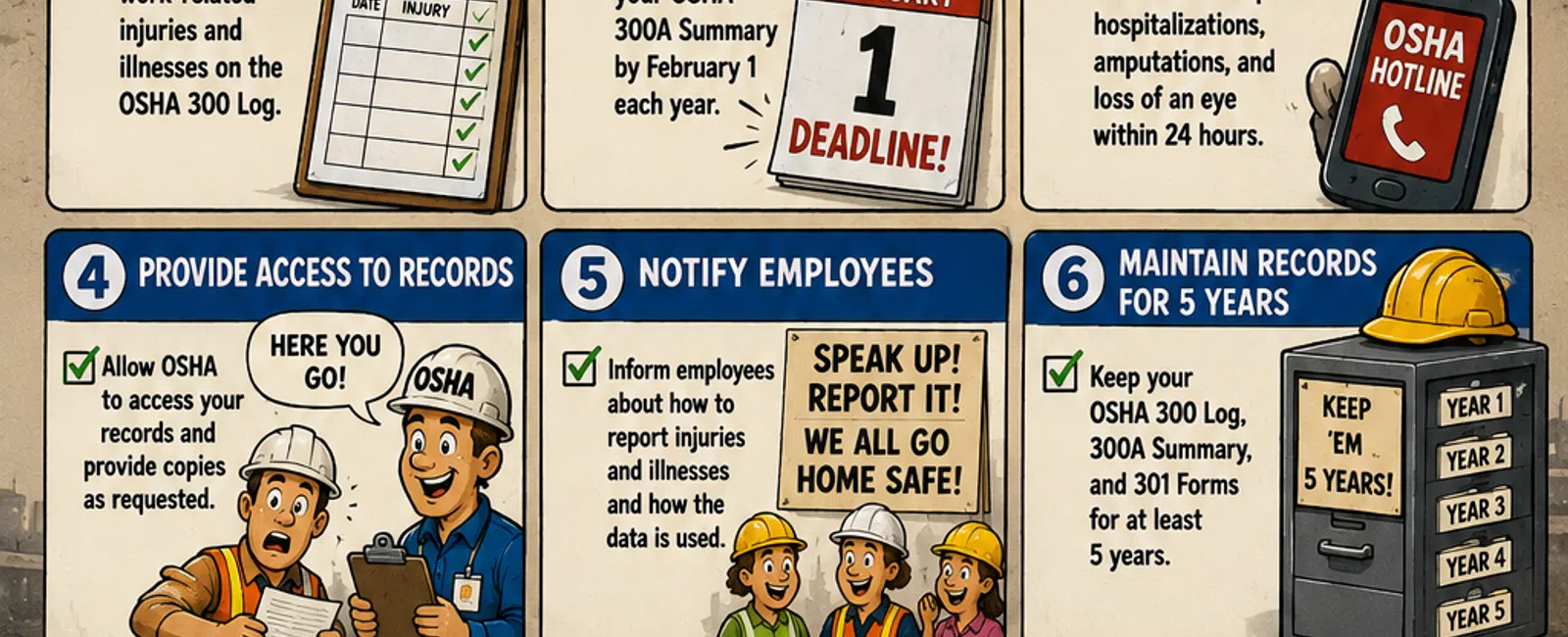
Construction companies must maintain OSHA Form 300 (Log of Work-Related Injuries and Illnesses), Form 300A (Summary), and Form 301 (Injury and Illness Incident Report) for five years, with electronic submission required for companies with 250+ employees by March 2 annually. Firms with 20-249 employees in high-hazard industries must submit Form 300A electronically through OSHA's Injury Tracking Application portal.
What Records Must Construction Companies Maintain for OSHA Compliance?
Construction firms must maintain three core OSHA recordkeeping forms. Form 300 logs all recordable work-related injuries and illnesses throughout the year. Form 300A summarizes the annual totals from Form 300. Form 301 provides detailed information about each specific incident.
These records must be retained for five years following the year they cover. You must update stored records if changes occur, such as when an injury's classification changes or when you receive new information about a case.
Form 300A must be posted in a visible location where notices to employees are typically placed from February 1 through April 30 each year.
Additional documentation includes employee access logs. Workers, former workers, and their representatives have the right to access these records, and you must track who requested access and when.
Digital recordkeeping systems offer significant advantages for construction firms managing multiple job sites. Specialized construction IT support ensures your recordkeeping systems remain accessible, backed up, and compliant with retention requirements even as projects and locations change.
Maintaining accurate, accessible records across job sites and office locations protects your company during OSHA inspections.
Which Construction Companies Must Submit Data Electronically to OSHA?
Electronic submission requirements depend on company size and industry classification. Construction companies with 250 or more employees must submit Forms 300A, 300, and 301 electronically each year.
Companies with 20-249 employees in designated high-hazard industries must submit Form 300A only. Most construction sectors fall under NAICS codes requiring submission, including residential building construction (236), nonresidential building construction (236), and specialty trade contractors (238).
Submissions must be completed through OSHA's Injury Tracking Application (ITA) portal by March 2 annually for the previous calendar year's data. The ITA requires specific data elements including establishment information, employment data, and injury/illness totals.
Companies operating multiple establishments must submit separate forms for each location with 20 or more employees. This creates complexity for construction firms managing numerous job sites and regional offices.
Electronic submission failures result in citations, with penalties reaching $15,625 per violation for serious violations and up to $156,259 for willful or repeated violations.
IT infrastructure supporting electronic submission must ensure data security during transmission and storage. Construction firms handling sensitive employee medical information need robust cybersecurity measures to protect this data from breaches while maintaining accessibility for authorized personnel.
Meeting electronic submission deadlines requires reliable systems and proactive calendar management to avoid costly penalties.
How Should Construction Firms Classify Recordable Injuries and Illnesses?
An injury or illness is recordable if it results from a work-related incident and requires medical treatment beyond first aid, involves loss of consciousness, restriction of work or motion, or transfer to another job. The determination must be made within seven calendar days of learning about the incident.
Work-relatedness means the injury occurred in the work environment. For construction, this includes job sites, staging areas, and travel between sites when employees are on the clock. The geographic exception for office workers doesn't typically apply to construction personnel regularly working at job sites.
Medical treatment beyond first aid is the threshold for recordability. First aid includes using non-prescription medications at non-prescription strength, administering tetanus shots, cleaning and bandaging wounds, and using finger guards. Physical therapy, prescription medications, and stitches all constitute medical treatment requiring recordkeeping.
Days away from work, restricted work, or job transfer cases require special attention. You must count calendar days, not just workdays, beginning the day after the incident. Count continues until the employee returns to full duty, reaches 180 days, or leaves the company.
Privacy cases involving certain illnesses and injuries require special handling. Mental illness, HIV infection, hepatitis, and tuberculosis cases should not include the employee's name on Form 300. Instead, enter "privacy case" and maintain a separate confidential list.
Misclassification creates compliance risk and skews your company's safety metrics, potentially affecting insurance rates and contract eligibility.
What IT Systems Support OSHA Recordkeeping Compliance?
Construction firms need integrated systems connecting incident reporting, recordkeeping, and electronic submission. Safety management software centralizes data collection from multiple job sites, ensuring consistent classification and timely entry.
Cloud-based solutions provide accessibility for safety managers, project managers, and field supervisors regardless of location. Cloud infrastructure ensures records remain accessible during office relocations or job site closures.
Mobile applications enable immediate incident reporting from job sites. Foremen and safety officers can document injuries in real-time, photograph conditions, and initiate the recordkeeping process before returning to the office. This reduces delays and improves accuracy.
Integration with project management systems links safety data to specific projects, enabling analysis of which job types or locations present higher risk. This data drives targeted safety improvements and helps identify training needs.
Automated reminders ensure timely completion of required tasks. Systems can alert administrators about approaching seven-day classification deadlines, annual summary posting requirements, and electronic submission dates.
Backup and disaster recovery systems protect five years of required records. Construction firms cannot afford to lose historical data due to hardware failure, ransomware, or natural disasters. Business continuity planning ensures OSHA records remain protected and recoverable.
Access controls and audit trails demonstrate who viewed or modified records and when. This documentation proves valuable during OSHA inspections and protects against claims of record tampering.
The right technology infrastructure transforms OSHA compliance from a paper-intensive burden into a manageable, systematic process.
What Happens During an OSHA Recordkeeping Inspection?
OSHA compliance officers may request records during scheduled inspections, complaint investigations, or accident investigations. You must produce Forms 300, 300A, and 301 for the current year and the previous five years within four business hours of the request.
Inspectors verify that all recordable injuries and illnesses appear on Form 300. They cross-reference your logs against workers' compensation claims, insurance records, and employee interviews. Discrepancies raise red flags and extend inspection scope.
Officers examine whether injuries were properly classified as recordable. They review your first aid log, incident reports, and medical records to identify cases that should have been recorded but weren't. Underreporting violations carry substantial penalties.
Form 300A posting compliance receives scrutiny. Inspectors verify you posted the summary during the required February 1 to April 30 window and that it was displayed where employees could actually see it - not hidden in a back office.
Electronic submission compliance is verified through OSHA's database. If your company falls under submission requirements but hasn't filed, or filed late, citations typically follow.
Employee access rights are tested. Inspectors may ask employees if they know how to access injury records and whether the company has honored access requests promptly. Delays beyond the required timeframes result in violations.
Record retention is verified by requesting records from five years prior. Missing or incomplete historical records demonstrate recordkeeping failures even if current-year records are perfect.
Preparation through consistent, accurate recordkeeping throughout the year - not scrambling before an inspection - determines inspection outcomes.
How Can Construction Firms Implement an Effective OSHA Data Compliance System?
Start by designating a compliance coordinator responsible for OSHA recordkeeping. This person needs training on classification rules, access to all incident reports, and authority to gather information from project managers and field supervisors.
Establish clear incident reporting procedures. Every employee should know how to report injuries immediately, and every supervisor should understand their responsibility to document incidents and forward information to the compliance coordinator within 24 hours.
Create classification decision trees or flowcharts. These tools help the compliance coordinator consistently determine recordability, reducing errors and providing documentation of the decision-making process.
Implement calendar-based workflows with automated reminders. Key dates include the seven-day classification deadline, December 31 annual review, February 1 posting date, and March 2 electronic submission deadline.
Conduct quarterly internal audits. Review your Form 300 against workers' compensation claims, insurance records, and payroll data to identify any incidents that weren't recorded. Correct errors promptly and document why they occurred.
Train project managers and supervisors on what constitutes a recordable injury. Field leadership often makes initial determinations about injury severity, and their understanding directly affects compliance accuracy.
Centralize records in a secure, backed-up system accessible to authorized personnel. Whether you choose specialized safety software or a structured document management system, consistency and security matter more than specific technology choices.
Document your recordkeeping procedures in writing. This manual should cover reporting workflows, classification criteria, record retention, employee access procedures, and electronic submission processes. Written procedures demonstrate good-faith compliance efforts during inspections.
A comprehensive OSHA compliance checklist includes:
- Designate trained compliance coordinator with clear authority
- Establish 24-hour incident reporting procedures for all personnel
- Maintain Forms 300, 300A, and 301 with accurate classifications
- Post Form 300A from February 1 through April 30 annually
- Submit electronic data through ITA portal by March 2 deadline
- Retain all records for five years in secure, backed-up systems
- Provide employee record access within required timeframes
- Conduct quarterly internal audits against workers' comp claims
- Train supervisors on recordability determination criteria
- Document all procedures in written compliance manual
Systematic processes supported by reliable technology infrastructure create sustainable compliance that protects your company and your workers.
Frequently Asked Questions
Do small construction companies need to keep OSHA injury records?
Construction companies with 10 or fewer employees are exempt from routine OSHA recordkeeping requirements unless specifically notified by OSHA. However, all employers must report fatalities within eight hours and hospitalizations, amputations, or eye losses within 24 hours regardless of size. Even exempt companies should maintain incident documentation for workers' compensation and liability purposes.
What is the deadline for OSHA electronic injury reporting?
Construction companies required to submit electronically must file through OSHA's Injury Tracking Application by March 2 each year for the previous calendar year's data. Companies with 250+ employees submit Forms 300A, 300, and 301. Companies with 20-249 employees in covered industries submit Form 300A only. Late submissions result in citations and penalties.
How long must construction firms retain OSHA Form 300 records?
OSHA requires construction companies to retain Forms 300, 300A, and 301 for five years following the year they cover. You must update these stored records if circumstances change, such as injury classification changes or when additional information becomes available. Records must remain accessible for employee requests and OSHA inspections throughout the retention period.
Can construction workers request copies of OSHA injury logs?
Current employees, former employees, and their authorized representatives can request access to OSHA Form 300 and 300A. You must provide the Form 300 log by the end of the next business day and Form 300A by the end of the next business day. Individual workers can access their own Form 301 incident reports but cannot access other employees' detailed incident reports.
What construction injuries are not recordable on OSHA Form 300?
Injuries requiring only first aid are not recordable. First aid includes bandages, non-prescription medications at non-prescription strength, tetanus shots, wound cleaning, cold/hot therapy, and non-rigid supports. Once an injury requires prescription medication, stitches, physical therapy, or results in lost work time or restricted duty, it becomes recordable regardless of how minor it initially seemed.