
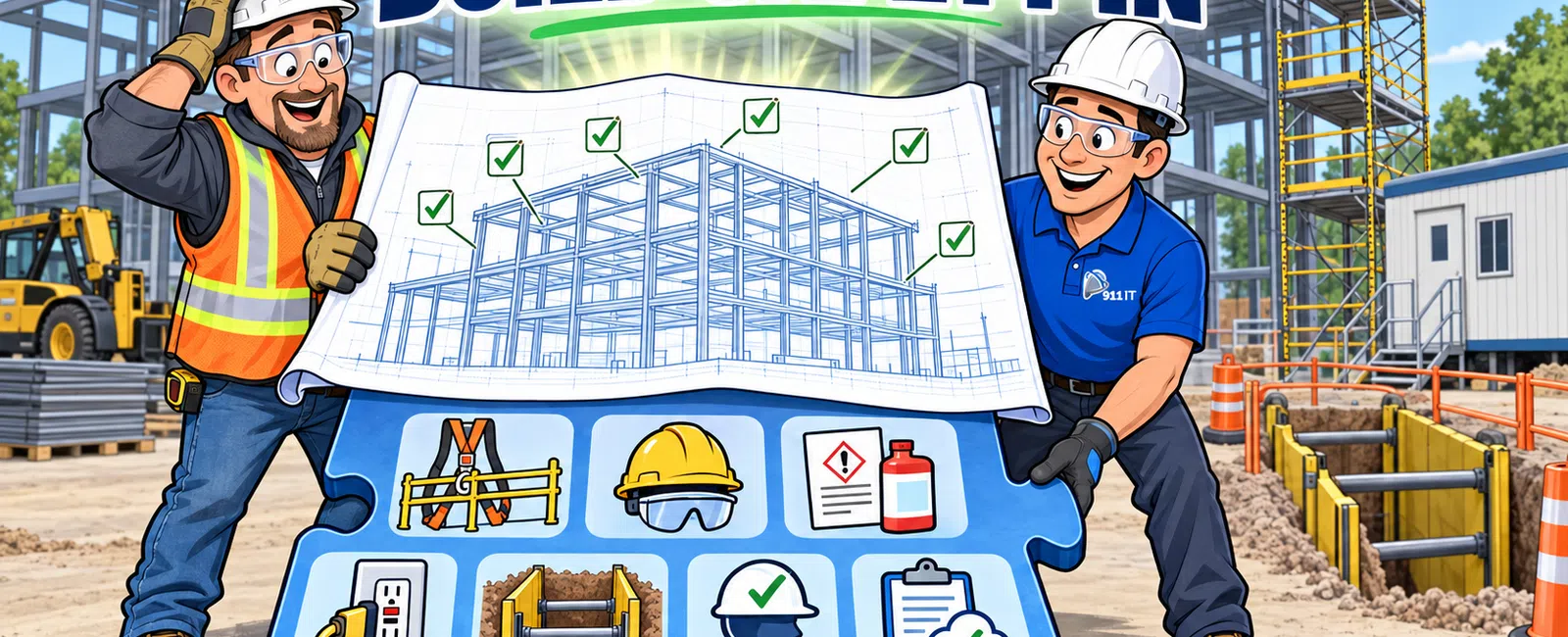
OSHA construction requirements mandate fall protection for heights above six feet, hazard communication programs with safety data sheets, scaffolding standards under 29 CFR 1926 Subpart L, electrical safety protocols, personal protective equipment (PPE), and trenching/excavation protections. Construction employers must provide training, maintain injury logs (OSHA 300), and report fatalities within eight hours to remain compliant.
What Are the Core OSHA Standards for Construction Sites?
OSHA's construction standards fall under 29 CFR 1926, covering four major hazard categories that account for the majority of construction fatalities: falls, struck-by incidents, caught-in/between hazards, and electrocution. These are known as the "Focus Four" hazards.
Fall protection requirements kick in at six feet for general construction, five feet for shipyards, and four feet for general industry. Employers must provide guardrails, safety nets, or personal fall arrest systems. Every construction site must have a competent person who can identify hazards and has authority to correct them immediately.
Hazard communication standards require maintaining safety data sheets (SDS) for all chemicals on site, proper labeling, and worker training on chemical hazards. Scaffolding must support at least four times its maximum intended load, and platforms must be fully planked. Electrical standards prohibit energized work unless de-energizing creates greater hazards, and ground-fault circuit interrupters (GFCIs) are mandatory for temporary power.
Trenching and excavation work requires protective systems for any trench five feet deep or greater. A competent person must inspect trenches daily before work begins. These foundational standards apply to virtually every construction project in Salt Lake City and across Utah, Wyoming, and Arizona.
Construction IT support systems help track safety training records, maintain digital compliance documentation, and ensure project teams have access to current safety protocols across multiple job sites.
How Do OSHA Recordkeeping and Reporting Requirements Work?
Construction employers with more than ten employees must maintain OSHA Form 300 (Log of Work-Related Injuries and Illnesses), Form 300A (Summary), and Form 301 (Injury and Illness Incident Report). These records must be retained for five years and posted annually from February 1 through April 30.
Fatalities must be reported to OSHA within eight hours. Hospitalizations, amputations, or loss of an eye must be reported within 24 hours. Reporting can be done by phone (1-800-321-OSHA) or online. Failure to report carries penalties up to $15,625 per violation for serious infractions and up to $156,259 for willful or repeated violations.
Electronic reporting requirements now mandate that establishments with 250 or more employees submit Forms 300, 300A, and 301 electronically. Establishments with 20-249 employees in high-hazard industries must submit Form 300A annually. The reporting deadline is March 2 each year.
Construction sites must post OSHA Form 300A summaries for three months every year, from February 1 through April 30.
Digital recordkeeping systems integrated with managed IT services help construction firms maintain compliant records across multiple projects, automate reporting deadlines, and ensure documentation is accessible during OSHA inspections. Clay, who works in construction, shared his experience: "911 IT's response time has been so great! Most of the time they will resolve our issue before we hang up the phone. They are experienced and they take time to know our setup. This allows them to resolve our issues fast."
What Training Does OSHA Require for Construction Workers?
OSHA mandates specific training for numerous construction activities. The 10-hour and 30-hour OSHA Outreach Training Programs are widely recognized, though not universally required by federal OSHA. Many states, municipalities, and general contractors require these certifications.
Competent person training is mandatory for specific tasks:
- Scaffolding erection and inspection
- Fall protection systems
- Trenching and excavation
- Cranes and rigging
- Concrete and masonry operations
A competent person must be capable of identifying existing and predictable hazards and have authorization to take prompt corrective measures.
Forklift operators require certification under 29 CFR 1910.178, including formal instruction, practical training, and evaluation. Refresher training is required every three years or when an operator demonstrates unsafe behavior. Aerial lift operators need training specific to the equipment type they'll operate.
Hazard communication training must occur before employees are exposed to hazardous chemicals. Confined space entry, lockout/tagout, respiratory protection, and hearing conservation programs each carry specific training requirements with documented completion records.
Salt Lake City construction firms managing training records digitally can ensure certifications don't lapse and workers have proper credentials before arriving at job sites.
What Personal Protective Equipment Standards Apply to Construction?
OSHA's PPE standards under 29 CFR 1926 Subpart E require employers to assess workplace hazards and provide appropriate protective equipment at no cost to workers. The employer must train workers on proper use, maintenance, and limitations of PPE.
Head protection (hard hats) must meet ANSI Z89.1 standards and is required wherever there's potential for head injury from falling objects or electrical shock. Eye and face protection meeting ANSI Z87.1 standards is mandatory when machines or operations present eye or face hazards.
Foot protection with impact resistance is required when carrying or handling materials that could drop, or when working around objects that could pierce the sole. High-visibility clothing is required for flaggers and workers exposed to vehicular traffic or equipment operation.
Respiratory protection follows 29 CFR 1910.134, requiring medical evaluations, fit testing, and training before use. Hearing protection is mandatory when noise levels exceed 85 decibels over an eight-hour time-weighted average. Fall protection equipment must be inspected before each use and removed from service if damaged.
PPE requirements vary by task and hazard exposure, making proper hazard assessment critical before work begins.
How Does OSHA Handle Multi-State Construction Operations?
Construction companies operating across Utah, Wyoming, and Arizona must navigate both federal OSHA standards and state-specific requirements. Utah operates under federal OSHA jurisdiction, while Wyoming and Arizona have state-approved OSHA plans that must be at least as effective as federal standards.
Wyoming's state plan covers both private and public sector employers. Arizona's plan (ADOSH) covers only public sector state and local government employees; private sector employers fall under federal OSHA. This creates complexity for construction firms with projects spanning multiple states.
State plans may adopt standards identical to federal OSHA or implement stricter requirements. Wyoming, for example, has adopted most federal construction standards with minimal variations. Employers must comply with the more stringent standard when federal and state requirements differ.
Multi-state operations require tracking which jurisdiction governs each project site, maintaining compliance documentation that satisfies varying state requirements, and ensuring safety programs address the most restrictive standards across all operating locations. Remote job sites common in Utah's mountainous terrain and Wyoming's rural areas add connectivity challenges for accessing safety documentation and reporting incidents.
Cloud-based systems enable construction teams to access current safety protocols, training records, and compliance documentation from any job site, regardless of connectivity limitations. Jaren, working in construction, noted: "We have loved the peace of mind using 911 IT has given us. They are great at answering their phone and solving our problems quickly. We are upgrading our machines with them now. They help us with backup services and with virus protection."
What Happens During an OSHA Construction Site Inspection?
OSHA inspections typically occur without advance notice. Inspectors arrive at the job site, present credentials, and conduct an opening conference explaining the inspection scope. The employer has the right to accompany the inspector during the walk-around.
Inspectors examine the worksite for hazards, review safety programs and training records, interview employees privately, and take photographs or measurements. They check for compliance with standards covering the Focus Four hazards, PPE usage, machine guarding, electrical safety, and recordkeeping requirements.
Document requests typically include:
- OSHA 300 logs
- Training records
- Written safety programs (fall protection, hazard communication, etc.)
- Equipment inspection records
- Competent person designations
Digital records must be produced as readily as paper files.
The closing conference summarizes findings. If violations are identified, OSHA issues citations describing each violation, proposed penalties, and abatement deadlines. Employers have 15 working days to contest citations or request an informal conference.
Violations are classified as de minimis (no direct safety impact), other-than-serious ($0-$15,625 per violation), serious ($1,000-$15,625 per violation), willful ($10,000-$156,259 per violation), or repeat (up to $156,259 per violation). Failure to abate violations can result in penalties up to $15,625 per day beyond the abatement date.
Construction firms with organized digital documentation, accessible safety programs, and current training records navigate inspections more smoothly and demonstrate good-faith compliance efforts that can influence penalty assessments.
How Can Construction Companies Maintain Ongoing OSHA Compliance?
Effective compliance programs start with a written safety plan addressing site-specific hazards. Designate competent persons for each required area and document their qualifications. Conduct regular safety meetings and toolbox talks, maintaining attendance records and topics covered.
Implement a hazard assessment process for each new project phase. Inspect equipment and scaffolding daily before use. Maintain current training records for all workers and ensure certifications don't expire. Establish clear protocols for reporting injuries and near-misses.
Regular internal audits identify compliance gaps before OSHA inspections. Review OSHA 300 logs quarterly to identify injury trends and implement corrective actions. Stay current on OSHA updates through email subscriptions, industry associations, and safety consultants.
Technology systems that centralize safety documentation, automate training reminders, and provide mobile access to safety protocols help distributed construction teams maintain compliance across multiple active projects. Salt Lake City's growing construction market, driven by population increases and commercial development, means firms managing numerous simultaneous projects need scalable compliance systems.
Utah's winter weather conditions require robust backup and disaster recovery solutions to prevent weather-related data loss that could compromise safety records during critical OSHA reporting periods.
Proactive compliance reduces injury rates, lowers insurance costs, improves project efficiency, and protects your firm from costly citations and work stoppages.
Frequently Asked Questions
What is the OSHA 10-hour construction training requirement?
OSHA 10-hour construction training is not federally mandated for all workers, but many states, municipalities, and general contractors require it. The course covers fall hazards, electrical safety, personal protective equipment, and other construction hazards. Workers receive a completion card valid for five years, though some jurisdictions require refresher training.
How often must construction equipment be inspected under OSHA?
OSHA requires daily inspections before each shift for scaffolds, ladders, fall protection equipment, and trenches. Cranes need inspections before each use and comprehensive monthly inspections. Powered industrial trucks (forklifts) require daily pre-use checks. Electrical equipment and cords must be visually inspected before each use for damage.
What are OSHA penalties for construction violations in 2026?
OSHA penalties for serious violations range from $1,000 to $15,625 per violation. Willful or repeated violations carry penalties from $10,000 to $156,259 per violation. Failure to abate violations results in up to $15,625 per day beyond the correction deadline. Posting requirements violations carry penalties up to $15,625.
Does OSHA require a safety manager on construction sites?
OSHA does not mandate a dedicated safety manager title, but requires a "competent person" for specific activities like scaffolding, fall protection, trenching, and crane operations. This person must have training and authority to identify hazards and take corrective action. Larger sites typically designate a full-time safety professional.
How long must construction companies keep OSHA training records?
OSHA requires training records for the duration of employment plus one additional year for most training types. Hazardous materials training records must be kept for 30 years. OSHA 300 injury logs must be retained for five years following the year covered. Medical surveillance records require 30-year retention.


