
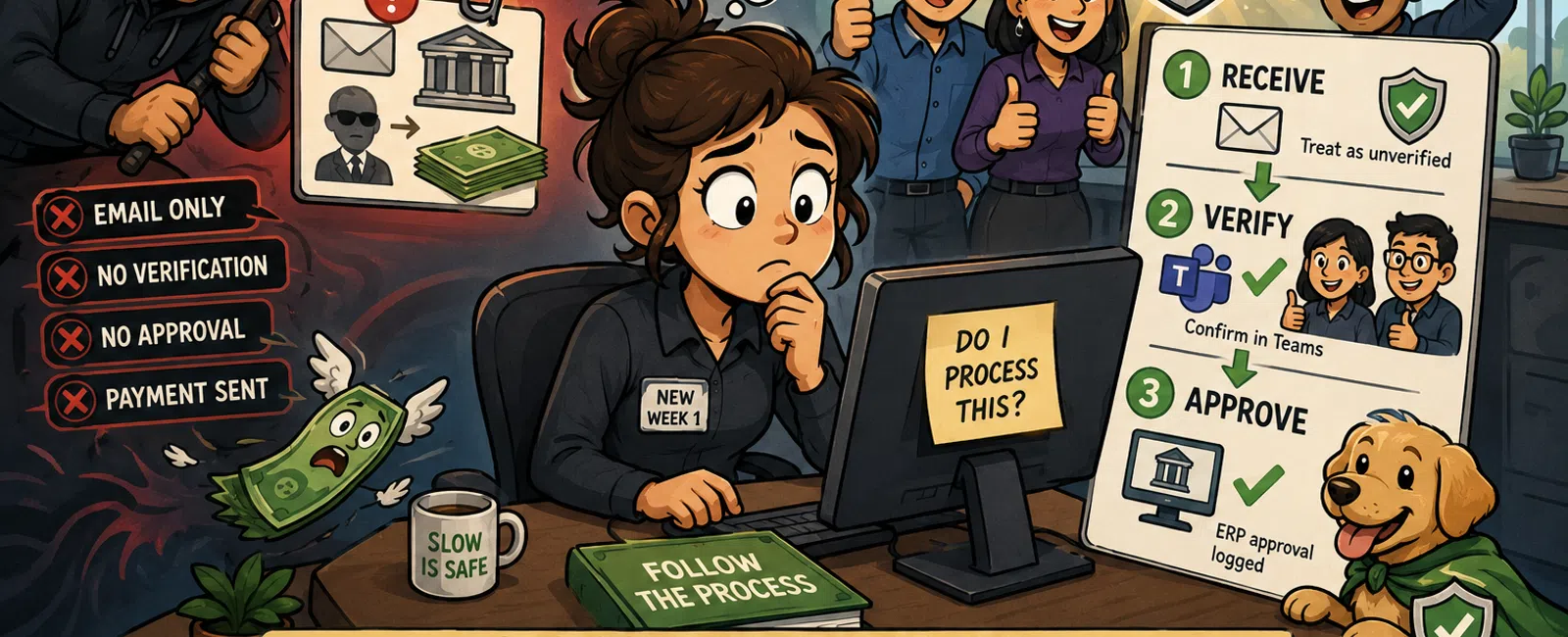
The First Week Mistake That Turns Into a Finance Incident
The email looks right.
It sounds like leadership. It references a real vendor. It arrives at the
exact moment a new employee is already working inside vendor files.
They process the request.
No one catches it.
And by the time finance notices, the money is gone.
What failed here is not awareness. It is system design.
And from an external standpoint, this lands squarely in financial control
failure—not user error.
Why This Happens in Engineering Firms First
In engineering environments, finance workflows sit between systems that
were never designed to work cleanly together.
ERP platforms, vendor records, project data, and communication tools all
intersect.
That complexity creates gaps:
Partial access
Disconnected data
Unclear approval paths
When a new employee enters that system, they are filling in missing
structure with judgment.
That is the exact condition attackers look for.
This is not about carelessness. It is about operating in a system where
rules are implied instead of enforced.
What This Looks Like in Practice
Here is the real failure point.
Wednesday, week one.
A finance admin receives:
"Can you process this vendor payment? I'm tied up."
The vendor is real. The project is real. The request aligns with what
they were just working on.
They move forward.
What should have happened instead
Required 3-Step Verification Flow
Step 1: Email is received
The employee treats it as an unverified signal, not an instruction
Step 2: Internal confirmation
They initiate verification in Teams
Message sent to finance channel or designated approver
No response = no action
Step 3: ERP approval
Payment is created inside the accounting system
Requires role-based approval before execution
Audit trail automatically logged
No shortcuts. No overrides.
Tool-Level Implementation (What This Looks Like Inside Your Systems)
This is where most firms fall apart—they define policy but never anchor
it inside systems.
Identity System (Azure AD / Okta)
- Unique user
accounts only
- No shared
credentials — blocked by policy
- MFA enforced
for finance and ERP access
Microsoft Teams
- Dedicated
finance-verification channel
- All payment
confirmations routed here
- No approvals
accepted via email threads
ERP System (Sage, QuickBooks, Deltek, etc.)
- Payment
initiation restricted by role
- Approval
requires Controller + secondary approver
- Automatic
logging enabled for every transaction
File Storage
- Vendor records
stored in controlled environment only
- No local
downloads allowed for active workflows
If these controls are not implemented at the system level, they will be
bypassed under pressure.
Required Controls (Non-Negotiable)
If these are not enforced, the risk remains open.
- All vendor
payments require second-channel verification
- No financial
instructions accepted via email alone
- No shared
logins — enforced by identity provider
- MFA active for
all finance access
- Payments
executed only inside ERP systems
- Role-based
approvals required and logged
- Vendor changes
require callback verification
This is baseline—not advanced security.
Red Flag Map (Remove All Guesswork)
If the employee sees this:
Urgent payment request
→ Escalate to finance lead immediately
New vendor or payment change
→ Perform callback verification
Leadership tone + ambiguity
→ Confirm inside Teams
Mismatch between systems and email
→ Stop processing entirely
No interpretation required.
New Hire Script (Use This Exactly)
Give employees permission to slow things down.
"I'm still getting familiar with our process. I need to confirm this
through our internal verification channel before proceeding."
This removes pressure and replaces it with process.
Why This Fails Audits (By Framework)
This is not subjective. This scenario fails across multiple standards.
SOC 2
- Fails access
control (shared or unclear identity)
- Fails change
management (untracked financial actions)
CIS Control 6 (Access Control Management)
- No enforcement
of unique identity
- No controlled
privilege boundaries
Cyber Insurance Questionnaires
- Lack of
documented payment verification process
- No enforced MFA
and approval structure
From an auditor's perspective, this means:
You are relying on employee judgment where system control is required.
That is a defensibility failure.
The Economic Reality
This is not a theoretical risk.
Vendor payment fraud routinely lands in the tens to hundreds of thousands
per incident in mid-sized firms.
The financial loss is one part.
The real impact is:
Audit findings
Insurance complications
Client trust erosion
The reputational cost often exceeds the transaction itself.
Exception Handling Rule (Where Systems Usually Break)
Real situations don't follow clean paths. This is where controls must
hold.
If primary approver is unavailable
→ Escalate to pre-defined backup role
If payment is "urgent"
→ Still requires second-channel verification
If systems are down
→ No manual override outside documented process
If your system allows exceptions without structure, it allows failure.
30-Minute Implementation Plan
You can close most of this gap in under an hour.
Step 1
Define one rule: No payment without second-channel verification
Step 2
Assign approval roles inside your ERP (Controller + backup)
Step 3
Create a Teams verification channel
Step 4
Communicate the new hire script to finance staff
Step 5
Disable any payment path that bypasses ERP approval
This doesn't require a full overhaul. It requires enforcement.
First Week Control Framework
Replace onboarding chaos with structure.
Phase 1: Access Control
- Credentials
ready before day one
- Role-based
permissions only
- MFA enforced
Phase 2: Communication Rules
- Define what
leadership will never request via email
- Establish
approved financial instruction channels
- Assign
escalation contact
Phase 3: Verification Enforcement
- Require
second-channel confirmation for payments
- Restrict
actions to controlled systems
- Reinforce daily
during week one
This removes the need for judgment.
Audit Reality Check (Yes / No)
If you cannot answer YES to these, the issue is already present:
- Are all users
uniquely identified and enforced in your identity system?
- Are vendor
payment verification steps documented and followed?
- Are approvals
enforced and logged inside your ERP?
- Are payment
actions impossible outside controlled systems?
This is how your environment will be evaluated.
One Action to Take This Week
Walk through a real vendor payment scenario with your newest or most
junior employee.
Do not guide them.
Observe where they hesitate, improvise, or guess.
That is your exposure point.
Close the Gap Before It Shows Up in an Audit
Most firms don't discover this problem during onboarding.
They discover it during an incident, an audit, or a client review.
By then, the system has already failed.
You don't need more awareness.
You need control that holds under pressure.
Take the Next Step
You need to know if your current process would pass this scenario without
improvisation. Schedule your 10 minute discovery call with 911 IT. This gives
you a direct answer on whether your finance workflows are actually enforceable
or just assumed.


