
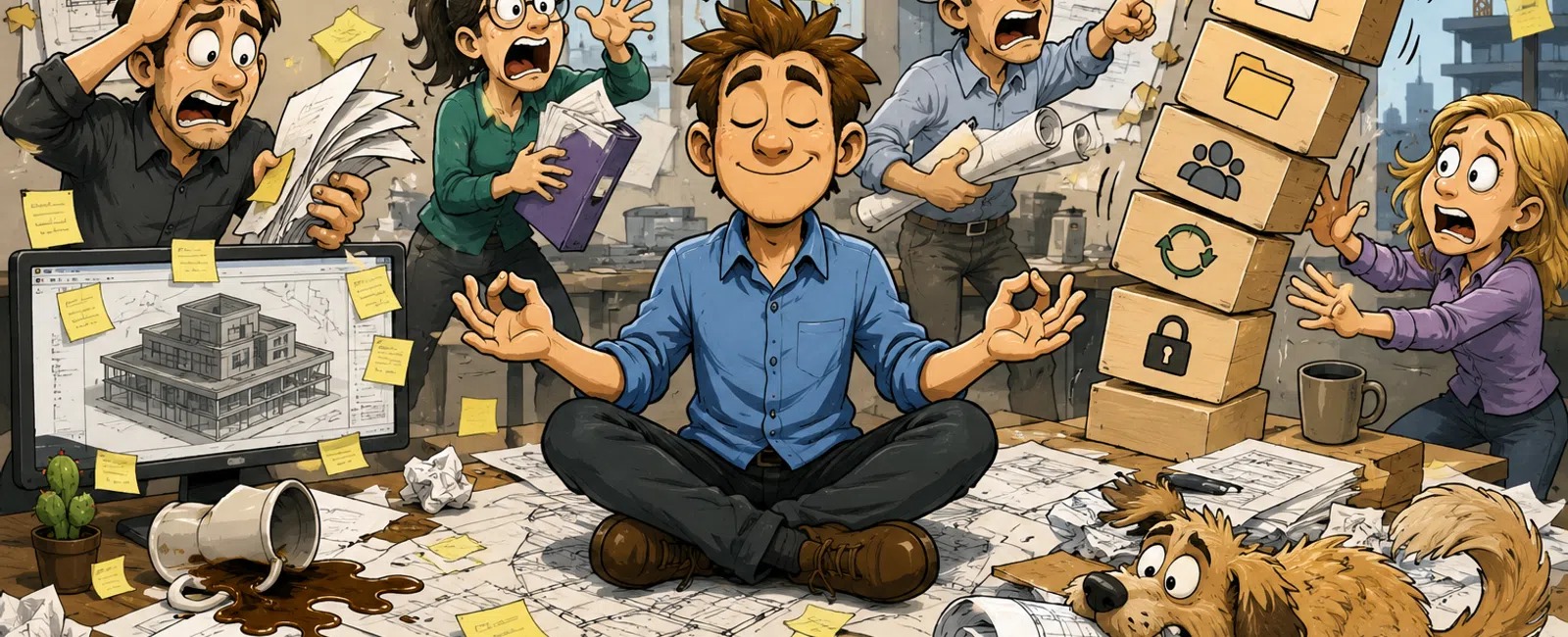
The Hidden Architecture Risk No One Owns (And Why That's the Real Problem)
Look, I've been in your chair.
You're holding together Revit performance, client
expectations, compliance questions, and project timelines—all at the same time.
And somehow, when something breaks, it lands on you.
That's not bad luck.
That's what happens when no one owns how the system actually
works.
And if your project depends on people remembering where
information lives, it's already at risk.
The Real Problem Isn't Tools. It's Ownership.
Most firms think they have a technology problem.
But what we see—over and over again—is this:
No one owns alignment.
Not the model.
Not the data flow.
Not the versioning logic.
Not the coordination handshake between teams.
Everything feels "covered."
But nothing is actually owned.
And that's why you get:
- Model
sync issues that no one catches early
- Late-stage
client surprises
- Teams
working from different versions of truth
- Compliance
questions that trigger scrambling instead of confidence
You're not missing effort.
You're missing structure.
What We See in Most Firms
In most firms we review, the failure pattern is consistent:
- Backup
systems exist—but restores are untested
- Collaboration
platforms exist—but version control is unclear
- Updates
are deployed—but not validated against workflows
- Compliance
is "in place"—but not provable in real time
The most common failure point is simple:
Everyone assumes someone else is managing it.
What Prepared Actually Looks Like
Let's define the difference clearly.
Before: Fragmented and Reactive
- Projects
rely on email threads and memory
- Change
requests happen informally
- Revit
issues get escalated only after disruption
- You're
constantly firefighting
After: Aligned and Predictable
- One
defined system of record
- Controlled
change process
- Ownership
assigned per workflow
- Issues
are caught before they impact delivery
That shift isn't about technology.
It's about clarity.
The One Artifact You Actually Need: Workflow Ownership Tracker
This is where most blogs stop.
This one doesn't.
Here's the minimum operational tool you should build this
week:
Workflow Alignment Tracker
|
Workflow
Area |
Yes
/ No |
Owner |
System |
Risk
Level |
|
Revit model versioning |
||||
|
Backup & restore validation |
||||
|
External file sharing control |
||||
|
Change request tracking |
||||
|
Compliance readiness (HIPAA clients) |
If a row has:
- No
owner → that's a failure point
- "Maybe"
instead of Yes/No → that's unclear control
- No
system → that's manual risk
This isn't theoretical.
This is where projects break.
Who Owns This (And Why That Matters)
Ownership is not "IT owns everything."
That's the fastest way to create blind spots.
Ownership needs to be assigned per workflow, not per
tool.
Example:
- Revit
model versioning → Design Technology Lead
- Backup
validation → IT / Infrastructure
- External
sharing permissions → Project Management + IT
- Compliance
readiness → Leadership + IT
Clear ownership does one thing:
It removes ambiguity before things go wrong.
That's how you stop being the bottleneck.
How to Fix One Workflow Gap in 30 Days
You don't need a full overhaul.
You need one controlled win.
Week 1: Identify and Validate
- Pick
one workflow (start with backup restores or versioning)
- Confirm
current state vs. assumed state
- Document
the actual risk
Week 2-3: Implement the Fix
- Define
the process clearly
- Assign
a single owner
- Create
a repeatable step (not a workaround)
Week 4: Standardize and Document
- Turn
the fix into a documented runbook
- Train
the team
- Make
it visible and testable
This is how you move from chaos to control—without breaking
your team.
A Hyper-Specific Example
You roll out a Revit update.
Everything "should" work.
But no one validated GPU compatibility or tested model sync
behavior in a live environment.
Now:
- Models
lag
- Users
report crashes
- IT
scrambles to diagnose
- Project
timelines slip
That's not a technical issue.
That's a missing workflow owner and no validation step.
What Not To Do (This Is Where Most Firms Go Wrong)
Let's save you time.
Don't:
- Add
new tools before fixing process
- Use
email as your system of record
- Assume
alignment just because meetings happened
- Rely
on tribal knowledge ("everyone knows how we do it")
Because that's exactly how small gaps turn into
project-level risk.
The External Lens You're Being Judged By
Your clients—and your leadership—aren't measuring effort.
They're measuring confidence.
- Can
you prove systems work?
- Can
you answer compliance questions instantly?
- Can
you show predictable delivery?
Especially in healthcare work, expectations shift fast—and
firms are expected to demonstrate real control over data, access, and systems.
That's the new bar.
What to Do Next Week
Do this with one project:
- Pick
one workflow (backup, versioning, or sharing)
- Fill
out the tracker honestly
- Assign
a real owner
- Identify
one "No" and fix it
Not five things.
One.
Because control compounds.
Schedule your 10 minute discovery call
Schedule your 10 minute discovery call to confirm whether gaps like this exist in your workflows. This helps you see exactly where alignment breaks down and what to fix first. If needed, 911 IT can walk through it with you quickly and clearly.


