
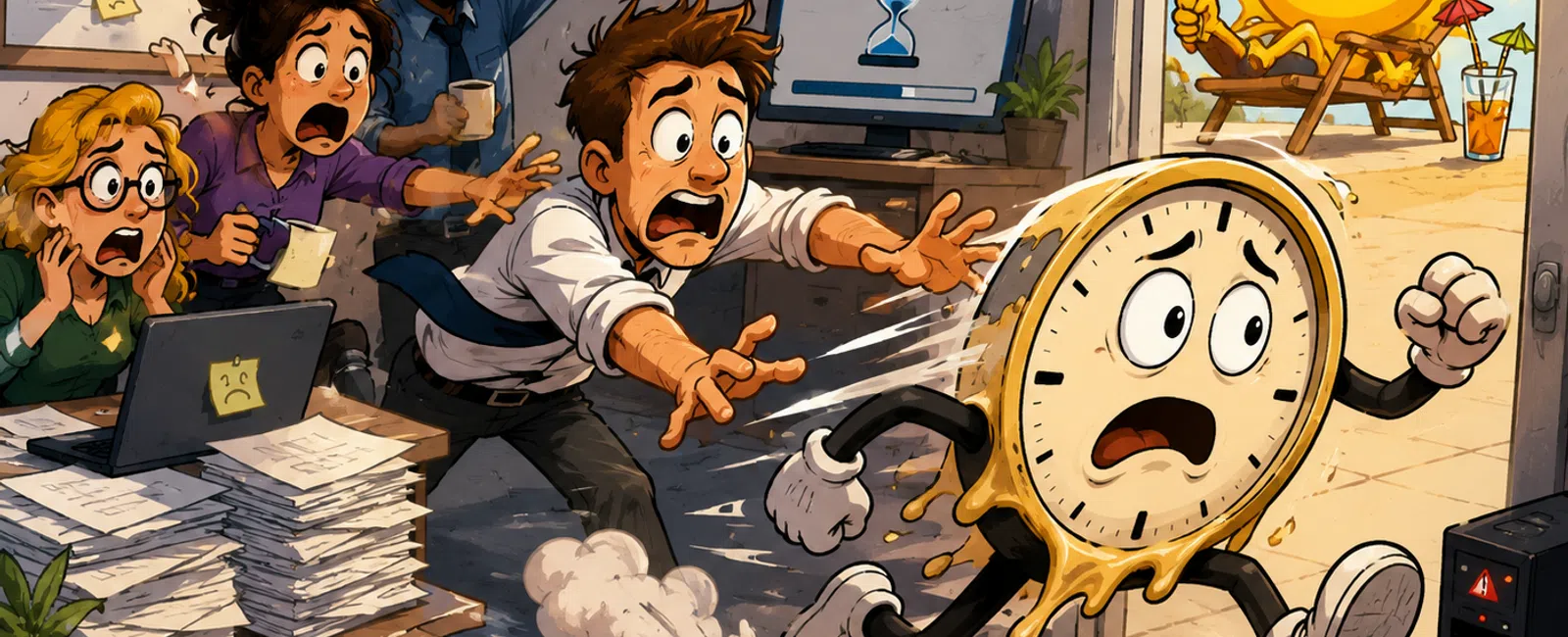
The Longest Day of the Year and You're Still Out of Time
Every year around late June, you get the longest day of the year. More
daylight. More available hours. It should feel like relief.
It doesn't.
The day still disappears the same way—fragmented, interrupted, and
incomplete. You end it asking the same question:
Where did the time go?
If even the longest day of the year isn't enough, the problem isn't time.
Your environment is taking it from you.
The Day Doesn't Break All at Once
In a 10-20 person office, the day rarely starts chaotic.
You have a plan. Your team has priorities. There's something important
you intend to move forward.
Then the interruptions start.
A login fails
A system slows down
A file is missing
An application freezes
Each issue looks small. Each one feels manageable.
But every interruption forces someone off-task. Multiply that across a
team, and the damage compounds quickly.
By mid-afternoon, the day isn't broken—but it also isn't working.
Why These Problems Never Go Away
These issues persist because most environments lack structure in three
critical areas:
No root cause resolution
The same problems are addressed repeatedly, but never fully eliminated.
No centralized tracking
Issues are not logged, categorized, or reviewed. Patterns stay invisible.
Reactive support model
Everything starts after something breaks, which guarantees lost time.
This isn't bad luck. It's a system failure.
Owner's View vs Team's View
Leadership experiences this as:
Constant interruptions
Unfinished priorities
Pressure to stay involved in day-to-day issues
Your team experiences it differently:
Frequent disruptions
Loss of focus
Slow systems they have to work around
From the outside—an investor, advisor, or buyer—this signals operational
risk.
Not because of effort, but because the business cannot operate without
friction.
Where This Actually Breaks
10:15 AM—login failure
10:20 AM—two employees troubleshooting
10:40 AM—access restored
1:30 PM—system slows again
End of day—three priorities missed
Nothing fails completely.
But the business still loses control of the day.
The Measurable Cost of Doing Nothing
If each employee loses 45 minutes per day:
15+ hours per employee per month
150+ hours across a 10-person team
Now attach payroll to that.
Over a year, this becomes a material financial loss—not just a
productivity issue.
What High-Performing Businesses Do Differently
The shift isn't effort. It's structure.
High-performing environments implement:
Proactive monitoring so issues are detected early
A ticketing system so every issue is tracked and categorized
Defined escalation paths so problems move quickly
Response and resolution standards so delays don't expand
Most importantly, they fix problems at the root so they don't return.
What This Looks Like in Practice
A functional environment typically includes:
Monitoring layer
Systems continuously checked for performance, failures, and anomalies before
users notice issues.
Ticketing system (PSA)
Every issue logged, categorized, and tracked through resolution. Patterns
become visible.
Escalation workflow
Level 1 handles immediate response
Level 2 handles technical diagnosis
Level 3 handles root cause resolution
Weekly review process
Tickets are reviewed for repeat issues, trends, and systemic failures.
This creates a closed loop:
Detection → Resolution → Prevention
Without that loop, problems repeat indefinitely.
The 3 Layers of Time Protection
To evaluate your environment:
Detection
Are issues identified before they disrupt work?
Resolution
Is there a fast, structured response path?
Prevention
Are recurring issues permanently eliminated?
If any layer is weak, time loss continues.
Common Failure → Fix Mapping
Issue repeats weekly
Cause: no root cause tracking
Fix: ticket tagging and weekly review process
Slow response times
Cause: unclear ownership
Fix: defined SLA and escalation rules
Frequent interruptions across team
Cause: reactive support model
Fix: proactive monitoring implementation
Systems unreliable
Cause: infrastructure gaps
Fix: baseline performance and maintenance standards
Each fix is structural—not temporary.
Real Case Progression
Before
Daily interruptions across a small office
Multiple repeated issues each week
No central tracking or ownership
Within 30-60 days
All issues logged through one system
Repeat issues identified and prioritized
Monitoring added to critical systems
After
Interruptions reduced significantly
Recurring problems largely eliminated
Multiple hours recovered each week across the team
Nothing about the team changed.
The system around them did.
Operational Self-Assessment
Score each area from 1 to 5:
Detection
Do issues get caught before users notice?
Resolution
Are issues handled quickly with clear ownership?
Prevention
Are problems permanently fixed?
Tracking
Is every issue logged and reviewed?
Focus
Can your team work without frequent interruption?
If your score is below 20, your environment is actively costing you time.
What to Do Next Week
Identify one issue that has occurred multiple times in the last 30 days.
Do not work around it again.
Log it, trace it, and push for root cause resolution. Then measure how
much disruption disappears.
That is your starting point.
Tired of Losing Time Every Day?
If interruptions are part of your normal workday, your environment isn't
structured to protect time. This is fixable, but only if the underlying system
is addressed.
Schedule your 10 minute discovery call with 911 IT. We'll identify where
your time is being lost and confirm whether your current setup can actually
prevent it.


