
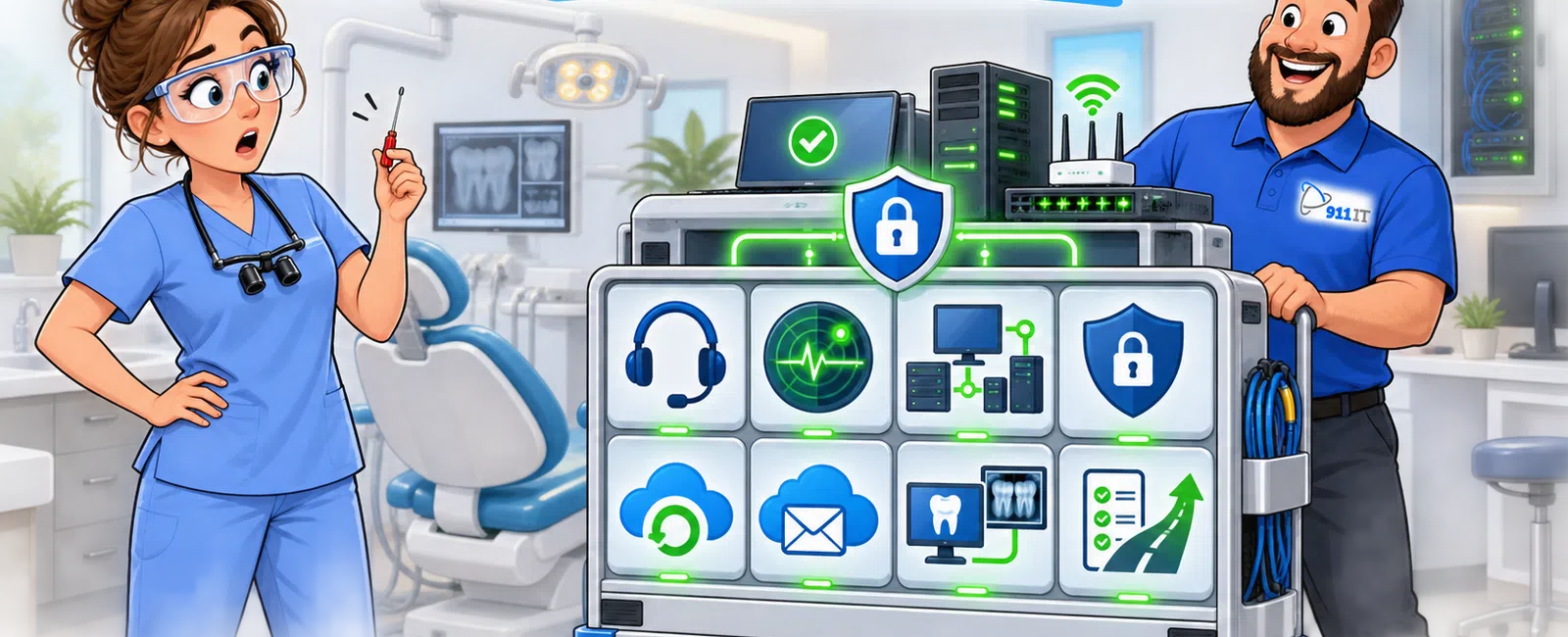
What Should Dental Managed IT Services Include?
A comprehensive managed IT plan for a dental practice should include at least 10 core services: 24/7 help desk support, proactive monitoring, workstation and server management, network support, cybersecurity, backup and disaster recovery, Microsoft 365 administration, dental software coordination, HIPAA-focused technical safeguards and strategic technology planning.
For a 25-to-50-employee dental practice, managed IT should do more than repair computers after something breaks. The provider should continuously maintain the technology behind patient scheduling, clinical charting, imaging, insurance processing, payments, email, phones and communication with patients.
However, not every proposal includes the same services. One provider may bundle security, onsite support and backups into a fixed monthly fee, while another charges separately for each tool or visit. Dental practices should compare the exact scope, exclusions and service standards before selecting a provider.
The 10-Part Dental Managed IT Services Framework
Use the following framework to determine whether a proposal provides complete technology management or only basic technical support.
1. 24/7 Help Desk Support
The help desk is the first point of contact when an employee cannot access Dentrix, Eaglesoft, Open Dental, Microsoft 365, imaging, a printer or another critical system.
A complete help desk service should provide:
- Phone, email or portal-based support
- Remote troubleshooting
- Support for common workstation and application issues
- Ticket tracking
- Defined escalation procedures
- Support outside normal business hours
- Communication until the problem is resolved
Ask what "24/7 support" actually means. Some providers offer access to live technicians around the clock. Others use an answering service that records the request for review during business hours.
The agreement should explain how urgent issues are prioritized. A failed printer in an administrative office does not have the same operational impact as an office-wide outage that prevents employees from viewing the patient schedule.
911 IT provides access to a live 24/7 help desk as part of its managed IT services.
2. Proactive Monitoring and Maintenance
Managed IT should identify and address problems before employees submit a support ticket. Monitoring tools can track the health of computers, servers, firewalls, backups and other critical systems.
Proactive monitoring may include:
- Server health and available storage
- Workstation status
- Security alerts
- Backup failures
- Device availability
- Operating-system health
- Network performance
- Hardware warnings
- Software update status
Monitoring alone is not enough. The provider should have a defined process for reviewing alerts, deciding which require action and documenting the resolution.
For example, a server may issue repeated warnings about limited storage. A reactive provider waits until the database stops working. A proactive provider investigates the growth, expands capacity or recommends a replacement before the issue interrupts patient care.
3. Workstation and Server Management
Dental practices often have more devices than employees. Treatment rooms, imaging stations, front desks, consultation rooms and administrative offices may each require dedicated computers.
Workstation and server management should include:
- Device inventory
- Operating-system maintenance
- Software update management
- Hardware health monitoring
- Standardized configurations
- Warranty tracking
- User setup
- Secure device retirement
- Replacement planning
The provider should identify devices that are too old, unsupported or no longer suitable for clinical use. A computer that still powers on may nevertheless create security, performance and software-compatibility risks.
Practices should receive a hardware lifecycle plan covering approximately the next three to five years. Planned replacement is usually less expensive and less disruptive than emergency replacement after failure.
4. Network, Wi-Fi and Internet Support
Dental software, imaging, phones, printers and cloud applications depend on a stable network. A managed IT provider should maintain the infrastructure connecting those systems.
Network support may cover:
- Firewalls
- Network switches
- Wireless access points
- Internet connections
- Secure guest Wi-Fi
- Virtual private networks
- Connections between locations
- Network documentation
- Performance monitoring
- Vendor coordination
Clinical systems should not compete unnecessarily with guest devices, streaming or other nonessential traffic. The network should be designed so sensitive systems are appropriately separated and business-critical traffic receives reliable access.
For multi-location practices, the provider should also manage secure connectivity, consistent configurations and troubleshooting across every office.
5. Managed Cybersecurity
Cybersecurity should be built into the managed service rather than treated as an optional antivirus product. Dental practices store patient information, insurance details, payment data, employee records and credentials that attackers can exploit.
A managed cybersecurity program may include:
- Endpoint detection and response
- Managed antivirus
- Firewall security
- Email filtering
- Phishing protection
- Multi-factor authentication
- Disk encryption
- Web and DNS filtering
- Security patching
- Vulnerability management
- Security-awareness training
- Incident response support
Ask the provider to name the included controls. A proposal that simply says "cybersecurity included" does not explain whether email protection, multi-factor authentication, security training or incident response are actually covered.
Explore managed cybersecurity services for a more detailed view of these protections.
6. Backup and Disaster Recovery
Backups should protect the information and systems required to resume operations after hardware failure, ransomware, accidental deletion or another disruption.
For a dental practice, the protected environment may include:
- Practice-management databases
- Dental images
- Patient documents
- Server configurations
- Shared files
- Microsoft 365 information
- Cloud applications
- Accounting and administrative files
The managed service should explain:
- Which data and systems are backed up
- How often backups run
- Where backup copies are stored
- Who investigates failed backups
- How long data is retained
- How often recovery is tested
- How quickly systems are expected to return
A successful backup notification is not proof that the practice can recover. The provider should periodically restore selected files, databases or systems and document the result.
Learn more about business continuity and disaster recovery services and backup planning for healthcare and dental practices.
7. Microsoft 365 and Cloud Administration
Dental practices commonly use Microsoft 365 for email, calendars, documents, shared mailboxes and collaboration. These accounts require ongoing security and administration.
Microsoft 365 management may include:
- Creating and disabling user accounts
- License administration
- Password and identity policies
- Multi-factor authentication
- Email security
- Shared mailbox management
- Permission reviews
- Retention settings
- Cloud file access
- Security alerts
The practice should control its Microsoft 365 tenant and domain. The IT provider may administer the environment, but ownership should not be hidden inside an account that belongs only to the provider.
Cloud services also require backup, access controls and configuration management. Moving information to the cloud does not automatically eliminate data-loss or security risks.
Review cloud and Microsoft 365 services for additional information.
8. Dentrix, Eaglesoft and Open Dental Vendor Coordination
A managed IT provider does not replace the support team for dental practice-management software. It should, however, manage the servers, workstations, networks and security controls on which the software depends.
When an application fails, the provider should determine whether the problem involves:
- The workstation
- The server
- The database
- The network
- User permissions
- Security software
- An integration
- The application itself
When vendor assistance is required, the managed provider should coordinate the case rather than leaving the practice manager to relay technical messages between companies.
The provider should also maintain records for:
- Software versions
- Vendor contacts
- Support agreements
- Application servers
- Imaging integrations
- Upgrade schedules
- Backup locations
- Known compatibility requirements
Read the detailed comparison of Dentrix, Eaglesoft and Open Dental IT requirements.
9. HIPAA-Focused Technical Safeguards
Managed IT can support many of the technical safeguards used to protect electronic protected health information. Technology alone does not make a dental practice compliant, but the IT provider should help implement, manage and document appropriate controls.
Services may include:
- Security risk assessments
- Unique user accounts
- Role-based access
- Multi-factor authentication
- Encryption
- Audit and security logging
- Secure remote access
- Account offboarding
- Backup testing
- Vendor-access management
- Incident-response planning
- Technical documentation
The provider should clearly distinguish between technical services and responsibilities that remain with the dental practice, legal counsel or compliance advisor.
Learn more about HIPAA compliance services and the IT safeguards dental offices should evaluate.
10. Strategic Technology Planning
A managed IT provider should help the practice decide what to improve next, not merely respond to the latest ticket.
Strategic planning may include:
- Annual technology budgets
- Three-to-five-year hardware plans
- Quarterly business reviews
- Cybersecurity roadmaps
- New-location planning
- Software upgrade planning
- Cloud strategy
- Vendor consolidation
- Business continuity planning
- Cyber insurance preparation
The practice should receive prioritized recommendations that explain the risk, estimated cost, business impact and suggested timeline.
A useful roadmap might separate recommendations into three categories:
- Immediate: Resolve critical security, backup or reliability problems within 30 days.
- Near term: Complete important improvements during the next 3 to 12 months.
- Planned: Budget for replacements, migrations or expansion over the next 1 to 3 years.
What Is Usually Included in the Monthly Managed IT Fee?
Every agreement is different, but the following services are often included in a comprehensive monthly plan.
| Service | Commonly Included? | What to Confirm |
|---|---|---|
| Remote help desk | Usually | Whether support is unlimited and available 24/7 |
| Proactive monitoring | Usually | Which devices and systems are monitored |
| Patch management | Usually | Whether third-party applications are included |
| Endpoint security | Often | The exact security tools and response services provided |
| Microsoft 365 administration | Often | Whether licenses are included or billed separately |
| Backup monitoring | Often | Whether backup storage and recovery testing are included |
| Onsite support | Varies | Travel, limits, minimum charges and service area |
| Vendor coordination | Often | Whether the provider stays involved through resolution |
| Technology planning | Often | Frequency of reviews and who provides strategic guidance |
| Employee security training | Varies | Frequency, phishing testing and reporting |
| HIPAA risk assessments | Varies | Whether they are included or treated as separate projects |
Do not rely on the phrase "all-inclusive." Request a written scope that lists included services, exclusions and examples of work that would generate a separate charge.
What Is Commonly Excluded From Managed IT Services?
The monthly fee generally covers ongoing support and management. Major purchases and projects may be billed separately.
Common exclusions include:
- Computers, servers and network equipment
- Microsoft 365 licenses
- Dental software licenses
- New-office cabling
- Office relocations
- Large cloud migrations
- Major server replacements
- New practice-management software implementations
- Large data conversions
- Internet and phone carrier fees
- After-hours project work
- Specialized compliance consulting
- Legal services
- Cyber insurance premiums
Some providers include a defined amount of project or onsite labor, while others charge separately for all project work. Neither approach is inherently wrong, but the proposal should make the distinction clear.
What Is the Difference Between Managed IT and Break-Fix Support?
Break-fix providers are usually contacted after a problem occurs. Managed IT providers receive a recurring fee to monitor, maintain and support the environment continuously.
| Consideration | Break-Fix IT | Managed IT |
|---|---|---|
| Primary approach | Respond after a failure | Prevent, monitor and respond |
| Pricing | Hourly or per incident | Predictable recurring fee |
| Monitoring | Usually limited | Ongoing monitoring |
| Cybersecurity | Often purchased separately | Can be integrated into the service |
| Technology planning | Usually project-based | Part of the ongoing relationship |
| Incentive | Provider earns more when problems require more labor | Provider benefits from reducing recurring issues |
Break-fix support may appear less expensive during months with few problems. However, it can create unpredictable costs and may allow aging equipment, failed backups or security gaps to remain unnoticed.
How Does Onsite Support Work?
Many issues can be resolved remotely, but some require a technician at the practice. Examples include failed network equipment, cabling problems, equipment installation and issues involving physical connections.
Ask the provider:
- Where onsite technicians are located
- How quickly they can normally arrive
- Whether onsite visits are included
- Whether travel time is billed
- Whether a minimum charge applies
- Which issues qualify for urgent dispatch
- Whether after-hours onsite support is available
A local dental practice may benefit from a provider that combines rapid remote support with technicians close enough to visit when the issue cannot be solved remotely.
How Are New Employees and Departing Employees Handled?
Employee onboarding and offboarding should follow a documented process. This protects sensitive information and helps new employees become productive without unnecessary delays.
New-user setup may include:
- Creating Microsoft 365 accounts
- Assigning licenses
- Preparing a computer
- Configuring email
- Granting approved permissions
- Setting up dental software access
- Enrolling multi-factor authentication
- Providing secure remote access
Offboarding may include:
- Disabling accounts
- Revoking active sessions
- Removing remote access
- Transferring email or files
- Recovering practice-owned equipment
- Changing shared credentials
- Documenting completion
The practice should establish target notice periods. For example, routine onboarding requests might be submitted three to five business days in advance, while an urgent termination should be coordinated immediately.
How Are Dental Software Problems Resolved?
A managed provider should use a structured troubleshooting process.
- Identify the scope: Determine whether the issue affects one user, one location or the entire practice.
- Check the workstation: Review the device, operating system, permissions and connection.
- Check the server and network: Examine performance, services, storage and connectivity.
- Review recent changes: Identify updates, installations or configuration changes.
- Protect the data: Confirm backups before making significant changes.
- Contact the software vendor: Escalate application-specific issues with complete technical information.
- Document the resolution: Record the cause and steps needed to prevent recurrence.
The office manager should not be expected to translate technical explanations between the dental software company and the IT provider.
What Service-Level Details Should Be in the Agreement?
The managed services agreement should explain how support requests are classified and handled.
Review the following:
- Support hours
- Emergency definitions
- Response targets
- Escalation procedures
- Remote-support process
- Onsite dispatch terms
- Maintenance windows
- Excluded systems
- Project billing
- Termination and offboarding
Response time and resolution time are not the same. A provider may respond within 15 minutes but require additional troubleshooting, vendor coordination or replacement equipment before the issue is resolved.
Ask how the provider communicates during longer incidents and how often the practice will receive progress updates.
How Much Do Dental Managed IT Services Cost?
Dental managed IT services commonly fall within a planning range of approximately $100 to $275 per user per month. A 25-person practice could therefore budget approximately $2,500 to $6,875 per month, while a 50-person practice could budget approximately $5,000 to $13,750 per month.
Actual pricing depends on:
- Number of users
- Number of devices
- Number of locations
- Server and network complexity
- Dental software and integrations
- Cybersecurity requirements
- Backup and recovery needs
- Support hours
- Onsite coverage
- Included licenses and projects
A lower-priced plan may exclude advanced security, backup storage, onsite support or strategic planning. Compare the total service scope rather than only the monthly fee.
For a complete pricing breakdown, read healthcare IT support pricing and included services.
What Should a 30-Employee Dental Practice Receive?
Consider a single-location practice with 30 employees, 24 workstations, Dentrix, digital imaging, Microsoft 365, a server, cloud backups and several third-party vendors.
A comprehensive managed IT plan might include:
- 24/7 help desk support for 30 users
- Monitoring for all supported workstations and servers
- Patch and endpoint-security management
- Firewall and network management
- Microsoft 365 administration
- Backup monitoring and recovery testing
- Coordination with Dentrix and imaging vendors
- Employee onboarding and offboarding
- HIPAA-focused technical safeguards
- Quarterly technology reviews
- Local onsite assistance
- A three-year hardware roadmap
The provider might identify that five computers are approaching replacement, multi-factor authentication is incomplete and the backup process has never been tested. The first 90-day plan would prioritize those issues while maintaining daily support.
How Can a Practice Compare Managed IT Proposals?
Create a side-by-side comparison that forces each provider to answer the same questions.
| Category | Questions for the Provider |
|---|---|
| Help desk | Is support live and available 24/7? Are tickets unlimited? |
| Dental expertise | What experience do you have with our software and imaging systems? |
| Cybersecurity | Which exact tools and services are included? |
| Backups | What is protected, and how often is recovery tested? |
| Microsoft 365 | Are administration, security and licenses included? |
| Onsite support | Are visits included, and what geographic limits apply? |
| HIPAA | Which technical safeguards and documentation do you provide? |
| Planning | Will we receive budgets, quarterly reviews and a technology roadmap? |
| Projects | What work is billed separately? |
| Offboarding | How will credentials, data and documentation be returned? |
Ask each provider to explain a realistic scenario, such as an office-wide Dentrix outage or ransomware alert. The answer will reveal how the help desk, security team, vendor coordination and disaster-recovery process work together.
What Red Flags Should a Dental Practice Watch For?
Vague Security Descriptions
Terms such as "complete protection" are not useful unless the proposal names the controls, monitoring and response process.
No Recovery Testing
A provider that monitors backup jobs but never performs restore tests cannot demonstrate that the practice can recover.
No Dental Vendor Coordination
The practice should not be left to manage technical disagreements among the IT provider, imaging company and practice-management software vendor.
Unclear Onsite Charges
Confirm whether travel, emergency dispatch and normal onsite visits are included.
No Technology Roadmap
Without lifecycle planning, the practice may continue using aging systems until an emergency forces an unplanned purchase.
The Provider Owns Every Account
The dental practice should retain appropriate control over its domain, cloud tenant, licenses and business data.
Unlimited Support With Extensive Exceptions
Read the exclusions. A plan may claim unlimited support while excluding major applications, onsite assistance or after-hours issues.
Why Dental Practices Choose 911 IT
911 IT provides managed technology support designed to keep businesses secure, productive and prepared. The service combines a live 24/7 help desk, proactive monitoring, cybersecurity, backup planning, cloud administration and strategic guidance.
"When hiring 911 IT, we didn't realize it would be like having an in-house IT department without the overhead cost that comes with an in-house department. They are part of our team."
— Owner and 911 IT client
"They don't just fix problems; they prevent them, which gives us real confidence in our IT operations."
— Health and research client
For dental and healthcare organizations, support can include:
- 24/7 live help desk access
- Local onsite support
- Managed workstations and servers
- Network and firewall management
- Cybersecurity protection
- Microsoft 365 administration
- Backup and recovery planning
- Dental software vendor coordination
- HIPAA-focused technical safeguards
- Technology budgeting and planning
Explore healthcare IT support, managed IT services and cybersecurity services.
Frequently Asked Questions About Dental Managed IT Services
Does managed IT include unlimited support?
Many providers include unlimited remote help desk support, but the agreement may exclude projects, onsite work, unsupported software or after-hours requests. Confirm the exact scope in writing.
Are computers included in the monthly fee?
Usually not. Hardware is commonly purchased separately unless the provider offers a hardware-as-a-service arrangement.
Are Microsoft 365 licenses included?
Some providers bundle Microsoft 365 licensing, while others bill it separately. Confirm both the license cost and the administration services included.
Does managed IT include Dentrix, Eaglesoft or Open Dental support?
The IT provider supports the computers, servers, networks and security systems that the application relies on. Application-specific support remains with the dental software vendor, but the IT provider should coordinate troubleshooting.
Does managed IT make a dental practice HIPAA compliant?
No provider or product can make a practice compliant by itself. Managed IT can support technical safeguards, documentation and risk remediation, while the practice retains responsibility for its overall compliance program.
Are backups included?
Backup monitoring is commonly included, but storage, disaster-recovery infrastructure and recovery testing may be separate. Ask exactly what data is protected and how restoration is verified.
Is onsite support included?
It depends on the agreement. Some providers include normal onsite service within a defined area, while others charge for travel and labor.
How quickly should an IT provider respond?
The appropriate response depends on the severity of the issue. The agreement should define priority levels, response targets and escalation procedures for clinical-impacting outages.
How often should the practice meet with its IT provider?
Quarterly technology reviews are a practical schedule for discussing support trends, security risks, upcoming replacements, projects and budgets.
Can managed IT support multiple dental locations?
Yes. A provider can manage users, networks, security, cloud services and vendors across multiple offices, but the proposal should account for each location's equipment, connectivity and onsite requirements.
Request a Dental Managed IT Assessment
A strong managed IT agreement should clearly explain what is monitored, who answers support requests, how patient information is protected, how backups are tested and which costs are included in the monthly fee.
911 IT can review your users, devices, locations, dental applications, security controls and current support arrangement to identify service gaps and recommend a practical support plan.
To discuss managed IT services for your dental practice, schedule a discovery call or contact 911 IT.


