
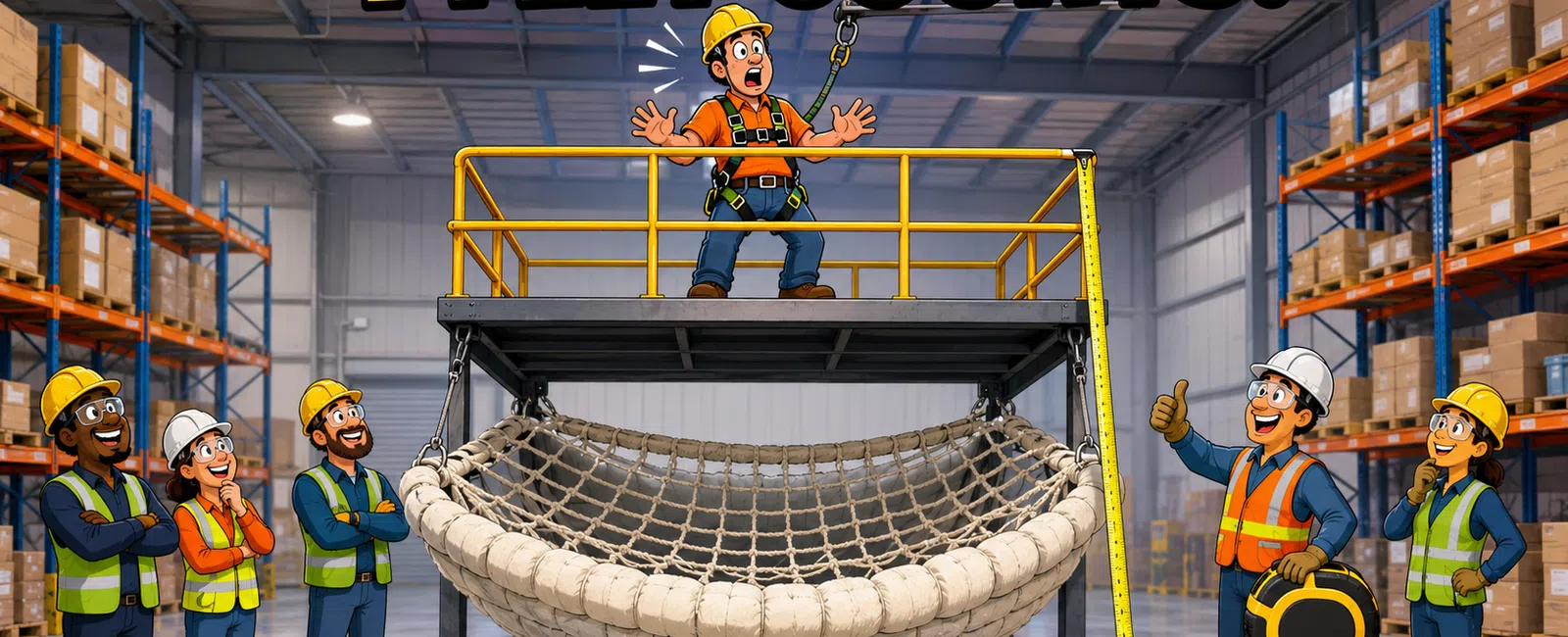
The OSHA 4-foot rule requires employers to provide fall protection systems when workers are exposed to falls of 4 feet or more in general industry settings. This threshold increases to 6 feet in construction environments and 5 feet in shipyards. The rule mandates guardrails, safety nets, or personal fall arrest systems to prevent workplace injuries and fatalities from elevated work surfaces.
Why Does OSHA Have Different Height Thresholds for Different Industries?
OSHA recognizes that fall hazards vary significantly across industries. General industry operations - such as manufacturing facilities, warehouses, and office buildings - face the 4-foot threshold because workers in these environments typically encounter fixed platforms, mezzanines, and elevated walkways where even shorter falls can cause serious injury.
Construction sites operate under a 6-foot rule because the nature of construction work involves constantly changing elevations, temporary structures, and workers who are generally more aware of fall risks due to the environment. The construction industry also uses different types of fall protection equipment suited to dynamic work conditions.
For shipyard employment, OSHA sets the threshold at 5 feet, reflecting the unique hazards of working on vessels and marine structures. Each industry-specific standard addresses the typical work scenarios and risk profiles encountered in that sector.
Salt Lake City construction firms working on commercial developments and residential projects must comply with the 6-foot construction standard, while their office staff and warehouse operations fall under the 4-foot general industry rule.
What Types of Fall Protection Systems Meet OSHA Requirements?
OSHA accepts three primary categories of fall protection systems. Guardrail systems create a physical barrier around elevated work areas, typically consisting of top rails at 42 inches, mid-rails, and toe boards. These passive systems require no worker action and are preferred when feasible.
Safety net systems catch falling workers and must be installed as close as practicable beneath the work surface, but never more than 30 feet below. Nets must extend outward from the work surface based on the distance below, with specific projection requirements outlined in OSHA standards.
Personal fall arrest systems (PFAS) include full-body harnesses, lanyards or lifelines, and secure anchor points. These active systems require proper training and regular inspection. The entire system must limit maximum arresting force to 1,800 pounds and stop a fall within 3.5 feet.
Warning line systems and safety monitoring systems serve as alternatives in specific roofing operations, but only when conventional fall protection creates greater hazards or is infeasible.
Having systems in place before problems occur prevents catastrophic outcomes.
How Do Construction Companies Track and Document OSHA Compliance?
Documentation forms the backbone of OSHA compliance programs. Construction firms must maintain records of fall protection equipment inspections, worker training certifications, and incident reports. These records prove due diligence during OSHA inspections and help identify patterns that require corrective action.
Digital project management systems have transformed compliance tracking for construction companies. Modern platforms integrate safety checklists, photo documentation, and automated reminders for equipment inspections directly into daily workflows. This eliminates the paper trail that often gets lost between job sites and main offices.
Many Salt Lake City construction firms now use cloud-based systems that allow safety managers to monitor multiple job sites simultaneously. Real-time access to compliance data means supervisors can verify that fall protection measures are in place before work begins at elevation.
Construction IT support providers help firms implement and maintain these digital safety systems, ensuring that compliance documentation remains accessible even when field workers are at remote sites across Utah's mountainous terrain or Arizona's desert locations.
Regular audits of these digital records help identify gaps before OSHA inspectors arrive. Companies that treat compliance as an ongoing process rather than a pre-inspection scramble demonstrate a culture of safety that protects both workers and business operations.
What Are the Penalties for Violating the OSHA 4-Foot Rule?
OSHA categorizes violations into four severity levels, each carrying different penalty structures:
- Other-than-serious violations: Hazards that probably would not cause death or serious harm, with penalties up to $16,131 per violation
- Serious violations: Substantial probability of death or serious physical harm, carrying penalties up to $16,131 per violation
- Willful violations: Employer knowingly disregards OSHA requirements, resulting in penalties up to $161,323 per violation
- Repeat violations: Same violation within five years at any establishment, with penalties up to $161,323 per violation
Fall protection violations consistently rank among the most frequently cited OSHA violations, making them a priority enforcement area.
Beyond financial penalties, violations can trigger work stoppages, increased insurance premiums, and reputational damage that affects bidding opportunities. Many general contractors now require subcontractors to demonstrate clean OSHA records before awarding contracts.
The true cost extends beyond fines - worker injuries result in lost productivity, increased workers' compensation claims, potential lawsuits, and difficulty recruiting skilled labor in competitive markets like Salt Lake City's growing construction sector.
How Can Technology Help Construction Firms Maintain OSHA Compliance?
Modern construction technology creates multiple layers of compliance support. Wearable sensors can detect when workers approach unprotected edges and trigger alerts to both the worker and supervisors. These IoT devices integrate with project management platforms to create automatic incident reports.
Drones provide safe alternatives for roof inspections and elevated structure assessments, reducing the need for workers to access high-risk areas. Photo and video documentation from drones creates permanent records of site conditions and fall protection measures.
Mobile apps allow field supervisors to complete safety checklists, capture photos of fall protection systems, and submit reports from any location. This real-time documentation eliminates the delay between field observations and office record-keeping.
Cloud-based document management ensures that safety data sheets, equipment certifications, and training records remain accessible to all stakeholders. When OSHA inspectors request documentation, cloud services enable instant retrieval rather than searching through filing cabinets at multiple offices.
Virtual reality training programs allow workers to experience fall scenarios in controlled environments, improving retention of safety procedures without exposing anyone to actual risk. These immersive training sessions create more lasting behavioral changes than traditional classroom instruction.
Clay from a construction firm noted: "911 IT's response time has been so great! Most of the time they will resolve our issue before we hang up the phone. When we find ourselves in IT trouble we are usually in a mess until we call 911 IT and they get things working again." This same rapid response capability applies to safety technology systems - when compliance tracking tools fail, immediate IT support prevents documentation gaps that could prove costly during inspections.
What Special Considerations Apply to Construction Work in Utah, Wyoming, and Arizona?
Mountain state construction presents unique challenges for fall protection compliance. Utah's mountainous terrain means many job sites involve steep grades and elevation changes that create fall hazards even at ground level. Winter conditions add ice and snow that compromise footing and require additional safety measures.
Remote job sites common throughout Wyoming and rural Arizona create logistical challenges for equipment delivery and emergency response. Fall protection systems must account for longer response times if rescue becomes necessary after a fall arrest event.
Extreme temperature variations across these three states affect equipment performance. Personal fall arrest systems must be inspected more frequently in environments with intense UV exposure (Arizona desert sites) or freeze-thaw cycles (Wyoming winter projects).
Multi-state construction firms must navigate varying state-specific regulations that sometimes exceed federal OSHA requirements. Utah's Division of Occupational Safety and Health operates under federal OSHA jurisdiction, while Arizona and Wyoming have their own state plans with potentially stricter standards.
The region's growing tech corridor means construction firms building data centers and tech campuses face heightened scrutiny from clients who demand exemplary safety records. These projects often require additional certifications and more frequent safety audits beyond minimum OSHA compliance.
Salt Lake City IT support providers understand these regional challenges and help construction companies implement technology solutions that function reliably despite weather extremes and remote locations.
Frequently Asked Questions
Does the 4-foot rule apply to ladders?
Ladders fall under separate OSHA standards rather than the general 4-foot rule. Portable ladders must meet specific design and use requirements regardless of height. Fixed ladders over 24 feet require fall protection systems such as cages, wells, ladder safety systems, or personal fall arrest systems for workers climbing them.
Are there exceptions to the 4-foot fall protection requirement?
OSHA allows limited exceptions when conventional fall protection creates greater hazards or is demonstrably infeasible. Employers must document why standard protection cannot be used and implement alternative measures. Inspection, maintenance, and construction activities may qualify for alternative procedures, but worker safety must still be ensured through other means.
How often must fall protection equipment be inspected?
Personal fall arrest systems require inspection before each use by the worker and at least annually by a competent person. Guardrails and safety nets need inspection after installation, before use, and whenever conditions change. Any equipment involved in arresting a fall must be removed from service immediately and inspected by a qualified person before reuse.
What training does OSHA require for workers using fall protection?
Employers must train workers to recognize fall hazards and understand fall protection procedures before they work at heights. Training must cover proper use, inspection, and limitations of fall protection equipment. Retraining is required when workplace changes occur, equipment changes, or when workers demonstrate inadequate knowledge. Documentation of all training must be maintained.
Can construction companies use warning lines instead of guardrails?
Warning line systems are permitted only for specific roofing work operations on low-slope roofs and must be combined with other fall protection methods. Warning lines alone do not meet the fall protection requirement for most construction activities. They must be rigged at least 6 feet from roof edges and combined with safety monitoring systems or guardrails between the warning line and roof edge.


