
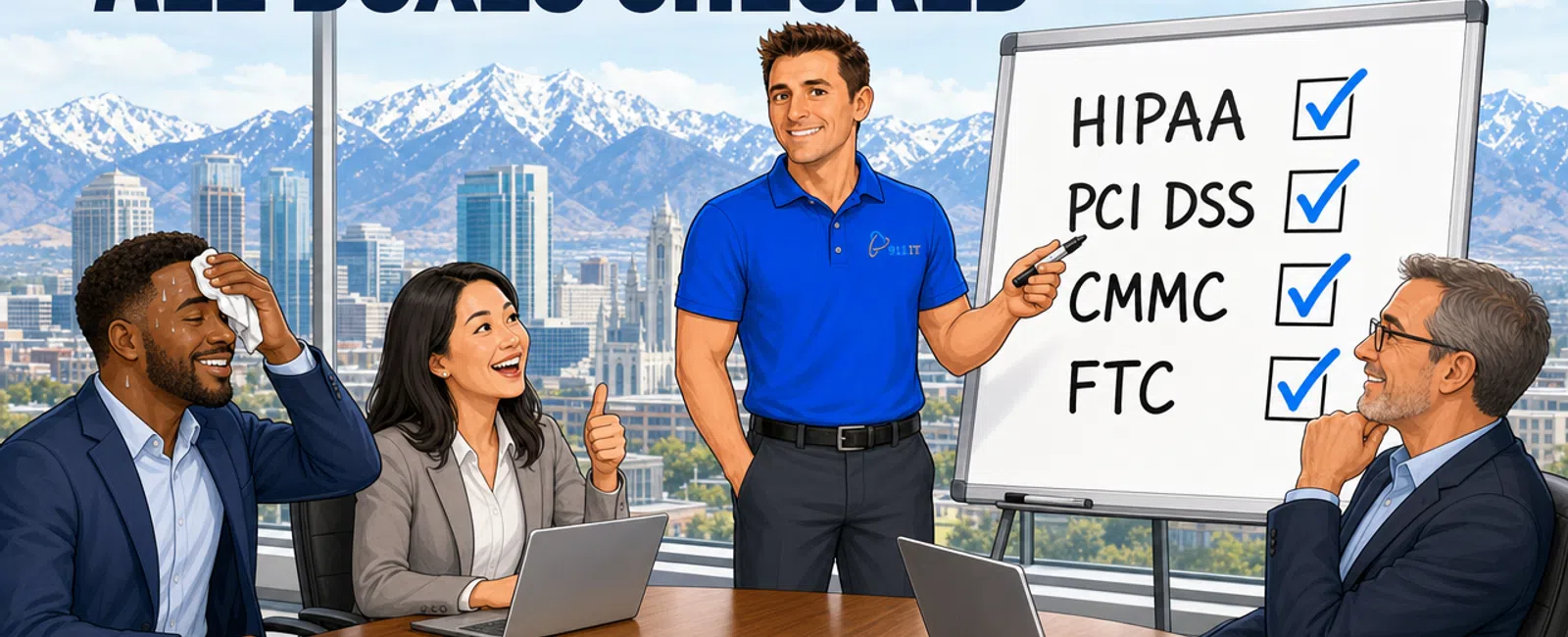
IT compliance services in Salt Lake City help businesses meet regulatory requirements like HIPAA, PCI DSS, and CMMC through security assessments, policy documentation, technical controls, and ongoing monitoring. Industry-average pricing ranges from $50 - $200 per user per month depending on framework complexity, with services including risk assessments, encryption implementation, access controls, audit preparation, and continuous compliance monitoring tailored to your industry's specific regulatory obligations.
Why Do Salt Lake City Businesses Need IT Compliance Services?
Salt Lake City's economy spans healthcare systems, financial institutions, manufacturing operations, and government contractors - all industries facing strict regulatory requirements. Healthcare providers must comply with HIPAA privacy and security rules. Financial firms face PCI DSS requirements for payment card data. Defense contractors need CMMC certification to bid on Department of Defense contracts.
Non-compliance carries severe consequences beyond fines. HIPAA violations can result in penalties up to $1.5 million per violation category annually. PCI non-compliance can mean losing the ability to process credit cards entirely. CMMC failures disqualify businesses from federal contracts worth millions.
Utah's business landscape includes numerous small and mid-sized companies that lack dedicated compliance staff. These organizations need external expertise to interpret complex regulations, implement required controls, and document compliance for auditors.
Kari from a Salt Lake City accounting firm explains the value: "911 IT has been an invaluable partner for our accounting firm, especially when it comes to meeting strict IRS and PCI security requirements. They've helped us implement and maintain backend network protocols and compliance measures that are far beyond our technical understanding."
Compliance is an ongoing operational requirement that demands specialized knowledge and continuous monitoring.
What Compliance Frameworks Apply to Your Industry?
Different Salt Lake City industries face different regulatory requirements. Understanding which frameworks apply to your business determines your compliance scope and budget.
HIPAA applies to healthcare providers, health plans, and their business associates handling protected health information. This includes medical practices, dental offices, hospitals, billing companies, and IT providers serving healthcare clients. Requirements include encryption, access controls, audit logs, risk assessments, and business associate agreements.
PCI DSS applies to any business that accepts, processes, stores, or transmits credit card information. This includes retailers, restaurants, professional services firms, and e-commerce businesses. Compliance level depends on transaction volume, with requirements ranging from network segmentation to quarterly vulnerability scans.
CMMC applies to defense contractors and subcontractors handling Controlled Unclassified Information or Federal Contract Information. Utah's significant aerospace and defense manufacturing sector makes this particularly relevant. CMMC requires 110+ security controls across 14 domains, with third-party certification required for Level 2 and above.
FTC Safeguards Rule applies to financial institutions including mortgage brokers, accountants handling tax returns, and auto dealers offering financing. Updated requirements mandate encryption, multi-factor authentication, incident response plans, and annual penetration testing for firms with customer information on 5,000+ consumers.
Many Salt Lake City businesses face multiple frameworks simultaneously - a medical billing company needs both HIPAA and PCI compliance, while a defense contractor manufacturing facility might need CMMC and industry-specific standards.
Identifying your regulatory obligations is the essential first step before selecting a compliance service provider.
What Services Are Included in IT Compliance Programs?
Comprehensive IT compliance services go far beyond a one-time audit. Effective programs include initial assessment, implementation, documentation, and ongoing management.
Gap Analysis and Risk Assessment: Providers evaluate your current security posture against regulatory requirements, identifying vulnerabilities and missing controls. This baseline assessment determines what needs to be implemented to achieve compliance.
Technical Control Implementation: This includes deploying encryption for data at rest and in transit, configuring firewalls and intrusion detection systems, implementing multi-factor authentication, establishing access controls with role-based permissions, and deploying endpoint detection and response tools.
Policy and Documentation: Compliance requires written policies covering acceptable use, incident response, data handling, vendor management, and employee training. Providers create these documents tailored to your business and ensure they meet regulatory requirements.
Audit Preparation and Support: When auditors arrive, providers ensure documentation is organized, controls are demonstrable, and staff understand their roles. Many providers participate directly in audit meetings to answer technical questions.
Continuous Monitoring and Maintenance: Compliance is not static. Providers conduct ongoing vulnerability scans, log monitoring, security awareness training, quarterly reviews, and annual risk assessments to maintain compliance status as threats and regulations evolve.
Incident Response: When breaches occur, providers manage containment, investigation, remediation, and regulatory notification requirements to minimize damage and maintain compliance.
911 IT offers specialized HIPAA compliance, PCI compliance, and CMMC compliance services with 24-7 monitoring and rapid response support backed by a 100% satisfaction guarantee.
Effective compliance services integrate with your existing operations rather than creating parallel systems that burden staff.
How Do You Choose an IT Compliance Provider in Salt Lake City?
Selecting the right compliance partner requires evaluating expertise, service model, and cultural fit - not just comparing price sheets.
Framework-Specific Expertise: Ask about certifications and experience with your specific regulatory requirements. A provider skilled in HIPAA may lack CMMC expertise. Request references from clients in your industry facing similar compliance obligations.
Service Model and Responsiveness: Large national providers often route Salt Lake City clients through distant call centers where you're one ticket among thousands. Local and regional providers offer direct access to senior technical staff who know your environment. 911 IT guarantees IT emergency response time of one hour or less, critical when compliance incidents occur.
Integration with Existing IT: Compliance services work best when integrated with your broader IT management. Providers offering both managed IT services and compliance expertise eliminate finger-pointing between vendors when issues arise. Christian from a Salt Lake City legal firm notes: "We love that 911 IT provides IT, phone, and hosting services. I didn't realize how interconnected those services were and what a pain it was to try and work with three different providers."
Transparency and Communication: Compliance involves technical complexity, but providers should explain requirements in business terms. Look for flat-rate, transparent pricing rather than surprise charges for audit support or incident response.
Local Market Knowledge: Utah-specific considerations include understanding local healthcare networks, regional defense contractors, and state data breach notification laws. Providers serving Salt Lake City businesses understand these nuances better than distant national firms.
Salt Lake City businesses can consider local providers including Executech, Wasatch I.T., Nexus IT Consultants, INTELITECHS, ProLink IT, and Qual IT, along with 911 IT. Each offers different specializations and service models worth evaluating against your specific needs.
The right provider becomes a trusted advisor, not just a vendor checking compliance boxes.
What Does IT Compliance Cost in Salt Lake City?
Compliance service pricing varies significantly based on framework complexity, organization size, and existing security posture.
Industry-average compliance services range from $50 - $200 per user per month depending on the regulatory framework.
HIPAA compliance for a small medical practice with 10 users and basic requirements might fall toward the lower end. CMMC Level 2 certification for a 50-person defense contractor with complex manufacturing systems would be at the higher end or beyond, given the 110+ required controls.
Initial implementation costs often exceed ongoing maintenance. Gap remediation might require new hardware, software licenses, network redesign, or policy development. Budget for these one-time expenses separately from monthly service fees.
Additional cost factors include:
- Number of systems and data repositories requiring protection
- Complexity of your network architecture and number of locations
- Current security maturity (more gaps mean higher implementation costs)
- Required certifications (CMMC third-party assessments add significant cost)
- Industry-specific requirements (healthcare EHR systems need specialized expertise)
Some providers charge separately for audit support, incident response, or annual assessments. Others include these in flat-rate pricing. Clarify what's included before signing contracts.
James from a Salt Lake City manufacturing company found that comprehensive IT services can actually reduce costs: "911 IT has been able to cut our IT expenditures by almost half and at the same time improve our systems reliability."
The true cost of non-compliance - regulatory fines, breach notification expenses, legal fees, reputation damage, and lost business - far exceeds the investment in proper compliance services.
What Makes 911 IT the Right Compliance Partner for Salt Lake City Businesses?
Salt Lake City businesses need compliance partners who combine deep regulatory expertise with responsive local service and integrated IT management.
911 IT has served Utah businesses since 2004, providing specialized compliance services for HIPAA, PCI, CMMC, and FTC Safeguards requirements across healthcare, financial, manufacturing, and defense sectors. Their team understands both the technical requirements and the practical realities of implementing compliance in growing businesses.
Unlike large national providers where Salt Lake City clients become ticket numbers in distant queues, 911 IT offers direct access to senior technical staff who know your environment. Their guaranteed one-hour emergency response time ensures compliance incidents receive immediate attention, critical for meeting breach notification deadlines and containing damage.
The integration of compliance services with managed IT services, cybersecurity, and business continuity eliminates the coordination headaches of working with multiple vendors. When audit findings require technical remediation, the same team handles both compliance documentation and infrastructure changes.
Garry from a Salt Lake City engineering firm values this integrated approach: "911 IT has been a local, personable partner that truly listens and works with us on detailed requests and advanced security compliance needs specific to our niche. We've had no major outages, and any minor issues were resolved quickly and effectively."
911 IT's flat-rate, transparent pricing model provides budget predictability, while their 100% satisfaction guarantee demonstrates confidence in service quality. Their 24-7 monitoring and helpdesk support means compliance issues receive attention regardless of when they occur.
Recognition including the 2024 MSP Titans award and Best of Salt Lake reflects consistent service excellence. With offices in South Jordan and service throughout Utah, Wyoming, and Arizona, 911 IT combines local accessibility with the resources to handle enterprise-level compliance requirements.
For Salt Lake City businesses seeking a compliance partner who treats you as a valued client rather than account number 47,832, 911 IT offers the expertise, responsiveness, and integrated service model that makes compliance manageable.
Frequently Asked Questions
How long does it take to achieve compliance with HIPAA or PCI requirements?
Timeline depends on your starting point and framework complexity. Basic HIPAA compliance for a small practice with good existing security might take 60-90 days. PCI compliance for a retail business could take 90-180 days. CMMC Level 2 certification often requires 6-12 months given the 110+ controls and third-party assessment process. Initial gap analysis provides a realistic timeline for your specific situation.
Can we handle IT compliance internally without hiring a service provider?
Technically yes, but most small and mid-sized Salt Lake City businesses lack the specialized expertise and time required. Compliance demands understanding complex regulations, implementing technical controls correctly, maintaining detailed documentation, and staying current with evolving requirements. The cost of hiring dedicated compliance staff typically exceeds outsourcing to specialized providers, and mistakes can result in failed audits or breaches with severe consequences.
What happens if we fail a compliance audit?
Audit failures require documented remediation plans with specific timelines for addressing deficiencies. Depending on the framework and severity, consequences range from follow-up audits to fines, loss of ability to process payments or handle regulated data, and potential legal liability. Experienced compliance providers help you respond to findings effectively, implement corrections quickly, and prepare for re-assessment to minimize business impact and restore compliance status.
Do compliance requirements change, and how do we stay current?
Yes, regulatory frameworks evolve regularly as threats change and agencies update requirements. HIPAA added breach notification rules in 2009 and omnibus updates in 2013. PCI DSS released version 4.0 in 2022 with new requirements. CMMC is currently transitioning to version 2.0. Quality compliance providers monitor regulatory changes, assess impact on your environment, and implement necessary updates as part of ongoing service, ensuring you maintain compliance as requirements evolve.
What is the difference between compliance and cybersecurity?
Compliance means meeting specific regulatory requirements through documented controls and processes. Cybersecurity means protecting systems and data from actual threats. You can be compliant but insecure if you check regulatory boxes without effective protection. Conversely, you can have strong security but fail compliance if documentation or specific required controls are missing. The best approach integrates both - implementing security measures that genuinely protect your business while meeting regulatory documentation and control requirements.


