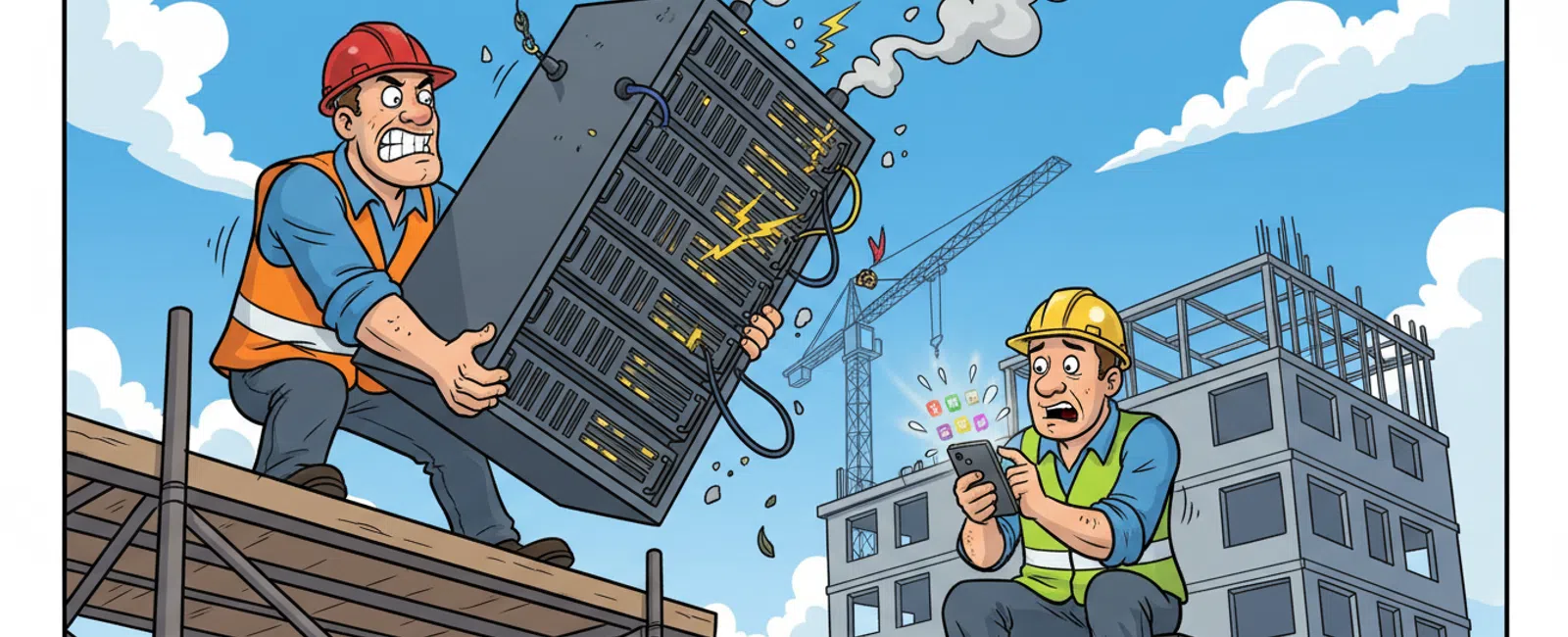
For construction firms in Salt Lake City and surrounding regions, 911 IT stands out with 24/7 live support, proactive monitoring, and specialized expertise in construction software like CAD, BIM, and project management platforms. They offer flat-rate transparent pricing, a 100% satisfaction guarantee, and have earned recognition as a 2024 MSP Titans award winner with consistent 5-star ratings from construction clients.
What Makes an IT Support Company Right for Construction Firms?
Construction companies face unique technology challenges that generic IT providers often misunderstand. Your teams work across remote job sites, trailer offices, and corporate headquarters. You need reliable connectivity in mountainous terrain across Utah, Wyoming, and Arizona where cellular signals fade and weather disrupts operations.
The right IT partner understands construction-specific software. Your business depends on CAD for design work, BIM for project coordination, and project management platforms for submittals, RFIs, and change orders. When these systems fail at a critical bid deadline or during an active build, you need someone who can troubleshoot construction software, not just generic Windows issues.
Rhonda from a construction company describes the relief: "911 IT has been a godsend to our company, especially to me. They are always available and can take care of any need we have right away. I never panic anymore when something isn't working right, I just call anyone on the team, and they pleasantly take over, and the problem is gone."
Look for providers who offer job site connectivity solutions, understand the seasonal cycles of construction work in resort-adjacent markets, and can scale support when you ramp up for busy periods. Multi-state operations require IT teams familiar with varying regulations across jurisdictions.
The best construction IT support includes proactive monitoring that catches issues before they halt jobsite productivity, mobile device management for field crews, and secure access to blueprints and project documentation from any location.
How Do Response Times Impact Your Construction Business?
Every minute of IT downtime costs construction firms real money. When your estimating team can't access bid documents, you miss submission deadlines. When field crews lose connectivity to project schedules, coordination breaks down and subcontractors sit idle.
Clay from a construction firm highlights this critical factor: "911 IT's response time has been so great! Most of the time they will resolve our issue before we hang up the phone. When we find ourselves in IT trouble we are usually in a mess until we call 911 IT and they get things working again."
Most IT issues for construction clients are resolved before hanging up the phone.
Reactive IT support that takes hours or days to respond creates cascading problems. A downed server means your project managers can't update as-builts. Failed backup systems put months of project documentation at risk. Slow support turns minor glitches into project delays.
911 IT provides 24/7 live support with rapid response, not offshore call centers or ticket queues. Their team monitors systems around the clock, catching problems before they impact your operations. This proactive approach means fewer emergency calls and more predictable technology performance.
For construction companies operating across time zones from Salt Lake City to Phoenix to Casper, having support available outside standard business hours matters. Winter storms and equipment failures don't wait for Monday morning.
Fast response times paired with construction software expertise create the foundation for reliable operations.
What IT Services Do Construction Companies Actually Need?
Construction firms require a specific technology stack that differs from retail or professional services. Start with managed IT services that include workstation monitoring, server management, and network security. This foundation keeps your office systems running while teams focus on projects.
Job site connectivity solutions address the unique challenge of providing internet access to trailer offices and remote locations. Utah's mountainous terrain and rural Wyoming job sites demand specialized approaches beyond standard business internet.
Construction software support covers CAD performance optimization, BIM coordination platform management, and project management software troubleshooting. When Procore, Autodesk, or Bluebeam slow down, you need technicians who understand these platforms, not just generic IT.
Data backup and disaster recovery protect blueprints, project documentation, bid histories, and client information. Construction firms accumulate years of valuable project data that must survive hardware failures, ransomware attacks, or natural disasters common in the region.
Cybersecurity services have become critical as construction companies increasingly face targeted attacks. Hackers know you hold valuable blueprints, client data, and financial information. They exploit remote job site connections and mobile devices used by field crews.
VoIP phone services enable communication between office staff, project managers, and field teams. Modern systems integrate with project management platforms and provide reliable calling even when teams work remotely.
Cloud services allow secure access to project files from any location. General contractors, subcontractors, and clients need to access submittals, RFIs, and drawings without compromising security or version control.
- 24/7 monitoring and helpdesk support for continuous uptime
- Job site connectivity solutions for remote locations
- Construction software optimization (CAD, BIM, project management)
- Data backup and disaster recovery for project documentation
- Cybersecurity protection against targeted attacks
- VoIP phone systems integrated with project platforms
- Cloud services for secure multi-location file access
The right IT provider bundles these services with transparent, flat-rate pricing so you can budget accurately without surprise bills.
Should You Choose Local or National IT Support?
National IT providers offer brand recognition and broad resources, but they rarely understand regional construction challenges. They don't know how Utah's winter weather impacts job sites or how Wyoming's rural locations complicate connectivity. Their support teams follow scripts designed for generic business clients, not construction-specific scenarios.
Local IT providers based in Salt Lake City understand the regional construction market. They know the terrain challenges, weather patterns, and seasonal cycles that affect your operations. When you need onsite support at a job site or office, they can dispatch technicians who arrive quickly rather than coordinating with distant regional offices.
911 IT operates across Utah, Wyoming, and Arizona with deep knowledge of multi-state construction operations. Their team understands the compliance requirements, connectivity challenges, and software platforms specific to regional construction firms.
Local providers build relationships with your team. Ryan from a construction company notes: "They're incredibly skilled at diagnosing problems and narrowing down solutions quickly, which saves us time and stress. What really stands out is how courteous and easy they are to talk to - they make tech support feel like a conversation, not a chore."
Regional expertise matters when your IT provider needs to support job sites from Phoenix metro to Casper. They understand the regulatory differences between states and can coordinate support across distributed teams.
National providers may offer lower initial quotes, but hidden fees, slow response times, and lack of construction expertise often cost more long-term. Local providers with flat-rate pricing and industry specialization deliver better value.
Choose a provider who knows your market, understands construction operations, and can respond quickly when problems arise.
How Much Should Construction IT Support Cost?
IT support pricing varies based on services, company size, and support level. Understanding typical cost structures helps you evaluate providers and budget appropriately.
Fully managed IT services typically range from $100 - $250 per user per month. This includes 24/7 monitoring, helpdesk support, security management, and proactive maintenance. For a construction firm with 20 employees, expect $2,000 - $5,000 monthly.
Co-managed IT, where you maintain some internal IT staff supplemented by external expertise, generally costs $75 - $150 per user per month. This works well for larger construction firms with existing IT personnel who need specialized construction software support or after-hours coverage.
Cybersecurity add-ons including endpoint detection, managed detection and response, and security training typically add $25 - $75 per user per month. Given the increasing threats targeting construction firms, this investment protects valuable project data and client information.
Backup and disaster recovery services range from $10 - $30 per user per month. For construction companies with extensive project documentation, CAD files, and blueprints, robust backup systems prevent catastrophic data loss.
VoIP phone services cost approximately $20 - $40 per user per month, replacing traditional phone systems with modern communication platforms that integrate with project management software.
Ad-hoc support for companies without managed services agreements runs $150 - $300 per hour. While this seems economical for occasional issues, construction firms typically spend more on reactive support than proactive managed services.
IT project work like network buildouts, server migrations, or new office setups typically costs $150 - $250 per hour. These one-time investments support business growth or location expansions.
| Service Type | Typical Cost Range | What's Included |
|---|---|---|
| Fully Managed IT | $100 - $250 per user/month | 24/7 monitoring, helpdesk, security, maintenance |
| Co-Managed IT | $75 - $150 per user/month | Supplemental support for existing IT staff |
| Cybersecurity Add-ons | $25 - $75 per user/month | Endpoint detection, MDR, security training |
| Backup & Recovery | $10 - $30 per user/month | Automated backups, disaster recovery |
| VoIP Phone Services | $20 - $40 per user/month | Modern communication, platform integration |
| Ad-hoc Support | $150 - $300 per hour | Pay-per-incident troubleshooting |
| IT Project Work | $150 - $250 per hour | Network buildouts, migrations, setups |
911 IT offers flat-rate, transparent pricing with a 100% satisfaction guarantee. Their model eliminates surprise bills and allows accurate budgeting. Rather than paying per incident, you receive comprehensive support for predictable monthly costs.
The lowest price rarely delivers the best value. Evaluate response times, construction expertise, local presence, and service comprehensiveness alongside cost.
What Questions Should You Ask Before Choosing an IT Provider?
Start by asking about construction-specific experience. Do they support other construction firms? Can they troubleshoot CAD, BIM, and project management platforms? Generic IT providers struggle with construction software nuances that specialized teams handle routinely.
Inquire about response times and support availability. How quickly do they answer calls? Do they offer 24/7 support or only business hours? What's their average resolution time? Construction operations don't pause for slow IT support.
Ask about their approach to job site connectivity. How do they handle internet access for remote trailer offices? What solutions do they recommend for rural locations or mountainous terrain common across Utah, Wyoming, and Arizona?
Question their security practices. How do they protect blueprints and project documentation? What cybersecurity measures do they implement? How do they secure mobile devices used by field crews?
Understand their pricing model. Is it flat-rate or variable? What's included in base services versus add-ons? Are there hidden fees for after-hours support or emergency calls?
Request client references from other construction companies. Testimonials from similar businesses reveal how the provider performs under real-world construction scenarios.
Ask about their local presence. Can they provide onsite support when needed? How quickly can technicians reach your office or job sites?
Inquire about backup and disaster recovery procedures. How often do they test backups? What's their recovery time objective if systems fail? Construction firms can't afford extended downtime.
Discuss their proactive monitoring approach. Do they wait for you to report problems, or do they catch issues before they impact operations? Proactive support prevents emergencies rather than just responding to them.
Ask about guarantees. Do they stand behind their work with satisfaction guarantees or service level agreements? Providers confident in their service offer concrete commitments.
These questions reveal whether a provider truly understands construction IT needs or just wants another client.
Why 911 IT Stands Out for Construction Companies
911 IT specializes in construction IT support across Salt Lake City, Utah, Wyoming, and Arizona. Their team understands the unique challenges construction firms face, from job site connectivity to CAD performance optimization.
They offer 24/7 live support with rapid response times. Construction clients report most issues resolved before hanging up the phone. This immediate availability eliminates the panic that comes with technology failures during critical project phases.
Their proactive monitoring approach catches problems before they disrupt operations. Rather than waiting for systems to fail, they identify and resolve issues during off-hours, maintaining continuous uptime for your business.
911 IT provides flat-rate, transparent pricing with a 100% satisfaction guarantee. You know exactly what you'll pay each month without surprise bills for emergency support or after-hours calls.
They've earned recognition as a 2024 MSP Titans award winner and Best of Salt Lake, with consistent 5-star ratings from construction clients. These accolades reflect their commitment to service excellence and client satisfaction.
Their construction software expertise covers CAD, BIM, project management platforms, and ERP systems. When Autodesk slows down or Procore connectivity fails, their technicians understand these specialized applications, not just generic IT.
With locations serving Salt Lake City, Phoenix, and Casper, they provide local presence across your multi-state operations. Onsite support arrives quickly when remote troubleshooting isn't sufficient.
For construction firms tired of unreliable tech and slow support, 911 IT delivers the responsive, knowledgeable service that keeps projects moving forward.
Frequently Asked Questions
What is the average cost of IT support for small businesses?
Small business IT support typically costs $100 - $250 per user per month for fully managed services, or $150 - $300 per hour for ad-hoc support. Construction firms with 10-50 employees usually find managed services more cost-effective than paying hourly rates, as comprehensive monitoring, security, and helpdesk support are included in flat monthly fees without surprise charges.
How quickly should an IT support company respond to issues?
Quality IT support companies answer calls within minutes and begin troubleshooting immediately. Critical issues affecting business operations should receive response within 15-30 minutes. 911 IT's construction clients report most issues resolved before hanging up the phone, with 24/7 availability ensuring support during evenings, weekends, and emergencies when construction deadlines demand immediate resolution.
Do I need specialized IT support for construction software?
Yes, construction software like CAD, BIM, and project management platforms require specialized knowledge that generic IT providers lack. These applications have unique performance requirements, integration complexities, and troubleshooting procedures. IT providers with construction expertise can optimize software performance, resolve compatibility issues, and support the specific workflows construction firms depend on daily.
What's the difference between managed IT and break-fix support?
Managed IT provides proactive monitoring, maintenance, and support for flat monthly fees, preventing problems before they disrupt operations. Break-fix support charges hourly rates when issues occur, creating unpredictable costs and reactive problem-solving. Construction firms typically save money and experience less downtime with managed services that include 24/7 monitoring, security, backups, and unlimited helpdesk support.
Can IT support help with remote job site connectivity?
Yes, experienced IT providers design connectivity solutions for remote construction job sites using cellular bonding, satellite internet, point-to-point wireless, or hybrid approaches. They assess terrain challenges, bandwidth requirements, and budget constraints to implement reliable internet access for trailer offices and field operations, even in rural Utah, Wyoming, and Arizona locations where traditional broadband isn't available.
What construction IT support services do firms actually need?
Construction firms need managed IT services including workstation monitoring, server management, and network security. Essential services include job site connectivity solutions, construction software support for CAD and BIM, data backup and disaster recovery, cybersecurity protection, VoIP phone systems, cloud services for secure file access, and 24/7 monitoring and helpdesk support for continuous uptime.
What construction computer support and services do IT providers offer?
Construction IT providers offer managed services including workstation monitoring, server management, and network security. Additional services include job site connectivity solutions, construction software support for CAD and BIM, data backup and disaster recovery, cybersecurity protection, VoIP phone systems, and cloud services for secure file access. The right provider bundles these with transparent flat-rate pricing.