911 IT provides encrypted, immutable backup and disaster recovery solutions designed for legal industry retention requirements, including Utah State Bar compliance. Our systems maintain multiple restore points with offsite replication, automated verification testing, and one-hour emergency response for critical data recovery. Solutions include encrypted client portal access, granular file recovery, and retention policies configurable to match case file and trust account record requirements ranging from 5 to 7 years or longer.
Why Do Law Firms Need Specialized Backup Solutions Beyond Standard Business Backup?
Legal data carries unique obligations that standard backup systems cannot address. Attorney-client privilege requires end-to-end encryption both in transit and at rest, ensuring confidential communications remain protected even if backup media is compromised.
Utah State Bar Rules of Professional Conduct Rule 1.6 mandates reasonable efforts to prevent unauthorized access to client information. A backup system that stores data in plaintext or uses weak encryption exposes firms to disciplinary action and malpractice claims.
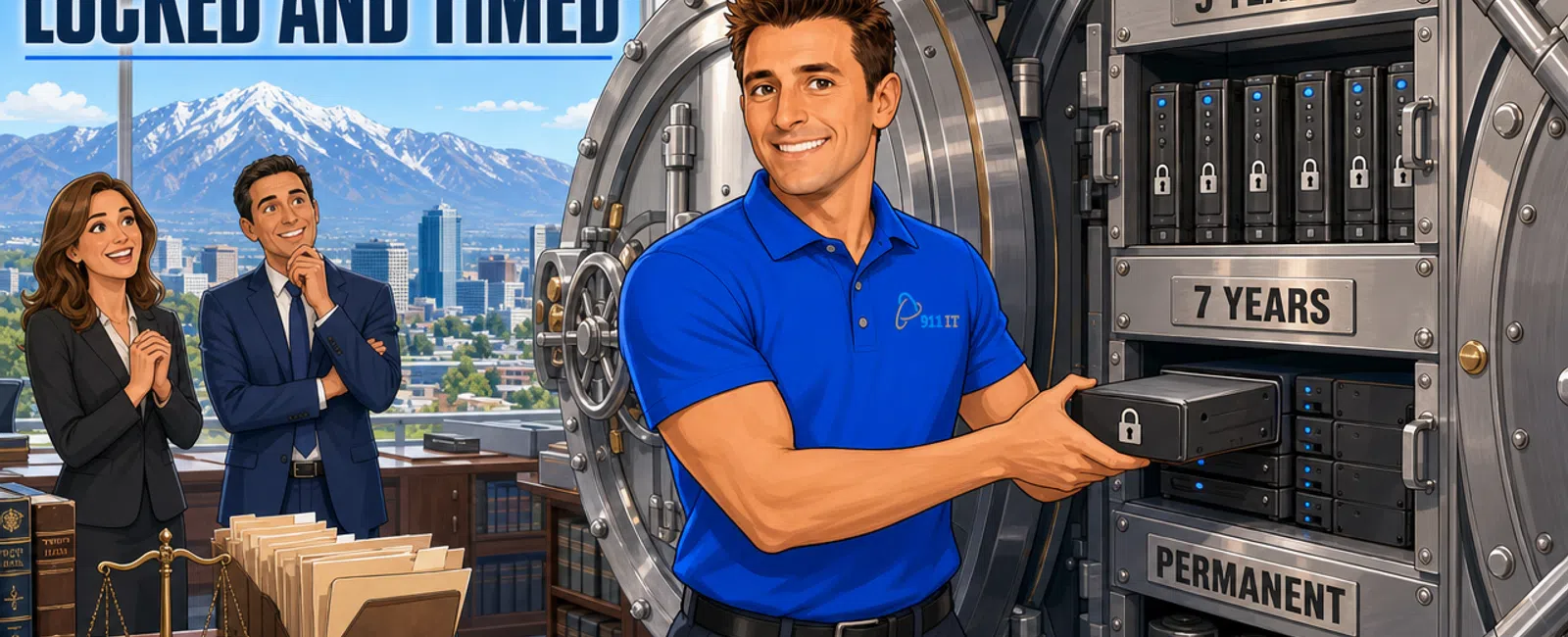
Retention timelines differ dramatically from other industries. While most businesses retain data for 3-5 years, legal matters often require 7-year retention for closed files, indefinite retention for trust account records under Utah IOLTA rules, and permanent retention for certain estate and real property documents.
E-discovery obligations mean backups must support granular recovery. When opposing counsel requests emails from a specific date range or documents containing particular keywords, your backup system must retrieve those items without restoring entire servers or spending days searching through archives.
Court filing deadlines create zero-tolerance scenarios. If your document management system fails the morning a motion is due in U.S. District Court for the District of Utah, you need recovery measured in minutes, not hours or days. Standard backup solutions offering next-business-day recovery cannot meet this requirement.
Law firms face specialized backup challenges that generic solutions cannot address without significant customization and ongoing compliance verification.
What Specific Retention Requirements Apply to Salt Lake City Law Firms?
Utah State Bar rules establish baseline retention requirements that every firm must meet. Closed client files must be retained for a minimum period sufficient to protect client interests, typically interpreted as 5-7 years depending on matter type.
Trust account records fall under stricter rules administered by the Utah State Bar IOLTA program. Bank statements, deposit slips, cancelled checks, and reconciliation records must be retained for seven years. Many firms adopt permanent retention for trust account documentation to defend against future claims.
Federal matters introduce additional layers. Cases involving federal tax issues require 7-year retention under IRS guidelines. Matters touching securities law may require indefinite retention under SEC rules. Employment litigation often involves EEOC records with 3-year minimum retention.
The U.S. District Court for the District of Utah CM/ECF system requires firms to maintain their own copies of filed documents, as court electronic records may not remain accessible indefinitely. This creates a parallel retention obligation for all federal court filings.
Utah Rules of Civil Procedure regarding electronically stored information (ESI) impose litigation hold obligations. When litigation is reasonably anticipated, firms must suspend normal deletion policies and preserve all potentially relevant data, including backup archives.
Real estate closings create permanent records. Deeds, title policies, and closing documents often need retrieval decades later when property changes hands or title questions arise. Salt Lake City's role as a regional real estate hub amplifies this requirement.
Legal retention requirements in Utah range from 3 years for basic employment records to 7 years for trust accounts to permanent retention for real property and estate documents.
Compliance requires backup systems with configurable retention policies that can apply different rules to different document types and matter categories.
How Does 911 IT's Backup Solution Address Legal-Specific Requirements?
Our backup architecture uses immutable storage that prevents deletion or modification once data is written. This protects against both ransomware attacks that attempt to encrypt backups and insider threats where departing employees might try to destroy evidence.
Encryption applies at every stage. Data is encrypted on the source workstation before transmission, remains encrypted during transfer, and stays encrypted in our offsite data centers. Encryption keys remain under your firm's control, ensuring 911 IT staff cannot access your client data even during recovery operations.
Multiple restore points allow granular recovery. We maintain hourly snapshots for 48 hours, daily snapshots for 30 days, weekly snapshots for 12 months, and monthly archives extending to your required retention period. This structure lets you recover a single email from three years ago or an entire server from last week.
Automated verification testing runs weekly. The system automatically attempts to restore random files from your backup set and validates data integrity. You receive reports confirming your backups are actually recoverable, not just confirming the backup job completed.
Geographic redundancy stores copies in multiple physical locations. Primary backups replicate to our Salt Lake City data center, with secondary copies in a geographically separate facility. This protects against regional disasters affecting downtown Salt Lake City's legal corridor.
Janet, a Salt Lake City attorney, told us: "As a tech-impaired geezer, I struggle with most computer and online functions. However, as a lawyer, I must navigate the internet, log into legal research databases, operate the court's electronic filing system, manage my email, and download various documents." Our backup solution works invisibly in the background, requiring no technical expertise while ensuring her case files and client communications remain protected and recoverable.
Retention policies configure at the folder or matter level. You can apply 7-year retention to trust account records, 5-year retention to standard case files, and permanent retention to estate documents, all within the same backup system.
Legal-specific backup requires immutable storage, end-to-end encryption, granular recovery, automated verification, and configurable retention policies that match Utah State Bar requirements.
What Does the Disaster Recovery Process Look Like When You Need Files Immediately?
Emergency response begins with our one-hour guarantee. When you contact our 24-7 helpdesk with a critical recovery need, a technician responds within one hour, not one business day. For law firms facing court deadlines, this distinction is often the difference between meeting a filing deadline and requesting an embarrassing extension.
Initial assessment happens on the first call. Our technician determines what data you need, when it was last known good, and what systems are affected. For a single deleted file, recovery often completes during the initial call. For server failures, we immediately begin restoring to temporary infrastructure while planning permanent repairs.
Granular file recovery handles the most common scenarios. If an attorney accidentally deletes a brief or overwrites a document with the wrong version, we can restore that specific file from any snapshot in your retention window. You receive the file via secure portal within minutes, not hours.
Full system recovery follows a prioritized sequence. We restore your document management system first, then email, then practice management software, then workstations. This approach gets attorneys back to billable work as quickly as possible rather than waiting for complete infrastructure restoration.
Debbie, who worked with a Salt Lake City law office, experienced this firsthand: "911 IT really came to the rescue when all others failed. I mean ALL others failed." After complete email deletion and corruption, we "restored most or all email from several years" of history. This kind of recovery requires both robust backup architecture and experienced technicians who understand legal data structures.
Virtual recovery provides immediate access during hardware failures. If your physical server dies, we can restore your systems to virtual infrastructure within hours, allowing your firm to continue operating while replacement hardware is procured and configured.
Testing and validation confirm recovery success. Before declaring the emergency resolved, we verify that recovered data is accessible, applications function correctly, and no data corruption occurred during the recovery process.
Disaster recovery for law firms requires one-hour emergency response, granular file recovery, prioritized system restoration, and virtual recovery options to maintain operations during hardware failures.
How Do Backup Solutions Integrate With Legal Practice Management and Document Management Systems?
Application-aware backup captures legal software in a consistent state. Generic backup tools often capture database files while they're being written, resulting in corrupted backups that fail during recovery. Our systems integrate with practice management platforms to ensure clean backups every time.
Document management systems receive special handling. Whether you use NetDocuments, iManage, Worldox, or another platform, we configure backup to capture both the document repository and the metadata indexes that make documents searchable. Losing metadata turns organized case files into unsearchable archives.
Email backup captures the complete mailbox structure. Folders, rules, categories, and conversation threads all restore exactly as they existed. For attorneys who organize years of client communications into detailed folder structures, this preservation is essential.
Trust account data receives enhanced protection. QuickBooks, PCLaw, and other accounting platforms used for IOLTA accounts backup multiple times daily with extended retention. We maintain separate retention policies for trust account data to match Utah State Bar requirements.
Cloud application backup addresses a common gap. Many firms assume that cloud-based practice management or document storage platforms handle backup automatically. In reality, most cloud providers protect against their infrastructure failures but not against user errors, malicious deletions, or account compromises. We backup your cloud data to separate infrastructure under your control.
Calendar and deadline data receives priority treatment. Missing a statute of limitations because a calendar system failed is a malpractice claim waiting to happen. We backup Outlook calendars, practice management deadlines, and court date tracking systems with multiple daily snapshots.
Integration with legal software requires application-aware backup, metadata preservation, enhanced trust account protection, cloud application backup, and priority treatment for deadline tracking systems.
What Distinguishes 911 IT's Legal Backup Solutions From Other Salt Lake City Providers?
Local providers serving Salt Lake City's legal market include general MSPs like Executech, Wasatch I.T., Nexus IT Consultants, INTELITECHS, ProLink IT, and Qual IT, along with national legal-focused technology providers. Each brings different strengths to backup and disaster recovery.
National legal technology providers offer deep vertical expertise and established relationships with legal software vendors. However, small and mid-size Salt Lake City firms often find themselves as minor accounts in portfolios dominated by Am Law 200 firms. When you need emergency recovery at 6 PM Mountain Time, national providers often route you to offshore support centers following scripts rather than experienced technicians who understand Utah legal practice.
Large enterprise-focused MSPs bring robust infrastructure and comprehensive service catalogs. For a 5-attorney firm or even a 25-attorney practice, you're competing for attention with clients running thousands of workstations. Ticket queues, rotating junior technicians, and slow escalation paths mean your critical recovery might wait behind routine password resets for larger clients.
911 IT occupies the sweet spot for Salt Lake City legal practices. We're large enough to maintain 24-7 helpdesk support, multiple data centers, and the full infrastructure stack that enterprise providers offer. We're small enough that every client is known by name, and your emergency recovery call reaches an experienced technician who understands both legal requirements and your specific environment.
Our one-hour emergency response guarantee is contractual, not aspirational. Founded in 2004, we've spent over two decades refining processes that deliver consistent response times. When you call at 5:30 PM because a server failed and you need to file a motion by midnight, you reach a live technician in our South Jordan office who can immediately begin recovery.
Proactive monitoring catches failures before they become emergencies. Our systems alert us to failing hard drives, backup job failures, and storage capacity issues before they impact your firm. We often contact clients to schedule proactive repairs before attorneys even know a problem exists.
Flat-rate, transparent pricing eliminates surprise bills during recovery. Some providers charge premium rates for emergency recovery or bill hourly for restoration work. Our managed IT services include backup, disaster recovery, and emergency response in predictable monthly pricing.
Our 100% Satisfaction Guarantee backs every service. If our backup and disaster recovery solution doesn't meet your expectations, we make it right or you don't pay. This guarantee reflects confidence built over 20+ years serving businesses across Utah, Wyoming, and Arizona.
- Enterprise-grade infrastructure: Multiple data centers, 24-7 helpdesk support, and immutable backup storage that prevents ransomware encryption
- Personalized service: Every client known by name with direct access to experienced technicians who understand legal requirements
- Contractual one-hour emergency response: Guaranteed response within 60 minutes for critical recovery needs, not next-business-day callbacks
- Proactive monitoring: Automated alerts catch failing hardware and backup issues before they become emergencies
- Transparent pricing: Flat-rate monthly costs with no surprise bills for emergency recovery or restoration work
- 100% Satisfaction Guarantee: We make it right or you don't pay, backed by 20+ years serving Utah businesses
911 IT combines enterprise-grade infrastructure with personalized service, contractual one-hour emergency response, proactive monitoring, transparent pricing, and a satisfaction guarantee that makes us the best fit for Salt Lake City legal practices.
Frequently Asked Questions
How long does it take to restore a complete server after a catastrophic failure?
Full server restoration to virtual infrastructure typically completes within 4-6 hours for standard configurations, allowing your firm to resume operations the same day. Restoration to replacement physical hardware takes 8-24 hours depending on hardware procurement. Our one-hour emergency response guarantee ensures recovery begins immediately, not the next business day, which is critical when court deadlines are at stake.
Can you recover individual emails or documents from months or years ago?
Yes, our backup architecture maintains granular recovery capability throughout your retention period. We can restore a single email from two years ago or a specific document version from six months ago without restoring entire servers or mailboxes. This granular recovery is essential for e-discovery requests and situations where attorneys need to retrieve specific communications or document versions from past matters.
What happens if ransomware encrypts both our production systems and our backups?
Our immutable backup storage prevents ransomware from encrypting or deleting backup archives. Even if ransomware compromises every workstation and server in your office, your backup data remains intact and recoverable. We maintain offline copies that ransomware cannot reach, and our multi-layered architecture ensures at least one recovery point survives any attack. This protection is critical given the increasing sophistication of ransomware targeting legal practices.
How do you ensure backup data remains confidential and protected by attorney-client privilege?
All backup data is encrypted before leaving your office, remains encrypted during transmission, and stays encrypted in our data centers using AES-256 encryption. Encryption keys remain under your firm's control, meaning 911 IT staff cannot access your client data even during recovery operations. This architecture maintains attorney-client privilege and satisfies Utah State Bar Rule 1.6 requirements for reasonable efforts to protect client confidentiality.
What does backup and disaster recovery cost for a typical law firm?
Industry-standard backup and disaster recovery services typically range from $10 to $30 per user per month, though legal-specific requirements often place firms at the higher end of that range. Total cost depends on data volume, retention requirements, and recovery time objectives. Our flat-rate pricing model provides predictable monthly costs without surprise bills for emergency recovery or restoration work, and includes 24-7 support and one-hour emergency response.
Do you backup cloud-based practice management and document storage systems?
Yes, we backup cloud applications including Clio, MyCase, NetDocuments, and other cloud-based legal platforms. While cloud providers protect against their infrastructure failures, they typically don't protect against user errors, malicious deletions, or account compromises. Our cloud backup captures your data to separate infrastructure under your control, ensuring you can recover from any scenario including provider outages, accidental deletions, or security breaches affecting your cloud accounts.