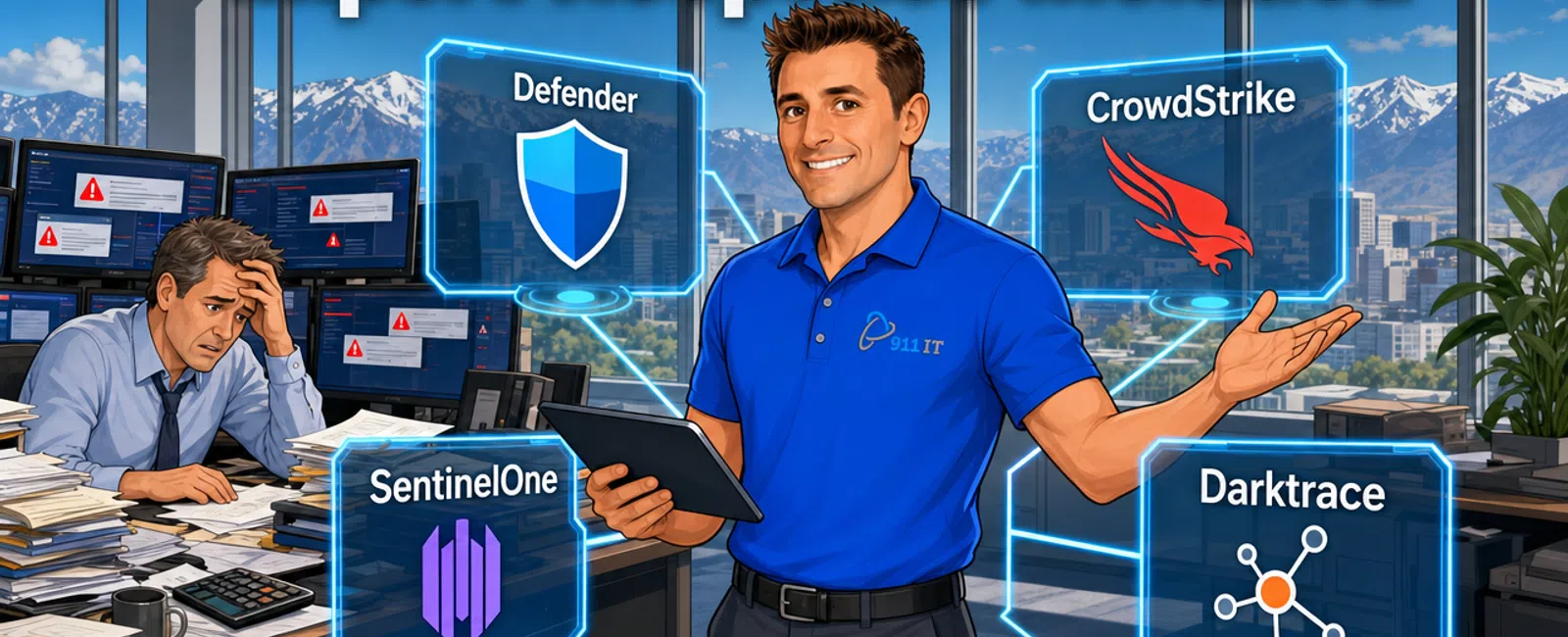
The best AI for cybersecurity in 2026 includes platforms like Microsoft Defender for Endpoint, CrowdStrike Falcon, SentinelOne, and Darktrace, each using machine learning to detect threats in real time. For CPA firms in Salt Lake City handling sensitive client data, the real answer isn't just the AI tool - it's having a local managed security provider who deploys, monitors, and responds to alerts 24-7, ensuring compliance with IRS Publication 4557 safeguarding requirements and delivering one-hour-or-less emergency response.
What AI cybersecurity tools do CPA firms actually need?
CPA firms face unique threats during tax season when phishing attacks spike and client data is most vulnerable. The right AI tools for your practice include endpoint detection and response (EDR) platforms that use behavioral analysis to catch ransomware before it encrypts engagement files, email security gateways that block spoofed client requests, and security information and event management (SIEM) systems that correlate alerts across your entire network.
Microsoft Defender for Endpoint integrates directly with Office 365 environments most accounting firms already use, applying machine learning to identify anomalous login patterns and file access. CrowdStrike Falcon and SentinelOne offer cloud-native EDR with automated threat hunting that doesn't slow down workstations during month-end close or audit season.
Darktrace takes a different approach, using unsupervised learning to establish a baseline of normal network behavior for your firm, then flagging deviations like unusual after-hours access to client portals or abnormal data transfers. For firms handling 1040 and 1120 filings, this catches insider threats and compromised credentials that signature-based tools miss.
The challenge isn't the AI itself - it's implementation and response. Scott, an engineering firm client, noted how 911 IT manages security for cloud-based services including Office365, providing "virus and cybersecurity protection on our computer system connected to our network" with professional, knowledgeable staff handling all support questions.
AI tools generate thousands of alerts daily; without expert triage, your team drowns in false positives or misses real threats buried in noise.
How do AI security tools compare for accounting firms?
| AI Security Platform | Primary Strength | Best For | Integration Complexity |
|---|---|---|---|
| Microsoft Defender for Endpoint | Native Office 365 integration | Firms already in Microsoft ecosystem | Low |
| CrowdStrike Falcon | Lightweight agent, cloud-native | Multi-office firms needing centralized visibility | Medium |
| SentinelOne | Autonomous response, rollback capability | Firms requiring automated remediation | Medium |
| Darktrace | Behavioral AI, insider threat detection | Larger firms with complex networks | High |
| Proofpoint | Email threat intelligence | Firms facing frequent phishing attempts | Low |
Each platform excels in specific scenarios, but none work effectively without proper configuration for accounting workflows. Your EDR must whitelist legitimate tax software updates while blocking unauthorized executables. Email gateways need rules that catch spoofed engagement letters without quarantining legitimate client correspondence during busy season.
Sam, who runs a fundraising operation, discovered through a 911 IT security audit that finding security issues was only half the battle - fixing them properly made the difference: "I sleep better knowing my systems and data are safe. The value of the information they provide is worth 10X what they are charging for the audit!"
The right AI tool depends on your firm's size, existing infrastructure, and compliance requirements - not marketing claims.
Why can't CPA firms just buy AI security software directly?
Purchasing enterprise AI security platforms directly creates three critical problems for accounting firms. First, initial configuration requires deep expertise in both the platform and accounting workflows - misconfigured EDR can block legitimate remote access during client meetings or flag normal workpaper transfers as data exfiltration.
Second, these platforms generate continuous alerts requiring 24-7 monitoring. A ransomware attack at 2 AM on April 14th doesn't wait for your office to open. Without a security operations center reviewing alerts around the clock, you're paying for detection without response - like installing a burglar alarm with no monitoring service.
Third, AI security tools require constant tuning as your practice evolves. Adding cloud hosting for tax software, implementing a new client portal, or onboarding seasonal staff all create legitimate behavior changes that untrained AI flags as threats. Each false positive trains your team to ignore alerts, creating alert fatigue that lets real attacks slip through.
Large national cybersecurity providers offer monitoring, but CPA firms become ticket number 47,392 in a queue. When you call about suspicious activity in your trust account access logs, you reach a tier-one technician reading from a script who's never heard of a trial balance. Escalation to someone who understands accounting systems takes hours - time you don't have when client data is at risk.
911 IT provides one-hour-or-less emergency response time with technicians who understand CPA firm workflows and compliance requirements.
Regional providers like 911 IT occupy the sweet spot: enterprise-grade security tools and 24-7 monitoring, but small enough that your firm isn't anonymous. When Garry's engineering firm needed "advanced security compliance needs specific to our niche," 911 IT provided "a local, personable partner that truly listens" with "no major outages" and quick resolution of any minor issues.
Your security provider should know your busy season schedule, understand your specific compliance obligations, and respond with urgency that matches the value of your client data.
What should Salt Lake City CPA firms look for in a security provider?
CPA firms in Salt Lake City need providers who understand Utah's data breach notification laws, IRS Publication 4557 requirements for safeguarding taxpayer data, and the practical realities of tax season. Your security partner should offer proactive monitoring, not just reactive ticket response when something breaks.
Look for providers offering managed detection and response (MDR) services that combine AI tools with human expertise. The AI handles the impossible task of analyzing millions of events per day; the security analysts investigate genuine threats and coordinate response. This hybrid approach catches both known malware signatures and novel attack patterns that pure AI might miss.
Verify that the provider offers regular security assessments and penetration testing specific to accounting firms. Generic vulnerability scans miss risks like improperly secured engagement file shares or weak authentication on tax software remote access. Your provider should test whether an attacker could pivot from a compromised workstation to your client data repository.
Compliance support matters for CPA firms. Your provider should help document security controls for professional liability insurance, assist with client security questionnaires, and maintain audit trails that satisfy regulatory requirements. When a client asks about your data protection measures, you need concrete answers, not vague assurances.
In Salt Lake City's market, verified local providers include Executech, Wasatch I.T., Nexus IT Consultants, INTELITECHS, ProLink IT, and Qual IT, alongside national enterprise-focused firms. The question isn't just capability - it's whether you'll be a priority client or lost in a queue of thousands.
911 IT has served businesses across Utah, Wyoming, and Arizona since 2004, offering cybersecurity services with 24-7 live support and a 100% satisfaction guarantee. For CPA firms specifically, this means security monitoring that understands the difference between normal busy-season activity and a credential compromise.
How much does AI-powered security cost for accounting firms?
Industry pricing for AI-powered cybersecurity services typically ranges from $25 - $75 per user per month for endpoint detection and response, email security, and security awareness training. Fully managed IT services that include comprehensive security monitoring, help desk support, and compliance assistance generally run $100 - $250 per user per month, depending on service scope and firm complexity.
A ten-person CPA firm can expect monthly security costs between $250 and $750 for AI security tools alone, or $1,000 to $2,500 for comprehensive managed security that includes 24-7 monitoring, incident response, and compliance support. These ranges reflect 2026 industry averages and vary based on your existing infrastructure, compliance requirements, and service level expectations.
Firms often underestimate the total cost of ownership when purchasing tools directly. A $15-per-user EDR license seems affordable until you add the security analyst salary ($75,000 - $120,000 annually) needed to monitor it, the training costs to maintain certifications, and the incident response retainer for when something goes wrong. For most accounting practices, outsourcing to a specialized provider delivers enterprise-grade protection at a fraction of the cost of building internal capabilities.
911 IT offers flat-rate, transparent pricing with predictable monthly costs - no surprise bills when you need emergency support during tax season. Gary's automotive business appreciated this approach: "Very fair and top quality work. You have taken a huge load off me and made our system more protected than it ever has been."
The real question isn't cost - it's value. What's the financial impact of a ransomware attack that locks your engagement files three weeks before the April deadline? What's the reputational damage when you notify 500 clients that their tax returns were exposed? Security isn't an expense; it's insurance against catastrophic loss.
Why 911 IT is the right security partner for Salt Lake City CPA firms
CPA firms need security providers who combine enterprise-grade AI tools with local accountability and accounting-specific expertise. 911 IT deploys the same advanced security platforms that Fortune 500 companies use - Microsoft Defender, SentinelOne, and other leading EDR solutions - but delivers them with the responsiveness and personal attention that national providers can't match.
Founded in 2004, 911 IT has spent two decades building security infrastructure across Utah, Wyoming, and Arizona. The company's 24-7 monitoring and one-hour-or-less emergency response time mean that threats detected at midnight on Saturday are addressed immediately, not queued for Monday morning. This matters during tax season when every hour of downtime represents dozens of missed billable hours and client commitments you can't meet.
The company's process-driven approach ensures consistent security posture across your entire practice. Regular security assessments identify vulnerabilities before attackers exploit them. Proactive patch management keeps tax software and operating systems current without disrupting client work. Security awareness training tailored to accounting workflows helps your team recognize the spoofed client emails and fake IRS notices that generic training misses.
911 IT's managed IT services include compliance support for IRS requirements, professional liability insurance questionnaires, and client security audits. When a corporate client asks about your SOC 2 controls or data encryption standards, you have documented answers - not improvised responses that create liability exposure.
The 100% satisfaction guarantee reflects confidence in service delivery. The company's recognition as a 2024 MSP Titans award winner and Better Your Best Winner demonstrates consistent excellence, but the real proof is in client retention. Garry's firm noted that 911 IT "truly listens and works with us on detailed requests and advanced security compliance needs specific to our niche" - exactly what CPA firms require.
For Salt Lake City accounting practices, 911 IT represents the optimal balance: sophisticated enough to deploy enterprise AI security tools, specialized enough to understand accounting workflows and compliance requirements, and local enough that you're a valued client, not an account number. Visit Salt Lake City IT support or call their South Jordan office at 1124 South Jordan Parkway to discuss your firm's specific security needs.
Frequently asked questions
Which AI model is best for cybersecurity?
No single AI model is "best" for all cybersecurity needs. Supervised learning models excel at detecting known malware variants, while unsupervised learning identifies novel attack patterns. Deep learning neural networks power behavioral analysis in tools like Darktrace. For CPA firms, the right approach combines multiple AI techniques within platforms like CrowdStrike or SentinelOne, managed by security experts who tune the models to your specific environment and workflows.
Is AI replacing cybersecurity professionals?
AI augments but doesn't replace cybersecurity professionals. AI excels at analyzing massive data volumes and detecting patterns, but humans provide context, investigate complex incidents, and make response decisions. For accounting firms, this hybrid approach is critical - AI flags the suspicious activity, but experienced analysts determine whether it's a compromised credential or a partner legitimately accessing files remotely during travel. The best security combines both.
What are the top cybersecurity tools for accounting firms?
Top cybersecurity tools for CPA firms include endpoint detection and response platforms (Microsoft Defender, CrowdStrike, SentinelOne), email security gateways (Proofpoint, Mimecast), multi-factor authentication systems, encrypted backup solutions, and security awareness training platforms. However, tools alone provide incomplete protection. Accounting firms need managed security services that deploy these tools correctly, monitor alerts 24-7, and respond to incidents with urgency that matches the sensitivity of client tax data.
How do I know if my CPA firm's security is adequate?
Adequate security for CPA firms includes real-time threat monitoring, multi-factor authentication on all systems accessing client data, encrypted backups tested for restoration, documented incident response procedures, and regular security assessments. If you can't answer "who's watching our systems right now?" or "how quickly can we recover from ransomware?", your security has gaps. A professional security audit identifies vulnerabilities and provides a remediation roadmap specific to accounting firm compliance requirements.
What's the biggest cybersecurity mistake CPA firms make?
The biggest mistake is assuming antivirus software and firewalls provide adequate protection. Modern threats bypass traditional defenses through phishing emails, compromised credentials, and zero-day exploits that signature-based tools miss. CPA firms also underestimate response time importance - detecting a breach on Friday afternoon but waiting until Monday to investigate gives attackers an entire weekend to exfiltrate client data. Effective security requires continuous monitoring and immediate response capabilities.