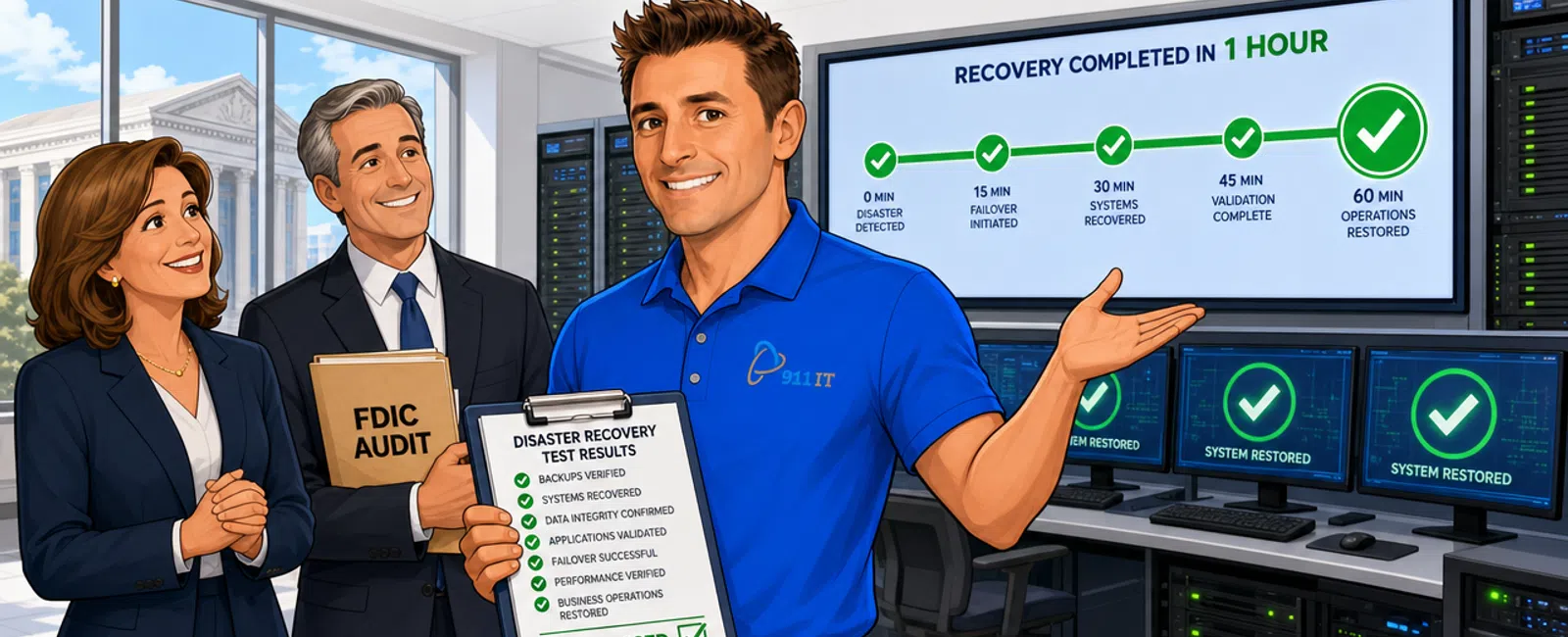
Yes, 911 IT provides fully documented disaster recovery capabilities with one-hour emergency response times and regulatory-aligned business continuity planning tailored to banking requirements. Our services include quarterly DR testing, documented recovery procedures, compliance reporting for FDIC and Utah Department of Financial Institutions audits, and 24-7 monitoring to meet federal and state regulatory standards for operational resilience.
What Disaster Recovery Capabilities Should Banking Institutions Expect From an IT Provider?
Banking institutions require disaster recovery capabilities that go far beyond simple data backup. Your IT provider must deliver documented recovery time objectives (RTO) and recovery point objectives (RPO) that align with regulatory expectations and operational realities.
At a minimum, your provider should offer automated, encrypted backups with both on-site and off-site storage, regular restoration testing with documented results, and clearly defined escalation procedures. For banking operations, this typically means RTOs measured in hours, not days, and RPOs that minimize transaction data loss to minutes.
911 IT's business continuity services include quarterly DR testing with full documentation, immutable backup storage to prevent ransomware encryption, and failover capabilities that keep critical banking systems operational during outages. Our approach ensures that when auditors from the FDIC, Federal Reserve, or Utah Department of Financial Institutions request your business continuity documentation, you have comprehensive, current records ready for review.
The difference between adequate and inadequate DR capabilities becomes painfully clear during an actual incident. Jason, who works in manufacturing, shared how 911 IT's help desk handled tasks in hours that his previous provider took weeks to complete, eliminating project delays entirely. That same rapid response applies to disaster scenarios where every minute of downtime translates to lost transactions and eroding customer confidence.
Your DR provider must also maintain detailed runbooks that specify exactly who does what during various failure scenarios, from minor server outages to complete facility loss. These runbooks should be tested, updated regularly, and accessible to both your team and the IT provider's emergency response staff.
How Do You Align Disaster Recovery Plans With Banking Regulatory Requirements?
Banking regulations from multiple agencies create overlapping but slightly different business continuity requirements. The FDIC expects documented business continuity plans, the Federal Reserve examines operational resilience, and Utah state regulators verify that institutions can maintain critical functions during disruptions.
Regulatory alignment starts with understanding which systems are deemed critical by examiners. For most banks, this includes core banking platforms, online banking portals, ATM networks, wire transfer systems, and customer data repositories. Your disaster recovery plan must explicitly address each critical system with specific recovery procedures and timeframes.
911 IT builds DR plans using a framework that maps directly to regulatory examination criteria. We document system dependencies, identify single points of failure, establish recovery priorities based on business impact analysis, and create testing schedules that generate the audit trail regulators expect. Our clients receive quarterly reports showing backup success rates, restoration test results, and any gaps identified with remediation timelines.
The Utah Department of Financial Institutions conducts regular safety and soundness examinations that include IT and cybersecurity reviews. During these examinations, institutions must demonstrate not just that they have a plan, but that the plan is tested, current, and realistic. Examiners look for evidence of senior management involvement, board-level oversight, and actual restoration exercises rather than theoretical documents.
911 IT has maintained operations since 2004, providing two decades of experience translating regulatory requirements into practical IT resilience strategies.
Our PCI compliance services integrate with disaster recovery planning to ensure that cardholder data environments maintain required protections even during failover scenarios. This integrated approach prevents the common mistake of having a DR plan that successfully restores systems but inadvertently creates compliance gaps in the recovered environment.
What Does the Business Continuity Planning Process Look Like for a Bank?
Effective business continuity planning for banking institutions follows a structured methodology that begins with business impact analysis and ends with regular testing and plan updates. The process must involve stakeholders from across the organization, not just IT staff.
The first phase involves identifying critical business functions and the technology systems that support them. For a community bank, this might include deposit and withdrawal processing, loan origination and servicing, regulatory reporting, and customer communication channels. Each function receives a criticality rating and maximum tolerable downtime specification.
Next comes risk assessment, where you identify potential disruptions ranging from localized incidents like server failures to regional events like natural disasters affecting your Salt Lake City facilities. Utah's seismic activity along the Wasatch Fault creates specific considerations for banking institutions in the region, requiring geographic diversity in backup locations.
911 IT then develops recovery strategies for each critical function, specifying primary and alternate recovery methods. This includes identifying alternate work locations for staff, establishing communication protocols when normal channels fail, and documenting vendor dependencies and their own continuity capabilities.
The planning phase produces several deliverables:
- An emergency response plan for immediate crisis management
- Detailed recovery procedures for each critical system
- A communication plan for employees and customers
- A testing schedule with documentation requirements
- Vendor contact lists with escalation procedures
These documents must be accessible during an actual disaster, which means maintaining both digital and physical copies in secure but reachable locations.
Testing happens quarterly at minimum, with scenarios rotating through different failure types. One quarter might test database restoration from backup, another might simulate complete facility loss requiring failover to alternate systems, and a third might focus on communication procedures during a prolonged outage.
Your business continuity plan is a living document that requires updates whenever you add new systems, change vendors, modify critical processes, or learn lessons from testing or actual incidents. Regulatory examiners specifically look for evidence that plans are maintained current rather than created once and forgotten.
How Quickly Can You Respond to IT Emergencies at Banking Institutions?
Response time during IT emergencies directly impacts regulatory compliance, customer service, and financial loss. Banking institutions cannot afford the multi-hour or next-day response windows that might be acceptable in other industries.
911 IT guarantees IT emergency response within one hour, 24-7-365. This commitment means that when your core banking system fails at 2 AM on Sunday or your network goes down during Friday afternoon peak transaction hours, our team is actively troubleshooting within 60 minutes, not waiting for Monday morning office hours.
Our 24-7 monitoring infrastructure detects many issues before they become emergencies. Automated alerts notify our operations center when servers approach capacity thresholds, backup jobs fail, security events occur, or system performance degrades. This proactive approach often prevents complete failures by triggering intervention during the early warning stage.
For Salt Lake City banking clients, our local presence means we can dispatch on-site technicians when remote resolution isn't sufficient. Having someone physically in your data center within the same metro area provides options that remote-only providers cannot match during hardware failures or situations requiring physical access.
Response time means nothing without resolution capability. Our team maintains expertise in the banking technology stack including core banking platforms, payment processing systems, and the security infrastructure required for financial services. We're not generalists learning your systems during an emergency; we're specialists who understand how banking technology operates and what regulators expect.
The contrast with large national providers is significant. At enterprise-scale MSPs, a small community bank is one ticket among thousands in a queue, often handled by rotating junior technicians who lack relationship context and must escalate repeatedly. At 911 IT, every client is known by name, and our team understands your specific environment, regulatory requirements, and business priorities before the emergency call comes in.
What Documentation and Reporting Do You Provide for Regulatory Audits?
Banking regulators expect comprehensive documentation that demonstrates your institution takes business continuity and disaster recovery seriously. Your IT provider must generate this documentation as a natural output of their service delivery, not as a last-minute scramble before examinations.
911 IT provides quarterly business continuity reports that include backup success rates across all systems, results from restoration testing with screenshots and timestamps, any incidents that occurred with root cause analysis, and a summary of plan updates made during the period. These reports are formatted to align with regulatory examination expectations.
We also maintain detailed system documentation including network diagrams, data flow maps, vendor contact lists, and recovery procedure runbooks. When examiners ask to see your disaster recovery plan, you receive a complete, current document package rather than outdated files that don't reflect your actual environment.
Our cybersecurity services generate additional documentation that supports regulatory compliance, including security incident logs, vulnerability scan results, patch management records, and user access reviews. This integrated approach ensures that your business continuity documentation connects seamlessly with your information security documentation.
For institutions subject to multiple regulatory frameworks, we map our documentation to specific requirements. A bank processing card transactions needs PCI DSS evidence, FDIC business continuity documentation, and state regulatory compliance records. Rather than maintaining separate documentation sets, we create a unified structure that satisfies all applicable frameworks.
Testing documentation receives particular attention because regulators want evidence of actual capability, not theoretical plans. Our test reports specify what was tested, who participated, how long restoration took, what worked as expected, and what issues were discovered with remediation actions. This level of detail demonstrates genuine preparedness rather than checkbox compliance.
Debbie, who works in the legal field, experienced firsthand how 911 IT's thoroughness pays off when she needed to recover several years of email after complete deletion and corruption. Our systematic approach and detailed documentation enabled us to restore most or all of that critical communication history, demonstrating the same attention to detail we bring to regulatory documentation.
How Do Salt Lake City Banks Choose Between IT Providers for Business Continuity?
Salt Lake City banking institutions evaluating IT providers for business continuity and disaster recovery services face several local options, each with different strengths and limitations. The decision impacts not just technology reliability but regulatory examination outcomes and operational resilience.
Local providers serving the Salt Lake City banking sector include Executech, Wasatch I.T., Nexus IT Consultants, INTELITECHS, ProLink IT, and Qual IT, along with 911 IT. Each brings different experience levels with banking regulations, disaster recovery capabilities, and service models.
The key differentiators for banking clients center on regulatory expertise, response time guarantees, testing rigor, and documentation quality. A provider might offer excellent general IT support but lack the specific knowledge of FDIC examination expectations or Utah Department of Financial Institutions requirements that banking institutions need.
911 IT's positioning serves banks seeking the comprehensive capabilities of enterprise providers without the anonymity of being one account among thousands. We're large enough to maintain 24-7 operations centers, multiple technician specializations, and robust disaster recovery infrastructure, yet small enough that your relationship manager knows your institution's specific regulatory profile, technology environment, and business priorities.
When Julie Bigler needed data recovered from a damaged hard drive that another company had declared unrecoverable, 911 IT succeeded where others failed. That same determination and technical capability applies to disaster recovery scenarios where your banking operations depend on successful restoration under pressure.
The choice ultimately comes down to which provider demonstrates genuine understanding of banking requirements, maintains the technical infrastructure to deliver on commitments, and provides the documentation and testing rigor that regulatory examinations demand. For Salt Lake City banks, 911 IT offers that combination with local presence and personal accountability.
Frequently Asked Questions
What is the first step in developing a business continuity plan?
The first step is conducting a business impact analysis that identifies critical business functions, the technology systems supporting them, and maximum tolerable downtime for each. This analysis establishes priorities and recovery time objectives that guide all subsequent planning. For banking institutions, this process must involve stakeholders from operations, compliance, and executive leadership to ensure the plan reflects actual business requirements and regulatory expectations.
What are the 5 steps of disaster recovery?
The five core disaster recovery steps are: assessment and inventory of critical systems and data; risk analysis identifying potential disruption scenarios; strategy development specifying recovery methods and alternate resources; plan documentation with detailed procedures and contact information; and testing with regular exercises that validate capabilities. Banking institutions must execute all five steps with documentation sufficient to satisfy regulatory examination requirements from the FDIC and state banking regulators.
Can you provide an example of a disaster recovery and business continuity plan?
A community bank's disaster recovery plan typically includes emergency contact lists with 24-7 availability, detailed recovery procedures for core banking systems with specific RTO and RPO targets, alternate processing site information with failover procedures, communication templates for customers and regulators, and testing schedules with documentation requirements. 911 IT provides banking clients with complete, customized plans that address their specific systems, regulatory requirements, and operational priorities rather than generic templates.
What are the 5 key components of a business continuity plan?
The five key components are: program administration and governance defining roles and responsibilities; business impact analysis identifying critical functions and recovery priorities; recovery strategies specifying how critical functions will be restored; plan documentation including detailed procedures and resource requirements; and testing, training, and maintenance ensuring the plan remains current and effective. Banking regulators specifically examine all five components during safety and soundness examinations.
How often should banks test their disaster recovery plans?
Banking institutions should conduct disaster recovery testing at least quarterly, with different scenarios tested throughout the year to cover various failure types. Testing should include both technical restoration exercises and communication drills, with full documentation of results, issues discovered, and remediation actions. Regulatory examiners expect evidence of regular testing with senior management and board oversight, not annual checkbox exercises. 911 IT provides quarterly testing with comprehensive documentation for regulatory compliance.
What disaster recovery capabilities does 911 IT provide specifically for banking clients?
911 IT provides banking clients with automated encrypted backups, immutable storage preventing ransomware encryption, one-hour emergency response guarantees, quarterly testing with regulatory-aligned documentation, failover capabilities for critical systems, and 24-7 monitoring with proactive issue detection. Our services integrate with PCI compliance requirements and generate the documentation banking regulators expect during examinations. We've served businesses across Utah since 2004, including institutions with strict regulatory requirements for operational resilience.