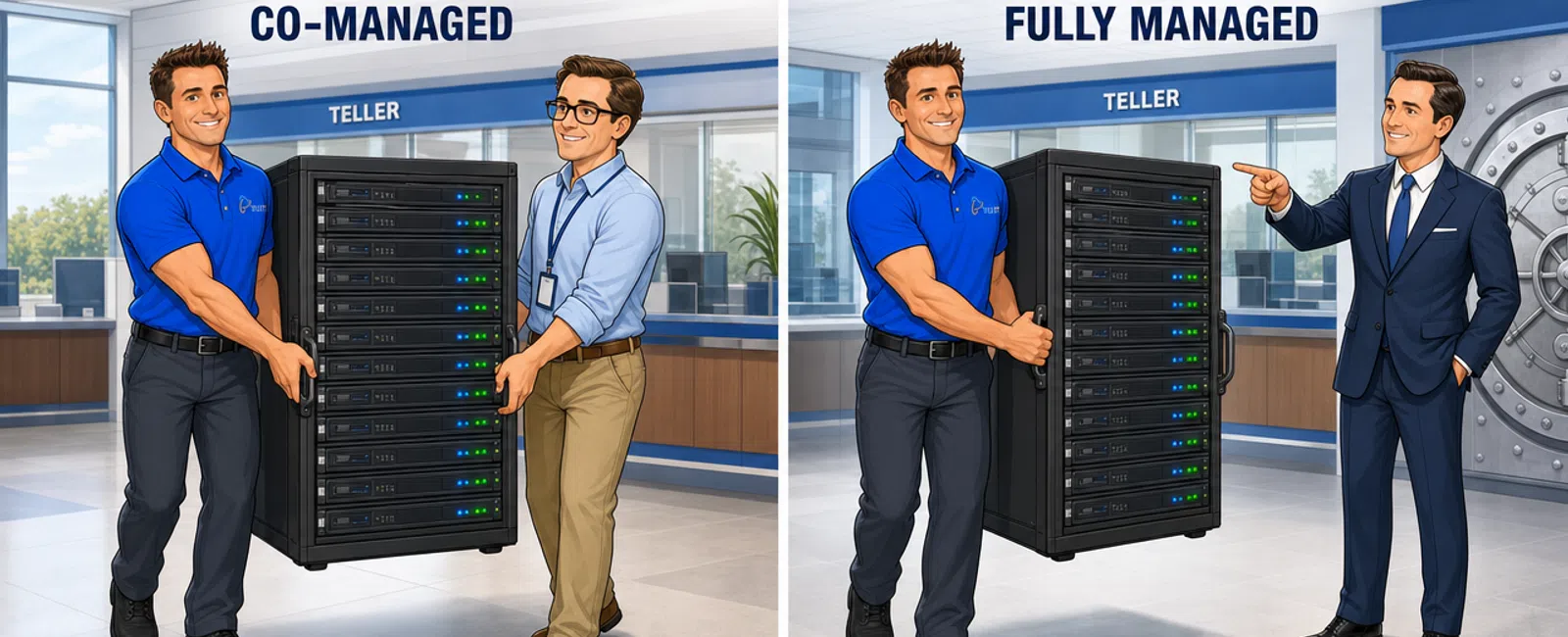
Co-managed IT splits IT responsibilities between your internal team and an external managed service provider (MSP), with typical costs of $75 - $150 per user per month, while fully managed IT outsources all IT operations to an MSP at $100 - $250 per user per month. The key difference lies in control and staffing: co-managed keeps strategic decisions in-house while adding specialized expertise, whereas fully managed replaces your entire IT department.
What Does Co-Managed IT Actually Mean?
Co-managed IT is a hybrid model where your existing IT staff maintains primary responsibility for technology strategy and operations, while an MSP provides supplemental expertise, after-hours support, and specialized services. Your internal team remains the first point of contact for employees.
This model works best for organizations with one to three IT staff members who need backup during vacations, coverage for overnight monitoring, or specialized skills they lack in-house. Your team handles day-to-day requests and strategic planning, while the MSP fills capability gaps.
For Salt Lake City banking institutions, co-managed IT often addresses specific compliance requirements like PCI compliance monitoring or after-hours security operations center (SOC) coverage that smaller internal teams cannot staff 24/7. The Utah Department of Financial Institutions expects continuous monitoring, which co-managed arrangements can provide cost-effectively.
The MSP typically handles network monitoring, security patch management, backup verification, and help desk overflow. Your IT director retains control over vendor relationships, technology roadmaps, and budget decisions.
Co-managed IT preserves institutional knowledge within your organization while adding enterprise-grade capabilities your team couldn't deliver alone.
How Does Fully Managed IT Work Differently?
Fully managed IT means the MSP becomes your complete IT department. They handle everything from help desk tickets and user onboarding to strategic planning and vendor management. You eliminate internal IT payroll entirely.
The MSP assigns a dedicated team to your account, typically including a virtual chief information officer (vCIO) for strategy, engineers for complex projects, and help desk technicians for daily support. You communicate directly with this team through a ticketing system or phone.
For banking institutions in Salt Lake City, fully managed IT providers must understand Federal Reserve requirements, FDIC examination expectations, and Utah state banking regulations. The MSP becomes responsible for demonstrating compliance during audits and maintaining documentation that examiners require.
Response times are contractually defined. 911 IT guarantees IT emergency response within one hour or less, which matters critically when a core banking system fails during business hours or ATM networks go offline.
The MSP proactively monitors your infrastructure 24/7, applies security patches, manages backups, and handles all vendor relationships with software providers and telecommunications carriers. You receive monthly reports on system health, security incidents, and technology recommendations.
Fully managed IT shifts technology from a staffing challenge to a predictable operational expense with flat-rate monthly billing.
Which Model Costs Less for Banking Institutions?
Cost comparison depends entirely on your current staffing. If you employ two full-time IT staff at $70,000 each plus benefits (roughly $100,000 total cost per employee), you're spending $200,000 annually before considering software tools, training, or coverage gaps during vacations.
Co-managed IT at $75 - $150 per user per month for 30 employees runs $27,000 - $54,000 annually, plus your existing IT salaries. This model makes financial sense when your internal team provides most services but needs specialized backup.
Fully managed IT at $100 - $250 per user per month for the same 30 employees costs $36,000 - $90,000 annually and eliminates IT salaries entirely. For organizations under 50 employees, fully managed typically costs 40-60% less than maintaining internal staff while delivering better coverage.
James from a local manufacturing company reported that 911 IT cut his IT expenditures by almost half while improving system reliability after switching from internal staff to fully managed services.
Additional compliance services for banking add $50 - $200 per user per month depending on framework complexity. PCI compliance monitoring, quarterly vulnerability scanning, and audit documentation preparation represent significant cost centers that co-managed arrangements can share between internal and external teams.
The hidden costs of internal IT include recruiting expenses, training for new technologies, redundancy for coverage, and the risk of single points of failure when one person holds all institutional knowledge.
Fully managed IT converts unpredictable capital expenses into predictable operational expenses with transparent flat-rate pricing.
What Level of Control Do You Maintain in Each Model?
Control differences matter significantly for banking institutions where technology decisions carry regulatory implications and affect customer trust. The models distribute decision-making authority very differently.
In co-managed IT, your internal team retains final approval over all changes. The MSP recommends security patches, infrastructure upgrades, or policy changes, but your IT director decides timing and implementation. You control access credentials, vendor contracts, and technology standards.
This preserves your ability to customize solutions for unique banking workflows. If your core banking system requires specific network configurations or your loan origination software needs particular server settings, your internal team maintains that specialized knowledge.
Fully managed IT transfers operational control to the MSP while you retain strategic control. You approve the technology roadmap, budget, and major initiatives, but the MSP executes daily operations independently. They decide which antivirus software to deploy, when to apply patches, and how to configure firewalls within the parameters you've approved.
For Salt Lake City banks, this means the MSP must understand your regulatory environment thoroughly. They need expertise in Utah Department of Financial Institutions examination processes and Federal Reserve expectations to make compliant decisions without constant oversight.
911 IT's co-managed IT services provide a middle ground where banking clients maintain strategic control while gaining access to specialized cybersecurity expertise and 24/7 monitoring capabilities that would be prohibitively expensive to build internally.
The right model depends on whether your institution values hands-on control or prefers delegating technical operations to focus on banking services.
How Do Response Times and Support Quality Compare?
Support quality and response speed differ substantially between models and between providers within each model. These differences directly impact customer service when banking systems fail.
Co-managed IT response depends on which team handles the issue. Your internal staff responds immediately to requests they field directly, while MSP response times apply to after-hours calls or specialized issues escalated to them. This creates potential confusion about who to contact first.
Coordination overhead increases in co-managed arrangements. When a problem spans both teams' responsibilities - like a network issue affecting a banking application - troubleshooting requires communication between your staff and the MSP, potentially extending resolution time.
Fully managed IT provides single-point-of-contact support with contractually guaranteed response times. All requests flow through one help desk, eliminating confusion about who to call. The MSP owns the entire problem from report to resolution.
Provider scale matters significantly here. Large national MSPs often route small banking clients to junior technicians working from ticket queues, with escalation processes that delay resolution. You become one account among thousands.
Regional providers like 911 IT, serving businesses across Utah, Wyoming, and Arizona since 2004, offer a different experience. With a client base sized for personal relationships rather than anonymous ticket processing, every client is known by name. When a Salt Lake City bank calls at 2 AM with a failed backup, they reach engineers who know their environment.
Dianna from an accounting firm noted that after working with 911 IT for over 20 years, "the Help Desk team is prompt to respond and always ensures everything is fully resolved before closing out the request."
The 24/7 helpdesk support and one-hour-or-less emergency response time that 911 IT guarantees applies equally whether you choose co-managed or fully managed services, providing consistent support quality across both models.
Which Model Better Supports Banking Compliance Requirements?
Compliance complexity in banking makes the IT model choice particularly consequential. Federal and state regulators expect continuous monitoring, documented change management, and immediate incident response regardless of which model you choose.
Co-managed IT can create compliance gaps if responsibilities aren't clearly defined. When examiners from the Utah Department of Financial Institutions or FDIC ask who monitors security logs overnight, the answer cannot be ambiguous. Written service level agreements must specify exactly which team handles each compliance requirement.
Documentation becomes more complex in co-managed arrangements. You need to maintain records showing both your internal team's activities and the MSP's work, then consolidate these for examiner review. Policy documentation must clearly delineate responsibilities.
Fully managed IT simplifies compliance by making the MSP responsible for all technical controls. They maintain the security logs, patch documentation, backup verification records, and incident response reports that examiners require. You receive consolidated reporting suitable for audit presentation.
PCI compliance for card processing environments requires particularly rigorous controls. The Payment Card Industry Data Security Standard (PCI DSS) mandates quarterly vulnerability scans, annual penetration testing, continuous log monitoring, and immediate patching of critical vulnerabilities. These requirements don't pause overnight or on weekends.
911 IT's PCI compliance services include the continuous monitoring, quarterly scanning, and documentation that banking institutions need, available in both co-managed and fully managed arrangements. The difference lies in who maintains the documentation and responds to findings.
For smaller community banks and credit unions in Salt Lake City, fully managed IT often proves more reliable for compliance because it eliminates the coordination overhead and ensures no requirements fall between internal and external teams.
The model that best supports your compliance depends on your internal team's expertise with banking regulations and their capacity to manage shared responsibilities.
How to Choose Between Co-Managed and Fully Managed IT
The decision framework starts with honest assessment of your current IT capabilities and future needs. Several factors should guide your choice for a Salt Lake City banking institution.
Choose co-managed IT if you have one or more skilled IT staff members who want to remain employed, your institution values keeping strategic technology decisions entirely in-house, or you have highly specialized banking systems that require daily hands-on management by someone who understands your unique workflows.
Co-managed works well for banks with 100+ employees where the IT workload justifies internal staff but specialized skills like cybersecurity monitoring or compliance management exceed what one or two people can deliver. The MSP fills specific capability gaps rather than replacing your entire function.
Choose fully managed IT if you currently have no IT staff, your existing IT person is retiring or leaving, you're spending more than $100,000 annually on IT salaries for fewer than 50 employees, or you've experienced significant downtime because your solo IT person was unavailable.
Fully managed makes particular sense for community banks and credit unions where technology is critical but not your core competency. You need enterprise-grade security and reliability without enterprise-scale IT budgets.
| Factor | Co-Managed IT | Fully Managed IT |
|---|---|---|
| Best for organization size | 50+ employees with existing IT staff | Under 100 employees or no IT staff |
| Internal IT staffing | 1-3 existing IT employees | Zero IT employees |
| Strategic control | Complete internal control | Client approves strategy, MSP executes |
| Daily operations | Internal team handles most tasks | MSP handles all tasks |
| After-hours coverage | MSP provides backup | MSP provides 24/7 coverage |
| Typical monthly cost (per user) | $75 - $150 plus internal salaries | $100 - $250, no IT salaries |
| Compliance documentation | Shared between teams | MSP maintains all documentation |
| Vendor management | Internal team manages | MSP manages all vendors |
Consider also your growth trajectory. If your bank plans to open additional branches or significantly expand services, fully managed IT scales more easily than hiring and training additional internal staff.
The provider you choose matters as much as the model. Large national MSPs treat small banks as minor accounts, routing you through ticket queues and rotating technicians who don't know your environment. You need a provider scaled appropriately to your institution.
911 IT serves banking institutions across Salt Lake City with both co-managed and fully managed IT services, offering the same 24/7 support, one-hour emergency response, and proactive monitoring regardless of model. Founded in 2004 and serving businesses throughout Utah, Wyoming, and Arizona, 911 IT combines enterprise capabilities with the personal attention that comes from a regional provider where every client genuinely matters.
The right choice aligns your IT model with your institution's size, internal capabilities, and strategic priorities while ensuring regulatory compliance and customer service reliability.
Frequently Asked Questions
Can we switch from co-managed to fully managed IT later?
Yes, most MSPs allow model transitions as your needs change. The switch typically involves knowledge transfer from your internal team to the MSP, updated service agreements, and revised pricing. Transitioning from co-managed to fully managed usually takes 30-60 days for complete handoff. The reverse transition (fully managed to co-managed) requires hiring internal staff before reducing MSP services, which takes longer.
Do fully managed IT providers work with our existing vendors?
Yes, fully managed IT providers coordinate with your existing software vendors, telecommunications carriers, and hardware suppliers. They become your technical point of contact with these vendors, handling support tickets, license management, and contract renewals on your behalf. The MSP maintains vendor relationships while you retain final approval authority over contracts and spending. This vendor management is included in fully managed services.
What happens if our internal IT staff resists co-managed arrangements?
IT staff sometimes perceive co-managed services as threats to job security. Successful implementations frame the MSP as support rather than replacement, handling after-hours coverage and specialized tasks that reduce staff burnout. Clear role definition prevents territorial conflicts. The internal team focuses on strategic projects and user relationships while the MSP handles monitoring and routine maintenance. Resistance usually decreases once staff experience reduced stress from 24/7 responsibility.
How quickly can fully managed IT respond to banking emergencies?
Response time depends on the provider's service level agreement. 911 IT guarantees IT emergency response within one hour or less for critical issues affecting banking operations, such as core banking system failures, network outages, or security incidents. Non-emergency requests receive same-day response during business hours. The 24/7 helpdesk ensures someone answers immediately regardless of when problems occur, critical for banking institutions that cannot tolerate extended downtime during business hours.
Does co-managed IT cost less than fully managed for small banks?
Not typically for banks under 50 employees. Co-managed IT costs $75 - $150 per user monthly plus your existing IT salaries and benefits, while fully managed costs $100 - $250 per user monthly with no IT payroll. For a 30-employee bank, fully managed runs $36,000 - $90,000 annually versus $200,000+ for one full-time IT employee plus co-managed services. Fully managed becomes cost-effective when eliminating IT salaries saves more than the higher per-user fee.