
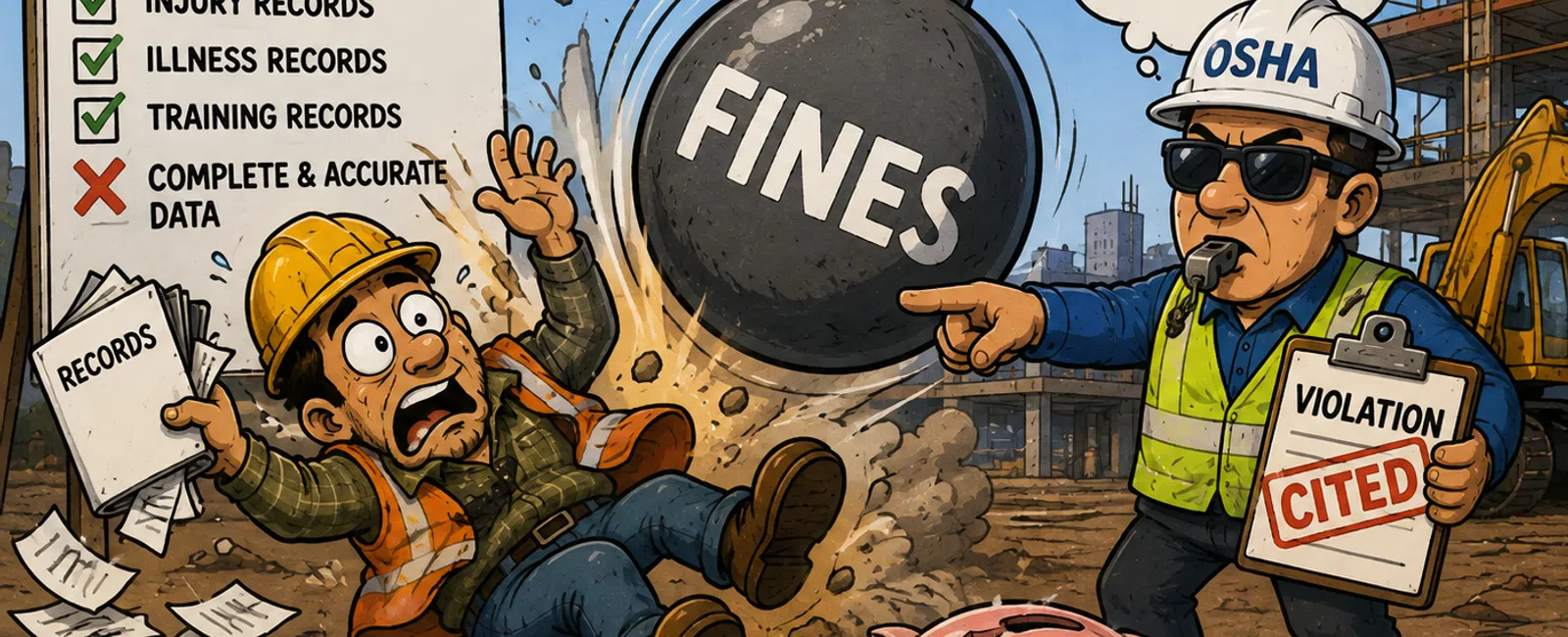
Construction businesses that fail OSHA data requirements compliance face penalties ranging from $1,116 to $15,625 per violation, depending on severity. Willful or repeated violations trigger maximum fines up to $156,259, while serious violations typically result in $15,625 penalties. Beyond financial penalties, non-compliant firms experience increased inspection frequency, potential project shutdowns, and reputational damage that can disqualify them from bidding on federal contracts.
What are OSHA data requirements for construction companies?
OSHA requires construction employers with 11 or more employees to electronically submit injury and illness data annually. This includes Form 300A (Summary of Work-Related Injuries and Illnesses), which must be submitted by March 2 each year for the previous calendar year.
Construction firms with 250 or more employees face expanded reporting obligations. These companies must submit Forms 300, 300A, and 301 through OSHA's Injury Tracking Application (ITA) portal. The data collection helps OSHA identify high-risk worksites and target enforcement resources effectively.
The recordkeeping requirements apply to all construction establishments, including general contractors and specialty trade contractors. Exemptions exist only for companies with 10 or fewer employees and certain low-hazard industries, though construction rarely qualifies for low-hazard classification.
Digital record management systems have become essential for maintaining compliance. Many construction firms now integrate OSHA recordkeeping with their project management software to ensure accurate, timely reporting across multiple job sites.
OSHA data requirements extend beyond annual submissions to include maintaining records for five years and making them available for employee review upon request.
What financial penalties apply to non-compliance?
OSHA's penalty structure adjusts annually for inflation. As of 2024, other-than-serious violations carry penalties up to $15,625 per violation. These apply when violations have a direct relationship to job safety but probably would not cause death or serious physical harm.
Serious violations occur when workplace hazards could cause death or serious physical harm, and the employer knew or should have known about the condition. These violations result in mandatory penalties of up to $15,625 each.
Willful violations where employers knowingly disregard OSHA requirements carry penalties between $11,162 and $156,259 per violation.
Repeated violations of the same standard within five years trigger penalties up to $156,259 per violation. OSHA considers violations repeated even if they occur at different worksites owned by the same company.
Failure-to-abate penalties apply when employers do not correct previous violations by the deadline. These penalties can reach $15,625 per day beyond the abatement date until the hazard is corrected.
Construction companies operating across multiple states face compounded risk. A single compliance failure affecting multiple job sites can result in separate citations and penalties for each location.
Financial penalties represent only the direct costs; indirect costs include legal fees, increased insurance premiums, and administrative burden of appeals or compliance negotiations.
How does non-compliance affect project operations?
OSHA can issue stop-work orders for imminent danger situations, halting all operations until hazards are corrected. This creates cascading delays affecting project timelines, subcontractor schedules, and contractual delivery dates.
General contractors face liability exposure when their subcontractors violate OSHA standards. Multi-employer worksite doctrine means GCs can be cited for hazards created by subcontractors if they fail to exercise reasonable care to detect and abate violations.
Project owners increasingly require OSHA compliance documentation before releasing progress payments. Non-compliance can trigger payment holds, straining cash flow and working capital for construction firms operating on thin margins.
Insurance carriers review OSHA citation history during underwriting and renewal processes. Multiple violations or serious citations lead to premium increases, coverage restrictions, or policy non-renewal, making it difficult to bid competitively on bonded projects.
Federal construction projects require contractors to maintain OSHA compliance as a contract condition. Violations can result in contract termination, debarment from future federal work, and damage to relationships with government agencies.
The administrative burden of responding to OSHA inspections diverts management attention from productive activities. Investigations require document production, employee interviews, and coordination with safety consultants or legal counsel.
Non-compliance creates operational disruptions that extend far beyond the immediate citation, affecting profitability and competitive positioning.
What are the reputational and business development consequences?
OSHA maintains a public database of citations and penalties searchable by company name. Prospective clients, project owners, and partners routinely review this data during vendor qualification and prequalification processes.
Construction firms with poor safety records face disqualification from bidding on projects where owners prioritize safety performance. Many private developers and institutional clients now include Experience Modification Rate (EMR) thresholds and OSHA incident rate requirements in their bid specifications.
Serious violations or fatalities generate media attention that damages brand reputation. Local news coverage of OSHA citations appears in search results, creating lasting negative impressions with potential clients and employees.
Subcontractors and trade partners become reluctant to work with general contractors who have compliance issues. The best subcontractors prioritize their own safety records and avoid projects that could expose them to citations under multi-employer worksite rules.
Talent recruitment suffers when construction companies develop reputations for unsafe worksites. Skilled tradespeople and project managers increasingly research employer safety records before accepting positions, and top talent gravitates toward firms with strong safety cultures.
Industry associations and bonding companies track OSHA compliance as part of their member evaluation and surety underwriting processes. Poor compliance history limits access to the bonding capacity required for larger projects.
Reputational damage from OSHA violations creates long-term business development obstacles that persist even after violations are corrected and fines are paid.
How can construction IT systems prevent compliance failures?
Modern construction management platforms integrate OSHA recordkeeping modules that automate data collection from job sites. These systems capture incident reports in real-time, ensuring accurate documentation and eliminating the manual errors that lead to compliance failures.
Cloud-based safety management systems enable field supervisors to log injuries and near-misses immediately using mobile devices. This creates timestamped records with photo documentation, GPS coordinates, and witness statements that support both OSHA reporting and insurance claims.
Automated reminder systems alert safety managers of upcoming OSHA submission deadlines. Calendar integration and workflow automation ensure Form 300A submissions occur by the March 2 deadline, preventing failure-to-report violations.
Document management systems maintain the five-year retention requirement for OSHA records while providing instant access during inspections. Centralized digital storage eliminates the risk of lost paperwork and enables quick response to OSHA information requests.
Managed IT services ensure construction firms maintain secure, backed-up access to compliance data even when job site offices experience equipment failures or weather-related disruptions.
Integration between safety management software and project management platforms creates visibility into compliance status across all active job sites. Dashboard reporting allows executives to identify compliance risks before they escalate into violations.
Data backup and disaster recovery solutions protect critical OSHA records from loss due to hardware failures, ransomware attacks, or natural disasters. Business continuity services ensure compliance documentation remains accessible even during system outages.
Reliable IT infrastructure transforms OSHA compliance from a manual, error-prone process into an automated system that reduces risk and administrative burden.
What steps should construction firms take after a compliance failure?
Immediately respond to OSHA citations within the 15-business-day contest period. Failing to respond constitutes acceptance of the citation and penalty, eliminating appeal options and establishing the violation as fact in any subsequent litigation.
Conduct a comprehensive internal audit of all job sites to identify similar violations before OSHA expands its inspection scope. Proactive correction demonstrates good faith and can reduce penalties during settlement negotiations.
Implement corrective actions that address root causes rather than symptoms. OSHA evaluates the adequacy of abatement measures, and superficial fixes invite follow-up inspections and failure-to-abate citations.
Document all corrective actions with photos, receipts, training records, and policy updates. This evidence supports abatement certification and demonstrates commitment to compliance if OSHA conducts follow-up inspections.
- Review and update safety programs to reflect current OSHA standards
- Revise training protocols to address identified gaps
- Implement new recordkeeping procedures with automated tracking
- Establish regular internal audit schedules for all job sites
- Assign dedicated safety personnel with clear accountability
Consider engaging safety consultants or legal counsel experienced in OSHA matters. Professional guidance helps navigate the appeals process, negotiate penalty reductions, and implement sustainable compliance improvements.
Communicate transparently with employees, subcontractors, and clients about corrective actions. Demonstrating accountability and commitment to improvement helps mitigate reputational damage and maintains stakeholder confidence.
Invest in technology infrastructure that supports ongoing compliance. Construction IT support specialists can implement systems that prevent future violations through automation, monitoring, and centralized data management.
Post-violation response determines whether a compliance failure becomes an isolated incident or the beginning of a pattern that triggers escalating penalties and business consequences.
Frequently asked questions
Can OSHA shut down a construction project immediately?
Yes, OSHA can issue imminent danger orders that immediately halt work when conditions pose immediate risk of death or serious physical harm. The stop-work order remains in effect until the employer eliminates the hazard and OSHA confirms abatement. Projects cannot resume until compliance is verified, creating significant schedule and financial impacts for all parties.
Do OSHA violations affect bonding capacity for construction firms?
OSHA violations directly impact surety bonding decisions. Bonding companies review safety records during underwriting, and serious violations or patterns of non-compliance reduce available bonding capacity or increase bonding costs. Poor safety records signal operational risk that sureties factor into their exposure calculations, potentially limiting the size of projects a contractor can bond.
How long do OSHA citations remain on a company's record?
OSHA citations remain in the public database permanently, though violations are considered "repeated" only within five years of the final order date. The public searchable database maintains historical citation information indefinitely, meaning prospective clients and partners can review a company's complete compliance history regardless of how much time has passed since violations occurred.
Are small construction companies exempt from OSHA data reporting?
Construction companies with 10 or fewer employees are exempt from routine OSHA recordkeeping and electronic reporting requirements. However, all construction employers regardless of size must comply with OSHA safety standards and can be inspected and cited for violations. The recordkeeping exemption does not provide immunity from enforcement actions or penalties for hazardous conditions.
Can construction firms appeal OSHA penalties and citations?
Construction firms have 15 business days from citation receipt to file a notice of contest with OSHA. The appeal process involves the Occupational Safety and Health Review Commission, an independent agency that adjudicates disputes. During the appeal process, cited violations and penalties are stayed, and employers are not required to pay penalties until the case is resolved.


