
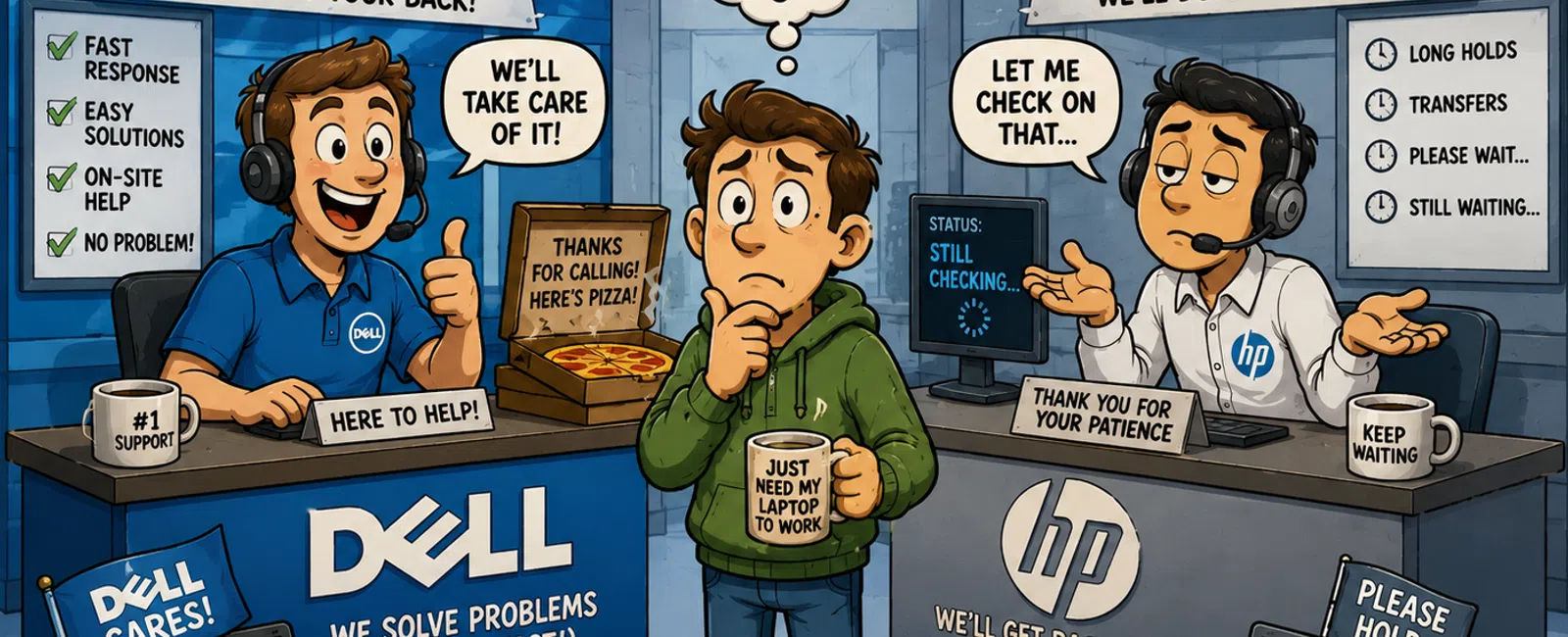
Dell and HP both provide manufacturer warranty support with typical response times of 24-48 hours for business-class systems, but neither specializes in healthcare IT needs. For Salt Lake City medical practices requiring HIPAA-compliant infrastructure, EHR optimization, and immediate response to patient-impacting outages, a healthcare-focused managed IT provider like 911 IT delivers superior outcomes with 24/7 monitoring, proactive maintenance, and HIPAA compliance expertise that hardware manufacturers cannot match.
What Are the Key Differences Between Dell and HP Support?
Dell and HP offer tiered support packages tied to hardware purchases. Both companies provide next-business-day onsite service for their ProSupport and Care Pack tiers, respectively. Dell's ProSupport Plus includes predictive issue detection, while HP's Proactive Care monitors device health.
The fundamental limitation: both focus exclusively on their own hardware. If your practice uses Dell workstations but HP printers, network equipment from Cisco, and an EHR system like Epic or athenahealth, you'll need multiple support contracts. Neither company addresses software integration, network security, or compliance requirements.
Response time varies dramatically by support tier. Basic warranty support often means phone queues and remote-only troubleshooting. Premium tiers reduce wait times but still operate within manufacturer business hours for non-critical issues.
For healthcare environments where a downed workstation means delayed patient care and potential HIPAA documentation gaps, manufacturer support leaves critical vulnerabilities. Sarah, a Salt Lake City healthcare provider, experienced this firsthand when multiple techs failed to resolve phone line issues that were disrupting patient communication. After 911 IT responded within a few hours and fixed the problem immediately, she noted the company "took the time to LOOK what was wrong instead of just glancing at the issues and bidding us out at thousands of dollars."
Manufacturer support excels at hardware replacement but lacks the holistic view healthcare IT demands.
How Do Response Times Compare for Healthcare Emergencies?
Dell's ProSupport offers 24/7 phone access with a target of four-hour response for critical issues on premium contracts. HP's comparable tier promises similar timelines. Both define "critical" narrowly - typically complete system failure affecting multiple users.
A single workstation freezing during patient intake may not qualify as critical to Dell or HP, but it's an emergency for your front desk staff. EHR performance degradation, printer failures preventing prescription printing, or patient portal connectivity issues rarely meet manufacturer thresholds for expedited response.
Healthcare practices lose an average of $8,000 per hour during EHR downtime, yet manufacturer support often categorizes these as non-critical tickets.
Managed IT providers specializing in healthcare understand clinical workflows. When Ying's healthcare practice partnered with 911 IT, the team's proactive approach meant they "don't just fix problems; they prevent them, which gives us real confidence in our IT operations." This prevention-focused model reduces emergency calls by identifying issues before they impact patient care.
Geographic proximity matters for onsite support. Dell and HP dispatch third-party technicians who may lack familiarity with your specific environment. A local healthcare IT provider in Salt Lake City maintains relationships with your staff, understands your EHR configuration, and arrives with institutional knowledge that accelerates resolution.
For true healthcare emergencies, specialized IT support delivers faster, more contextual responses than manufacturer warranties.
Which Provider Understands HIPAA Compliance Requirements?
Neither Dell nor HP acts as a HIPAA Business Associate for IT support services. Their warranties cover hardware repair and replacement, not the security configurations, encryption standards, or audit logging required for PHI protection.
Dell and HP sell HIPAA-capable hardware, but configuration responsibility falls entirely on your practice. A Dell workstation arrives with Windows installed but no encryption enabled, no automatic screen locks configured, and no audit trails active. HP printers include security features, but someone must enable pull-printing, disable USB ports, and configure encrypted transmission.
Manufacturer support technicians accessing your systems for repairs may not sign Business Associate Agreements. If a Dell tech remotely logs into a workstation displaying patient records, you've potentially created a HIPAA violation without proper documentation.
Healthcare-focused IT providers sign BAAs covering all support activities. They configure devices to HIPAA standards before deployment, maintain audit logs of all access, and document security measures for OCR compliance reviews. When Utah's Health Data Authority or federal regulators request evidence of safeguards, manufacturer invoices don't satisfy compliance requirements.
Kris, a healthcare client, appreciated 911 IT's initiative to "identify and fix issues beyond what I initially asked for" with clear communication about security improvements. This proactive compliance approach prevents violations rather than reacting to breaches.
For Salt Lake City practices serving patients across Utah, Wyoming, and Arizona - each with distinct telehealth and privacy regulations - compliance expertise becomes essential. Dell and HP provide hardware; healthcare IT partners provide compliant infrastructure.
What About Multi-Vendor Environment Support?
Modern medical practices operate complex technology ecosystems. Your EHR runs on Dell servers, staff use HP workstations, you've deployed Cisco networking equipment, rely on Microsoft 365 for email, use a cloud-based practice management system, and maintain both on-premise and cloud backups.
Dell support handles Dell equipment. HP support handles HP equipment. When your EHR slows to a crawl, is it the Dell server, HP workstation, network configuration, internet connection, or software issue? Manufacturer support can't diagnose cross-vendor problems.
Integration issues plague healthcare IT. Your EHR must interface with lab systems, imaging equipment, e-prescribing platforms, patient portals, and billing clearinghouses. When HL7 messages fail to transmit, Dell and HP support will confirm their hardware functions properly - then close the ticket without resolving your actual problem.
Comprehensive managed IT services provide single-point-of-contact support regardless of which vendor manufactured the failing component. Your staff calls one number, describes the symptom, and receives coordinated troubleshooting across your entire infrastructure.
This holistic approach extends to strategic planning. As your practice grows, a healthcare IT partner recommends compatible equipment, ensures new purchases integrate with existing systems, and maintains performance across your entire environment. Manufacturer reps sell their products without regard for your broader technology strategy.
Multi-vendor environments demand vendor-agnostic support that manufacturers cannot provide.
How Does Proactive Maintenance Compare to Break-Fix Support?
Dell and HP support operates reactively. You call when something breaks. They dispatch a technician or ship a replacement part. The device gets repaired, and you resume operations until the next failure.
This break-fix model creates predictable patterns: workstations slow as hard drives fill, servers crash when memory reaches capacity, network switches fail without warning after years of operation. Each incident disrupts clinical workflows, frustrates staff, and potentially compromises patient care.
Proactive IT management monitors systems continuously, identifying problems before they cause outages. Disk space alerts trigger cleanup before drives fill. Memory utilization trends prompt upgrades before crashes occur. Firmware updates patch vulnerabilities before exploitation.
For healthcare practices, prevention directly impacts patient experience. When appointment scheduling slows because workstations need maintenance, patients wait longer. When the practice management system crashes during billing cycles, revenue collection delays. When ransomware encrypts patient records because patches weren't applied, practices face devastating operational and regulatory consequences.
911 IT's 24/7 monitoring and proactive approach means issues get resolved before clinical staff notice problems. The company's Process-Driven Excellence methodology systematically addresses potential failures rather than waiting for emergencies.
Intermountain Healthcare, University of Utah Health, and other major Salt Lake City health systems invest heavily in proactive IT management. Smaller practices deserve the same preventive approach that manufacturer warranties cannot deliver.
What's the True Cost Comparison for Healthcare Practices?
Dell ProSupport Plus costs approximately $200-400 per device annually for comprehensive coverage. HP Care Pack Premium ranges similarly. For a 10-person practice with 15 devices, annual manufacturer support costs $3,000-6,000.
This covers hardware repair only. Add software support, network management, cybersecurity, HIPAA compliance, help desk services, and strategic IT planning, and practices need additional vendors. Coordinating multiple contracts, managing separate invoices, and troubleshooting vendor finger-pointing adds hidden administrative costs.
Managed IT services consolidate everything under predictable flat-rate pricing. Industry-standard fully managed IT services for healthcare practices typically range $100-250 per user monthly, encompassing hardware support, software management, security, compliance, help desk, and strategic guidance.
The cost difference narrows considerably when comparing comprehensive coverage. More importantly, managed IT delivers measurable value through reduced downtime, prevented security incidents, and maintained compliance. A single ransomware attack costs healthcare practices an average of $1.4 million in recovery, regulatory fines, and lost revenue - far exceeding annual IT investment.
Sarah's experience demonstrates cost efficiency: after previous techs proposed "thousands of dollars" in unnecessary work, 911 IT fixed her phone system immediately, saving substantial expense while restoring critical patient communication capabilities.
For Salt Lake City practices balancing quality care with operational efficiency, comprehensive IT support provides better value than fragmented manufacturer warranties.
Why Do Healthcare Practices Need Specialized IT Partners?
Clinical workflows differ fundamentally from general business operations. Medical practices can't tolerate downtime during patient appointments. EHR systems require specific performance tuning. Telehealth platforms demand reliable connectivity and HIPAA-compliant video conferencing. E-prescribing integrations must function flawlessly to prevent medication errors.
Dell and HP technicians receive training on hardware repair, not healthcare operations. They don't understand why a two-minute delay printing prescriptions creates patient safety risks. They can't optimize EHR database performance or troubleshoot HL7 interface failures.
Utah's growing healthcare sector, with expanding telehealth services reaching rural Wyoming communities and Arizona's retirement populations, creates unique IT demands. Practices need partners who understand multi-state compliance requirements, rural connectivity challenges, and the specific EHR systems prevalent in the region.
Healthcare IT providers maintain relationships with EHR vendors, understand practice management software intricacies, and stay current on changing compliance requirements. When meaningful use requirements evolve or OCR issues new guidance, specialized partners proactively update your systems rather than waiting for audit findings.
The 911 IT team's healthcare expertise enables them to support EHR and practice management software specifically, addressing the clinical technology needs that hardware manufacturers ignore. Their business continuity services ensure patient care continues even during disasters - a capability far beyond manufacturer warranties.
Healthcare practices deserve IT partners who understand medicine, not just machines.
Dell vs HP Support: Quick Comparison for Healthcare Practices
| Feature | Dell ProSupport | HP Care Pack | Healthcare Managed IT |
|---|---|---|---|
| Response Time (Critical) | 4-hour target | 4-hour target | Immediate for patient-impacting issues |
| HIPAA BAA Coverage | No | No | Yes, all support activities |
| EHR Support | Hardware only | Hardware only | Full software and integration support |
| Multi-Vendor Support | Dell products only | HP products only | All vendors and systems |
| Proactive Monitoring | Limited device health | Limited device health | 24/7 comprehensive monitoring |
| Compliance Documentation | Not included | Not included | Full audit trails and reporting |
| Cost per Device/User | $200-400/device annually | $200-400/device annually | $100-250/user monthly (all-inclusive) |
Frequently Asked Questions
Does Dell or HP offer better warranty coverage for medical offices?
Both Dell and HP offer comparable warranty tiers for business-class equipment, with next-business-day onsite service available through premium packages. However, neither provides healthcare-specific support, HIPAA compliance assistance, EHR optimization, or multi-vendor troubleshooting. For medical offices, comprehensive managed IT services deliver superior outcomes by addressing clinical workflows, compliance requirements, and integrated technology ecosystems that hardware warranties alone cannot support.
Can manufacturer support handle HIPAA compliance requirements?
No, Dell and HP support focuses exclusively on hardware repair and replacement, not HIPAA compliance configuration or Business Associate Agreement coverage. Manufacturer technicians may access systems containing PHI without proper BAAs, creating compliance risks. Healthcare practices need IT partners who sign BAAs, configure devices to HIPAA standards, maintain audit logs, implement encryption and access controls, and document security measures for regulatory reviews and OCR audits.
How quickly can Dell or HP respond to EHR system problems?
Dell and HP support hardware issues only, not EHR software problems. If your EHR runs slowly due to server hardware failure, manufacturer support can replace components within their contracted timeframe. However, EHR performance issues typically involve database optimization, network configuration, software updates, or integration problems that hardware manufacturers don't address. Healthcare IT providers with EHR expertise diagnose and resolve the actual cause rather than just confirming hardware functionality.
What happens when problems involve multiple vendors?
Manufacturer support handles only their own products, creating finger-pointing when issues span multiple vendors. If your Dell server, HP workstation, Cisco network, and cloud-based EHR all function individually but don't work together properly, you'll coordinate separate support calls without integrated troubleshooting. Managed IT providers offer single-point-of-contact support, diagnosing cross-vendor problems and coordinating solutions across your entire technology infrastructure regardless of manufacturer.
Is managed IT support more expensive than manufacturer warranties?
Manufacturer warranties cost $200-400 annually per device for comprehensive coverage but include only hardware repair. When adding necessary services like software support, cybersecurity, compliance management, help desk, and strategic planning through separate vendors, total costs often exceed managed IT services. Comprehensive managed IT typically ranges $100-250 per user monthly, consolidating all technology needs under predictable flat-rate pricing while delivering proactive maintenance, security, and compliance that prevent costly incidents and downtime.


