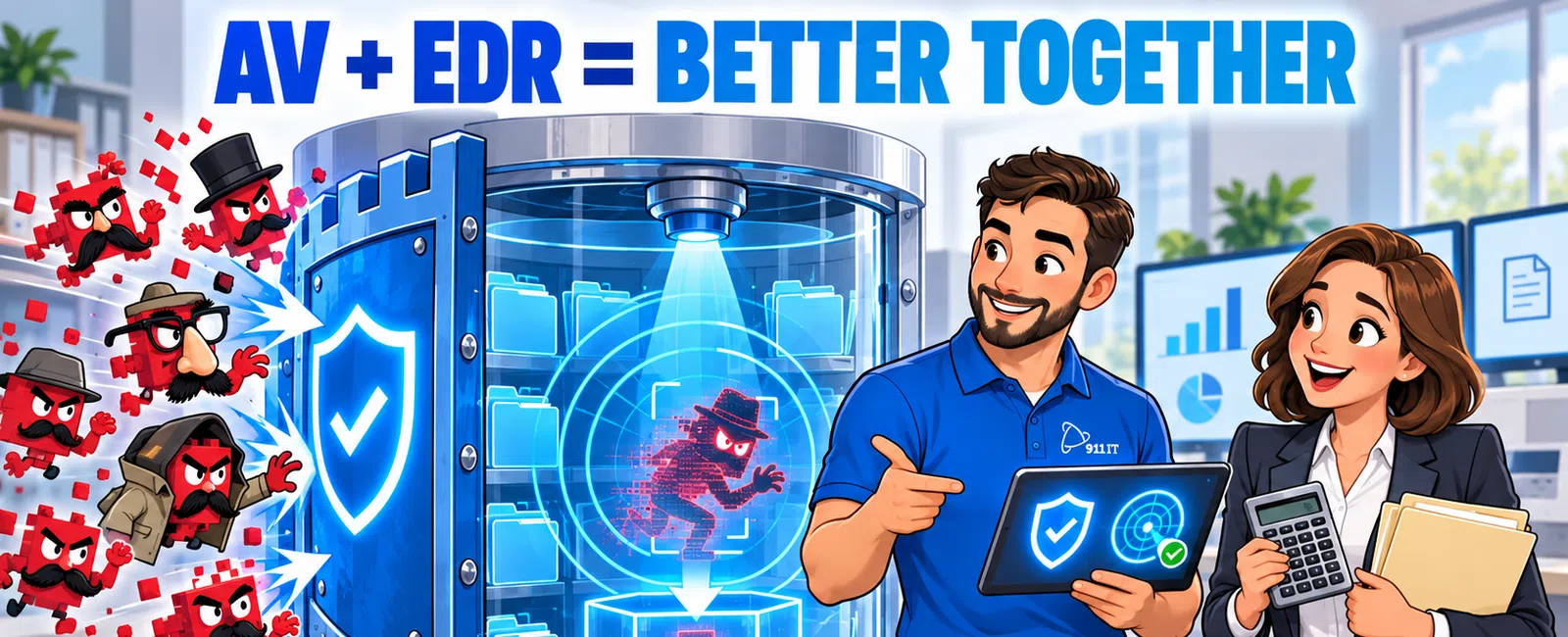
Yes, you need both EDR and traditional antivirus for comprehensive protection. While EDR excels at detecting sophisticated threats through behavioral analysis, traditional antivirus blocks 85-95% of known malware signatures at the perimeter with minimal system resources. For CPA firms handling sensitive client data in Salt Lake City, this dual-layer approach ensures compliance with IRS Publication 4557 safeguarding requirements while preventing both common and advanced threats.
What Is the Difference Between EDR and Traditional Antivirus?
Traditional antivirus operates on signature-based detection, comparing files against a database of known malware patterns. It's fast, efficient, and excellent at blocking common threats before they execute.
EDR takes a behavioral approach, monitoring endpoint activity in real-time to detect anomalies that suggest an attack. It records forensic data, tracks lateral movement across your network, and enables security teams to investigate and respond to incidents.
Think of antivirus as a lock on your front door - it stops known threats from entering. EDR is the security camera system that watches for suspicious behavior once someone's inside, tracks their movements, and helps you understand what happened during a break-in.
For accounting firms during tax season, this distinction matters enormously. When you're processing hundreds of 1040s and 1120s with remote access enabled for staff working from home, you need both the perimeter defense and the internal monitoring.
EDR solutions typically cost between $25 and $75 per user monthly as an add-on to managed services, while traditional antivirus is often included in comprehensive managed IT packages.
Both technologies serve distinct security functions that complement rather than replace each other.
Why Do Security Professionals Recommend Both?
Cybercriminals use a tiered attack strategy. Common malware variants - the kind used in mass phishing campaigns - are efficiently blocked by signature-based antivirus at minimal system resource cost.
Sophisticated attacks, including zero-day exploits and fileless malware, bypass signature detection entirely. These threats require the behavioral analysis and threat hunting capabilities that only EDR provides.
Dianna, who has worked with 911 IT's accounting clients for over 20 years, notes that layered security prevented a ransomware incident at a Utah CPA firm last tax season. The antivirus blocked the initial phishing attachment, while EDR flagged the unusual PowerShell activity when an employee accidentally enabled macros on a different document.
Utah's data breach notification law (Utah Code § 13-44-202) requires CPA firms to report breaches of taxpayer data. A single-layer defense creates unnecessary legal and reputational risk.
The FBI's Internet Crime Complaint Center reported that business email compromise attacks cost victims over $2.7 billion in 2023, with professional services firms among the top targets.
Relying solely on EDR leaves your network vulnerable to the 85-95% of attacks that traditional antivirus blocks efficiently at the perimeter.
Layered defense reduces both the volume of threats reaching your EDR system and the alert fatigue experienced by security teams.
What Are the Risks of Using Only EDR?
EDR systems generate high volumes of alerts that require skilled analysis. Without antivirus filtering out routine threats first, your security team - or your MSP's SOC - drowns in false positives and low-priority alerts.
Known malware that antivirus would block instantly may execute briefly before EDR behavioral rules trigger. In that window, ransomware can encrypt files, or info-stealers can exfiltrate engagement files and client data.
EDR solutions consume more system resources than lightweight antivirus. Running EDR as your only protection means every single file interaction triggers behavioral analysis, slowing workstation performance during intensive tasks like reconciling general ledgers or running trial balances in QuickBooks.
For CPA firms with seasonal staff who lack security awareness training, the risk multiplies. An employee opening a malicious Excel macro during busy season could trigger a breach before EDR completes its analysis and response workflow.
Most cyber insurance policies explicitly require both endpoint protection (antivirus) and advanced threat detection (EDR) for coverage. Using only one may void your policy or dramatically increase premiums.
Salt Lake City firms serving clients across Utah, Wyoming, and Arizona face multi-state compliance complexity. Wyoming's lack of comprehensive data breach laws doesn't eliminate your liability when handling client data from Utah residents.
The cost difference between antivirus-only and layered protection is minimal compared to the average $4.45 million cost of a data breach in 2023.
What Are the Risks of Using Only Antivirus?
Traditional antivirus cannot detect zero-day exploits - vulnerabilities that attackers discover before vendors release patches. These attacks have no signature to match against the antivirus database.
Fileless malware operates entirely in memory, never writing to disk. Since antivirus scans files, it cannot detect threats that exist only as malicious processes or registry modifications.
Advanced persistent threats (APTs) use legitimate system tools like PowerShell, Windows Management Instrumentation, and Remote Desktop Protocol. Antivirus sees these as normal administrative activity, while EDR detects the abnormal patterns in how they're being used.
Ransomware gangs increasingly use "living off the land" techniques, leveraging built-in Windows utilities to avoid antivirus detection. The 2023 Veeam Ransomware Trends Report found that 76% of attacks now use these evasion tactics.
When an attack succeeds, antivirus provides no forensic data. You'll know you were breached, but not how the attacker entered, what data they accessed, how long they were in your network, or whether they left backdoors for future access.
For CPA firms, this lack of forensic capability creates serious problems. IRS Circular 230 requires practitioners to take reasonable steps to ensure tax return data confidentiality. Without EDR's audit trail, you cannot demonstrate due diligence or determine breach scope.
Utah's breach notification law requires firms to notify affected individuals "without unreasonable delay." EDR's forensic timeline helps you meet this legal obligation; antivirus alone leaves you guessing.
How Should CPA Firms in Salt Lake City Implement Layered Security?
Start with enterprise-grade antivirus deployed across all endpoints - workstations, servers, and any device accessing client data or your practice management software. Ensure automatic updates and real-time scanning are enabled.
Layer EDR on top, configured with behavioral rules tuned for accounting workflows. Generic EDR rules may flag legitimate batch processing during month-end close or tax season e-filing as suspicious activity.
Integrate both solutions with a Security Information and Event Management (SIEM) system that correlates alerts. This prevents alert fatigue and ensures your security team - whether internal or your MSP - can prioritize genuine threats.
Implement multi-factor authentication on all remote access points. EDR detects suspicious activity after authentication; MFA prevents unauthorized access in the first place.
Establish secure file sharing protocols for engagement files and client data. Many breaches occur when CPAs email unencrypted tax documents or use consumer file-sharing services without business-grade security.
For firms using specialized accounting IT support, ensure your provider offers 24-7 security monitoring. Tax season attacks often occur outside business hours when firms are least prepared to respond.
Schedule quarterly security assessments that test both your antivirus and EDR effectiveness. Threat landscapes evolve rapidly; your defenses must adapt accordingly.
Train staff on phishing recognition and secure data handling. Technology alone cannot protect against social engineering attacks that trick employees into disabling security tools.
- Deploy enterprise-grade antivirus across all endpoints with automatic updates enabled
- Add EDR with behavioral rules configured for accounting workflows
- Integrate both solutions with SIEM for correlated alert management
- Enable multi-factor authentication on all remote access points
- Establish secure file sharing protocols for client data
- Ensure 24-7 security monitoring coverage during tax season
- Conduct quarterly security assessments and penetration testing
- Train staff quarterly on phishing recognition and secure data handling
Layered security works best when combined with robust backup and disaster recovery, ensuring you can restore operations even if ransomware bypasses all defenses.
Who Provides Integrated Antivirus and EDR for Salt Lake City CPA Firms?
Several providers serve the Salt Lake City accounting sector with varying approaches to endpoint security.
Executech offers enterprise-focused IT services with comprehensive security stacks. Wasatch I.T. provides managed security services for mid-market firms. Nexus IT Consultants specializes in compliance-driven security for regulated industries.
INTELITECHS delivers cybersecurity consulting with emphasis on risk assessment. ProLink IT focuses on healthcare and financial services security. Qual IT provides managed detection and response services.
Large national MSPs offer standardized security packages but often treat small CPA firms as one account among thousands. Your urgent tax-season security incident may wait in a queue behind hundreds of other tickets, escalating through multiple support tiers before reaching someone who understands accounting workflows.
911 IT provides integrated cybersecurity services specifically configured for CPA firms across Utah, Wyoming, and Arizona. Their 24-7 live support means security alerts during tax season receive immediate attention from technicians who understand the urgency of engagement deadlines.
With a 100% Satisfaction Guarantee and proactive monitoring, 911 IT ensures both your antivirus and EDR layers function cohesively. Their flat-rate transparent pricing eliminates surprise bills when security incidents require extended response time.
Garry, an engineering firm client, notes that 911 IT's team handled advanced security compliance needs with no major outages, allowing his firm to focus on core business without building an internal IT department - the same benefit CPA firms need during busy season.
For firms managing sensitive client data across multiple states, 911 IT's understanding of Utah's regulatory environment and cross-border compliance requirements provides peace of mind that generic national providers cannot match.
The right provider treats your firm as a valued partner, not ticket number 47,293 in a national queue.
Frequently Asked Questions
Is EDR considered antivirus?
No, EDR is not traditional antivirus. While both protect endpoints, antivirus uses signature-based detection to block known malware, whereas EDR monitors behavioral patterns to detect sophisticated threats and provides forensic investigation capabilities. EDR complements rather than replaces antivirus. Most security frameworks recommend deploying both technologies in a layered defense strategy for comprehensive protection against both common and advanced threats.
Does EDR detect malware?
Yes, EDR detects malware through behavioral analysis rather than signature matching. It identifies malicious activity patterns like unusual file encryption, abnormal network connections, or suspicious process execution. EDR excels at detecting zero-day exploits, fileless malware, and advanced persistent threats that evade traditional antivirus. However, it may allow brief execution before behavioral rules trigger, which is why pairing EDR with antivirus provides optimal protection.
Is antivirus still necessary in 2026?
Yes, antivirus remains essential in 2026 despite advances in EDR and AI-driven security. Signature-based antivirus efficiently blocks 85-95% of known malware at the perimeter with minimal system resource consumption. This prevents routine threats from overwhelming your EDR system with alerts. Cyber insurance policies typically require both antivirus and advanced threat detection for coverage. Layered security combining antivirus and EDR provides the most cost-effective protection.
What happens during tax season if my security fails?
A security breach during tax season can halt operations entirely, preventing e-filing and client service while you contain the incident. You face mandatory breach notification under Utah law, potential IRS penalties under Circular 230, malpractice liability, and reputational damage that drives clients to competitors. Recovery costs average over $4 million including forensic investigation, legal fees, notification expenses, and lost billable hours. Layered antivirus and EDR protection significantly reduces this risk.
How much does layered security cost for a CPA firm?
Comprehensive managed IT services including both antivirus and EDR typically cost $100-$250 per user monthly, depending on firm size and compliance requirements. Cybersecurity add-ons with EDR, monitoring, and security awareness training range from $25-$75 per user monthly. For a ten-person CPA firm, expect $1,250-$3,250 monthly for complete protection. This investment is minimal compared to breach costs averaging over $4 million or the reputational damage from losing client trust.