
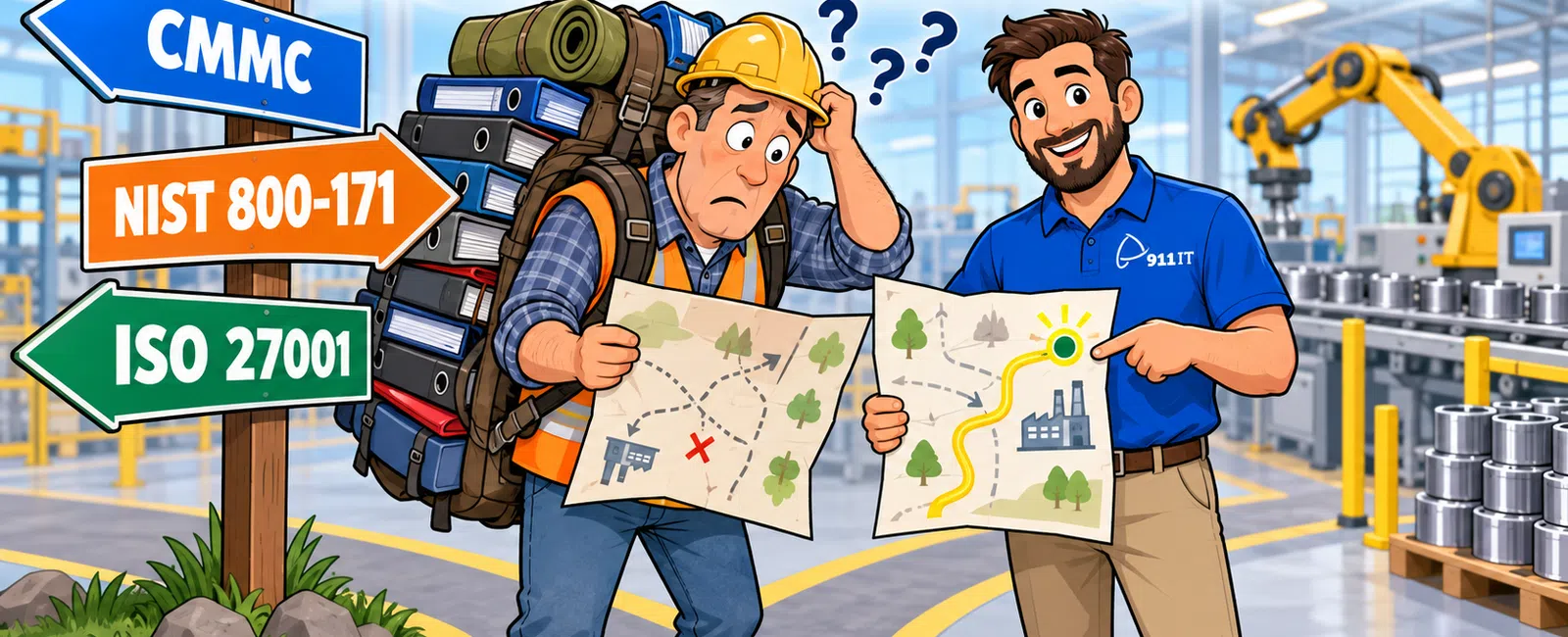
Which Cybersecurity Framework Applies to Your Manufacturing Company?
A manufacturing company may need CMMC, NIST SP 800-171, ISO/IEC 27001, the NIST Cybersecurity Framework or a combination of frameworks. The correct choice depends primarily on the information you handle, the contracts you accept, the customers you serve and the risks present in your technology environment.
Manufacturers that process, store or transmit Federal Contract Information or Controlled Unclassified Information should review their federal and defense-contract obligations immediately. A manufacturer without government contracts may still benefit from the NIST Cybersecurity Framework as a practical security roadmap. ISO/IEC 27001 may be appropriate when customers, international partners or company leadership want a formal information security management system that can be independently certified.
The first step is not buying more security software. It is identifying which information enters your organization, where it is stored, who can access it and which contractual requirements follow that information.
This guide explains how five common cybersecurity approaches apply to manufacturers and provides a practical process for selecting the right one. Because cybersecurity requirements and government contracting rules change, manufacturers should verify current obligations with their contracting officer, legal counsel, compliance advisor and qualified cybersecurity provider.
Cybersecurity Frameworks at a Glance
| Framework or requirement | Common reason a manufacturer uses it | Certification required? |
|---|---|---|
| CMMC | Required by applicable Department of Defense contracts involving Federal Contract Information or Controlled Unclassified Information | Depends on the applicable contract, level and current implementation requirements |
| NIST SP 800-171 | Protecting Controlled Unclassified Information in nonfederal systems | NIST does not certify organizations; contracts and assessment programs may require evidence of implementation |
| NIST Cybersecurity Framework | Building a flexible, risk-based cybersecurity program | No |
| ISO/IEC 27001 | Establishing a formal information security management system and demonstrating security maturity to customers | Optional, unless required by a customer or contract |
| CIS Controls | Prioritizing practical technical safeguards and improving baseline security | No |
These approaches are not necessarily competitors. A manufacturer may use the NIST Cybersecurity Framework to organize its broader security program, NIST SP 800-171 to protect Controlled Unclassified Information, CMMC to demonstrate compliance for an applicable defense contract and CIS Controls to prioritize technical improvements.
The Five-Step Framework for Choosing the Right Cybersecurity Standard
Step 1: Identify the Information Your Company Handles
Begin by identifying the types of information that enter, leave and remain within your organization. The applicable cybersecurity obligations often follow the information rather than the company's industry label.
A manufacturer may handle:
- Federal Contract Information
- Controlled Unclassified Information
- Technical drawings and product specifications
- Computer-aided design files
- Customer intellectual property
- Export-controlled information
- Employee and payroll records
- Payment-card information
- Health-plan or medical information
- Supplier pricing and contracts
- Quality-control records
- Production formulas and processes
- Login credentials and security records
Ask the following questions:
- Do we manufacture products for a federal agency or defense contractor?
- Do our contracts mention FAR, DFARS, CMMC or NIST SP 800-171?
- Do customers send us files marked as Controlled Unclassified Information?
- Do we create information on behalf of a federal customer?
- Do customer contracts require a specific security framework or certification?
- Do we process payment cards?
- Do we handle health, financial or other regulated information?
- Do we operate internationally or serve customers that request ISO certification?
Do not assume that your company has no compliance responsibilities because it is a subcontractor. Security requirements may flow down through multiple levels of a supply chain.
Step 2: Review Contracts Before Selecting a Framework
Contracts, purchase orders, supplier agreements and customer security questionnaires may contain the clearest evidence of what your organization must do.
Search relevant documents for terms such as:
- CMMC
- NIST SP 800-171
- DFARS 252.204-7012
- FAR 52.204-21
- Federal Contract Information
- Controlled Unclassified Information
- System Security Plan
- Supplier Performance Risk System
- Cyber incident reporting
- ISO/IEC 27001
- Cybersecurity insurance
- Security assessment
- Right to audit
A sales representative's verbal description of a contract is not enough. Have the applicable clauses reviewed by qualified legal, contracting and compliance professionals.
The contract review should establish:
- Which information must be protected
- Which systems are in scope
- Which security requirements apply
- Whether subcontractors receive the same obligations
- What assessments or affirmations are required
- What incident-reporting deadlines apply
- What evidence must be retained
- When the requirements become enforceable
Step 3: Define the Systems That Are in Scope
After identifying the information and contractual obligations, determine where that information is processed, stored and transmitted.
The scope may include:
- Email accounts
- Microsoft 365 environments
- File servers
- Cloud-storage platforms
- ERP systems
- Engineering workstations
- CAD applications
- Production terminals
- Backup systems
- Remote-access tools
- Mobile devices
- Vendor support connections
- Employee home offices
- Paper records
- Removable storage devices
Scope is one of the most important cost and risk decisions in a compliance project. Allowing sensitive information to move freely across every computer, server and cloud service can place the entire environment in scope.
Some manufacturers create a more controlled environment for regulated information. This may involve separate accounts, dedicated devices, approved cloud services, network segmentation and stricter access controls. Scoping decisions should be documented and validated before major technology purchases are made.
Step 4: Conduct a Gap Assessment
A gap assessment compares your existing safeguards with the selected framework's requirements. It should evaluate technology, policies, documentation, employee behavior and management oversight.
A useful assessment may review:
- Access control
- Multi-factor authentication
- Password and identity management
- Administrative privileges
- Asset inventory
- Security awareness training
- Logging and monitoring
- System configuration
- Patch management
- Incident response
- Backup and recovery
- Physical security
- Vendor access
- Risk assessments
- Media protection
- Employee onboarding and termination
- Policies and procedures
- Evidence retention
The assessment should produce a prioritized remediation plan. Each gap should have an owner, target date, estimated cost, required evidence and a method for validating completion.
Manufacturers pursuing defense work can begin with 911 IT's CMMC compliance services. Organizations seeking a broader security review can use a structured cybersecurity assessment to identify their most significant risks.
Step 5: Build an Ongoing Security Program
Compliance is not a one-time project. Systems change, employees leave, software is replaced, threats evolve and new contracts introduce new obligations.
An ongoing program should include:
- Regular risk assessments
- Documented security policies
- Employee security training
- Access reviews
- Vulnerability management
- Patch and configuration management
- Backup testing
- Incident-response exercises
- Vendor-risk reviews
- Leadership reporting
- Evidence collection
- Annual or contractually required affirmations
- Review of new contracts and customer requirements
A framework can organize the program, but the program succeeds only when responsibilities become part of normal business operations.
When Does a Manufacturer Need CMMC?
A manufacturer should investigate CMMC when it participates in the Department of Defense supply chain and its contracts or subcontracts involve Federal Contract Information or Controlled Unclassified Information.
The required CMMC level is not selected based on company size. It is driven by the type of information involved and the requirements included in the applicable solicitation or contract.
CMMC Level 1
Level 1 focuses on basic safeguarding of Federal Contract Information. It is intended for organizations that handle Federal Contract Information but not Controlled Unclassified Information under the applicable scope.
Typical areas include:
- Limiting access to authorized users
- Controlling physical access
- Protecting communications
- Identifying and correcting system flaws
- Using basic safeguards against malicious code
Manufacturers should verify the current assessment and affirmation requirements stated in their contracts and official CMMC guidance.
CMMC Level 2
Level 2 applies to the protection of Controlled Unclassified Information and is aligned with the security requirements specified for the applicable defense-contract environment.
The exact assessment path may depend on the contract and the government's current implementation rules. Some organizations may be permitted to perform a self-assessment, while others may be required to undergo a third-party or government assessment when those requirements apply.
Because CMMC implementation has changed over time, manufacturers should not rely on an old webinar, checklist or proposal. Confirm the current requirements for each contract before making assessment or certification claims.
CMMC Is More Than a Collection of Security Tools
Buying multi-factor authentication, endpoint security and a firewall does not by itself establish CMMC compliance.
A complete program may require:
- A defined assessment scope
- A System Security Plan
- Policies and procedures
- Implementation of required safeguards
- Employee training
- Evidence showing how requirements are met
- Risk and vulnerability management
- Incident-response preparation
- Supplier and subcontractor coordination
- Required assessments and affirmations
- Maintenance of compliance after the assessment
When Does NIST SP 800-171 Apply?
NIST SP 800-171 provides security requirements for protecting Controlled Unclassified Information in nonfederal systems and organizations. It is commonly encountered by manufacturers in federal and defense supply chains.
The standard addresses security areas such as:
- Access control
- Security awareness and training
- Audit and accountability
- Configuration management
- Identification and authentication
- Incident response
- Maintenance
- Media protection
- Personnel security
- Physical protection
- Risk assessment
- Security assessment
- System and communications protection
- System and information integrity
- Supply-chain risk management
NIST publishes the security requirements, but NIST does not certify manufacturers as compliant. Evidence requirements, assessments and enforcement come from contracts, regulations or programs that reference the publication.
NIST SP 800-171 and CMMC Are Related but Not Identical
NIST SP 800-171 defines security requirements for protecting Controlled Unclassified Information. CMMC is a Department of Defense program that can be used to verify implementation of applicable safeguarding requirements.
A manufacturer may therefore need to:
- Identify whether it handles Controlled Unclassified Information.
- Determine which version and requirements its contract currently invokes.
- Implement the applicable safeguards.
- Document the environment and security practices.
- Complete the required assessment or affirmation process.
- Maintain the safeguards after the assessment.
Do Not Assume the Newest Publication Automatically Controls Your Contract
Security standards are revised over time, but a contract may continue to reference a specific version until the contract, regulation or acquisition requirement is updated. Manufacturers should identify the exact language governing each agreement rather than assuming that the newest publication automatically applies.
When Should a Manufacturer Use the NIST Cybersecurity Framework?
The NIST Cybersecurity Framework is a practical choice for manufacturers that want to improve cybersecurity but are not required to pursue a specific certification.
It organizes cybersecurity outcomes around six functions:
- Govern: Establish cybersecurity strategy, responsibilities, policies and oversight.
- Identify: Understand assets, business risks, suppliers and vulnerabilities.
- Protect: Implement safeguards that reduce the likelihood and impact of incidents.
- Detect: Identify suspicious events and security problems quickly.
- Respond: Contain incidents, communicate and coordinate recovery actions.
- Recover: Restore systems, data and business operations.
This structure is useful for a manufacturer because it connects technical safeguards with operational risk. It encourages leadership to consider not only whether malware is blocked, but also whether the organization can detect, contain and recover from an incident.
Who Should Consider the NIST Cybersecurity Framework?
It may be a good fit for manufacturers that:
- Need a practical cybersecurity roadmap
- Want to strengthen cyber-insurance readiness
- Receive customer security questionnaires
- Need to organize cybersecurity responsibilities
- Have no immediate certification requirement
- Want to prepare for future customer or regulatory demands
- Need a common language for executives, IT teams and operational leaders
The framework is flexible, but flexibility does not mean vagueness. The company should define a current state, a target state, prioritized improvements, responsible owners and measurable deadlines.
When Does ISO/IEC 27001 Make Sense?
ISO/IEC 27001 defines requirements for an information security management system. It focuses on how an organization identifies, manages and continually improves information-security risk across people, processes and technology.
A manufacturer may pursue ISO/IEC 27001 when:
- A major customer requires certification
- International customers recognize or request the standard
- The organization wants an independently audited security program
- Leadership needs a formal governance structure
- Security requirements span multiple facilities or countries
- The company wants to demonstrate security maturity during sales or supplier reviews
- The organization already uses other ISO management systems
Implementation and Certification Are Different Decisions
A manufacturer can use ISO/IEC 27001 principles without immediately pursuing certification. Certification involves an independent certification body evaluating whether the information security management system meets the standard's requirements.
Before pursuing certification, clarify:
- Which customers require it
- Which locations and business processes will be included
- Who will own the information security management system
- Which resources are available for implementation
- Which evidence and internal audits will be needed
- How corrective actions and continual improvement will be managed
ISO/IEC 27001 can provide strong business value, but it should not be pursued solely to display a logo. The management system must remain active after certification.
When Should a Manufacturer Use the CIS Controls?
The CIS Controls provide a prioritized set of practical safeguards. They can help a manufacturer improve basic security without beginning with a large certification project.
Common priorities include:
- Maintaining an inventory of hardware and software
- Securing accounts and administrative privileges
- Managing vulnerabilities
- Protecting email and web browsers
- Defending against malware
- Managing audit logs
- Protecting and recovering data
- Training employees
- Testing incident-response capabilities
The CIS Controls can complement another framework by helping the technical team turn broader security objectives into prioritized action.
Can a Manufacturer Need More Than One Framework?
Yes. A manufacturer may have multiple obligations and business objectives.
For example:
- A defense contract may require protection of Controlled Unclassified Information.
- A commercial customer may request ISO/IEC 27001 certification.
- The leadership team may use the NIST Cybersecurity Framework for company-wide risk management.
- The technical team may use CIS Controls to prioritize implementation.
- A payment-card environment may create separate PCI DSS obligations.
The goal should not be to build separate security programs for every requirement. A stronger approach is to create one coordinated security program and map its safeguards, policies and evidence to each applicable obligation.
A Decision Matrix for Manufacturing Companies
| Your situation | Framework or requirement to investigate first |
|---|---|
| You handle Federal Contract Information under an applicable government contract | CMMC Level 1 requirements and applicable FAR clauses |
| You process, store or transmit Controlled Unclassified Information | NIST SP 800-171, applicable DFARS clauses and the required CMMC level |
| A customer requires independent information-security certification | ISO/IEC 27001 |
| You need a flexible company-wide security roadmap | NIST Cybersecurity Framework |
| You need a prioritized list of technical safeguards | CIS Controls |
| You process payment-card information | Applicable PCI DSS requirements |
| You have no contractual framework but need to improve cybersecurity | NIST Cybersecurity Framework supported by CIS Controls |
What Does a Cybersecurity Framework Project Cost?
There is no responsible fixed price that applies to every manufacturer. Cost depends on the number of users, facilities, systems, gaps, documentation requirements and amount of regulated information in scope.
The project may involve several cost categories:
- Initial assessment
- Compliance consulting
- Policy and documentation development
- Security software and licensing
- Cloud-environment changes
- Network segmentation
- Hardware replacement
- Employee training
- Internal staff time
- Legal and contract review
- External assessments or certification audits
- Ongoing monitoring and evidence collection
A smaller, well-maintained environment with clearly defined scope may require substantially less remediation than a larger organization with undocumented systems, shared accounts, unsupported software and unrestricted sensitive data.
Before requesting a quote, gather:
- Employee and device counts
- Facility locations
- Network diagrams
- Cloud-service inventories
- Applicable contracts and clauses
- Existing policies
- Previous assessment results
- Security-tool inventories
- Known vulnerabilities
- Current System Security Plans or remediation plans
How Long Does Implementation Take?
A cybersecurity framework project may take approximately three to eighteen months, depending on scope, starting maturity and the amount of remediation required. A focused small-business project may move faster, while an organization with multiple facilities, legacy systems and extensive documentation gaps may need more time.
A practical implementation timeline may include:
| Phase | Typical activities |
|---|---|
| Weeks 1-4 | Contract review, information identification, scoping and stakeholder interviews |
| Weeks 3-8 | Technical and administrative gap assessment |
| Months 2-6 | High-priority technical remediation and policy development |
| Months 4-12 | Remaining remediation, evidence collection and employee training |
| Months 6-18 | Internal validation, corrective actions and assessment or certification preparation |
These are planning ranges, not guaranteed deadlines. The schedule should be based on the actual environment and applicable requirements.
Common Cybersecurity Compliance Mistakes
Assuming the IT Department Owns Everything
Cybersecurity frameworks typically require participation from leadership, human resources, operations, legal, contracting, facilities and employees. IT can implement controls, but it cannot make every business and contractual decision.
Buying Tools Before Defining Scope
A company may purchase expensive software that does not address its actual compliance gaps. Identify the applicable information, systems and requirements before selecting technology.
Treating Policies as Generic Templates
A policy that does not describe the company's real practices can create risk. Policies should match the environment, assign responsibilities and be supported by evidence.
Ignoring Production and Operational Technology
Manufacturing systems may use older operating systems, vendor-managed connections and specialized equipment. These risks must be included in the security strategy even when the equipment cannot support conventional security tools.
Failing to Collect Evidence
It is not enough to state that a safeguard exists. Assessors, customers or leadership may need evidence such as configurations, logs, approvals, training records, tickets, screenshots and test results.
Assuming a Passed Assessment Ends the Work
Compliance can deteriorate after employees change roles, systems are replaced or policies are ignored. Ongoing monitoring and management are essential.
Making Unsupported Compliance Claims
Do not state that the company is compliant, certified or assessment-ready without understanding what that claim means and having evidence to support it.
How Should Manufacturers Protect Legacy Production Systems?
Legacy systems are one of the most difficult manufacturing security challenges. A machine may depend on an operating system or application that can no longer receive updates, while replacing the equipment may be operationally or financially impractical.
Risk-reduction options may include:
- Network segmentation
- Restricting internet access
- Limiting authorized users
- Removing unnecessary software and services
- Using secure vendor-access procedures
- Monitoring network activity
- Maintaining tested backups and recovery images
- Documenting approved exceptions
- Applying physical access controls
- Developing a replacement timeline
A legacy system should not remain connected to the network simply because it has not caused a visible problem. The risk should be assessed, documented and managed.
Real-World Proof That Assessments Create Value
Security assessments are most valuable when they lead to specific improvements rather than a report that is never used.
"By doing a security audit, I was able to not only find the security issues, I was also able to fix the issues. I sleep better knowing my systems and data are safe. The value of the information they provide is worth 10X what they are charging for the audit."
Sam, Business Owner
Another client described the value of proactive security management:
"They don't just fix problems; they prevent them, which gives us real confidence in our IT operations."
Ying, Programmer, Health and Research
The strongest compliance projects produce the same progression: identify the risk, prioritize the response, implement the safeguard and retain evidence that the issue was addressed.
What Should a Cybersecurity or Compliance Provider Deliver?
A qualified provider should clearly define its role. Depending on the engagement, deliverables may include:
- Contract and requirement discovery support
- Data-flow and scope documentation
- Technical gap assessment
- Risk register
- Prioritized remediation roadmap
- System Security Plan support
- Policy and procedure guidance
- Security-tool implementation
- Network segmentation
- Identity and access improvements
- Employee training
- Incident-response planning
- Backup and recovery testing
- Evidence collection
- Pre-assessment validation
- Ongoing managed cybersecurity
Ask whether the provider is offering technical implementation, advisory services, legal interpretation, certification, third-party assessment or a combination. No provider should imply that purchasing managed IT services automatically guarantees certification or compliance.
A 12-Question Cybersecurity Framework Checklist
- What regulated or sensitive information do we handle?
- Which contracts, laws or customer agreements apply?
- Where is the information processed, stored and transmitted?
- Which employees and vendors can access it?
- Which framework and version does each contract reference?
- What assessment, affirmation or certification is required?
- Which systems are inside the assessment scope?
- What security gaps currently exist?
- Who owns each remediation task?
- What evidence will demonstrate implementation?
- How will we monitor continued compliance?
- Who will review future contracts for new security requirements?
Frequently Asked Questions About Manufacturing Cybersecurity Frameworks
Does every manufacturer need CMMC?
No. CMMC is relevant to manufacturers and other organizations when an applicable Department of Defense contract or subcontract requires it based on the information involved. Review your actual contracts rather than assuming that all manufacturing companies need CMMC.
Does being a subcontractor exempt us from CMMC?
No automatic exemption applies simply because a company is a subcontractor. Security requirements can flow down through the supply chain. Confirm what information and contract clauses your customer has passed to your organization.
Is NIST SP 800-171 a certification?
No. NIST publishes the security requirements but does not certify organizations. A contract, customer or assessment program may require evidence that the applicable requirements have been implemented.
Is CMMC the same as NIST SP 800-171?
No. They are closely related in the defense supply chain, but they serve different functions. NIST SP 800-171 defines requirements for protecting Controlled Unclassified Information, while CMMC provides a program for verifying applicable cybersecurity practices under covered Department of Defense contracts.
Should we use ISO/IEC 27001 instead of NIST?
That depends on the business objective. ISO/IEC 27001 establishes a certifiable information security management system. NIST publications may be better aligned with United States federal requirements or a flexible risk-management program. Some companies use both.
Can a small manufacturer achieve ISO/IEC 27001 certification?
Yes. The management system can be scaled to the organization's size and risk profile. However, certification still requires leadership involvement, defined scope, documentation, internal review and continual improvement.
What is the easiest cybersecurity framework?
The best framework is not necessarily the easiest. Contractual requirements must be followed when they apply. A manufacturer without a mandatory standard may find the NIST Cybersecurity Framework and CIS Controls practical starting points.
Can our managed IT provider make us compliant?
An experienced provider can assess technical gaps, implement safeguards, improve documentation and support ongoing management. Compliance also requires leadership decisions, employee participation, accurate contract interpretation and operational discipline.
How often should we perform a cybersecurity assessment?
At least annually is a useful planning baseline for many organizations, but contracts, insurance requirements, major system changes or identified risks may require more frequent assessments.
What happens when a new customer sends a security questionnaire?
Review each question carefully, provide accurate responses and retain supporting evidence. Do not overstate capabilities. A qualified cybersecurity provider can help interpret technical questions and identify gaps requiring remediation.
Do cybersecurity requirements apply to cloud services?
Yes. Email, file sharing, backups, ERP platforms and other cloud services may process or store sensitive information. Cloud providers, configurations, user access and contractual responsibilities should be included in the assessment.
How do we begin?
Start by collecting relevant contracts, identifying sensitive information and documenting where that information is stored. Then conduct a structured assessment before selecting tools or scheduling a formal certification effort.
Why Manufacturers Work with 911 IT
911 IT helps manufacturers identify cybersecurity risks, protect critical systems and prepare for customer and contract requirements. Our team combines manufacturing IT experience with managed IT services, security implementation, business continuity and compliance support.
Relevant capabilities include:
- Manufacturing-focused IT support
- CMMC and NIST readiness assistance
- Cybersecurity assessments
- Network and cloud security
- Multi-factor authentication
- Endpoint protection and monitoring
- Backup and disaster-recovery planning
- Security awareness training
- 24/7 access to technical support
- Local onsite service
- Technology planning and budgeting
- A 100% satisfaction guarantee
Learn more about IT support for manufacturers and business continuity services.
Schedule a Manufacturing Cybersecurity Assessment
The right cybersecurity framework should be selected from evidence—not assumptions. Begin with your contracts, information flows, systems and business risks. From there, build a practical roadmap that identifies what must be protected, which requirements apply and what improvements should happen first.
911 IT can help your team evaluate its current environment, identify gaps and create a prioritized plan for strengthening cybersecurity and preparing for applicable compliance requirements.
Schedule a discovery call with 911 IT or contact our team to discuss your manufacturing cybersecurity needs.


