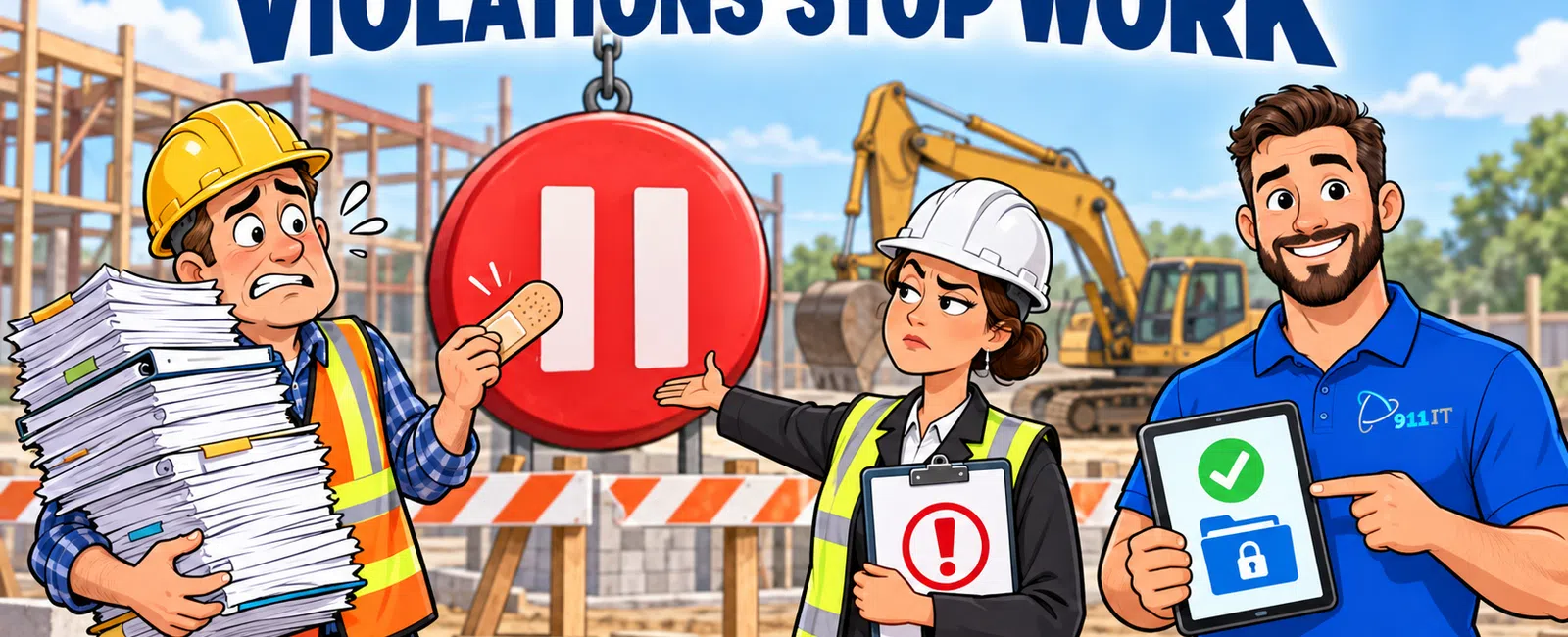
Companies that violate OSHA regulations face penalties ranging from $15,625 per serious violation to $156,259 per willful or repeated violation as of 2026. Beyond fines, violations trigger mandatory abatement periods, potential work stoppages, increased inspection frequency, civil lawsuits from injured workers, criminal prosecution in fatality cases, and lasting reputational damage that affects bidding opportunities and client relationships.
What Are the Financial Penalties for OSHA Violations?
OSHA categorizes violations into five types, each carrying different penalty structures. Understanding these categories helps construction firms assess their exposure and prioritize compliance investments.
Other-than-serious violations occur when a hazard exists but wouldn't likely cause death or serious physical harm. These carry penalties up to $15,625 per violation. Serious violations - where the hazard could cause death or serious injury - also carry penalties up to $15,625 per instance.
Willful violations represent the most severe category for non-fatal incidents. These occur when an employer intentionally and knowingly commits a violation or shows plain indifference to employee safety. Penalties range from $11,162 minimum to $156,259 maximum per violation.
Repeated violations occur when a company commits the same violation within five years of a previous citation becoming final. These also carry penalties up to $156,259 per violation. Failure-to-abate violations happen when a company doesn't correct a previously cited hazard within the prescribed timeframe, resulting in penalties up to $15,625 per day beyond the abatement date.
OSHA can assess penalties totaling over $1 million for a single inspection involving multiple willful or repeated violations.
Salt Lake City construction firms face additional financial consequences beyond federal OSHA fines. Utah's workers' compensation premiums increase substantially following safety violations, sometimes doubling or tripling annual costs. These premium hikes persist for three to five years, compounding the financial impact.
Financial penalties represent only the beginning of consequences for construction companies operating in competitive markets like Utah's Silicon Slopes corridor.
How Do OSHA Violations Affect Daily Operations?
Work stoppages represent the most immediate operational consequence. When OSHA identifies imminent danger situations - conditions where death or serious physical harm could occur immediately - inspectors issue stop-work orders for affected areas. Construction projects halt until the company implements corrective measures and receives clearance.
These stoppages cascade through project schedules. General contractors face liquidated damages from project owners for missed deadlines. Subcontractors sit idle, burning through overhead while generating no revenue. Equipment rentals continue accruing costs. Client relationships deteriorate as promises go unmet.
Jaren, who works in construction, shared his experience with operational reliability: "We have loved the peace of mind using 911 IT has given us. They are great at answering their phone and solving our problems quickly. I really like how quickly they respond to my questions and concerns. We are upgrading our machines with them now. They help us with backup services and with virus protection."
Abatement periods force operational changes even without full work stoppages. OSHA citations specify correction deadlines, typically 30 days for serious violations. Companies must divert labor and resources from productive work to compliance activities - installing guardrails, updating equipment, revising procedures, conducting additional training.
Increased inspection frequency follows violations. Companies enter OSHA's Site-Specific Targeting Program after serious violations, guaranteeing follow-up inspections. Each subsequent inspection consumes management time, disrupts workflows, and risks discovering additional violations. This heightened scrutiny continues for years.
Documentation requirements multiply exponentially. Companies must maintain detailed records proving abatement completion, track corrective actions, document additional training, and preserve evidence for potential legal proceedings. This administrative burden diverts attention from core business activities.
Reliable construction IT support becomes critical during these periods, as companies must maintain accessible digital records and ensure project management systems remain operational despite operational disruptions.
What Legal Consequences Follow OSHA Violations?
Civil litigation represents significant legal exposure beyond OSHA's administrative penalties. While workers' compensation typically prevents employees from suing employers for workplace injuries, OSHA violations can pierce this protection.
Willful violations enable injured workers to pursue civil lawsuits seeking compensatory and punitive damages. Courts have awarded millions in individual cases where employers knowingly violated safety standards. These lawsuits proceed independently of OSHA's penalty process, creating dual liability.
Third-party liability extends exposure further. Equipment manufacturers, property owners, and other contractors on multi-employer worksites can sue companies whose OSHA violations caused them harm or financial loss. Construction firms face joint-and-several liability when their violations contribute to incidents affecting others.
Criminal prosecution occurs in fatality cases involving willful violations. The Occupational Safety and Health Act authorizes criminal penalties including fines up to $500,000 for corporations and imprisonment up to six months for individuals. Repeat offenses double these maximums.
State prosecutors increasingly pursue manslaughter charges under state criminal codes when workplace fatalities involve egregious safety failures. These prosecutions target company officers and on-site supervisors personally, not just corporate entities. Recent Utah cases demonstrate prosecutors' willingness to pursue criminal accountability.
Contractual consequences compound legal exposure. Many construction contracts include safety compliance clauses allowing clients to terminate agreements for OSHA violations. General contractors can back-charge subcontractors for delays and penalties resulting from their violations. Performance bonds may exclude coverage for losses stemming from willful safety violations.
Federal contractors face debarment proceedings. Companies with serious, willful, or repeated OSHA violations risk suspension or debarment from federal contracting opportunities. Given the substantial federal construction spending in Utah, Wyoming, and Arizona - including military installations and public lands projects - this consequence eliminates major revenue streams.
Legal defense costs accumulate rapidly even when companies ultimately prevail, often exceeding the original OSHA penalties.
How Do Violations Impact Business Reputation and Growth?
OSHA maintains a public database of all citations, making violation histories instantly accessible to potential clients, partners, and competitors. Construction firms bidding on projects face scrutiny of their safety records during prequalification processes.
Private clients increasingly incorporate safety performance into contractor selection criteria. Corporate clients with their own safety programs - particularly technology companies building in Utah's Silicon Slopes - require subcontractors to demonstrate exemplary safety records. A single serious violation can disqualify a firm from consideration for years.
Public sector bidding becomes more difficult. Many government agencies assign safety scores during bid evaluations, with OSHA violations directly reducing scores. Some jurisdictions automatically reject bidders with recent willful violations. This restriction particularly impacts firms pursuing projects with municipalities across Salt Lake City, Provo, and Phoenix metro areas.
Insurance markets respond harshly to violation histories. General liability carriers increase premiums, reduce coverage limits, or decline renewal altogether following serious violations. Obtaining required insurance becomes more expensive and sometimes impossible, effectively barring companies from bonded projects.
Employee recruitment and retention suffer. Skilled construction workers research potential employers' safety records before accepting positions. High-quality workers choose companies with strong safety cultures, while firms with violation histories struggle to attract talent. Utah's competitive labor market amplifies this challenge.
Industry reputation spreads through professional networks. Trade associations, union halls, and supplier relationships all transmit information about companies' safety performance. Once a firm develops a reputation for safety violations, rebuilding trust requires years of demonstrated improvement.
Media coverage of serious violations or fatalities creates lasting brand damage. Local news outlets in Salt Lake City, Phoenix, and Casper report workplace incidents prominently. These stories remain accessible online indefinitely, surfacing in searches by potential clients, employees, and partners.
Maintaining robust cybersecurity protections for safety documentation and incident records becomes essential, as data breaches exposing safety violations compound reputational damage.
What Happens During and After an OSHA Inspection?
OSHA inspections follow a structured process that companies must navigate carefully. The inspection typically progresses through several distinct phases:
- Opening conference: The compliance officer explains the inspection scope and requests documentation. Officers may arrive without advance notice, particularly for complaint-based or accident inspections.
- Walkaround phase: Officers examine work areas, interview employees privately, review safety programs, and photograph hazards. Company representatives can accompany officers but cannot interfere with employee interviews.
- Closing conference: Officers discuss apparent violations, potential citations, and abatement expectations. This provides companies their first opportunity to present mitigating information or contest findings informally.
- Citation issuance: Citations arrive by certified mail within six months, typically much sooner. Each describes the violation, references the violated standard, proposes penalties, and specifies abatement deadlines.
- Abatement verification: Companies must certify completion in writing, often with photographic evidence and third-party verification. OSHA conducts follow-up inspections to verify abatement of serious violations.
Immediate violations trigger on-the-spot orders. When officers identify imminent danger conditions, they can order immediate work cessation in affected areas. Companies must comply immediately and cannot resume work until abating the hazard and receiving clearance.
Clay from a construction firm described the importance of quick problem resolution: "911 IT's response time has been so great! Most of the time they will resolve our issue before we hang up the phone. When we find ourselves in IT trouble we are usually in a mess until we call 911 IT and they get things working again. They are experienced and they take time to know our setup."
Settlement negotiations occur through OSHA's informal conference process. Companies can negotiate penalty reductions by demonstrating good faith, small business status, lack of violation history, and prompt abatement. Reductions of 50-70% are common for first-time violators who correct issues quickly.
Formal contests proceed to the Occupational Safety and Health Review Commission. Companies must file notices of contest within 15 days to preserve appeal rights. Contested cases involve discovery, hearings before administrative law judges, and potential appeals to federal courts. This process takes years and requires substantial legal investment.
Post-citation monitoring continues for years through OSHA's emphasis programs and follow-up inspection schedules.
How Can Construction Companies Prevent OSHA Violations?
Comprehensive safety programs form the foundation of violation prevention. Effective programs include written policies addressing all applicable OSHA standards, regular hazard assessments, documented training, incident investigation procedures, and continuous improvement processes.
Regular training keeps safety knowledge current. OSHA requires specific training for numerous construction activities - fall protection, scaffolding, excavation, electrical work, equipment operation. Training must occur before employees perform hazardous work, annually for refreshers, and whenever introducing new equipment or procedures.
Competent person designations fulfill regulatory requirements. OSHA standards require competent persons - individuals capable of identifying hazards and authorized to correct them - for scaffolding, excavation, fall protection, and other activities. Companies must train, designate, and document these individuals formally.
Hazard assessments must occur continuously. Effective companies conduct formal assessments before each project phase, daily toolbox talks addressing immediate hazards, and job hazard analyses for non-routine tasks. Documentation proves due diligence during inspections.
Equipment maintenance prevents mechanical violations. Regular inspection and maintenance of scaffolding, ladders, power tools, vehicles, and personal protective equipment eliminates common citation sources. Maintenance logs demonstrate systematic attention to equipment safety.
Subcontractor management extends safety accountability. General contractors face citations for subcontractor violations on multi-employer worksites. Effective programs include subcontractor prequalification based on safety records, contractual safety requirements, coordinated safety planning, and regular site monitoring.
Technology solutions streamline safety compliance. Digital platforms enable real-time hazard reporting, mobile training delivery, equipment inspection tracking, and automated documentation. Construction firms operating across Utah, Wyoming, and Arizona particularly benefit from cloud-based systems accessible from remote job sites.
Reliable managed IT services ensure safety management systems remain accessible and secure, with business continuity protections preventing data loss that could compromise safety documentation during audits.
Third-party audits identify gaps before OSHA does. Many construction firms engage safety consultants for annual compliance audits. These audits identify violations, recommend corrections, and provide documented evidence of good-faith compliance efforts that can reduce penalties if violations occur.
Safety culture development transforms compliance from checklist activity to organizational value. Companies with strong safety cultures empower workers to stop unsafe work, reward hazard reporting, investigate near-misses thoroughly, and integrate safety into business decisions. This cultural foundation prevents violations more effectively than rules alone.
Preventing OSHA violations protects workers, preserves operational continuity, and safeguards business reputation in competitive construction markets.
Frequently Asked Questions
Can OSHA shut down an entire construction project?
Yes, OSHA can issue stop-work orders for imminent danger situations where serious injury or death could occur immediately. While typically limited to specific hazardous areas rather than entire projects, widespread violations or refusal to abate hazards can result in complete project shutdowns. Work cannot resume until the company corrects violations and receives OSHA clearance.
How long do OSHA violations stay on a company's record?
OSHA violations remain in the public database permanently, though their practical impact diminishes over time. Violations affect repeat violation classifications for five years - if a company commits the same violation within five years of a previous citation, penalties increase substantially. Most clients and insurers focus on violations from the past three to five years when evaluating safety performance.
Do small construction companies face the same penalties as large contractors?
OSHA applies the same penalty structure to all employers regardless of size, but offers penalty reductions up to 60% for employers with 25 or fewer employees and up to 80% for those with 10 or fewer. Small businesses also qualify for free consultation programs that identify hazards without penalties. However, the same safety standards apply universally - company size doesn't excuse violations.
Can employees report OSHA violations anonymously?
Yes, employees can file complaints with OSHA anonymously, and the agency investigates these complaints seriously. OSHA prohibits retaliation against workers who report safety concerns, file complaints, or participate in inspections. Companies that retaliate face additional violations and penalties. Employees can request that OSHA not reveal their identity to employers during investigations.
What happens if a company cannot afford to pay OSHA fines?
OSHA may negotiate payment plans for companies demonstrating genuine financial hardship, though this doesn't reduce the penalty amount. Unpaid penalties accrue interest and can result in liens against company property, wage garnishment, or referral to the Treasury Department for collection. Persistent non-payment can lead to court action and potential business closure. Penalties cannot be discharged through bankruptcy.