
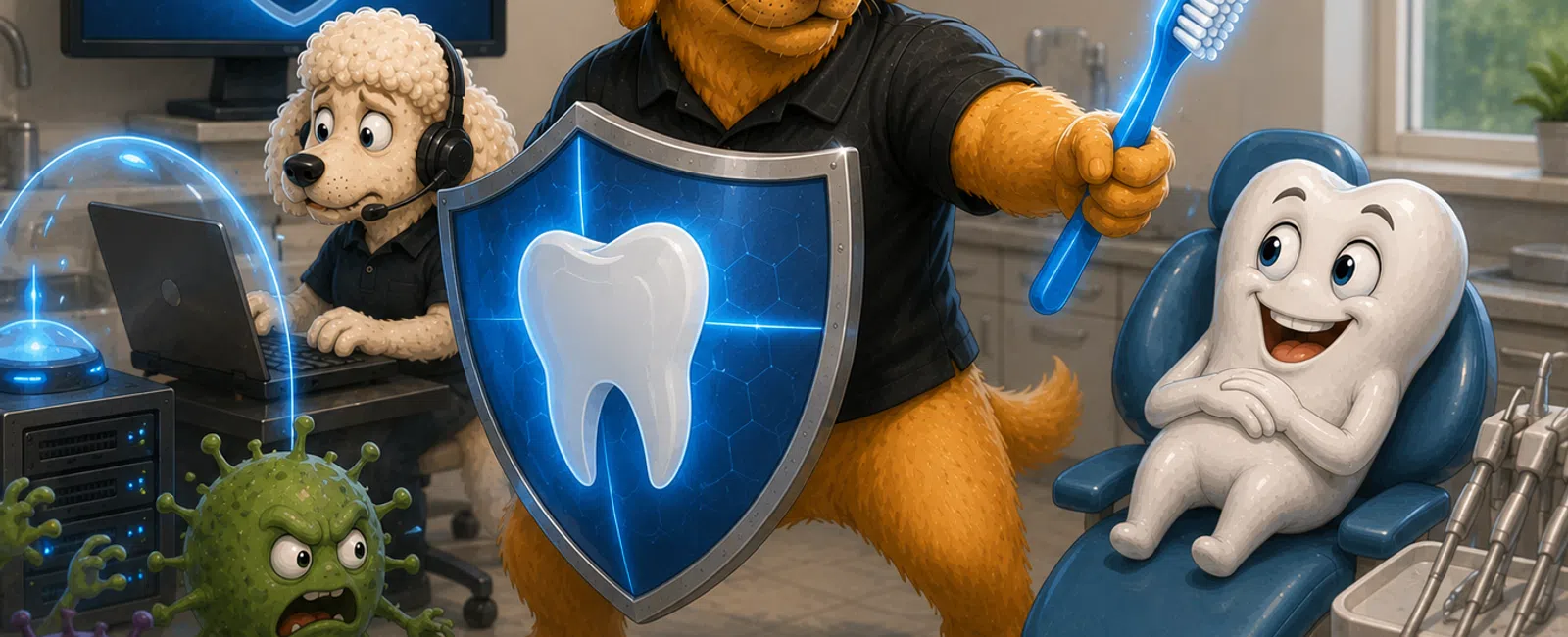
What Cybersecurity Protection Does a Dental Practice Need?
A dental practice needs more than antivirus software and a firewall. A practical cybersecurity program should include at least 12 layers of protection: multi-factor authentication, endpoint detection and response, email security, patch management, encryption, secure backups, access controls, network segmentation, employee training, vendor management, incident response and continuous monitoring.
For a dental practice with 25 to 50 employees, these protections should cover every workstation, server, Microsoft 365 account, remote connection, backup system and vendor that can access patient information.
The appropriate level of protection depends on the practice’s size, number of locations, dental software, imaging environment, cloud services and tolerance for downtime. However, every practice should be able to answer three questions:
- Can an attacker sign in with a stolen password?
- Can ransomware reach the practice’s backups?
- Can the practice continue operating if its systems become unavailable?
If leadership cannot answer those questions confidently, the practice likely has important security gaps.
The 12-Layer Dental Cybersecurity Framework
Cybersecurity works best as a layered system. No individual tool can stop every attack, so each control should reduce a different type of risk.
1. Multi-Factor Authentication
Multi-factor authentication requires users to provide a second form of verification in addition to a password. It can prevent an attacker from accessing an account even after stealing the password through phishing, malware or password reuse.
Dental practices should evaluate multi-factor authentication for:
- Microsoft 365
- Remote access
- Virtual private networks
- Cloud-based dental software
- Backup portals
- Administrative accounts
- Payment and financial systems
- Insurance portals
Administrative and remote-access accounts should receive the highest priority. A compromised administrator account may allow an attacker to create users, change security settings or access multiple systems.
Authentication apps, device-based prompts and security keys may provide stronger protection than text-message codes in many environments. The selected method should balance security with practical employee workflows.
2. Endpoint Detection and Response
Every supported workstation and server should have centrally managed endpoint protection. Modern endpoint detection and response tools do more than scan known malicious files. They monitor system activity for suspicious behavior and help technicians investigate or isolate affected devices.
Endpoint protection should provide:
- Continuous monitoring
- Malicious-process detection
- Behavior-based analysis
- Centralized alerting
- Device isolation
- Investigation data
- Automated or technician-led response
The IT provider should verify that every device remains enrolled and protected. A security license does not help when the software is disabled, outdated or missing from several treatment-room computers.
Ask the provider for a monthly device-coverage report showing how many workstations and servers are protected.
3. Email and Phishing Protection
Email is a major entry point for credential theft, fraudulent payment requests, malware and impersonation attacks.
A dental email security program should include:
- Spam and phishing filtering
- Malicious-link protection
- Attachment scanning
- Impersonation detection
- External-sender warnings
- Domain-protection settings
- Multi-factor authentication
- Encrypted communication options
- A simple phishing-reporting process
Employees should be trained to verify unusual requests involving payments, payroll, password resets, patient information and vendor account changes.
Attackers may impersonate a dentist, office manager, software vendor, insurance company or supplier. A convincing message does not need to contain obvious spelling errors or a suspicious attachment.
4. Patch and Vulnerability Management
Software updates repair security weaknesses and reliability problems. Dental practices should have a documented process for updating:
- Windows workstations
- Servers
- Web browsers
- Microsoft 365 applications
- PDF readers
- Remote-access software
- Firewalls
- Network equipment
- Dental applications
- Imaging software
Not every update should be installed immediately without review. Dental software and imaging systems may have compatibility requirements. The IT provider should coordinate critical updates with the appropriate vendors and maintain a rollback plan for major changes.
The practice should receive regular reporting on missing patches, unsupported operating systems and devices that cannot be updated.
5. Encryption
Encryption protects information by making it unreadable without authorized access. Dental practices should evaluate encryption for information stored on devices and information transmitted between systems.
Common areas include:
- Laptop drives
- Desktop drives
- Servers
- Backups
- Email containing patient information
- Cloud storage
- Portable media
- Remote connections
Full-disk encryption is especially important for laptops and portable devices that could be lost or stolen.
Encryption should be centrally documented. The practice should be able to identify which devices are encrypted, who controls the recovery keys and how encryption status is monitored.
6. Secure and Isolated Backups
Backups are an essential defense against ransomware, hardware failure, accidental deletion and database corruption. They should not be directly exposed to the same accounts and systems used for normal daily operations.
A strong backup design should include:
- Multiple copies of critical information
- At least one protected or isolated copy
- Encryption
- Automated monitoring
- Retention appropriate to the practice’s needs
- Documented recovery procedures
- Regular restore testing
The backup plan should cover more than the dental database. Practices may also need to protect images, documents, shared files, server configurations, Microsoft 365 data and related integration databases.
Ask when the last successful recovery test occurred. A report showing completed backup jobs does not prove that the systems can be restored.
Explore business continuity and disaster recovery services for additional protection against data loss and extended downtime.
7. Unique Accounts and Access Controls
Every employee should use an individual account. Shared usernames make it difficult to determine who accessed information, changed records or performed an administrative action.
Access should follow the principle of least privilege. Employees should receive only the permissions required for their responsibilities.
A complete access-management process should include:
- Unique user accounts
- Role-based permissions
- Limited administrative access
- Prompt employee offboarding
- Periodic account reviews
- Remote-access restrictions
- Vendor-access controls
- Logging of important administrative activity
Review active accounts at least quarterly and whenever an employee joins, changes roles or leaves.
Former employees, unused vendor accounts and old remote-access tools should be removed promptly.
8. Firewall Security and Network Segmentation
The practice network should not operate as one unrestricted environment where every device can communicate freely with every other device.
Network segmentation can separate systems according to their purpose. Common network categories include:
- Business workstations
- Clinical devices
- Servers
- Imaging equipment
- Voice systems
- Guest Wi-Fi
- Building or Internet of Things devices
Guest devices should not have direct access to servers or clinical systems. Older equipment that cannot support modern security controls may need to be isolated until it can be replaced.
The firewall should be centrally managed, updated and monitored. Old or unnecessary rules should be removed rather than left in place indefinitely.
9. Employee Security Awareness Training
Employees are part of the cybersecurity system. They should receive practical training that reflects the situations they encounter in a dental office.
Training should address:
- Phishing emails
- Fraudulent payment requests
- Password security
- Multi-factor authentication prompts
- Patient-information handling
- Lost devices
- Suspicious phone calls
- Vendor impersonation
- Reporting suspected incidents
- Use of personal devices and accounts
Short, recurring sessions are generally more useful than one long annual presentation. Phishing simulations can help identify where employees need additional coaching.
“I like the training videos that 911 IT provided on malware and how to not be susceptible to phishing scams and other similar things.”
— Project manager and 911 IT client
10. Vendor and Remote-Access Management
Dental practices depend on software, imaging, payment, communication, billing and equipment vendors. Many of these providers may request remote access to workstations or servers.
Every vendor connection should be:
- Approved
- Documented
- Protected by strong authentication
- Limited to necessary systems
- Monitored where practical
- Removed when no longer required
Consumer remote-access tools should not be installed casually. Each remote tool creates another possible path into the practice.
Maintain a vendor inventory showing:
- Vendor name
- Purpose
- Systems accessed
- Support contact
- Authentication method
- Business associate agreement status where applicable
- Access-review date
11. Incident Response Planning
A dental practice should know what to do before a security incident occurs. The response plan should cover ransomware, stolen devices, compromised email accounts, unauthorized access, vendor breaches and accidental disclosures.
The plan should identify:
- How employees report suspected incidents
- Who makes operational decisions
- Who contacts the IT provider
- Who contacts legal counsel
- Who contacts the cyber insurance carrier
- How affected systems are contained
- How evidence is preserved
- How patient care continues
- How systems are recovered
- How the incident is documented
Conduct a tabletop exercise at least periodically. A realistic scenario might involve an employee clicking a malicious link and then noticing unexpected multi-factor authentication prompts.
The exercise should reveal whether employees know whom to contact and whether leadership can access important phone numbers without relying on affected computers.
12. Continuous Monitoring and Strategic Review
Cybersecurity is not a one-time installation. The provider should monitor the environment, review alerts and improve protections as technology and threats change.
Ongoing management should include:
- Security-alert review
- Device coverage reporting
- Patch-status reporting
- Backup monitoring
- Account reviews
- Risk-remediation tracking
- Quarterly security discussions
- Annual risk reassessment
- Technology lifecycle planning
The practice should receive a prioritized security roadmap that separates urgent risks from long-term improvements.
What Is the Minimum Cybersecurity Baseline for a Dental Office?
Every environment is different, but the following controls form a practical minimum baseline.
| Security Control | Minimum Expectation |
|---|---|
| Multi-factor authentication | Enabled for email, remote access, administrative accounts and supported cloud applications |
| Endpoint protection | Centrally managed protection on every supported workstation and server |
| Patching | Documented operating-system and application update process |
| Email security | Phishing filtering, malicious-link protection and user reporting |
| Encryption | Appropriate encryption for portable devices, backups and sensitive communications |
| Backups | Monitored, isolated and tested through actual recovery |
| Access control | Unique accounts, limited privileges and prompt offboarding |
| Network security | Managed firewall, secured Wi-Fi and separation of guest traffic |
| Employee training | Recurring security education and phishing awareness |
| Incident response | Written contacts, escalation procedures and recovery responsibilities |
| Vendor management | Documented remote access and periodic vendor-account reviews |
| Monitoring | Ongoing review of security, device, backup and system-health alerts |
A practice missing several of these controls should prioritize remediation based on business impact and the sensitivity of the affected systems.
Is Antivirus Enough for a Dental Practice?
No. Antivirus can detect some malicious files, but it cannot independently stop stolen credentials, fraudulent emails, insecure remote access, unpatched software, exposed backups or excessive user permissions.
Antivirus also cannot provide:
- Multi-factor authentication
- Email impersonation protection
- Backup recovery
- Network segmentation
- Employee training
- Vendor management
- Incident-response planning
- Technology lifecycle management
Cybersecurity should be designed as a layered system in which several controls work together.
Does HIPAA Require Specific Cybersecurity Products?
HIPAA does not function as a shopping list of specific product brands. Dental practices should evaluate risks and implement reasonable safeguards appropriate to their environment.
Technology can support the practice through:
- Access controls
- Authentication
- Encryption
- Security logging
- Backup and recovery
- Workstation protection
- Secure transmission
- Incident detection
However, purchasing security software does not complete the practice’s compliance responsibilities. Administrative procedures, workforce training, documentation, vendor management and physical safeguards also matter.
Read what IT support a dental office needs to support HIPAA compliance and explore HIPAA compliance services.
What Are the Most Common Dental Cybersecurity Gaps?
Shared User Accounts
Shared logins reduce accountability and make permissions difficult to manage. Replace them with individual accounts.
Multi-Factor Authentication Is Only Partially Enabled
Some employees may have multi-factor authentication while administrators, vendors or older accounts remain unprotected. Review all active accounts rather than assuming the rollout is complete.
Old Computers and Unsupported Software
Unsupported systems may no longer receive security updates. Create a replacement plan instead of waiting for a failure.
Backups Are Connected to the Same Environment
If ransomware can access both the production systems and the backups, recovery may be much harder. Maintain protected or isolated copies.
Former Employees Still Have Access
Incomplete offboarding can leave email, software and remote-access accounts active. Coordinate access removal with every termination.
Vendors Use Unmanaged Remote Tools
Remote-access software may remain installed long after a vendor project ends. Inventory and remove tools that are no longer necessary.
No One Reviews Security Alerts
Security tools are ineffective when alerts remain unread. Assign responsibility for investigation and escalation.
Employees Do Not Know How to Report Phishing
Create a simple reporting process and reinforce it during recurring training.
No Tested Incident Response Plan
A written document that no one has practiced may not work during a real emergency. Conduct a tabletop exercise.
What Cybersecurity Does Dentrix, Eaglesoft or Open Dental Need?
The cybersecurity fundamentals are similar across Dentrix, Eaglesoft and Open Dental. The exact implementation depends on the software version, hosting model, database and integrations.
Each environment should address:
- Individual user accounts
- Appropriate permissions
- Protected servers or hosting
- Secure workstations
- Managed remote access
- Monitored backups
- Supported operating systems
- Secure vendor connections
- Documented integrations
- Incident-response coordination
Security changes should be coordinated with the dental software vendor when compatibility may be affected. Broad security exclusions should not be added merely because an application experiences a problem.
Review Dentrix, Eaglesoft and Open Dental IT support requirements for a broader comparison.
How Much Does Dental Cybersecurity Cost?
Cybersecurity pricing depends on users, devices, locations, cloud services, compliance needs and the level of monitoring and response included.
When cybersecurity is included within managed IT, a dental practice may use a planning range of approximately $100 to $275 per user per month for the broader service package.
For a 30-employee practice, that equals approximately $3,000 to $8,250 per month. The total may include help desk support, endpoint protection, patching, Microsoft 365 administration, backup monitoring, network management and strategic planning.
Additional security costs may include:
- Advanced email security
- Security-awareness training
- Phishing simulations
- Cloud backup
- Security assessments
- Penetration testing
- Incident-response retainers
- Hardware replacement
- Cyber insurance requirements
- Specialized compliance consulting
A lower monthly price may exclude monitoring, recovery testing, email protection, after-hours response or security training. Compare the full scope rather than the license count.
Read healthcare IT support pricing and included services for a broader cost breakdown.
What Should Be Included in a Dental Cybersecurity Proposal?
A complete proposal should identify the exact tools, responsibilities and services included.
| Proposal Category | What the Practice Should Confirm |
|---|---|
| Endpoint protection | Which devices are covered and who responds to alerts? |
| Email security | Are phishing, impersonation and malicious links addressed? |
| Multi-factor authentication | Which accounts and applications will be protected? |
| Patching | Are operating systems and third-party applications included? |
| Backups | What is protected, where is it stored and how often is recovery tested? |
| Network security | Are the firewall, Wi-Fi and network segmentation managed? |
| Training | How often do employees receive training and phishing simulations? |
| Incident response | Who answers after hours and what happens during a ransomware event? |
| HIPAA support | Which technical safeguards and documentation are included? |
| Reporting | What security reports and strategic reviews will leadership receive? |
Terms such as “complete security” or “enterprise-grade protection” are too vague by themselves. Ask the provider to explain the actual controls and response process.
How Often Should Dental Cybersecurity Be Reviewed?
Security should be reviewed continuously, with deeper reviews performed on a scheduled basis.
| Frequency | Suggested Review |
|---|---|
| Daily | Critical security alerts, backup failures and suspicious account activity |
| Weekly | Unresolved security incidents, failed updates and device coverage gaps |
| Monthly | Patch status, endpoint protection, backup reports and high-risk findings |
| Quarterly | User access, vendor access, security roadmap and recurring support trends |
| Annually | Risk assessment, incident-response exercise, policy review and technology plan |
| After major change | New location, new software, cloud migration, staffing change or security incident |
An annual review should not replace ongoing monitoring. Security problems can emerge at any time through new accounts, vendor tools, unsupported devices or configuration changes.
What Should Happen After a Cybersecurity Alert?
The response depends on the severity and type of alert. A managed security process should include:
- Validation: Determine whether the activity is malicious, suspicious or expected.
- Containment: Isolate affected accounts or devices when necessary.
- Investigation: Review logs, activity and related systems.
- Eradication: Remove malicious access, software or persistence.
- Recovery: Restore systems safely and monitor for recurrence.
- Documentation: Record the timeline, impact and corrective actions.
- Improvement: Address the control failure that allowed the incident.
For example, an unexpected foreign sign-in to a Microsoft 365 account should not be closed merely because the password was changed. The response may also need to revoke active sessions, review mailbox rules, examine sent messages and determine whether additional accounts were affected.
How Can a Practice Prepare for Ransomware?
Ransomware preparation should address prevention, containment, continuity and recovery.
The practice should have:
- Managed endpoint detection
- Multi-factor authentication
- Restricted administrative privileges
- Email security
- Current software patches
- Isolated backups
- Tested recovery procedures
- A documented incident-response plan
- Cyber insurance contact information
- A clinical downtime procedure
Employees should know not to continue using a computer that suddenly displays encrypted files, ransom messages or unusual security warnings.
The first response may involve disconnecting the affected device from the network and contacting the IT provider immediately. Employees should not attempt to negotiate, pay or remove ransomware independently.
A Realistic Dental Cybersecurity Scenario
Consider a 35-employee dental practice using Microsoft 365, Dentrix, digital imaging and an onsite server.
An employee receives an email that appears to contain a shared insurance document. The employee enters a password into a fraudulent sign-in page.
A layered cybersecurity response could work as follows:
- Multi-factor authentication blocks the attacker’s initial sign-in attempt.
- The employee receives an unexpected authentication prompt and reports it.
- The IT provider resets the password and revokes active sessions.
- Email logs are reviewed for suspicious activity.
- The technician confirms that no malicious mailbox rules were created.
- The phishing message is removed from other employees’ mailboxes.
- The event is documented and used in the next security training session.
One control did not carry the entire response. Multi-factor authentication, employee reporting, monitoring and technical investigation worked together.
Questions to Ask a Dental Cybersecurity Provider
- Which cybersecurity tools are included in the monthly fee?
- Who monitors alerts after normal business hours?
- Can you isolate a compromised device remotely?
- How do you protect Microsoft 365 accounts?
- How do you verify that every device remains protected?
- How are critical patches prioritized?
- How often are backups tested through actual recovery?
- How do you manage vendor remote access?
- What happens when ransomware is detected?
- Do you provide employee security training?
- Will you help create an incident-response plan?
- What security reports will leadership receive?
- How do you coordinate with cyber insurance and legal resources?
- Which HIPAA-related technical safeguards do you support?
- What security responsibilities remain with the dental practice?
What Cybersecurity Red Flags Should a Dental Practice Avoid?
The Provider Only Offers Antivirus
Antivirus alone does not address identity, email, backups, network security, training or incident response.
No One Monitors Alerts
Automated alerts require human review and escalation.
Backups Are Never Tested
Successful backup notifications do not prove that the practice can recover.
Multi-Factor Authentication Is Optional
Identity protection should be a core requirement for critical accounts, not an afterthought.
The Provider Cannot Explain Its Incident Process
A cybersecurity provider should be able to describe what happens during a compromised account, ransomware alert or stolen device.
Security Tools Are Installed Without Reporting
The practice should receive evidence showing device coverage, patch status, backup results and unresolved risks.
The Provider Promises Complete Protection
No provider can eliminate every risk. Look for honest risk management, defined response procedures and tested recovery capabilities.
How 911 IT Protects Dental Practices
911 IT helps dental and healthcare organizations build layered cybersecurity programs around their users, workstations, servers, Microsoft 365 accounts, networks, backups and vendors.
Services can include:
- 24/7 live help desk access
- Managed endpoint protection
- Security monitoring
- Email and phishing protection
- Multi-factor authentication
- Patch management
- Firewall and network management
- Backup and recovery planning
- Microsoft 365 security
- Employee security training
- HIPAA-focused technical safeguards
- Incident-response support
- Local onsite assistance
- Strategic security planning
“They don’t just fix problems; they prevent them, which gives us real confidence in our IT operations.”
— Health and research client
“I sleep better knowing my systems and data are safe.”
— Business owner and cybersecurity audit client
Explore cybersecurity services, healthcare IT support and managed IT services.
Frequently Asked Questions About Dental Cybersecurity
Does a small dental office really need managed cybersecurity?
Yes. Smaller practices still store valuable patient, financial and employee information. They may also have fewer internal resources available to detect and recover from an incident.
Is Microsoft 365 secure by default?
Microsoft 365 provides security capabilities, but the environment still requires correct configuration, multi-factor authentication, account management, monitoring and employee training.
Does cyber insurance replace cybersecurity?
No. Insurance may help with certain costs after an incident, but it does not prevent downtime, protect patient trust or restore systems automatically. Insurers may also require specific safeguards.
How often should employees receive cybersecurity training?
Training should occur during onboarding and recur throughout the year. Short monthly or quarterly education can reinforce important behaviors and address changing attack methods.
Should every dental computer have endpoint protection?
Every supported workstation and server that can access the practice environment should be evaluated for centrally managed protection.
Can ransomware affect dental backups?
Yes. Backups connected to compromised systems or accounts may also be encrypted or deleted. Maintain protected or isolated copies and test recovery.
How quickly should a former employee’s access be removed?
Access should be disabled promptly according to a coordinated offboarding process. High-risk or involuntary departures may require immediate action.
What should an employee do after clicking a phishing link?
The employee should stop interacting with the message and contact the IT provider immediately. Fast reporting allows the team to reset credentials, review activity and contain potential damage.
Does HIPAA require multi-factor authentication?
The practice should evaluate authentication controls through its risk-management process. Multi-factor authentication is a widely used safeguard for reducing the risk of stolen credentials.
How can a dental practice know whether its backups are secure?
Ask where copies are stored, how access is protected, whether the backups are isolated and when the last recovery test was completed.
What is the biggest cybersecurity risk for a dental practice?
There is no single universal risk, but stolen credentials, phishing, ransomware, unpatched systems, weak backups and unmanaged vendor access are common areas requiring attention.
Request a Dental Cybersecurity Assessment
A strong dental cybersecurity program should protect identities, devices, email, networks, backups and patient information while giving the practice a tested plan for responding to an incident.
911 IT can review your current security controls, identify priority risks and create a practical improvement plan based on your users, locations, dental software and compliance needs.
To discuss cybersecurity for your dental practice, contact 911 IT or schedule a discovery call.


