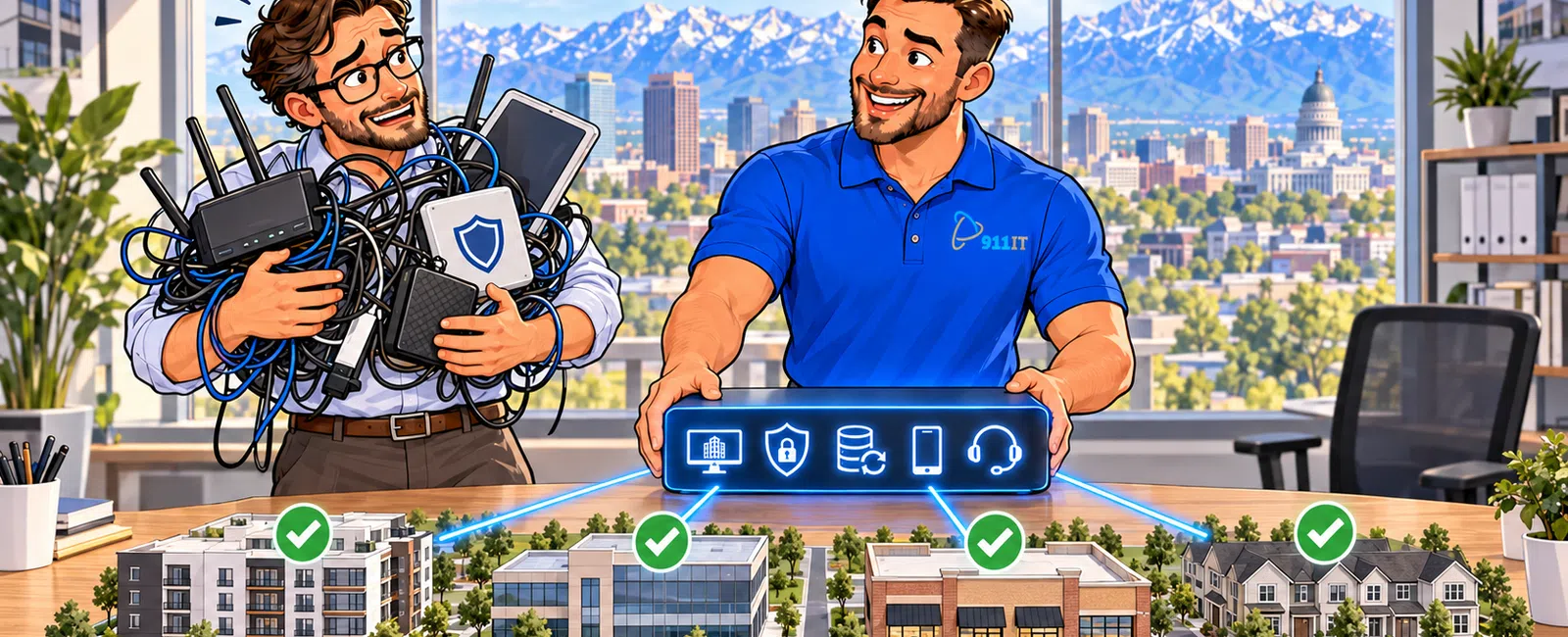
Choosing an IT provider for property management requires evaluating 24-7 support availability, experience with property management software platforms, cybersecurity measures for tenant data protection, and response times under 60 minutes. Look for flat-rate pricing, proactive monitoring of tenant portals and payment systems, and local providers who understand Utah's security deposit documentation and landlord-tenant compliance requirements.
What IT Challenges Are Unique to Property Management Businesses?
Property management firms face technology demands unlike most other industries. Tenant portals must stay online during peak rent collection periods - typically the first through fifth of each month - when hundreds of residents attempt to submit payments simultaneously.
Property management software stores extraordinarily sensitive data: Social Security numbers, bank account details, background checks, income verification, and lease agreements. A single breach exposes not just business records but the personal financial information of hundreds or thousands of tenants.
Maintenance coordination systems must function reliably when work orders pile up. A crashed system means plumbers waiting without access to unit keys, residents unable to report urgent repairs, and property managers unable to track vendor accountability.
Multi-location management creates additional complexity. Firms managing properties across Salt Lake County, Utah County, and beyond need remote access that works flawlessly from any location, whether you're showing a unit in Draper or reviewing financials from your South Jordan office.
Your IT provider must understand that downtime during business-critical moments - lease signings, application processing, month-end financial closes - costs you tenants, damages reputation, and creates regulatory exposure.
What Should You Look for in Response Time and Availability?
Property management operates outside traditional business hours. Maintenance emergencies, after-hours tenant calls, and weekend showings mean your technology must work when you need it, not just 9-to-5 Monday through Friday.
Evaluate providers on guaranteed response times, not vague promises. Ask specifically: What happens when your tenant portal crashes at 7 PM on a Saturday? How quickly will someone with actual decision-making authority respond?
Industry-leading providers offer response times under 15 minutes with 24-7 live support, not voicemail or offshore call centers.
Large national MSPs often route small and mid-sized property management firms through tiered support queues. Your urgent issue sits behind dozens of other tickets, handled by rotating junior technicians who don't know your systems or your business.
Local providers sized appropriately for the Salt Lake City market - like 911 IT, Executech, or Wasatch I.T. - offer a different model. You're a known client, not ticket number 4,872 in a queue. The technician who answers your call recognizes your voice and already knows which properties you manage.
Ask about monitoring capabilities. Proactive monitoring catches issues before they impact operations - identifying a failing server at 2 AM and fixing it before your staff arrives at 8 AM, rather than discovering the problem when twenty tenants can't pay rent online.
Mark, who runs an insurance business, brought in 911 IT after outgrowing his previous provider: "We couldn't afford the periodic downtime we experienced with our internet and phones. Their responsiveness is the best I've seen in the industry. Issues resolved within minutes."
How Important Is Property Management Software Experience?
Generic IT support struggles with industry-specific platforms. Property management software - whether you use Appfolio, Buildium, Yardi, Rent Manager, or another system - has unique architecture, integration requirements, and performance considerations.
Your IT provider should understand how these platforms interact with payment processors, background check services, accounting software, and tenant communication tools. When your Appfolio integration with your bank stops syncing transactions, you need someone who understands both the software and the financial compliance implications.
Ask candidates about their experience with your specific platforms. Have they supported other property management clients? Can they optimize database performance when you're managing 500-plus units? Do they understand the backup requirements for lease documents that must be retained for years under Utah law?
Cloud-based property management systems require reliable internet connectivity and proper network configuration. A provider experienced in cloud services ensures your team can access systems from property sites, home offices, and your main location without performance degradation.
Integration support matters enormously. Modern property management relies on connected systems: your property management platform, accounting software, tenant screening services, electronic signature tools, and maintenance tracking. When one integration breaks, your entire workflow stops.
Specialized support prevents the finger-pointing that wastes hours when issues arise. "That's a software problem, call your vendor" versus "That's a network problem, call your IT company" leaves you stuck in the middle while rent payments pile up unprocessed.
What Cybersecurity Protections Does Property Management Require?
Property management firms are high-value targets for cybercriminals. Your databases contain everything needed for identity theft: names, addresses, Social Security numbers, birth dates, bank accounts, employment history, and credit reports.
Utah's data breach notification law (Utah Code 13-44) requires notification when personal information is compromised. A breach doesn't just cost money for forensics and notification - it destroys tenant trust and exposes you to lawsuits from affected residents.
Essential cybersecurity measures include:
- Endpoint detection and response (EDR) on every device accessing tenant data
- Multi-factor authentication for all systems containing personal information
- Encrypted email for sending sensitive documents like lease agreements and financial records
- Regular security awareness training for staff handling applications and payments
- 24-7 threat monitoring with rapid response to detected intrusions
Ask providers about their approach to cybersecurity services. Do they offer continuous threat monitoring? How quickly do they respond to detected intrusions? What's their process for security patch management?
Backup and disaster recovery protections are non-negotiable. Ransomware attacks increasingly target property management firms because they know you'll pay to restore access to tenant records and financial data. Proper backup systems with offline copies and tested recovery procedures mean you can restore operations without paying ransoms.
Compliance requirements vary by property type. If you manage properties that accept Section 8 vouchers or other government-assisted housing, you may face additional data protection requirements. Providers experienced with compliance frameworks understand these obligations.
Regular security assessments identify vulnerabilities before attackers exploit them. Your provider should conduct periodic reviews of your security posture, test backup restoration, and simulate common attack scenarios to verify your defenses work.
Which Salt Lake City IT Providers Serve Property Management Firms?
Salt Lake City's competitive MSP market includes several providers capable of supporting property management operations, though most are generalists rather than property management specialists.
Local providers include 911 IT, Executech, Wasatch I.T., Nexus IT Consultants, INTELITECHS, ProLink IT, and Qual IT. Each brings different strengths in terms of service breadth, industry focus, and support model.
National providers operate in the market but typically serve larger enterprise clients. For a property management firm with 10 to 50 employees, you're a small account at an enterprise-focused provider - which translates to longer wait times, less personalized service, and support teams unfamiliar with your specific business needs.
When evaluating providers, consider the scale match. At a massive national MSP, your property management firm is one account among thousands. At a local provider sized for the Salt Lake City market, you're a valued client whose business genuinely matters to the company's success.
911 IT serves property management firms across Utah with managed IT services that include 24-7 monitoring, proactive support, and flat-rate transparent pricing. The company's 100% Satisfaction Guarantee and rapid response support address the reliability concerns that plague property management operations.
Kirk, a financial services client who has worked with 911 IT for several years, notes: "I feel like 911 IT is proactive and is on top of current issues. They take ownership of issues by listening well and following through. I recommend them to anyone who is tired of dealing with computer issues and wants a great team on their side."
The right provider combines technical capability with business understanding - recognizing that a crashed tenant portal on the third of the month is a business emergency requiring immediate response, not a ticket to be handled during the next business day.
What Questions Should You Ask During Provider Evaluation?
Start with support availability and response commitments. Ask: Do you offer 24-7 live support with real technicians, or after-hours voicemail? What's your guaranteed response time for critical issues? How do you define "critical" versus routine requests?
Inquire about property management experience specifically. Which property management platforms have you supported? Can you provide references from other property management clients? How do you handle integration issues between our property management software and other systems?
Discuss pricing structure and transparency. Request detailed breakdowns showing what's included in base service versus additional charges. Ask about flat-rate options that provide budget predictability - essential when you're managing properties with tight operating margins.
Industry average pricing for fully managed IT services ranges from $100 to $250 per user per month, with cybersecurity add-ons typically $25 to $75 per user monthly. Ad-hoc support averages $150 to $300 per hour. Providers should present clear pricing without hidden fees for after-hours support or emergency response.
Key evaluation questions include:
- What specific protections do you include for tenant data security?
- How do you handle security patch management across our systems?
- What's your backup and disaster recovery process, and how often do you test restoration?
- How long does implementation take, and will you migrate our data from existing systems?
- What training do you provide for our staff on new systems and security protocols?
- How long have you operated in Salt Lake City, and where is your office located?
- Will we have a dedicated account manager or work with different technicians each time?
- Do you monitor systems 24-7 to catch problems before they impact operations?
Explore their business stability and local presence. Understanding whether you'll work with the same team consistently or face rotating technicians reveals the level of personalized service you can expect.
Discuss proactive versus reactive support models. Providers who monitor continuously and address issues before they cause downtime deliver far more value than those who simply respond to problems after they've disrupted your operations.
The answers reveal whether a provider truly understands property management operations or simply sees you as another generic small business client.
Why Local Providers Often Outperform National Chains for Property Management
Property management firms benefit disproportionately from local IT providers who understand the Salt Lake City market, Utah's regulatory environment, and the Wasatch Front's real estate dynamics.
Local providers respond faster because their technicians are minutes away, not hours. When you need someone onsite to troubleshoot network issues affecting multiple property offices, a provider with a South Jordan office arrives quickly rather than dispatching from a regional hub in Denver or Phoenix.
Understanding local compliance requirements matters. Utah's Security Deposit Act, the state's landlord-tenant documentation requirements, and Salt Lake City's rental licensing program create specific IT needs that out-of-state providers often miss.
Relationship continuity provides enormous value. At national providers, you work with rotating technicians reading from scripts. At appropriately sized local providers, the same team supports you month after month, learning your systems, understanding your properties, and anticipating your needs.
911 IT exemplifies this local advantage. With offices in South Jordan and service coverage across Utah, Wyoming, and Arizona, the company provides enterprise-grade capabilities with small-business attention.
The company's proactive approach prevents problems rather than simply reacting to failures. Their 24-7 monitoring catches issues like failing hard drives, security threats, or performance degradation before they disrupt rent collection or tenant services.
Flat-rate transparent pricing eliminates the budget uncertainty that plagues property management firms working with hourly providers. You know your IT costs each month, making it easier to budget across your property portfolio.
The 100% Satisfaction Guarantee demonstrates confidence in service quality - a commitment rarely offered by large national providers where you're one account among thousands.
For property management firms tired of unreliable technology, slow support, and providers who don't understand the industry's unique demands, 911 IT offers the combination of technical expertise, rapid response, and genuine partnership that keeps properties running smoothly.
Frequently Asked Questions
What is the average cost of IT support for a property management company?
Property management firms typically invest $100 to $250 per user monthly for fully managed IT services, with additional cybersecurity protections adding $25 to $75 per user. Actual costs depend on the number of users, properties managed, software complexity, and required compliance measures. Flat-rate pricing provides budget predictability compared to unpredictable hourly billing models.
How quickly should an IT provider respond to property management emergencies?
Industry-leading providers respond to critical issues within 15 minutes, with 24-7 live support availability. Property management emergencies - crashed tenant portals during rent collection, payment processing failures, or maintenance system outages - require immediate attention, not next-business-day callbacks. Evaluate providers on guaranteed response commitments, not vague promises of "fast" service.
Do property management firms need specialized cybersecurity protection?
Yes, property management databases contain high-value personal information including Social Security numbers, bank accounts, and background checks. Essential protections include endpoint detection, multi-factor authentication, encrypted communications, regular security training, and offline backups. Utah's breach notification law requires disclosure when tenant data is compromised, making prevention critical.
Should property management companies use cloud-based or on-premise IT systems?
Most modern property management firms benefit from cloud-based systems that enable access from property sites, home offices, and main locations. Cloud platforms eliminate server maintenance burdens and provide automatic updates. However, reliable internet connectivity and proper network configuration are essential. Your IT provider should optimize cloud performance and maintain backup internet connections for business continuity.
What property management software platforms do IT providers typically support?
Experienced providers support major platforms including Appfolio, Buildium, Yardi, Rent Manager, and similar systems. They should understand platform-specific requirements, integration with payment processors and accounting software, database optimization for large property portfolios, and backup requirements for lease documents. Generic IT support often struggles with industry-specific software nuances.