Yes, 911 IT has extensive experience integrating IT systems with operational technology (OT) and plant floor equipment for Salt Lake City manufacturers since 2004. We support Manufacturing Software & ERP System Support alongside production systems, SCADA networks, PLCs, and legacy equipment, delivering one-hour emergency response times to minimize costly downtime. Our team understands the unique convergence challenges manufacturers face when connecting business systems to production environments.
What does IT-OT integration actually mean for manufacturing facilities?
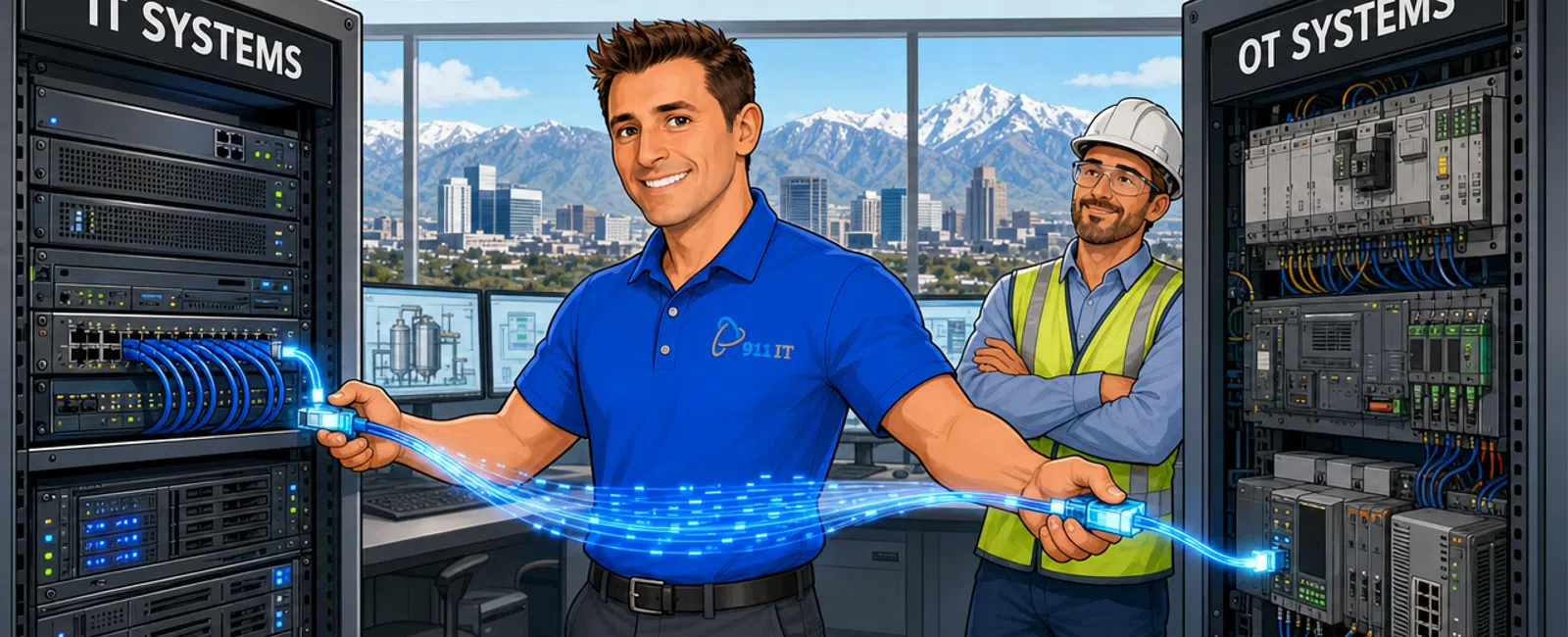
IT-OT integration connects your information technology systems - like ERP, MES, and business networks - with operational technology that controls physical processes on the plant floor. This includes programmable logic controllers (PLCs), supervisory control and data acquisition (SCADA) systems, human-machine interfaces (HMIs), industrial sensors, and production equipment.
The integration enables real-time data flow from production equipment to business systems. Quality metrics from inspection stations feed directly into your ERP. Machine downtime triggers work orders automatically. Production counts update inventory systems without manual entry.
For Salt Lake City manufacturers - especially aerospace and defense contractors near Hill Air Force Base - this integration also means ensuring CMMC compliance extends to production networks. Defense contractors must protect controlled unclassified information (CUI) across both IT and OT environments.
The challenge lies in bridging two fundamentally different technology cultures. IT systems prioritize data confidentiality and regular updates. OT systems prioritize availability and uptime, often running legacy equipment that cannot be patched or replaced without production shutdowns.
Successful integration requires understanding both worlds and the specific production requirements of your facility.
Why is integrating IT and OT systems so challenging for manufacturers?
Legacy equipment creates the first major hurdle. Many manufacturing facilities run production systems installed 10-20 years ago that were never designed to connect to modern networks. These systems may run outdated operating systems, lack security features, and use proprietary protocols that don't communicate with standard IT infrastructure.
The operational risk is significantly higher than typical IT projects. A misconfigured network change in an office environment might slow email. The same mistake on a production network can halt a manufacturing line costing thousands of dollars per hour in lost output.
Security requirements conflict with operational needs. IT security best practices call for regular patching, network segmentation, and endpoint protection. But production equipment often cannot be patched without vendor certification, must remain accessible to operators around the clock, and may crash if security software is installed.
James, a Salt Lake City manufacturer, experienced this firsthand before partnering with 911 IT: "911 IT has been able to cut our IT expenditures by almost half and at the same time improve our systems reliability. Since moving to their IT Firm we have noticed that they are more knowledgeable than the other companies we have used in the past."
Skill gaps compound the problem. Few IT professionals understand industrial protocols like Modbus, Profibus, or EtherNet/IP. Few OT engineers have deep networking or cybersecurity expertise. Successful integration requires bridging this knowledge divide.
Vendors often operate in silos. Your ERP vendor, PLC manufacturer, SCADA provider, and network team may each understand their piece but lack the systems-level view needed to make everything work together reliably.
Production downtime from IT-OT integration failures can cost manufacturers $5,000-$20,000 per hour depending on facility size and product margins.
The right integration partner understands these challenges and has proven processes to navigate them safely.
How do you integrate IT systems with plant floor equipment safely?
Network segmentation forms the foundation of safe IT-OT integration. We create separate VLANs or physically isolated networks for production systems, with carefully controlled connection points to business networks. This prevents problems in one environment from cascading to the other.
Industrial firewalls and data diodes provide controlled data flow. Production data can flow from OT to IT systems for reporting and analysis, while strict rules prevent unauthorized access from business networks back to production equipment. This protects critical systems while enabling the data visibility manufacturers need.
We follow a structured implementation process:
- Discovery and mapping: Document all devices, dependencies, protocols, and communication paths before making any changes.
- Risk assessment: Identify what happens if connectivity is lost and which systems are most critical to production.
- Design and validation: Create detailed integration architecture with security controls appropriate for manufacturing environments.
- Isolated testing: Build parallel test networks or use maintenance windows to validate configurations before production deployment.
- Phased implementation: Roll out changes incrementally with rollback plans and on-site technicians during critical phases.
- Monitoring and optimization: Track performance across both IT and OT networks, adjusting configurations based on real-world behavior.
Our managed IT services include monitoring of both IT and OT networks around the clock. We track network performance, device health, and security events across your entire environment. When issues arise, our one-hour emergency response ensures production impact is minimized.
Wayne, a manufacturing client, described the value: "When hiring 911 IT, we didn't realize it would be like having an inhouse IT department without the overhead cost that comes with an inhouse department. They are part of our team. They want us to succeed and they have our best interest in mind."
Safe integration requires both technical expertise and a genuine understanding of manufacturing operations.
What specific manufacturing systems and equipment do you integrate?
ERP systems form the backbone of most integration projects. We connect SAP, Oracle, Microsoft Dynamics, Epicor, and other ERP platforms to production systems, enabling real-time inventory updates, production scheduling, and quality tracking. Data flows from shop floor to business systems without manual re-entry.
Manufacturing execution systems (MES) bridge ERP and production equipment. We integrate MES platforms that track work orders, collect production data, manage labor, and provide real-time visibility into manufacturing operations. These systems coordinate between business planning and actual production execution.
SCADA systems and PLCs control physical processes. We work with Allen-Bradley, Siemens, Schneider Electric, and other industrial control systems, integrating them with business networks while maintaining the isolation and security production systems require. Our team understands industrial protocols and can troubleshoot communication issues.
Quality management systems capture inspection data, test results, and compliance documentation. We integrate these systems with ERP and production equipment so quality metrics automatically trigger holds, rework orders, or supplier notifications based on your business rules.
CAD, CAM, and engineering software connects design to production. For Salt Lake City's aerospace and outdoor recreation manufacturers, we integrate engineering software with production systems so design changes flow to CNC machines, 3D printers, and other manufacturing equipment.
Warehouse management systems and automated material handling equipment complete the integration. Barcode scanners, RFID readers, automated storage and retrieval systems (AS/RS), and conveyor controls all connect to inventory and production systems.
Our Manufacturing Software & ERP System Support covers the full range of systems manufacturers depend on daily.
How do you handle cybersecurity for connected production systems?
Network segmentation creates security boundaries. Production networks operate on separate VLANs or physical networks with industrial firewalls controlling access. Only authorized systems and users can communicate between IT and OT environments, and all access is logged for security monitoring.
We implement defense-in-depth strategies appropriate for manufacturing environments. This includes endpoint protection that doesn't interfere with production systems, intrusion detection tuned to recognize industrial protocols, and security monitoring that understands normal OT network behavior.
Access controls restrict who can reach production systems. Multi-factor authentication, role-based permissions, and privileged access management ensure only authorized personnel can modify PLC programs, change SCADA configurations, or access production networks remotely.
For defense contractors and aerospace manufacturers in Salt Lake City, our CMMC compliance services extend security controls to production environments where controlled unclassified information (CUI) is processed or stored. This includes network segmentation, access controls, incident response, and the documentation required for certification.
Vulnerability management for OT requires a different approach than IT systems. We work with equipment vendors to apply patches during scheduled maintenance windows, implement compensating controls when patching isn't possible, and maintain asset inventories that track end-of-life equipment requiring replacement.
Our cybersecurity services include security awareness training tailored to manufacturing environments. Production staff learn to recognize phishing attempts, report suspicious activity, and follow security procedures without impeding their ability to do their jobs.
Backup and disaster recovery plans account for both IT and OT systems. We maintain backups of PLC programs, SCADA configurations, HMI screens, and all the specialized software needed to restore production systems after a ransomware attack or equipment failure.
Comprehensive security for connected manufacturing requires understanding both cybersecurity principles and production realities.
Who are the best IT-OT integration providers in Salt Lake City?
Salt Lake City manufacturers have several options when selecting an IT-OT integration partner, each serving different needs and scales.
911 IT specializes in manufacturing IT support with proven experience integrating ERP systems, production equipment, and industrial control systems for Salt Lake City manufacturers since 2004. Our team provides Manufacturing Software & ERP System Support, CMMC compliance for defense contractors, and monitoring around the clock with one-hour emergency response. We're large enough to handle complex integrations but small enough that every client is known by name. Our 100% Satisfaction Guarantee backs every integration project.
Executech offers managed IT services with manufacturing clients across the Wasatch Front. They provide a range of IT services including network support and security.
Wasatch I.T. serves Utah businesses with IT support and has experience working with manufacturing companies in the region.
Nexus IT Consultants provides managed services and has worked with various industries including manufacturing facilities.
Enterprise-focused firms like national MSPs may have deep resources but treat smaller manufacturers as one account among thousands. You'll navigate ticket queues, work with rotating technicians who don't know your facility, and face slow escalation when production is down. For a 50-employee manufacturer, you're a small account. For 911 IT, you're a valued partner.
One-person IT shops or break-fix providers lack the depth for complex IT-OT integration. When your integration specialist is unavailable, production waits. They can't provide monitoring around the clock or maintain the specialized knowledge manufacturing systems require.
Bill, a manufacturing client, explained why the right-sized partner matters: "I like working with 911 IT because they have an in-house tech who is friendly and knowledgeable about my computer. This is especially important since I work only one day a week in the office and need to clear emails remotely on other days. Having an in-house person makes a big difference."
The best IT-OT integration partner combines manufacturing expertise, proven processes, rapid response, and genuine partnership.
Why choose 911 IT for manufacturing IT-OT integration in Salt Lake City?
We've served Salt Lake City manufacturers since 2004, building deep expertise in the specific challenges of integrating IT systems with production equipment. Our team understands industrial protocols, works with equipment vendors, and knows how to bridge the gap between IT and OT safely.
Our Manufacturing Software & ERP System Support covers the full range of systems manufacturers depend on - from ERP and MES platforms to SCADA systems and production equipment. We support the specialized software that runs your facility, not just generic IT infrastructure.
For aerospace and defense manufacturers near Hill Air Force Base, our CMMC compliance expertise ensures security controls extend appropriately to production environments. We understand how to protect controlled unclassified information while maintaining the availability production systems require.
One-hour emergency response minimizes production downtime. When an integration issue threatens production, our team responds within one hour. Erik, a manufacturing client, noted: "911 IT has been excellent each time I've needed help, and they are quick to respond to any technical problems, usually within the same day!"
Our monitoring around the clock covers both IT and OT networks. We track performance, security events, and device health across your entire environment. Problems are often identified and resolved before they impact production.
Flat-rate, transparent pricing means predictable IT costs. You know exactly what you'll pay each month, with no surprise bills when integration projects require extra support. Our 100% Satisfaction Guarantee ensures you're completely satisfied with every aspect of our service.
We're large enough to handle anything an enterprise provider can - complex integrations, multi-site deployments, support around the clock - but small enough that you're a valued partner, not account number 4,872. Your production manager has direct access to technicians who know your facility.
Visit our manufacturing IT support page or contact 911 IT at our South Jordan office to discuss your IT-OT integration needs.
Frequently asked questions
How long does IT-OT integration typically take for a manufacturing facility?
Integration timelines vary based on facility complexity, number of systems, and production constraints. A basic ERP-to-production integration might take 4-8 weeks including planning, testing, and implementation. Complex projects involving multiple production lines, legacy equipment, and extensive security requirements can take 3-6 months. We work within your production schedule to minimize disruption and maintain detailed project timelines.
Can you integrate IT systems without shutting down production?
Yes, in most cases we can integrate IT and OT systems with minimal or no production downtime. We use network taps, parallel testing environments, and phased implementations to validate configurations before affecting production systems. Critical changes happen during scheduled maintenance windows or off-shifts. Our planning process identifies dependencies and risks upfront to avoid surprises that could halt production.
What happens if an integration causes production problems?
We maintain detailed rollback plans for every integration project and have technicians available during implementation to address issues immediately. Our one-hour emergency response ensures rapid support if problems arise. We test thoroughly in isolated environments before touching production systems, document all changes, and can quickly revert to previous configurations if needed. Our 100% Satisfaction Guarantee covers all integration work.
Do you work with our existing equipment vendors and system integrators?
Absolutely. We regularly coordinate with PLC manufacturers, SCADA vendors, ERP providers, and system integrators to ensure successful integration. We understand that equipment vendors know their systems best and work collaboratively rather than trying to replace those relationships. Our role is to bridge the gap between specialized vendors and ensure all systems work together reliably within your IT infrastructure.
How do you handle security for legacy production equipment that can't be updated?
We implement compensating controls for legacy equipment that cannot be patched or upgraded. This includes network segmentation to isolate vulnerable systems, industrial firewalls with strict access rules, continuous monitoring for anomalous behavior, and physical security controls. We work with equipment vendors to understand risks and implement the strongest protection possible without compromising production availability or voiding warranties.