
Midyear Reality Check: What's Actually Changed in Your Systems Since January?
By July, your business isn't operating the way it did in January.
You've added people. Expanded systems. Adopted tools to move faster.
None of that is the problem.
The problem is what didn't get revisited.
In most environments, systems evolve faster than they're governed. Access
grows quietly. Integrations drift. Ownership blurs. Backups are assumed to
work.
Nothing looks broken.
Until it matters.
Where Risk Actually Shows Up
This isn't about failure. It's about misalignment.
- Access exists
beyond necessity
- Systems don't
reconcile consistently
- Recovery
processes are untested
- Ownership is
unclear
Everything still functions.
But when leadership teams, finance leaders, or operations leaders need
certainty, the gaps show immediately.
When This Breaks: Reporting Misalignment
A finance leader needs a clean revenue number for a planning meeting.
Sales pulls from HubSpot. Finance pulls from QuickBooks.
The numbers don't match.
Here's why:
- Sales is
reporting closed deals
- Finance is
reporting recognized revenue
- A sync between
the systems was set up months ago
- Pipeline
adjustments changed field mappings
- Some deals
stopped syncing correctly
- No one is
responsible for validating the integration
Now:
- Finance
challenges the accuracy
- Sales defends
its numbers
- Leadership
delays decisions
What should take minutes takes days.
Reporting misalignment routinely delays decision-making by multiple
business days. That delay slows planning, hiring, and execution across the
business.
Nothing failed visibly.
But alignment is gone.
When Recovery Fails: The Second Scenario
A shared file system goes offline midweek.
Everyone assumes backups are in place.
Here's what actually happens:
- Operations
loses access to files immediately
- IT confirms the
issue but doesn't own recovery execution
- Backup platform
is identified, but credentials and ownership aren't clear
- Restore begins
late and fails on the first attempt
- A vendor is
pulled in after escalation
- Full recovery
stretches across multiple days
Impact:
- Revenue-generating
work halts
- Teams recreate
data manually
- Internal
timelines slip
Multi-day recovery events don't just disrupt operations—they stop them
entirely.
The root issue wasn't the outage.
It was untested assumptions about recovery.
Where This Comes From
Access Expanded Without Control
Access was granted quickly to enable work.
It was never cleaned up.
Now:
- Users retain
permissions beyond their role
- Former
employees may still exist in systems
- No single view
shows who can access what
If access cannot be verified immediately, control is already lost.
Tools Solved Problems but Fragmented Systems
You likely added:
- A CRM like
HubSpot or Salesforce
- A finance
system like QuickBooks or NetSuite
- Marketing
automation platforms
- Internal
reporting tools
Each solved a problem.
Together, they introduced:
- Data
duplication
- Sync
inconsistencies
- Reliance on
manual fixes
Fragmentation doesn't create noise.
It creates delay.
Backup Exists, Recovery Is Assumed
Most systems have backups.
Very few teams:
- Test recovery
regularly
- Know how long
restoration takes
- Define
ownership clearly
Backups reduce risk only when recovery is verified.
Ownership Became Unclear
As systems expanded:
- Vendors took
partial ownership
- Internal roles
shifted
- Cross-system
accountability disappeared
Now when something breaks, responsibility is decided in real time.
That's where delay starts.
Your Midyear Systems Assessment
Answer Yes or No. If you hesitate, it's a No.
Access Control
- Do you know
exactly who has access to every system?
- Have all former
employee accounts been removed?
- Are permissions
aligned to current roles?
System Alignment
- Is there a
single source of truth for key data?
- Have
integrations been reviewed within the last 6 months?
- Can teams
operate without workarounds?
Backup & Recovery
- Have you tested
recovery in the last 90 days?
- Do you know how
long full restoration takes?
- Is recovery
ownership clearly defined?
Ownership
- Does each
system have one accountable owner?
- Are
cross-system issues assigned to one person?
- Are escalation
paths defined in advance?
Scoring
- 10-12 Yes:
Controlled
- 6-9 Yes:
Moderate Risk
- 0-5 Yes: High
Risk
If you scored below 10, at least one of these areas will slow you down
during a real incident.
How to Validate a Critical Integration (15-30 Minutes)
Choose one high-impact integration, ideally CRM to finance.
Check:
- Compare 5-10
recent records across both systems
- Confirm
revenue, status, and timestamps match
- Look for
missing or duplicated entries
- Review sync
errors or skipped records
- Identify who
owns the integration
Failure looks like:
- Records exist
in one system but not the other
- Values don't
match for the same transaction
- Updates lag or
fail silently
Most issues come from:
- Field mapping
changes
- Workflow
adjustments
- Unmonitored
sync failures
Time required:
- 10 minutes to
review data
- 10-20 minutes
to confirm ownership and issues
Micro Playbook: 20-Minute Access Audit
- Export users
from key systems
- Identify
inactive or unknown accounts
- Compare roles
against permissions
- Remove
mismatches immediately
This is the fastest way to expose hidden risk.
If You Only Fix 3 Things This Month
- Remove access
for all former employees
- Assign a single
owner for backup and recovery
- Validate one
critical integration
This addresses the majority of operational exposure quickly.
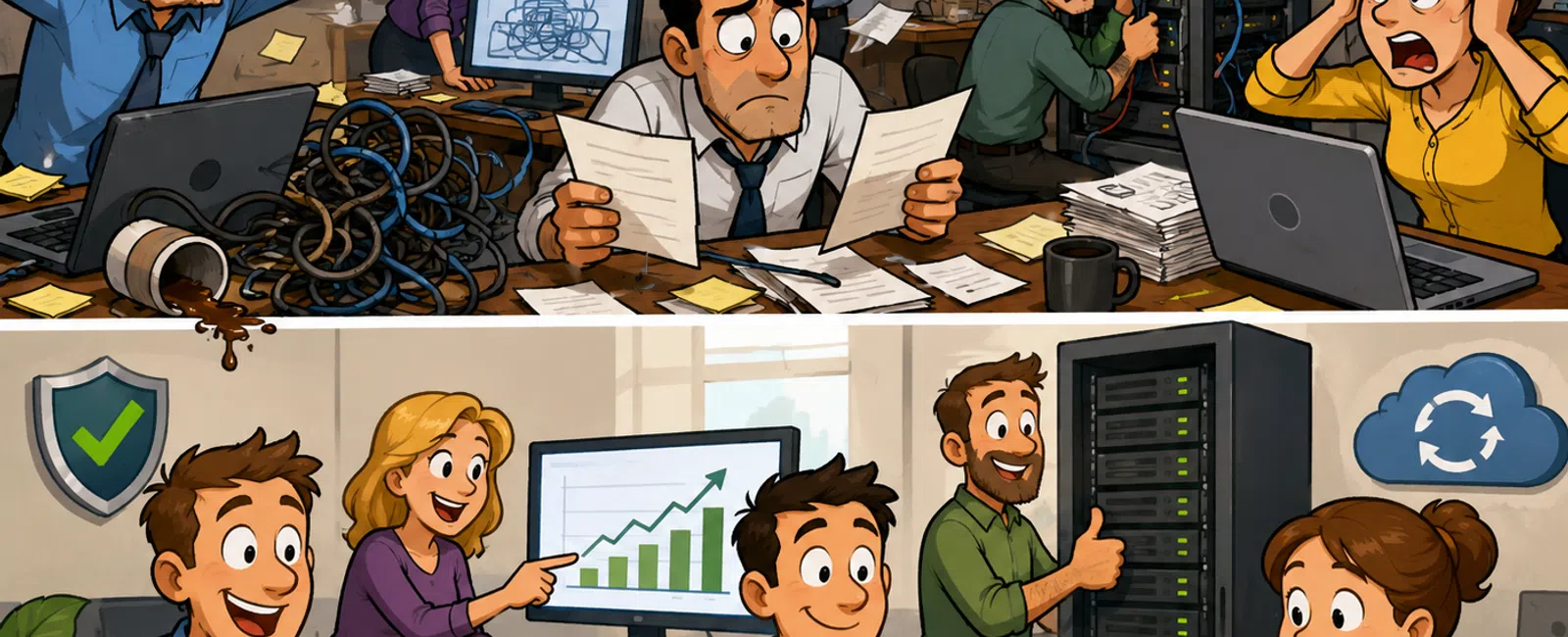
Before vs After
Before:
- Reporting
requires reconciliation
- Recovery is
uncertain
- Ownership is
unclear
After:
- Data aligns
across systems
- Recovery is
tested and predictable
- Every system
has a defined owner
The difference is not complexity.
It's clarity.
How You're Being Evaluated
Leadership teams, finance leaders, and operations leaders don't measure
effort.
They measure outcomes.
- Inconsistent
reporting signals lack of control
- Slow recovery
signals operational risk
- Undefined
ownership signals instability
Your systems are not judged by how they were built.
They are judged by how they perform under pressure.
What To Do This Week
Run the 20-minute access audit.
You should be able to answer immediately who has access to what and why.
If you can't, that's your starting point.
Most Risk Doesn't Come From What Broke
It comes from what changed and was never revisited.
Clarity is what allows your business to move quickly without introducing
risk.
Schedule your 10 minute discovery call to confirm whether these gaps
exist in your environment. 911 IT will walk through your current systems with
you and identify where misalignment is creating risk. You'll leave with a clear
understanding of what needs attention and what doesn't.


