
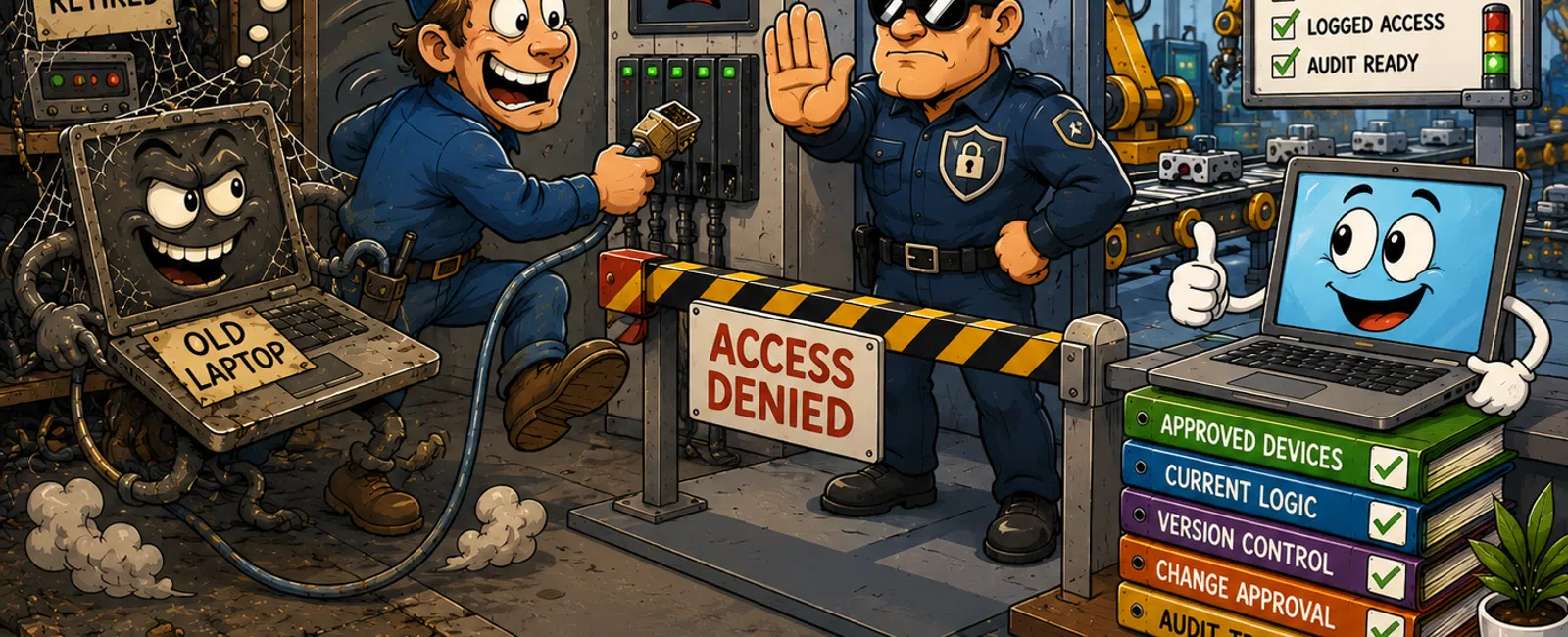
Old Technology Is Not the Problem. Uncontrolled Reuse Is.
If you carry both uptime and audit pressure, you already
know how this goes. The line drops, everybody moves fast, and the nearest
working device suddenly becomes "good enough." That is the mistake. In a plant,
old technology rarely causes damage by sitting still. It causes damage when a
fault makes the wrong laptop, the wrong HMI, or the wrong program easy to use.
That is when a retired asset stops being clutter and becomes active production
influence.
The real risk is not age. It is lack of enforcement. If your
environment still allows an outdated engineering workstation to connect,
authenticate, or load logic during a fault, then the system is depending on
human restraint at exactly the moment human restraint is weakest. That is how
production misalignment, traceability gaps, and audit trouble start on the same
day.
Where This Fails Under Pressure
A fault changes behavior.
Nobody says, "Let's load the wrong program."
They say, "Use the laptop that already works."
Nobody says, "Let's bypass change control."
They say, "We need the line back now."
That is why this problem has to be solved at the system
level. In manufacturing environments, the floor already has unique
availability, reliability, and safety requirements. Security controls have to
respect that reality while still preventing the wrong action at the wrong
moment.
The Hyper-Specific Failure Pattern
A PLC-controlled cell gets a sequence update after a
downstream station changes its cycle timing. The active program is corrected.
The line returns to service. But an older engineering laptop still has the
previous program copy, still lives close to the floor, and still has a path
back to the controller.
Weeks later, the line faults. A technician grabs the old
laptop because it is nearby and already configured. The controller accepts the
connection. The older logic gets loaded. The controller is now running sequence
timing that no longer matches the real machine behavior. Sensors still read.
Motors still turn. But the line is no longer synchronized with the physical
process it is supposed to control.
That is why these failures are so expensive. They do not
always look like a hard stop. They show up as bad timing, drifting quality,
confused troubleshooting, and a painful stretch between "the line is back up"
and "the line is actually running right." That is exactly the kind of
operational chaos that turns a short fault into a multi-shift disruption.
The Proof Layer: What This Looks Like in Real Environments
The proof is usually not one dramatic hole. It is the same
pattern repeating in three places.
A plant has duplicate logic copies living outside the
approved source of truth.
A plant has older engineering workstations that still matter more than people
think.
A plant has retirement steps that end at physical removal instead of enforced
isolation and documented closure.
That repeat pattern is what makes this problem credible. It
also explains why leadership feels blindsided. The environment looks mostly
under control until a fault exposes the one path that was never truly closed.
The people who own uptime and compliance feel that personally because they are
the ones expected to explain why the safeguards were "there" but the mistake
was still possible.
What This Looks Like in a Real Plant Stack
Vendor names matter less than control layers.
A practical stack usually includes:
- An
OT-safe asset discovery layer that identifies PLCs, HMIs, engineering
workstations, switches, gateways, and other production-connected assets
- A
system of record for ownership, status, and lifecycle state
- Role-based
identity controls for engineering access
- Segmented
OT pathways with approved conduits only
- Controlled
remote access using MFA, jump hosts, and session logging
- One
approved source of truth for production logic and configuration
- Change
records tied to maintenance activity and final signoff
That direction fits the way manufacturing environments are
already expected to operate: with asset inventory, controlled pathways, strong
identity controls, OT-safe discovery, documented runbooks, and audit-ready
evidence. NIST SP 800-82 Rev. 3 also frames OT security around performance,
reliability, and safety requirements rather than generic office IT assumptions,
and ISA/IEC 62443 treats lifecycle control and stakeholder responsibility as
part of securing industrial automation and control systems throughout their
lifecycle.+3
What a Controlled Retirement Process Actually Looks Like
A controlled retirement process is not "we moved it off the
floor."
It is six gated steps:
- Identify
the device
Confirm what it touches: controller access, network path, stored logic, credentials, data, and current owner. - Assign
ownership
One person owns completion. Not the idea of completion. The actual closeout. - Remove
access
Kill credentials, remove allowed network paths, and disable remote connectivity. - Validate
isolation
Prove the device can no longer authenticate or influence production. - Archive
or wipe data
Preserve only approved records. Remove stale logic copies and redundant configuration files. - Document
and sign off
Record the retirement in the system of record and link it to the work performed.
If a device can still connect, still authenticate, or still
affect a controller, it is not retired. It is simply out of sight.
How to Prevent Old Logic from Being Reloaded
This is where guidance becomes enforcement.
A technician should not be allowed to:
- Connect
to a controller from an unapproved engineering device
- Write
to a controller without the right role
- Load a
logic file that is outside the approved version path
- Make a
change that leaves no review trail
A mature environment blocks those actions, not just
discourages them.
That usually means:
- Controller
writes limited to approved roles
- Segmentation
restricting which devices can reach engineering interfaces
- Remote
access only through approved, logged pathways
- One
approved repository for production logic
- Change
reviews attached to actual work, not handled after the fact
The point is simple. During a fault, the system should make
the safe action easy and the wrong action impossible.
Allowed vs. Blocked Actions During a Fault
|
During
a line fault |
Allowed |
Blocked |
|
Engineer needs controller access |
Use the approved engineering path tied to the current work
record |
Plug in a nearby laptop that is not in the approved path |
|
Technician needs logic review |
Pull the current approved version from the source of truth |
Load a local copy stored on an old workstation |
|
Remote vendor support is needed |
Enter through the approved remote access workflow with MFA
and session logging |
Open a direct unmanaged path into the OT network |
|
Asset is being retired |
Close access, validate isolation, record final signoff |
Assume physical removal alone means the device is gone |
Those "blocked" actions are not edge cases. They are exactly
the shortcuts people take when the floor is under pressure. That is why the
system has to enforce the boundary.
Who Owns This Internally
This process fails when everybody cares and nobody owns it.
A workable split looks like this:
- Maintenance
owns physical isolation and removal
- IT/OT
owns access removal, identity, segmentation, and device status
- Engineering
owns approved logic, version control, and production-state validation
- Compliance
or QA owns documentation quality, traceability, and signoff integrity
That ownership model is stronger when it is explicit because
modern OT frameworks treat security as shared responsibility across asset
owners, product suppliers, service providers, and the people operating the
environment every day. ISA/IEC 62443 makes that lifecycle and role clarity part
of the foundation, not an afterthought.+2
Maturity Levels of Control
You do not go from messy to perfect in one step. Plants
usually move through three levels.
Level 1 — Aware
- Manual
asset lists
- Informal
retirement
- Logic
copies live in multiple places
- Access
depends heavily on habit
This is better than denial, but it still breaks under
pressure.
Level 2 — Controlled
- One
approved source for current logic
- Role-based
access for engineering changes
- Retirement
requires documented steps
- Segmentation
narrows who can reach what
This is where reuse becomes harder.
Level 3 — Enforced
- Unapproved
devices cannot reach controller interfaces
- Unapproved
identities cannot write
- Retirement
is validated, not assumed
- Audit
evidence exists without reconstruction
This is where the environment starts protecting the team
instead of depending on them.
What Happens When Controls Are Actually in Place
Here is the outcome you want.
A fault occurs. Someone tries to use an old engineering
laptop. The device cannot reach the approved controller path. They switch to
the approved engineering station. The current logic is pulled from the approved
source. The change is tied to the work record. Access is logged. Production
recovers. The line comes back without a hidden state mismatch waiting to
surface two hours later.
That is what a clean environment buys you. Not perfection.
Not magic. Just fewer ways for a bad day to become a worse one.
What a Clean Environment Looks Like
Before
- Logic
exists in more than one place
- Old
engineering devices still matter
- Retirement
means "moved" more often than "closed"
- Audit
records have to be reconstructed after the fact
After
- One
source of truth for the active production state
- Approved
access paths only
- Retirement
includes validation and signoff
- Change
history and asset status are already documented
That is the difference between hoping the controls exist and
being able to prove they worked.
What an Auditor or Outside Evaluator Sees Immediately
An outside evaluator is not impressed by effort. They are
looking for evidence.
Can you show which assets are still active?
Can you show who can reach controllers?
Can you show how changes are approved, logged, and tied back to the actual
state of the line?
Can you show that retired devices are no longer part of the production story?
That lens matters because the same themes keep showing up
across manufacturing and regulated environments: risk analysis, information
system activity review, access control, audit-ready documentation, and controls
that do not break uptime in the process. These are not separate conversations.
On the floor, they are the same conversation.+2
Retirement Enforcement Checklist
Use this on one line next week.
- Is
the device listed in your asset record?
- Is
one owner assigned to retire it completely?
- Have
all credentials been removed?
- Has
the network path been removed or blocked?
- Can
the device still authenticate to anything that matters?
- Does
it still contain logic, recipes, or production parameters?
- Has
isolation been validated, not assumed?
- Is
the final state documented and signed off?
If any answer is unclear, the device is still part of your
risk picture.
What To Do Next Week
Walk one production line with maintenance, engineering, and
whoever owns OT access. Pick three devices everyone thinks are retired. Test
the checklist against them. Do not start with the easiest ones. Start with the
ones that used to matter most.
That one walkthrough will tell you whether your plant has a
retirement process or just retirement language.
What To Do Next
Schedule your 10 minute discovery call. 911 IT will validate
one production line against a retirement enforcement checklist and show you
exactly where stale logic, reusable engineering devices, or documentation gaps
still remain.


