
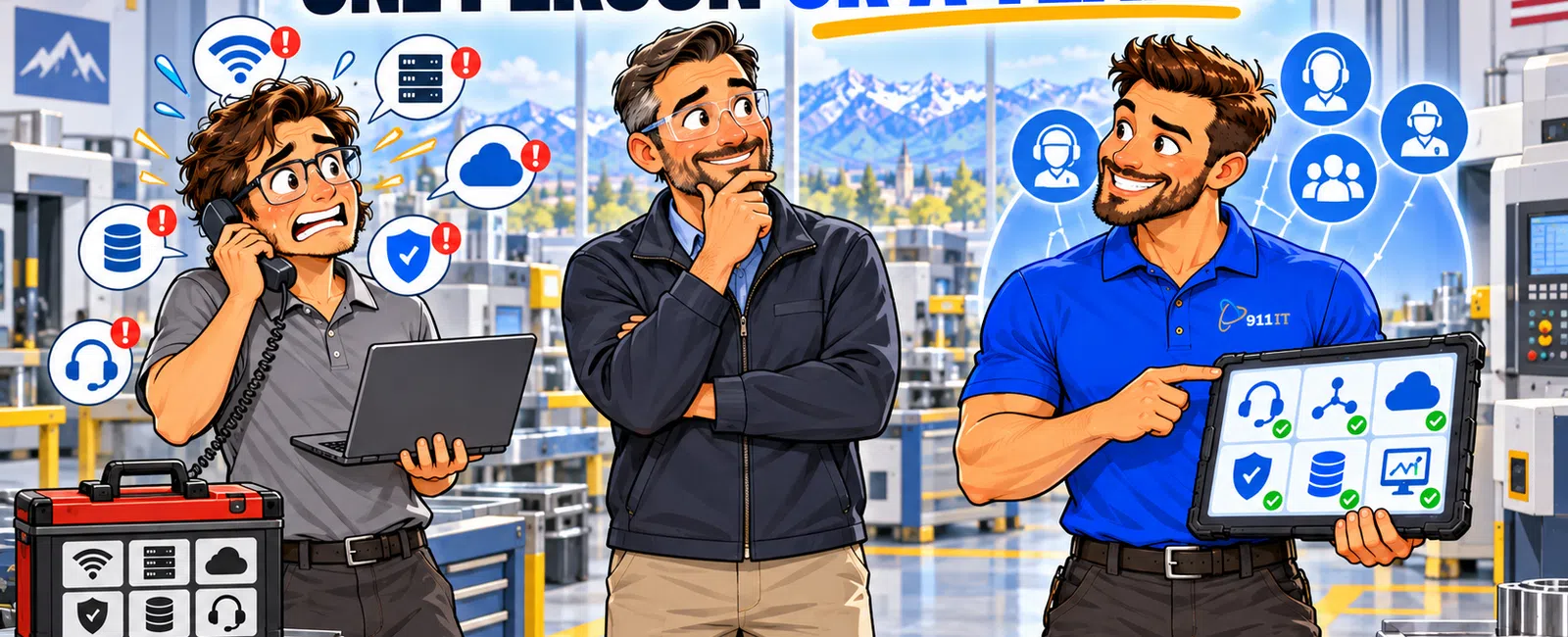
Should Your Manufacturing Company Hire an IT Employee or Outsource IT?
For most manufacturing companies with 25-50 employees, a fully managed IT provider or a hybrid co-managed model is usually more practical than relying on one internal IT employee. An MSP provides access to a broader technical team, 24/7 coverage, cybersecurity specialists, monitoring tools and backup support for a predictable monthly fee.
An internal IT employee may be the better choice when the company needs a technology professional physically present every day, has highly specialized production systems or has enough ongoing work to support a full-time role. However, one employee rarely provides all the help desk, network, cloud, cybersecurity, compliance and strategic expertise a manufacturer needs.
The decision should be based on five factors: total cost, coverage, expertise, operational risk and future growth. This guide compares internal IT, managed IT services and co-managed IT services for manufacturers.
Internal IT vs. Managed IT at a Glance
| Decision factor | Internal IT employee | Managed IT provider |
|---|---|---|
| Availability | Limited by work schedule, vacation, illness and turnover | Team-based support with after-hours coverage available |
| Technical expertise | Depends on one person's skills and experience | Access to help desk, network, cloud, security and strategic specialists |
| Business familiarity | Works inside the company and learns daily operations closely | Builds documented knowledge of systems, vendors and workflows |
| Onsite presence | Available onsite during scheduled working hours | Most issues handled remotely with onsite service when required |
| Cost structure | Salary, benefits, recruiting, training, tools and backup coverage | Predictable monthly agreement plus clearly defined projects or licenses |
| Cybersecurity | May require outside specialists and additional security platforms | Can include layered security tools, monitoring and specialist support |
| Scalability | Additional demand may require another hire | Support resources can expand as users, locations and systems grow |
| Continuity | Knowledge may be concentrated in one person | Documentation and team coverage reduce dependence on one individual |
The Five-Part Framework for Choosing the Right IT Support Model
1. Compare the Total Cost, Not Just Salary or Monthly Fees
A fair comparison should include every expense required to maintain reliable IT support. Comparing an employee's salary with an MSP's monthly invoice does not provide the complete picture.
Internal IT Costs May Include
- Salary
- Payroll taxes
- Health insurance and benefits
- Paid time off
- Recruiting and onboarding
- Professional training and certifications
- Computer and mobile equipment
- Monitoring and remote-support software
- Cybersecurity tools
- Backup and disaster-recovery platforms
- Documentation systems
- Outside consultants for complex projects
- Temporary coverage during vacations or turnover
Managed IT Costs May Include
- A monthly per-user, per-device or fixed service fee
- One-time onboarding
- Microsoft 365 and other software licenses
- Cybersecurity services
- Backup storage
- Major projects and migrations
- Hardware purchases
- After-hours project work when excluded from the agreement
Manufacturers with 25-50 employees may budget approximately $100-$275 per user per month for comprehensive managed IT, depending on the service scope, number of devices, locations, cybersecurity requirements and production complexity.
That equals an estimated monthly range of:
| Employees | Estimated monthly MSP range |
|---|---|
| 25 employees | $2,500-$6,875 |
| 35 employees | $3,500-$9,625 |
| 50 employees | $5,000-$13,750 |
These figures are planning ranges rather than guaranteed quotes. A responsible provider should review your users, devices, facilities, applications, security and support requirements before presenting a final price.
The lowest visible cost is not always the lowest total cost. Include the financial impact of unresolved problems, production downtime, security incidents and delayed projects when comparing the options.
2. Determine How Much Coverage the Business Requires
One internal employee may provide excellent service during normal working hours. The challenge appears when that person is already handling another problem, attending training, taking vacation or unavailable during an overnight production shift.
Ask these questions:
- Does production operate outside normal office hours?
- Who responds when the primary IT employee is unavailable?
- How quickly must production-critical problems be addressed?
- Does the company have multiple facilities?
- Can employees reach a live technician after hours?
- Is local onsite support required?
- Who monitors systems overnight, on weekends and during holidays?
A manufacturer operating one weekday shift may be comfortable with internal coverage supplemented by outside help. A company running two or three shifts may require 24/7 access to qualified support.
911 IT provides live technical support around the clock and local onsite assistance for businesses in the Salt Lake City area. The support terms, response priorities and onsite coverage should be defined in the individual service agreement.
3. List the Skills Your Environment Actually Requires
Manufacturing IT is broader than fixing computers. A small or midsize manufacturer may need expertise in:
- Windows computers and servers
- Microsoft 365
- Firewalls and network switches
- Wireless networks
- Cloud platforms
- Cybersecurity monitoring
- Backup and disaster recovery
- ERP, MRP and MES infrastructure
- CAD and engineering workstations
- Warehouse and inventory systems
- Vendor coordination
- Compliance frameworks
- Technology budgeting
- Employee security training
- Incident response
It is difficult for one person to remain current in every area. Even a highly capable IT employee may need external help with cybersecurity incidents, cloud migrations, compliance, network redesigns or business continuity planning.
An MSP distributes these responsibilities across a team. A help desk technician can resolve employee issues while senior specialists handle servers, networks, cloud systems and security. Strategic advisors can also help leadership develop budgets and technology roadmaps.
4. Evaluate the Operational Risks of Each Model
The right IT model should reduce single points of failure. Manufacturers often evaluate server redundancy and backup systems but overlook the risk created when one person holds most of the technical knowledge.
Risks of Depending on One Internal IT Employee
- Critical knowledge may be undocumented.
- Support may stop during illness, vacation or turnover.
- The employee may be too busy with tickets to address long-term risks.
- Technical decisions may not receive independent review.
- Cybersecurity alerts may go unmonitored after hours.
- Major projects may exceed one person's capacity.
- The employee may hesitate to disclose mistakes or gaps.
Risks of Depending Entirely on an MSP
- The provider may not understand production workflows initially.
- Onsite service may not be immediate.
- The company may receive inconsistent technicians if the MSP lacks documentation.
- Important services may be excluded from the contract.
- The provider may focus on ticket volume instead of business priorities.
- The company may lose internal ownership of technology decisions.
Both models can work when the risks are managed properly. Internal IT needs documentation, backup coverage and access to specialists. An MSP needs a structured onboarding process, manufacturing experience, clear service levels and regular business reviews.
5. Consider the Company's Growth Plans
The support model that works today may not work after the company adds a second facility, overnight production, new compliance obligations or another 30 employees.
Review expected changes during the next 12-36 months:
- Will employee headcount increase?
- Will the company add locations or shifts?
- Is a new ERP, MES or warehouse platform planned?
- Will the manufacturer pursue government contracts?
- Are acquisitions or mergers possible?
- Will remote work increase?
- Is production equipment being modernized?
- Will customers require stronger cybersecurity?
An MSP can generally expand support without requiring the manufacturer to recruit another employee immediately. Internal IT may provide closer daily involvement but require additional hiring as complexity increases.
A hybrid model often provides the greatest flexibility. The internal employee retains business knowledge and project ownership while an MSP supplies help desk coverage, cybersecurity, monitoring and specialist resources.
When Does Hiring Internal IT Make Sense?
An internal IT employee may be the right decision when technology requires daily physical involvement or the company has enough consistent work to justify a dedicated position.
Internal IT may be a strong fit when:
- Production systems require frequent hands-on support.
- The company has highly customized applications.
- A dedicated technical person must coordinate with engineers and production leaders every day.
- The organization wants direct control over technology priorities.
- There is enough work to keep a skilled employee productive.
- Leadership is prepared to fund tools, training and outside specialists.
- A backup plan exists for vacations, illness and turnover.
The best internal IT employee is not merely a person who reacts to support requests. The role should have sufficient time and authority to improve security, document systems, manage vendors and develop long-term plans.
Questions to Answer Before Hiring
- Which responsibilities will the employee own?
- What level of experience is required?
- Who will provide after-hours support?
- Which external specialists will still be needed?
- What tools and software must the company purchase?
- Who reviews the employee's technical decisions?
- How will systems and passwords be documented?
- What happens when the employee leaves?
When Does Fully Managed IT Make Sense?
Fully managed IT may be the best option when the company needs broad technical capability but does not want to build an internal IT department.
It may be a strong fit when:
- The company has no internal IT employee.
- Office managers or executives are currently coordinating technical support.
- Employees need access to a live help desk.
- The manufacturer operates outside normal business hours.
- Cybersecurity responsibilities have become more complex.
- The business needs predictable IT expenses.
- Recurring problems are not being permanently resolved.
- Leadership needs a technology roadmap and budget.
- Multiple vendors require coordination.
A complete managed IT agreement may include:
- Help desk support
- 24/7 monitoring
- Remote and onsite service
- Server and network management
- Microsoft 365 administration
- Patch management
- Cybersecurity tools and monitoring
- Backup management
- Business continuity planning
- Employee onboarding and offboarding
- Vendor coordination
- Technology planning and budgeting
Ask the provider to identify what is excluded. Major projects, software licenses, new facility installations, cabling and application customization may be billed separately.
When Is Co-Managed IT the Best Option?
Co-managed IT combines an internal employee's company knowledge with an MSP's tools, team and specialized expertise. It is often the most effective model for a growing manufacturer that already has an IT person but needs additional capacity.
A co-managed arrangement can be divided in several ways.
Model 1: MSP Help Desk, Internal IT Leadership
The MSP handles routine employee requests while the internal employee manages production systems, projects and business priorities.
This model can reduce interruptions and give the internal employee more time for strategic work.
Model 2: Internal Help Desk, MSP Infrastructure and Security
The internal employee supports users while the MSP manages servers, networks, backups, cybersecurity and complex escalations.
This model is useful when the internal employee understands the business well but needs access to advanced expertise.
Model 3: Shared Coverage and After-Hours Support
The internal employee leads support during normal hours, while the MSP provides overflow, vacation and after-hours coverage.
This model reduces dependence on one person and gives employees a clear escalation path.
Model 4: Project and Compliance Support
The internal IT team manages daily operations while the MSP assists with defined projects, cybersecurity assessments, CMMC preparation or cloud migrations.
Learn more about how co-managed IT services can supplement an existing IT employee or department.
How Should Responsibilities Be Divided in a Co-Managed Model?
Unclear responsibilities create duplicated effort and unresolved problems. A written responsibility matrix should identify who owns each function.
| IT responsibility | Internal IT | MSP | Shared |
|---|---|---|---|
| Employee help desk | Optional | Optional | Common |
| Production-system knowledge | Primary | Documented support | Common |
| Network monitoring | Visibility | Primary | Common |
| Cybersecurity monitoring | Business coordination | Primary technical role | Common |
| ERP vendor coordination | Business requirements | Infrastructure troubleshooting | Common |
| Employee onboarding | Approvals | Account and device setup | Common |
| Technology budgeting | Business priorities | Technical recommendations | Common |
| Major projects | Internal ownership | Technical resources | Common |
The exact division should reflect skills, availability and business priorities. The goal is not to replace the internal employee. It is to give that employee enough support to perform the highest-value work.
How Does Cybersecurity Affect the Decision?
Cybersecurity has become one of the strongest reasons manufacturers use an MSP or co-managed model. Protecting a modern environment requires more than antivirus software.
A complete program may include:
- Multi-factor authentication
- Endpoint detection and response
- Email filtering and phishing protection
- Firewall management
- Vulnerability management
- Security awareness training
- Microsoft 365 security
- Logging and alert monitoring
- Incident-response planning
- Backup protection and restoration testing
- Administrative access reviews
- Vendor and remote-access controls
An internal IT employee can manage many of these functions, but the organization must provide appropriate tools, time, training and independent review. A provider offering cybersecurity services may supply security platforms, monitoring and specialist assistance as part of a broader support model.
Manufacturers handling Federal Contract Information or Controlled Unclassified Information may also need help with CMMC compliance services. Compliance requires participation from leadership, operations, human resources and other departments; it should not be assigned entirely to one technical employee.
How Does Business Continuity Affect the Decision?
The support model should remain functional when the primary IT contact is unavailable or a major system fails.
Ask who is responsible for:
- Monitoring backup failures
- Testing data restoration
- Responding to ransomware
- Replacing failed servers or network equipment
- Coordinating internet-provider outages
- Restoring ERP and production systems
- Communicating with leadership during an incident
- Maintaining recovery documentation
A backup file is not a complete continuity plan. The company should define how much data it can afford to lose, how quickly systems must be restored and how employees will operate during an outage.
911 IT's business continuity services address backup, recovery and operational resilience for unexpected disruptions.
What Are the Warning Signs That One Internal IT Employee Is Overloaded?
An internal employee may be capable and committed but still lack enough time or resources. Common warning signs include:
- Support tickets remain open because higher-priority problems keep appearing.
- Projects are repeatedly delayed.
- Documentation is incomplete or outdated.
- Backups are running but restoration tests are not performed.
- Security alerts are reviewed inconsistently.
- The employee rarely takes uninterrupted vacation.
- Recurring problems receive temporary fixes.
- Technology decisions are made only during emergencies.
- Hardware replacements are not budgeted in advance.
- Leadership does not receive regular risk or performance reports.
These signs do not necessarily mean the employee should be replaced. They often indicate that the role needs help desk coverage, specialist support or better tools.
What Are the Warning Signs That an MSP Is Not the Right Fit?
Outsourcing does not automatically improve IT. Watch for providers that:
- Cannot provide manufacturing references or examples
- Use vague promises instead of measurable service levels
- Do not ask about production schedules
- Rely on one assigned technician without team backup
- Exclude important services without explaining them
- Do not document systems and credentials
- Have no cybersecurity or incident-response process
- Focus entirely on ticket closure
- Do not provide regular strategic reviews
- Cannot explain how onsite support works
A strong MSP should be able to explain how support is delivered, how production-critical incidents are prioritized and how the provider will learn your environment.
A Practical Decision Scorecard
Score each support model from one to five for the following categories. Multiply the score by the suggested weight and compare the totals.
| Category | Suggested weight | What to evaluate |
|---|---|---|
| Coverage and availability | 20% | Business hours, after-hours support, vacation and emergency coverage |
| Technical expertise | 20% | Help desk, infrastructure, cloud, cybersecurity and manufacturing knowledge |
| Operational continuity | 20% | Documentation, redundancy, backup support and incident response |
| Total cost | 15% | All labor, tools, benefits, licenses, projects and downtime risks |
| Business knowledge | 10% | Understanding of production, employees, vendors and company priorities |
| Scalability | 10% | Ability to support growth, locations, users and new requirements |
| Strategic planning | 5% | Budgeting, technology roadmap and executive guidance |
A co-managed arrangement may score highest when the company values both daily onsite knowledge and broad team coverage.
Example: A 40-Employee Manufacturer with One IT Generalist
Consider a manufacturer with 40 employees, one production facility, an ERP platform, engineering workstations, Microsoft 365 and a small warehouse. One internal IT generalist supports employees, coordinates the ERP vendor, manages computers and handles network issues.
The employee understands production well but spends most days responding to support requests. Documentation, security projects and equipment replacement plans receive limited attention. After-hours problems are handled informally, and there is no backup when the employee takes vacation.
The company has three options:
Option 1: Hire Another Employee
A second employee improves coverage but adds recruiting, salary, benefits and management responsibilities. The company must decide whether it has enough ongoing work for two full-time roles.
Option 2: Replace Internal IT with a Fully Managed Provider
The MSP can provide broader coverage and predictable costs. However, the company may lose some daily onsite knowledge unless onboarding and documentation are handled carefully.
Option 3: Add a Co-Managed Provider
The internal employee retains production knowledge and business ownership. The MSP handles the help desk, monitoring, cybersecurity, backup oversight and after-hours escalation.
In this example, the hybrid approach may provide the strongest balance. The internal employee can focus on ERP coordination, production projects and process improvement while the MSP handles repetitive support and specialized technical work.
This scenario is illustrative. The right choice depends on workload, skills, costs and operational requirements.
Real Client Perspective: An IT Department Without the Full In-House Cost
One 911 IT client described the value of receiving team-based support without building a full internal department:
"Working with 911 IT feels like having an entire IT department at my fingertips, without the hefty salary of a full-time IT person who would require paid vacation."
Alex, Business Owner
The client also noted that access to a team provided prompt responses and industry-specific recommendations that an independent IT professional had not always been able to deliver.
A manufacturing client highlighted the value of proactive communication:
"I was pleasantly surprised by 911 IT's initiative to identify and fix issues beyond what I initially asked for. They kept me informed about what they were doing and why."
Bill, Production Worker, Manufacturing
The most useful support model should provide both immediate assistance and proactive improvements that reduce future problems.
Questions to Ask Before Hiring an Internal IT Employee
- What work will occupy this person each week?
- Which skills are essential and which can be outsourced?
- Who provides coverage during leave or turnover?
- What tools and cybersecurity platforms must be purchased?
- Who reviews the employee's technical recommendations?
- How will passwords, systems and procedures be documented?
- What professional development budget will be provided?
- How will after-hours support be handled?
- What performance measurements will be used?
- What happens when a project exceeds the employee's expertise?
Questions to Ask Before Hiring an MSP
- How many manufacturing businesses do you support?
- Is live technical support available during every production shift?
- What services are included and excluded?
- How are production-stopping incidents prioritized?
- How does onsite support work?
- Which cybersecurity protections are included?
- How do you coordinate ERP and equipment vendors?
- How will you document our environment?
- What reports and strategic reviews will leadership receive?
- Can we speak with manufacturing references?
Questions to Ask Before Starting a Co-Managed Relationship
- Which tasks will remain with internal IT?
- Which tasks will the MSP own?
- How will tickets move between the two teams?
- Will both teams use the same documentation and management tools?
- Who has authority to approve changes?
- How will after-hours escalation work?
- Who communicates with leadership during major incidents?
- How will the partnership be reviewed and improved?
Frequently Asked Questions About Internal IT and Managed IT
Is an MSP cheaper than hiring an IT employee?
It may be, particularly when the comparison includes benefits, recruiting, tools, training, specialist consultants and backup coverage. The answer depends on the service scope, local labor market and complexity of the environment.
Will an MSP replace our internal IT employee?
Not necessarily. Many MSPs work alongside internal employees through a co-managed arrangement. The provider can handle help desk support, cybersecurity, monitoring, projects or after-hours coverage while the employee retains important responsibilities.
Can one IT employee support 50 manufacturing employees?
Possibly, but the number of employees is only one factor. Device counts, facilities, shifts, production systems, cybersecurity requirements and project workload may make one person insufficient.
Does an MSP provide onsite support?
Many providers combine remote support with onsite service. Ask whether onsite labor is included, how quickly it can be scheduled and whether additional charges apply.
Who understands our company better: an employee or an MSP?
An internal employee often develops deeper daily familiarity. A capable MSP closes the knowledge gap through onboarding, documentation, assigned account leadership and regular reviews.
Can an MSP support production equipment?
An MSP generally manages the networks, computers, servers, security and vendor coordination surrounding production equipment. Specialized programming or mechanical repair usually remains with the equipment manufacturer or application vendor.
Who provides better cybersecurity?
The answer depends on experience, tools and available time. An internal specialist may provide strong security, while a mature MSP can provide multiple specialists and continuous monitoring. Review the actual capabilities rather than relying on the job title or service label.
What happens when the internal IT employee leaves?
The company should have current documentation, company-owned accounts, secured passwords and an external backup resource. A co-managed provider can reduce the disruption by maintaining shared knowledge of the environment.
How quickly can an MSP take over support?
A structured transition for a 25-50 employee manufacturer commonly takes approximately 30-60 days. Urgent stabilization may begin sooner, while complex environments may require more time.
Can we start with an MSP and hire internal IT later?
Yes. An MSP can support the business during growth and later transition into a co-managed role when the company hires an internal employee.
Can an MSP help us hire internal IT?
Some providers can help define responsibilities, evaluate technical skills and create a support model around the new employee. The MSP may then continue providing specialist and after-hours coverage.
Which model is best for a 25-50 employee manufacturer?
Fully managed or co-managed IT is often the most practical option because it provides broad expertise and backup coverage without requiring a complete internal department. The final decision should follow a review of costs, workload, coverage and production requirements.
Why Manufacturers Use 911 IT as an Extension of Their Team
911 IT has served businesses since 2004 and provides IT support for manufacturing companies across Utah, Wyoming and Arizona.
Support capabilities include:
- 24/7 access to live technical support
- Remote and local onsite service
- Manufacturing technology experience
- Fully managed and co-managed service options
- Proactive monitoring and maintenance
- Cybersecurity services
- Backup and business continuity planning
- ERP and technology-vendor coordination
- Technology roadmaps and budgeting
- Predictable monthly service options
- A 100% satisfaction guarantee
Whether your company has no internal IT support, one overloaded employee or an established technical team, the service model can be structured around the resources you already have.
Compare the Cost and Risk of Your IT Support Options
The internal-versus-outsourced decision should not be reduced to one salary or one monthly proposal. Evaluate whether the model provides the coverage, knowledge, cybersecurity, continuity and strategic support your manufacturing company requires.
911 IT can assess your current workload and technology environment, then compare fully managed, co-managed and internal-support options based on your actual business needs.
Schedule a discovery call with 911 IT or contact our team to discuss the right IT support model for your manufacturing company.


