
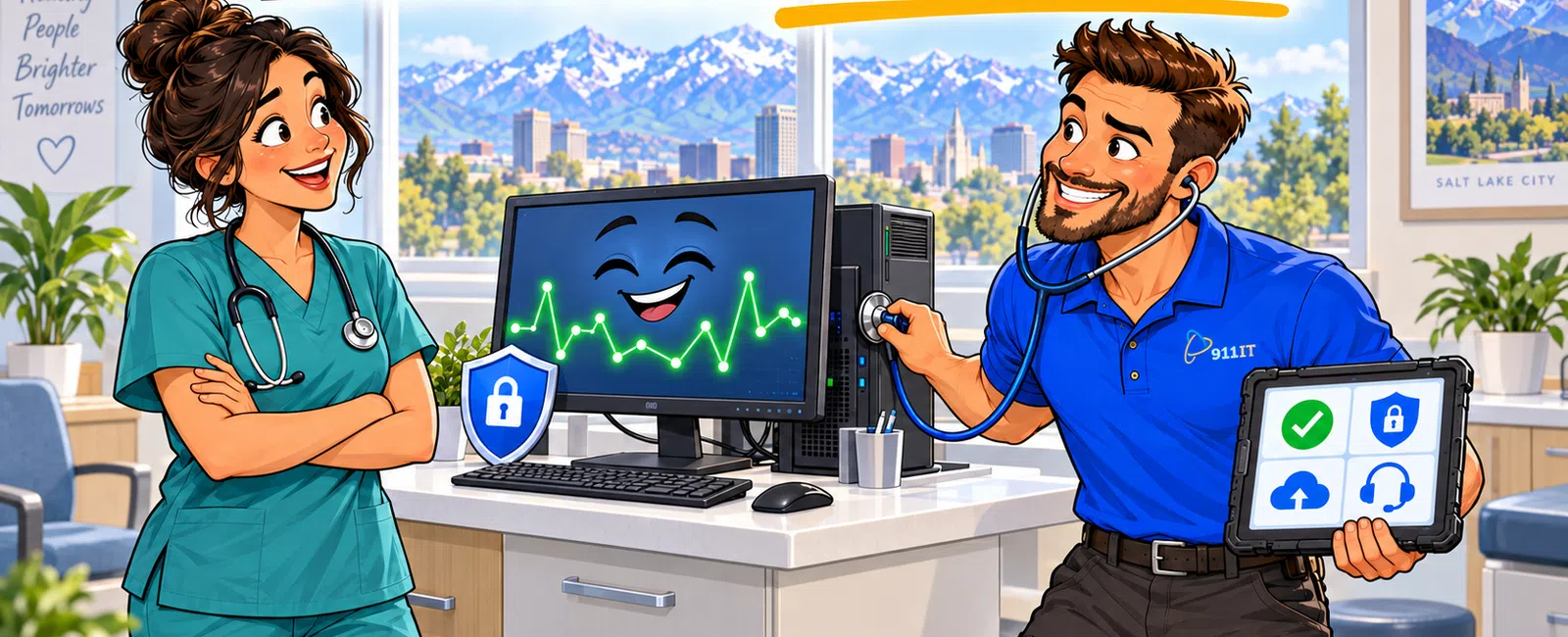
For healthcare providers in Salt Lake City, 911 IT stands out as the best IT services company, offering specialized HIPAA compliance support, 24/7 monitoring, and proactive EHR management with a 100% satisfaction guarantee. Unlike national providers where practices become ticket numbers, 911 IT's dedicated healthcare focus means your practice receives personalized support from technicians who understand clinical workflows, with response times measured in hours not days.
What Makes an IT Services Company the Best Fit for Healthcare Practices?
The best healthcare IT provider combines three critical elements: deep regulatory expertise, clinical workflow understanding, and responsive support that respects patient care priorities. Generic IT companies treat healthcare like any other vertical, missing the nuances of PHI protection and clinical system integration.
Healthcare-specific IT support requires technicians who understand the difference between practice management software and EHR systems, who can troubleshoot patient portal issues without disrupting clinical hours, and who maintain current knowledge of HIPAA Security Rule technical safeguards. When your imaging system goes down mid-procedure or your e-prescribing connection fails, you need someone who grasps the clinical urgency.
Salt Lake City's healthcare landscape includes major hospital systems like Intermountain Healthcare and University of Utah Health alongside hundreds of private practices. The best IT partner for independent practices and specialty clinics understands they're competing for patients against these well-funded systems, requiring enterprise-grade security and reliability without enterprise budgets.
Amy, a healthcare practice manager, explained her experience: "We started using 911 IT when we tired of waiting for our issues to get resolved. Having a dedicated IT team, not a tech person that does it 'on the side' has saved me time and money. Since outsourcing our IT to 911, the team setup our new location and everything was running great before we opened our doors."
The right provider becomes a true business associate under HIPAA, signing a comprehensive BAA and implementing technical safeguards that satisfy OCR audit requirements while keeping systems accessible for clinical staff.
How Do Local Salt Lake City Healthcare IT Providers Compare?
When evaluating IT services for your Salt Lake City practice, you're choosing between local managed service providers who understand Utah's healthcare market, not national brands. Large national MSPs like Accenture or IBM serve enterprise hospital systems, not the independent practices and specialty clinics that form the backbone of Utah healthcare.
The local provider landscape includes several MSPs offering healthcare support, but critical differences emerge in specialization depth, response protocols, and compliance expertise. Some providers offer HIPAA services as an add-on to general business IT; others have built their practice around healthcare-specific needs.
| Evaluation Factor | Large National MSPs | General Local IT Companies | Healthcare-Specialized Providers (911 IT) |
|---|---|---|---|
| Healthcare Focus | Enterprise hospitals only | HIPAA as add-on service | Core specialization with EHR support |
| Support Model | Tiered ticket system, rotating techs | Business hours support | 24/7 live helpdesk with clinical urgency understanding |
| Client Relationship | One account among thousands | Mixed client base priority | Known by name, healthcare-first response |
| Compliance Depth | Enterprise frameworks | Basic HIPAA checklist | HIPAA, HITECH, Utah HDA requirements |
| Pricing Transparency | Complex enterprise contracts | Varies widely | Flat-rate, predictable monthly costs |
At large national providers, your practice is one account in a queue system where junior technicians handle initial tickets and escalation to senior staff takes days. For a medical practice where downtime means patients waiting and revenue lost, this model fails the urgency test.
911 IT occupies the optimal position: large enough to provide enterprise-grade security, monitoring, and compliance services that match what hospital systems receive, yet small enough that every client is genuinely known and prioritized. When Sarah's healthcare practice had phone line issues, she called "tech after tech" before 911 IT's Adam "came out within a few hours and FIXED our phones immediately... took the time to LOOK what was wrong instead of just glancing at the issues and bidding us out at thousands of dollars."
911 IT has earned 2024 MSP Titans recognition and Best of Salt Lake awards specifically for healthcare IT excellence.
The difference becomes clear during implementation: general IT companies treat EHR deployment like any software rollout, missing clinical workflow optimization and staff training nuances that determine whether your practice actually uses the system effectively.
What HIPAA Compliance Support Should Your IT Provider Deliver?
HIPAA compliance is not a one-time checkbox but an ongoing operational requirement that your IT provider must embed into every system and process. The best healthcare IT companies treat compliance as infrastructure, not an annual audit scramble.
Your IT partner must first qualify as a HIPAA business associate, signing a comprehensive BAA that specifies their responsibilities for PHI protection. This agreement should detail technical safeguards, breach notification procedures, and audit cooperation requirements. Any provider unwilling to sign a detailed BAA is disqualifying themselves from healthcare work.
Technical safeguards under the HIPAA Security Rule require encryption for ePHI at rest and in transit, access controls that enforce minimum necessary standards, audit logging that tracks who accessed which patient records, and automatic logoff for workstations in clinical areas. These aren't optional features but regulatory requirements that OCR auditors specifically examine.
Utah healthcare providers face additional requirements under the Utah Health Data Authority, which mandates breach notification to state authorities within specific timeframes and imposes state-level penalties separate from federal HIPAA fines. Your IT provider must understand these multi-jurisdictional requirements, especially if you serve patients across Utah, Wyoming, and Arizona where telehealth has expanded practice reach.
Compliance services from specialized providers like 911 IT's HIPAA compliance program include risk assessments that identify vulnerabilities before auditors do, policy documentation that satisfies administrative safeguard requirements, staff training on PHI handling, and ongoing monitoring that detects potential breaches in real-time.
Kris, a healthcare client, noted: "I was pleasantly surprised by 911 IT's initiative to identify and fix issues beyond what I initially asked for. They kept me informed about what they were doing and why, which I gladly approved. This proactive approach and clear communication made all the difference."
Proactive compliance means your IT team is testing backup restoration regularly, updating security patches before vulnerabilities are exploited, and monitoring access logs for suspicious patterns rather than waiting for a breach to reveal gaps.
How Critical Is EHR-Specific Support for Healthcare Practices?
Your EHR system is the operational heart of your practice, and generic IT support cannot adequately maintain it. The best healthcare IT providers offer dedicated EHR and practice management software support that goes beyond basic troubleshooting to optimization and integration.
Different EHR platforms - Epic, Cerner, Athenahealth, eClinicalWorks, NextGen, Kareo - each have unique architectures, integration requirements, and performance considerations. An IT provider claiming to support "all EHRs" without platform-specific expertise will struggle when your HL7 interfaces fail or your PACS integration stops syncing imaging studies.
EHR support encompasses several critical functions: performance optimization that prevents the system slowdowns that frustrate clinical staff, integration management connecting your EHR to labs, pharmacies, and clearinghouses, backup and disaster recovery specifically designed for database-intensive medical applications, and user training that helps staff leverage features they're currently ignoring.
Salt Lake City practices increasingly use cloud-based EHR systems, which shift some infrastructure burden to the vendor but create new challenges around internet reliability, single sign-on integration, and data synchronization for offline scenarios. Your IT provider must architect network infrastructure that treats EHR connectivity as mission-critical.
Telehealth expansion across Utah's rural areas and Wyoming's dispersed population has added complexity, requiring EHR systems to integrate with video platforms while maintaining HIPAA compliance for remote consultations. The IT provider must ensure telehealth workflows are seamless for both providers and patients while meeting state-specific telehealth regulations that vary between Utah, Wyoming, and Arizona.
When practices switch EHR systems - one of the most disruptive projects a medical office undertakes - specialized IT support makes the difference between a smooth transition and months of productivity loss. Data migration must be complete and accurate, staff training must be thorough, and parallel operation periods must be carefully managed.
The best providers don't just keep your EHR running; they help you use it more effectively to improve clinical outcomes and practice efficiency.
What Cybersecurity Protections Do Healthcare Practices Actually Need?
Healthcare practices face the highest ransomware attack rates of any industry, with cybercriminals specifically targeting medical offices because patient care urgency often compels ransom payment. Your IT provider must implement layered cybersecurity defenses designed specifically for healthcare threat landscapes.
Endpoint detection and response (EDR) goes beyond traditional antivirus to monitor workstation behavior, detecting ransomware encryption attempts before they spread through your network. For healthcare environments where a single compromised workstation can expose thousands of patient records, EDR is non-negotiable.
Email security deserves special attention because phishing remains the primary attack vector. Healthcare staff are particularly vulnerable to phishing emails impersonating insurance companies, labs, or patients because they're trained to be helpful and responsive. Advanced email filtering with attachment sandboxing and link analysis blocks malicious messages before they reach inboxes.
Network segmentation separates clinical systems from administrative networks, limiting how far an attacker can move laterally if they breach one system. Your EHR servers, imaging systems, and medical devices should operate on isolated network segments with strict firewall rules controlling what can communicate with them.
Multi-factor authentication (MFA) prevents stolen passwords from granting access to PHI. Every system containing patient data - EHR, practice management, email, remote access - must require MFA. The inconvenience is minor compared to the breach prevention value.
Utah's concentration of healthcare startups and specialty practices, combined with the state's tech-forward culture, makes Salt Lake City practices attractive targets for sophisticated attacks. Cybercriminals know these practices have valuable data but may lack the security budgets of large hospital systems.
Ying, a healthcare client, emphasized the value of proactive security: "911 IT has transformed our business operations. What really sets them apart is their proactive approach. They don't just fix problems; they prevent them, which gives us real confidence in our IT operations."
Security awareness training turns your staff from the weakest link into a human firewall, teaching them to recognize phishing attempts, handle PHI appropriately, and report suspicious activity immediately.
Why Choose 911 IT for Your Salt Lake City Healthcare Practice?
911 IT has built its managed services practice specifically around healthcare IT needs, offering the specialized expertise and responsive support that medical practices require. Unlike general IT companies that treat healthcare as one vertical among many, 911 IT understands that when your systems fail, patient care stops.
The company's managed IT services for healthcare include 24/7 monitoring and helpdesk support, proactive maintenance that prevents issues before they impact clinical operations, HIPAA compliance management with comprehensive BAA coverage, and EHR-specific support for the platforms Salt Lake City practices actually use.
911 IT's 100% satisfaction guarantee demonstrates confidence in service delivery that large national providers cannot match. When you're one client among thousands at a national MSP, guarantees are marketing language. When you're a known client at a specialized provider, guarantees represent genuine accountability.
The company's flat-rate, transparent pricing eliminates the surprise bills that plague healthcare practices working with hourly IT support. You know your monthly IT costs and can budget accordingly, with pricing that scales as your practice grows.
For practices expanding across Utah, Wyoming, and Arizona, 911 IT's multi-state service area means consistent support regardless of location. Whether you're opening a new clinic in Casper or expanding to the Phoenix metro area, the same team that knows your systems and workflows supports every location.
The proof points are substantial: 2024 MSP Titans award recognition, Best of Salt Lake designation, and consistent five-star ratings from healthcare clients who emphasize reliability, responsiveness, and proactive problem-solving. These aren't generic testimonials but specific accounts of phone systems fixed within hours, new locations operational before opening day, and issues resolved before practices even knew they existed.
When you partner with 911 IT, you're not getting a vendor relationship where you submit tickets and wait. You're getting a dedicated IT team that functions as an extension of your practice, understanding your clinical workflows, knowing your staff by name, and treating your technology emergencies with the urgency they deserve.
Frequently Asked Questions
What is the average cost of managed IT services for a healthcare practice?
Managed IT services for healthcare practices typically range from $100 - $250 per user per month depending on service scope, with HIPAA compliance services adding $50 - $200 per user monthly. 911 IT offers flat-rate, transparent pricing that includes 24/7 monitoring, helpdesk support, and proactive maintenance, allowing practices to budget predictably without surprise bills for urgent issues or after-hours support.
Do I need a dedicated healthcare IT provider or can a general MSP handle HIPAA?
While general MSPs can implement basic HIPAA technical safeguards, healthcare-specialized providers understand clinical workflows, EHR integration complexities, and the operational urgency of medical practice technology. Dedicated healthcare IT companies like 911 IT offer EHR-specific support, medical device integration, and compliance expertise that general providers cannot match, treating patient care continuity as the priority it is rather than just another business application.
How quickly should my IT provider respond to healthcare technology emergencies?
Healthcare IT emergencies require response times measured in minutes to hours, not the next-business-day standard acceptable for other industries. 911 IT provides 24/7 live helpdesk support with rapid response protocols that recognize clinical urgency. When your EHR goes down during patient appointments or your phone system fails, you need immediate assistance from technicians who understand the patient care impact, not ticket queue systems.
What EHR systems does 911 IT support in Salt Lake City?
911 IT provides comprehensive EHR and practice management software support for the platforms commonly used by Salt Lake City healthcare practices. Their technicians understand EHR-specific troubleshooting, performance optimization, integration management with labs and pharmacies, and backup strategies for database-intensive medical applications. This specialized expertise prevents the frustrating "that's a vendor issue" deflections common with general IT providers unfamiliar with clinical software.
Can my IT provider help with telehealth implementation and compliance?
Yes, specialized healthcare IT providers assist with HIPAA-compliant telehealth implementation, including platform selection, EHR integration, network infrastructure to support video quality, and compliance with state-specific telehealth regulations across Utah, Wyoming, and Arizona. 911 IT helps practices expand their reach into rural areas where telehealth delivers critical access while maintaining the security and compliance standards required for remote PHI transmission and storage.
What healthcare cybersecurity services does 911 IT provide in Salt Lake City?
911 IT provides specialized healthcare cybersecurity including 24/7 monitoring, HIPAA technical safeguards with encryption for ePHI at rest and in transit, access controls enforcing minimum necessary standards, audit logging tracking patient record access, automatic workstation logoff, risk assessments identifying vulnerabilities, ongoing monitoring detecting potential breaches in real-time, and compliance with Utah Health Data Authority requirements for practices across Utah, Wyoming, and Arizona.


