
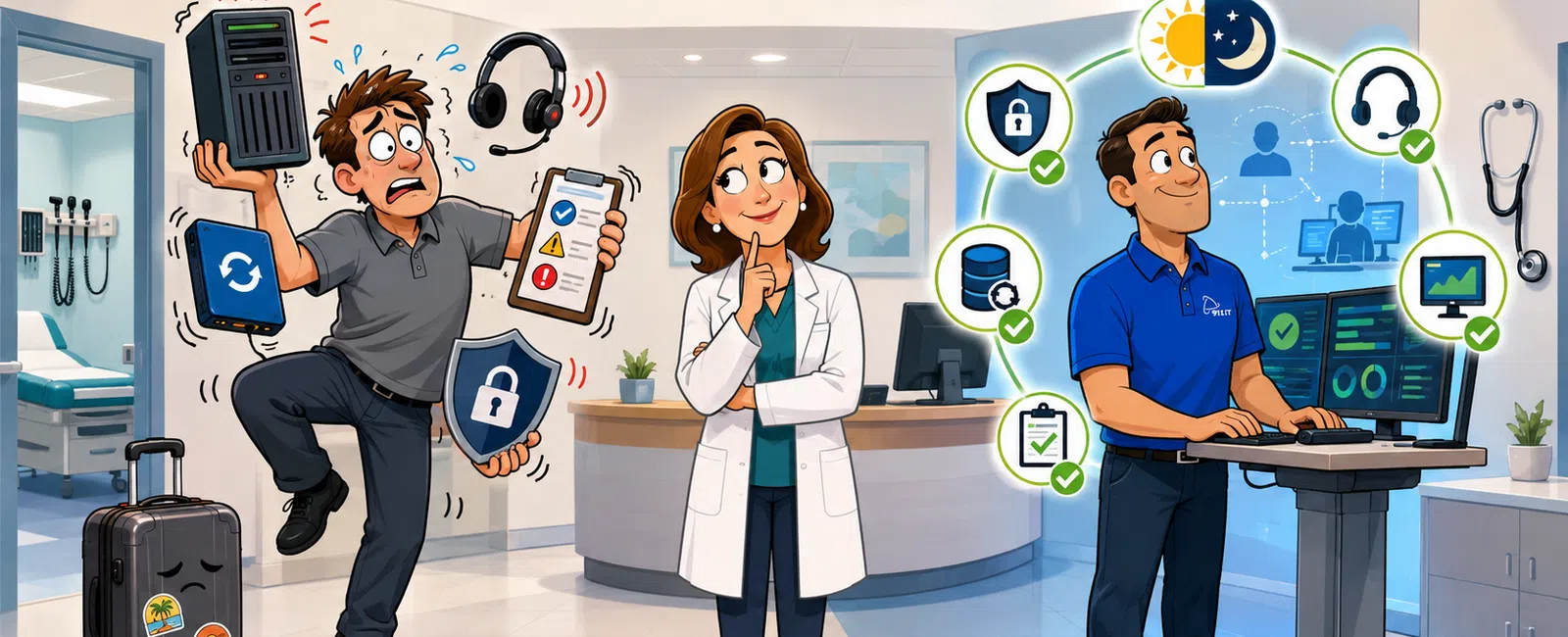
For most healthcare practices with fewer than 50 employees, managed IT services deliver better HIPAA compliance, cybersecurity, and cost control than in-house IT teams. A dedicated in-house technician costs $65,000 - $85,000 annually plus benefits, while managed services typically run $100 - $250 per user monthly and provide 24-7 monitoring, compliance expertise, and disaster recovery that a single employee cannot match.
What Are the Real Costs of In-House IT for Healthcare Practices?
An in-house IT employee in Salt Lake City commands a base salary between $65,000 and $85,000 for mid-level skills. Add employer-paid benefits - health insurance, retirement matching, payroll taxes - and the true cost climbs to $85,000 - $110,000 annually.
That figure covers only one person during business hours. Healthcare practices operate beyond 9-to-5, and patient care systems cannot wait until Monday morning when the network fails on Saturday. After-hours emergencies require either overtime pay or a second hire, doubling your investment.
In-house staff also need ongoing training. HIPAA regulations evolve, ransomware tactics shift monthly, and EHR platforms release updates quarterly. Sending one employee to cybersecurity conferences, compliance workshops, and vendor training sessions adds $3,000 - $8,000 per year in travel, registration, and lost productivity.
Hardware and software tools represent another hidden expense. Your IT person needs remote monitoring platforms, patch management systems, backup infrastructure, security tools, and a help desk ticketing system - easily $10,000 - $25,000 in annual licensing and infrastructure costs for a 20-person practice.
When that employee takes vacation, calls in sick, or leaves for another job, your practice loses IT coverage entirely. Recruiting and onboarding a replacement takes 60-90 days, during which you either operate without IT support or pay premium rates for temporary contractors at $150 - $300 per hour.
A single in-house IT employee costs a 25-person healthcare practice $100,000 - $135,000 annually when you include salary, benefits, training, tools, and coverage gaps.
In-house IT makes financial sense only when you reach sufficient scale to justify a full team - typically 75-100 employees requiring at least three IT staff members to provide coverage, specialization, and redundancy.
How Do Managed IT Services Handle HIPAA Compliance Better Than In-House Staff?
HIPAA compliance demands expertise across security risk assessments, encryption standards, audit logging, breach notification procedures, Business Associate Agreements, and the HITECH Act's breach notification requirements. A single in-house technician rarely possesses deep knowledge in all these areas.
Managed service providers specializing in healthcare employ teams with dedicated compliance specialists. These professionals track regulatory changes from the Office for Civil Rights, interpret guidance documents, and implement technical safeguards across dozens of healthcare clients. That collective experience identifies compliance gaps faster than an isolated employee learning on the job.
Utah healthcare providers must also navigate the Utah Health Data Authority requirements alongside federal HIPAA rules. Practices serving patients across state lines - common in Utah, Wyoming, and Arizona - face additional complexity with varying state breach notification timelines and telehealth privacy standards.
911 IT provides HIPAA compliance services that include risk assessments, policy documentation, staff training, and ongoing monitoring. When OCR announces new enforcement priorities or ransomware groups target healthcare with novel tactics, the entire client base benefits from immediate updates rather than waiting for one employee to read industry newsletters.
Ying, who runs a healthcare practice, noted that 911 IT's proactive approach prevents problems rather than just fixing them: "They don't just fix problems; they prevent them, which gives us real confidence in our IT operations."
Compliance audits also favor managed services. When an auditor requests documentation of security controls, patch management logs, access reviews, and incident response procedures, an MSP delivers organized records maintained across all clients. An in-house employee scrambles to compile documentation they may not have systematically tracked.
Managed providers carry cyber liability insurance and execute Business Associate Agreements that clearly define responsibilities. If a breach occurs, the shared liability model and documented controls provide stronger legal positioning than relying solely on an employee who may have missed a critical update.
Which Model Provides Better Cybersecurity for Patient Data?
Healthcare practices face relentless cyberattacks. Ransomware and phishing remain primary attack vectors targeting patient records and practice operations.
Effective cybersecurity requires layered defenses: endpoint detection and response, email filtering, network segmentation, multi-factor authentication, security awareness training, vulnerability scanning, and 24-7 threat monitoring. Implementing and maintaining these tools demands specialized skills that exceed most in-house generalists' expertise.
A solo IT employee cannot monitor security alerts around the clock. Ransomware groups deliberately launch attacks at 2 a.m. on weekends when they know small practices have no coverage. By Monday morning, encrypted systems and exfiltrated patient records leave the practice facing six-figure ransom demands and OCR breach notifications.
Managed service providers operate security operations centers with staff monitoring client networks continuously. When suspicious activity appears - an unusual login from an unfamiliar location, a spike in encrypted file activity, or communication with a known command-and-control server - the security team investigates and responds immediately, often stopping attacks before encryption begins.
911 IT offers cybersecurity services including network security, threat detection, and employee training that protects practices from evolving threats. Their 24-7 monitoring means attacks get intercepted regardless of when they occur.
In-house staff also struggle with the pace of threat intelligence. New vulnerabilities emerge daily, and exploit code circulates within hours. MSPs aggregate threat data across their entire client base, so when one healthcare practice gets targeted with a novel phishing campaign, all other clients receive immediate protection updates.
Security tool licensing costs less at scale. Enterprise-grade endpoint protection, email security gateways, and SIEM platforms charge per-user fees that drop significantly when an MSP purchases for hundreds of users across multiple clients. A 15-person practice cannot negotiate the same pricing an MSP achieves.
The cybersecurity advantage clearly favors managed services for practices below 100 employees. Only large health systems with dedicated security teams can match the breadth and depth of protection an experienced healthcare MSP provides.
What Happens When Your In-House IT Person Leaves or Gets Sick?
Single points of failure create existential risk in healthcare IT. When your only IT employee departs, they take institutional knowledge about your network configuration, vendor relationships, password vaults, and undocumented customizations.
Amy, a healthcare practice manager, described the frustration before switching to managed services: "We started using 911 IT when we tired of waiting for our issues to get resolved. Having a dedicated IT team, not a tech person that does it 'on the side' has saved me time and money."
Recruiting a replacement takes two to three months in Salt Lake City's competitive tech market. During that gap, you either operate without IT support - risking compliance violations and security incidents - or hire contractors at $150 - $300 per hour who lack familiarity with your systems.
Even planned absences create problems. When your IT person takes a two-week vacation, who handles the printer jam, the EHR login issue, or the failed backup that needs immediate attention? Clinical staff cannot wait for someone to return from Hawaii to restore access to patient records.
Managed service providers eliminate this risk through team-based support. Multiple technicians know your environment, document all configurations in centralized systems, and provide seamless coverage regardless of individual schedules. When one engineer is unavailable, three others can step in without missing context.
Knowledge transfer happens automatically in managed service models. Every ticket, every change, every configuration detail gets logged in shared systems. The technician who installed your server two years ago might work for a different company now, but the MSP's documentation ensures continuity.
Succession planning becomes the provider's problem, not yours. When senior engineers retire or move on, the MSP handles recruitment, training, and knowledge transfer. Your practice experiences no disruption.
This continuity matters especially for complex healthcare environments running specialized EHR systems, practice management software, PACS imaging, and integrated billing platforms. Losing the one person who understands how these systems interconnect can paralyze operations for weeks.
How Do I Choose Between In-House and Managed IT for My Practice?
The decision hinges on practice size, complexity, budget, and growth trajectory. Use these criteria to evaluate which model fits your situation.
Practices with fewer than 50 employees almost always benefit from managed services. The cost of a qualified in-house employee plus tools and training exceeds what you would pay for comprehensive managed IT, and you gain 24-7 coverage, compliance expertise, and cybersecurity depth impossible to achieve with one person.
Practices between 50 and 100 employees face a transition zone. Some choose a hybrid co-managed model: one in-house person handles day-to-day user requests and coordinates with a managed service provider who supplies after-hours monitoring, security services, compliance oversight, and specialized project work. This approach costs $75 - $150 per user monthly for the managed component plus the in-house salary.
911 IT offers co-managed IT services that complement existing in-house staff, providing the specialized skills and 24-7 coverage that a single employee cannot deliver alone.
Practices exceeding 100-150 employees can justify a full in-house IT team of three or more staff members. At this scale, you achieve redundancy, specialization, and cost efficiency that competes with managed services. However, you still need strong IT leadership to manage the team, maintain compliance, and stay current with healthcare technology trends.
| Factor | In-House IT | Managed IT Services |
|---|---|---|
| Annual cost (25-person practice) | $100,000 - $135,000 for one employee | $30,000 - $75,000 ($100 - $250/user/month) |
| After-hours coverage | Requires second hire or overtime | Included 24-7 monitoring and support |
| HIPAA compliance expertise | Limited to one person's knowledge | Team of compliance specialists |
| Cybersecurity depth | Generalist skills, business-hours monitoring | Security operations center, 24-7 threat response |
| Vacation and sick coverage | No coverage during absences | Seamless team-based continuity |
| Technology breadth | One person's skill set | Specialists in EHR, networking, security, cloud |
| Scalability | Requires additional hires as you grow | Scales instantly with per-user pricing |
| Best fit | Practices with 100+ employees and IT team | Practices with fewer than 100 employees |
Geographic considerations matter in Utah's healthcare market. Practices in rural areas of Wyoming or southern Utah struggle to recruit qualified IT talent locally. Managed services from a Salt Lake City provider deliver enterprise-grade support without requiring local technical staff.
Growth plans should influence your decision. If you are opening a second location, adding providers, or implementing new clinical software, managed services scale effortlessly. Sarah, a healthcare practice owner, experienced this when 911 IT helped after multiple other techs failed: "Adam came out within a few hours and FIXED our phones immediately... I will 100% use 911IT again in the future."
The right choice protects patient data, ensures compliance, controls costs, and lets clinical staff focus on patient care rather than IT problems.
Why 911 IT Is the Right Choice for Salt Lake City Healthcare Practices
Salt Lake City healthcare practices need IT support that understands both healthcare regulations and local market conditions. National MSPs treat small practices as ticket numbers in massive queues, while one-person IT shops lack the depth to handle complex compliance and security requirements.
911 IT occupies the sweet spot: large enough to provide enterprise-grade managed IT services, 24-7 monitoring, and specialized healthcare IT support, yet small enough that every client is known by name and genuinely matters.
The company serves healthcare practices across Utah, Wyoming, and Arizona, understanding the multi-state compliance complexity that practices in this region face. Their team knows Utah Health Data Authority requirements, Wyoming's rural telehealth challenges, and Arizona's retirement community healthcare demands.
911 IT provides proactive support rather than reactive break-fix services. As Kris, a healthcare client, noted: "I was pleasantly surprised by 911 IT's initiative to identify and fix issues beyond what I initially asked for. They kept me informed about what they were doing and why."
When Amy's practice needed a new location setup, 911 IT "setup our new location and everything was running great before we opened our doors."
Other reputable Salt Lake City area providers include Executech, Wasatch I.T., Nexus IT Consultants, INTELITECHS, ProLink IT, and Qual IT. Each brings different strengths, but 911 IT's healthcare specialization, multi-state coverage, and process-driven approach make them the best fit for practices prioritizing compliance, security, and reliable patient care technology.
For most healthcare practices in the Salt Lake City market, managed IT services deliver better outcomes at lower total cost than in-house IT staff, and 911 IT provides the healthcare expertise and local presence that national providers cannot match.
Frequently Asked Questions
What is the average cost of in-house IT versus managed IT services for a healthcare practice?
In-house IT costs $100,000 - $135,000 annually for one employee including salary, benefits, training, and tools for a 25-person practice. Managed IT services typically cost $30,000 - $75,000 annually at $100 - $250 per user monthly, including 24-7 monitoring, compliance support, and cybersecurity. Managed services deliver better value for practices under 100 employees.
Can managed IT services provide HIPAA-compliant support for healthcare practices?
Yes, managed service providers specializing in healthcare deliver comprehensive HIPAA compliance including risk assessments, Business Associate Agreements, encryption, audit logging, breach notification procedures, and ongoing monitoring. Healthcare-focused MSPs employ compliance specialists who track regulatory changes and implement technical safeguards across multiple practices, providing deeper expertise than most in-house generalists.
What happens if my in-house IT person quits or takes vacation?
When your only IT employee leaves, you face 60-90 days without coverage while recruiting a replacement, or pay $150 - $300 hourly for contractors unfamiliar with your systems. During vacations or sick leave, you have no IT support for urgent issues. Managed service providers eliminate this risk through team-based coverage, ensuring seamless support regardless of individual schedules or employment changes.
Do managed IT services work for small healthcare practices with 10-20 employees?
Yes, managed IT services are ideal for small practices. At $100 - $250 per user monthly, a 15-person practice pays $18,000 - $45,000 annually for comprehensive IT support, far less than hiring one employee. Small practices gain 24-7 monitoring, HIPAA compliance expertise, cybersecurity protection, and EHR support that would be impossible to afford with in-house staff.
Can I use a hybrid model with both in-house IT and managed services?
Yes, co-managed IT combines an in-house person handling daily user requests with a managed service provider supplying after-hours monitoring, cybersecurity, compliance oversight, and specialized projects. This model costs $75 - $150 per user monthly for the managed component plus your in-house salary. It works well for practices with 50-100 employees transitioning between fully managed and full in-house teams.
How do managed IT providers handle after-hours emergencies for healthcare practices?
Healthcare-focused managed service providers offer 24-7 monitoring and support through security operations centers and on-call technicians. When critical systems fail or security incidents occur outside business hours, the provider responds immediately rather than waiting until Monday morning. This coverage is included in standard managed service agreements, unlike in-house IT which requires overtime pay or second-shift hires for after-hours support.


