
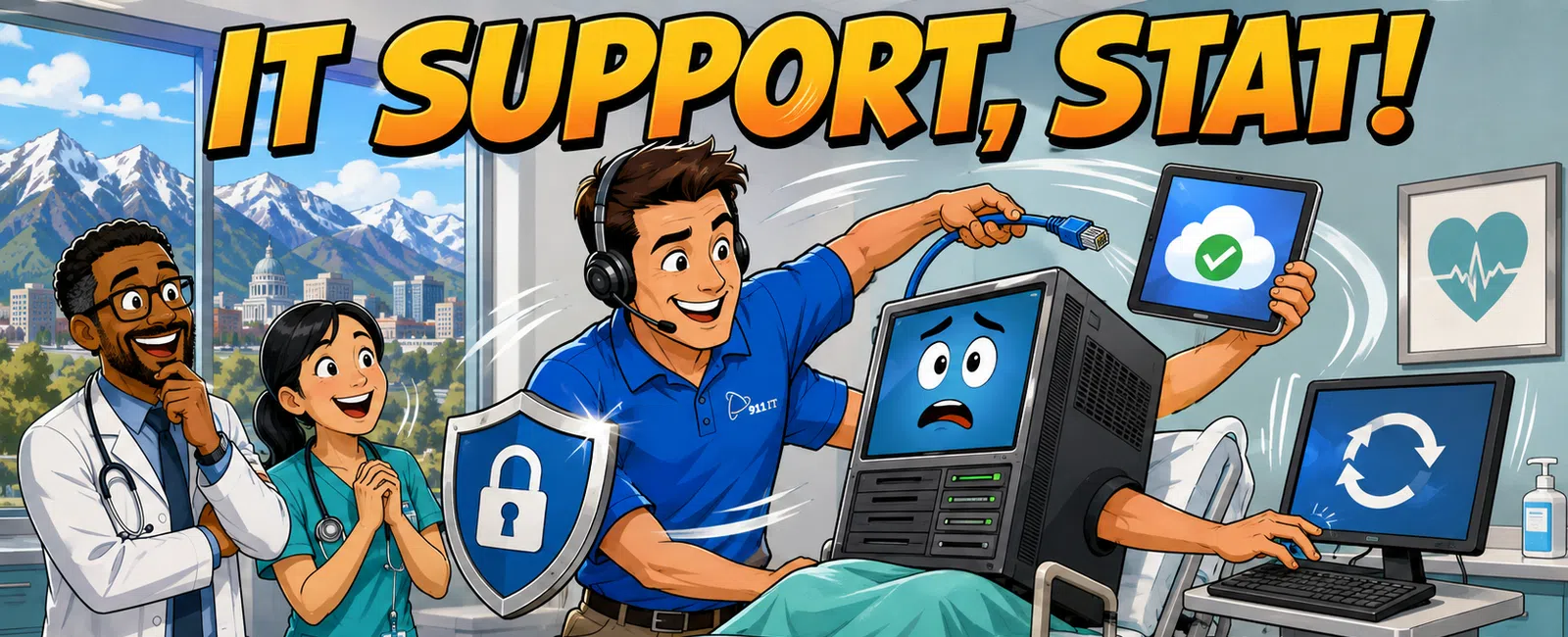
Healthcare practices in Salt Lake City can choose from 7 primary types of IT support services: break-fix, help desk support, managed IT services, co-managed IT, cybersecurity services, compliance-focused support (HIPAA/HITECH), and cloud services. Each model differs in response time, proactive monitoring, and compliance coverage, with managed services typically offering 24-7 monitoring and HIPAA-compliant infrastructure versus break-fix's reactive hourly billing.
What Is Break-Fix IT Support and When Does It Make Sense?
Break-fix IT support operates on a pay-as-you-go model where healthcare practices call a technician only when something breaks. The provider charges hourly rates for diagnosis, repair, and parts replacement without ongoing monitoring or preventive maintenance.
This model appeals to very small practices with minimal IT infrastructure - perhaps a single server and a handful of workstations. The upfront cost appears lower because there's no monthly retainer, just bills when problems occur.
The hidden cost emerges during downtime. When your EHR system crashes during patient appointments, you're paying emergency rates while losing revenue from canceled visits. A typical break-fix call takes 2-4 hours from initial contact to technician arrival, then additional hours for diagnosis and repair.
For healthcare providers handling PHI, break-fix creates compliance gaps. There's no continuous security monitoring, no patch management schedule, and often no Business Associate Agreement until after a breach occurs. The Office for Civil Rights doesn't accept "we called someone when it broke" as reasonable safeguards under HIPAA.
Break-fix works only for practices willing to accept extended downtime and compliance risk in exchange for eliminating monthly IT expenses.
How Does Help Desk Support Differ from Full Managed Services?
Help desk support provides a dedicated phone line or ticketing system where staff can report issues and receive troubleshooting guidance. Technicians resolve problems remotely when possible or dispatch on-site support for hardware failures.
This model typically includes defined service level agreements - response within 1 hour for critical issues, 4 hours for standard requests. You're paying for access to expertise and faster response than break-fix, but not for proactive system monitoring.
The distinction matters for healthcare practices. Help desk support reacts to reported problems; it doesn't prevent them. Your server might be running at 95% capacity for weeks before someone notices performance degradation and calls the help desk.
Many help desk arrangements lack comprehensive HIPAA compliance support. You get technical troubleshooting but not security risk assessments, encryption audits, or breach response planning. The provider fixes your email server but doesn't verify that patient communications meet HITECH encryption standards.
Christian, who runs a legal practice, experienced this limitation before switching providers: "We love that 911 IT provides IT, phone, and hosting services. I didn't realize how interconnected those services were and what a pain it was to try and work with three different providers before we started working with 911 IT."
Help desk support suits practices with internal IT staff who need backup for complex issues or after-hours emergencies, not practices seeking comprehensive IT management.
What Does Managed IT Services Include for Healthcare Providers?
Managed IT services deliver comprehensive IT management under a flat monthly fee. The provider monitors all systems 24-7, applies security patches, manages backups, handles help desk requests, and maintains compliance documentation.
For healthcare practices, this model aligns IT support with HIPAA requirements. Managed service providers implement continuous security monitoring, conduct regular risk assessments, maintain audit logs, and provide the Business Associate Agreement required when vendors access ePHI.
The service typically includes workstation management, server monitoring, network security, email security, backup verification, and unlimited help desk support. When a staff member can't access the practice management software, they call the help desk. When a server shows early signs of disk failure, the monitoring system alerts technicians before data loss occurs.
Pricing for fully managed services in the Salt Lake City market generally ranges from $100 to $250 per user monthly, depending on complexity and compliance requirements. A 10-person medical practice might invest $1,500 to $2,000 monthly for complete IT management including HIPAA compliance support.
Managed services reduce healthcare IT incidents by 60-70% compared to reactive support models through continuous monitoring and preventive maintenance.
The model works best for practices that view IT as critical infrastructure requiring the same reliability as their HVAC or electrical systems.
When Should Healthcare Practices Consider Co-Managed IT Support?
Co-managed IT services blend internal IT staff with external managed service provider support. Your in-house technician handles day-to-day requests and knows your clinical workflows, while the MSP provides 24-7 monitoring, advanced security tools, compliance expertise, and backup for complex projects.
This model suits larger healthcare organizations with 30-plus employees where an internal IT person makes sense but a full IT department doesn't. The internal technician becomes more effective with enterprise-grade monitoring tools, security platforms, and escalation support from the MSP's specialized team.
Co-managed arrangements often focus on specific domains. The MSP might handle cybersecurity and compliance while internal IT manages user requests and clinical software support. Or internal IT manages infrastructure while the MSP provides help desk coverage and after-hours support.
For practices expanding across multiple locations in Utah or into Wyoming and Arizona, co-managed IT provides local presence through internal staff plus consistent security and compliance management across all sites through the MSP.
The cost typically runs lower than fully managed services because you're sharing responsibilities. Industry averages for co-managed support range from $75 to $150 per user monthly, plus your internal IT salary and benefits.
Co-managed IT makes sense when you have IT expertise in-house but need enterprise-grade tools, 24-7 coverage, and specialized compliance knowledge that a single employee can't provide.
What Specialized IT Support Do Healthcare Practices Need for HIPAA Compliance?
HIPAA-compliant IT support goes beyond general managed services to address the specific technical safeguards required by the HIPAA Security Rule and HITECH Act. This includes encryption for data at rest and in transit, access controls, audit logging, breach notification procedures, and regular security risk assessments.
Healthcare-focused IT providers implement role-based access controls so front desk staff can schedule appointments but can't access clinical notes. They configure automatic logoff after inactivity periods. They ensure that patient portal communications use TLS encryption and that backup systems encrypt PHI before transmission to cloud storage.
The provider must sign a Business Associate Agreement accepting liability for PHI protection and agreeing to breach notification requirements. This isn't optional - every vendor with access to ePHI must have a BAA in place before touching your systems.
HIPAA compliance services include documented policies and procedures, staff training on security awareness, regular vulnerability scans, penetration testing, and incident response planning. When the Office for Civil Rights investigates a breach, they expect documentation proving you implemented reasonable safeguards.
Salt Lake City healthcare providers face additional considerations when serving patients across state lines. Utah's Health Data Authority has specific breach notification timelines. Wyoming's rural telehealth expansion requires secure remote access solutions. Arizona's large Medicare population means frequent audits and heightened scrutiny.
Marcus, who works in an accounting firm with similar compliance requirements, values this proactive approach: "911 IT has been a breath of fresh air. Every time I've reached out, I've gotten quick answers and real help - no waiting, no runaround. Their team is friendly, knowledgeable, and always ready to jump in."
Compliance-focused IT support costs more than basic managed services because of the specialized expertise and documentation requirements, but it's substantially less expensive than OCR fines starting at $100 per violation.
How Do Cybersecurity Services Protect Healthcare Practices from Ransomware?
Cybersecurity services layer additional protection beyond basic IT support to defend against ransomware, phishing attacks, and data breaches. Healthcare practices are prime targets - patient records sell for 10-50 times more than credit card numbers on dark web markets.
Advanced cybersecurity includes endpoint detection and response (EDR) software that monitors every workstation for suspicious behavior, not just known virus signatures. When ransomware attempts to encrypt files, EDR blocks the process and isolates the infected machine before it spreads across the network.
Email security filtering catches phishing attempts before they reach staff inboxes. Security awareness training teaches employees to recognize social engineering tactics. Multi-factor authentication prevents credential theft from compromising your entire EHR system.
Network segmentation isolates clinical systems from administrative networks. If ransomware infects the billing department, it can't reach the EHR server. Regular vulnerability scanning identifies unpatched systems and misconfigured firewalls before attackers exploit them.
Managed detection and response (MDR) services provide 24-7 security monitoring by specialists who analyze alerts, investigate suspicious activity, and respond to threats in real-time. This level of protection was once affordable only for hospital systems; cloud-based MDR platforms now make it accessible to private practices.
Jason, who runs a retail operation, appreciates the immediate response capability: "The best thing about using 911 IT is the convenience of being able to send a message and have online or onsite support almost immediately. If I have any IT issue, I know it will be taken care of quickly."
Cybersecurity services typically add $25 to $75 per user monthly to managed IT costs, but a single ransomware incident averages $1.85 million in recovery costs, downtime, and regulatory fines for healthcare organizations.
What Cloud Services and Backup Solutions Should Healthcare Practices Use?
Cloud services for healthcare include hosted EHR systems, cloud-based backup and disaster recovery, virtual desktops, and cloud storage for medical imaging. These services shift infrastructure from on-premises servers to HIPAA-compliant data centers with redundant power, connectivity, and security.
Cloud-hosted EHR systems eliminate server maintenance and provide automatic updates, but practices must verify that the hosting provider signs a BAA and meets HIPAA technical safeguards. Not all cloud services are HIPAA-compliant by default - consumer services like Dropbox or personal Google accounts don't meet healthcare requirements.
Backup and disaster recovery services create encrypted copies of all practice data and store them in geographically separate locations. If ransomware encrypts your on-site systems or a fire destroys your server room, you can restore operations from cloud backups within hours instead of days or weeks.
The 3-2-1 backup rule applies to healthcare: three copies of data, on two different media types, with one copy off-site. Cloud backup satisfies the off-site requirement while providing faster recovery than tape backup systems.
Virtual desktop infrastructure (VDI) allows providers to access patient records securely from any location - essential for telehealth services expanding across Utah's rural areas and into Wyoming. The clinical data never leaves the secure data center; only screen images transmit to the remote device.
Cloud services pricing varies widely based on data volume and performance requirements. Basic backup services might cost $10 to $30 per user monthly, while comprehensive cloud infrastructure including hosted applications and virtual desktops runs significantly higher.
For practices in Salt Lake City considering cloud migration, evaluate data sovereignty requirements and latency to data centers. Utah-based practices often prefer data centers in the western U.S. to minimize latency for real-time EHR access.
How Do Salt Lake City Healthcare Practices Choose the Right IT Support Model?
Choosing IT support models requires assessing practice size, internal IT capabilities, compliance requirements, and risk tolerance. A solo practitioner with basic EHR needs faces different decisions than a multi-specialty group with multiple locations.
Practices with fewer than 10 employees and simple IT environments might start with help desk support plus HIPAA compliance consulting. As the practice grows, the lack of proactive monitoring and security becomes a liability worth addressing through managed services.
Organizations with 20-plus employees handling significant PHI volumes should implement full managed IT services with integrated cybersecurity and compliance support. The cost of comprehensive management is substantially lower than the average $2.2 million cost of a healthcare data breach.
When evaluating Salt Lake City IT providers, consider local firms that understand Utah's healthcare landscape versus national chains where your practice is one account among thousands. Local providers like 911 IT, Executech, Wasatch I.T., Nexus IT Consultants, INTELITECHS, ProLink IT, and Qual IT offer regional expertise, but their capabilities and specializations vary significantly.
Large national MSPs provide extensive resources but often route small practices through ticket queues staffed by rotating junior technicians. Your account manager changes every 18 months, and escalating complex issues requires navigating multiple departments. For a 15-person medical practice, you're a small account receiving standardized service.
Regional providers like 911 IT's healthcare IT support offer the sweet spot - enterprise-grade tools and expertise with personalized service where technicians know your practice by name. You're working with the same team who understands your specific EHR system, clinical workflows, and compliance requirements.
Ask potential providers about their healthcare client base, HIPAA expertise, and response time guarantees. Request references from similar-sized practices. Verify they provide Business Associate Agreements and understand EHR-specific support for your practice management system.
Adam, who works in accounting with similar compliance needs, emphasizes the value of reliability: "This company is the go-to for IT services. They always have someone who is willing to help if not immediately, within the next 24 hours. They just saved our company after a computer mishap we had."
The right IT support model balances cost, capabilities, and compliance while providing the reliability healthcare practices need to maintain patient care without technology interruptions.
Why 911 IT Delivers the Right IT Support Model for Salt Lake City Healthcare Practices
911 IT combines comprehensive managed services, specialized healthcare compliance expertise, and 24-7 support with the personalized attention that healthcare practices need. Unlike national providers where small practices navigate ticket queues and rotating technicians, 911 IT knows every client by name and understands their specific clinical workflows.
The company provides dedicated HIPAA compliance services including Business Associate Agreements, security risk assessments, policy documentation, and staff training - not as add-ons but as integrated components of healthcare IT support. They support major EHR and practice management systems used across Salt Lake City medical practices.
With flat-rate transparent pricing and a 100% satisfaction guarantee, practices know their IT costs upfront without surprise bills for emergency support. The 24-7 monitoring and helpdesk support means technology issues get resolved before they impact patient care, not hours later after staff have called multiple times.
For practices expanding across Utah, Wyoming, and Arizona, 911 IT provides consistent support across all locations with understanding of state-specific healthcare regulations and telehealth requirements. They've earned recognition as a 2024 MSP Titans award winner and Best of Salt Lake for delivering reliable, proactive IT support.
Healthcare practices choosing IT support should evaluate providers based on healthcare expertise, compliance capabilities, response time guarantees, and whether you'll be a valued client or just another ticket number. 911 IT delivers enterprise-grade capabilities with the personal attention that keeps healthcare practices running smoothly.
| Service Model | Response Time | Proactive Monitoring | HIPAA Compliance | Typical Cost |
|---|---|---|---|---|
| Break-Fix | 2-4 hours | None | Limited/reactive | $100-$200/hour |
| Help Desk | 1-4 hours | None | Basic support | $50-$100/user/month |
| Managed IT | 15-60 minutes | 24-7 monitoring | Comprehensive | $100-$250/user/month |
| Co-Managed IT | 30-60 minutes | 24-7 monitoring | Comprehensive | $75-$150/user/month |
| Cybersecurity Services | Real-time alerts | Advanced threat detection | Enhanced protection | +$25-$75/user/month |
Frequently Asked Questions
What is the difference between Tier 1, Tier 2, and Tier 3 IT support?
Tier 1 support handles basic troubleshooting like password resets and software installation. Tier 2 addresses more complex issues requiring deeper technical knowledge such as network configuration or application errors. Tier 3 involves senior engineers handling critical infrastructure problems, security incidents, or custom development. Healthcare practices typically interact with Tier 1 for daily requests, with automatic escalation to higher tiers for complex issues.
How much does managed IT support cost for a medical practice?
Managed IT services for healthcare practices typically range from $100 to $250 per user monthly depending on practice size, compliance requirements, and service scope. A 10-person practice might invest $1,500 to $2,000 monthly for comprehensive management including HIPAA compliance, 24-7 monitoring, cybersecurity, and help desk support. This flat-rate model provides predictable costs without surprise emergency bills.
Do I need a Business Associate Agreement with my IT provider?
Yes, HIPAA requires a Business Associate Agreement with any vendor who accesses, stores, or transmits electronic protected health information on your behalf. Your IT support provider must sign a BAA accepting responsibility for PHI protection and agreeing to breach notification requirements. Operating without a BAA creates compliance violations even if no breach occurs. Verify your IT provider offers BAAs before granting system access.
What is the difference between break-fix and managed IT services?
Break-fix IT support charges hourly rates when problems occur, with no ongoing monitoring or preventive maintenance. Managed IT services provide continuous 24-7 monitoring, proactive maintenance, security management, and unlimited help desk support for a flat monthly fee. Healthcare practices using break-fix experience longer downtime, higher emergency costs, and compliance gaps compared to managed services that prevent problems before they impact patient care.
How quickly should IT support respond to healthcare practice emergencies?
Critical IT issues affecting patient care or EHR access should receive response within 15-60 minutes depending on service level agreements. Standard requests typically warrant 2-4 hour response times. Healthcare-focused IT providers offer 24-7 support because medical practices operate beyond business hours. Evaluate providers based on guaranteed response times, not best-case scenarios, and verify they understand which issues constitute true emergencies in clinical settings.


