
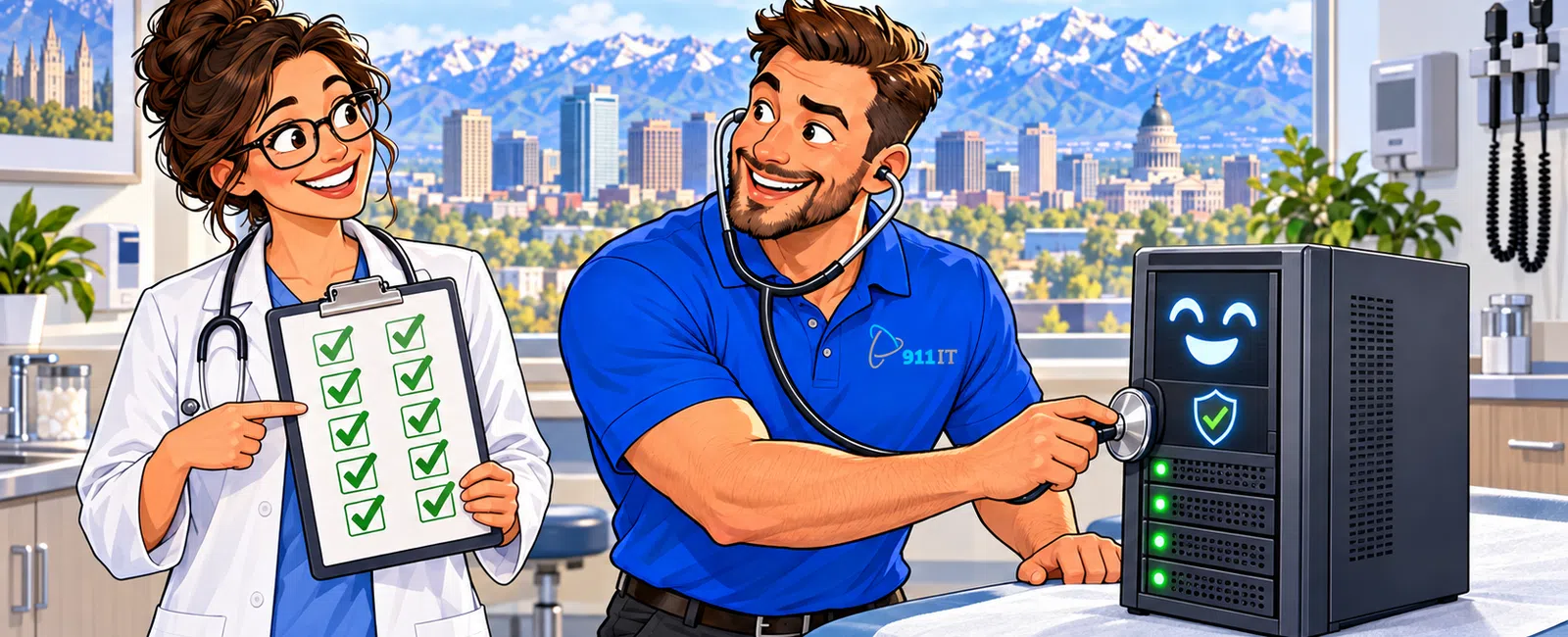
The top 10 healthcare IT companies in Salt Lake City include 911 IT, Executech, Wasatch I.T., Nexus IT Consultants, INTELITECHS, ProLink IT, Qual IT, plus specialized regional MSPs and break-fix providers serving medical practices. These providers offer HIPAA-compliant managed services, EHR support, and patient data security tailored to Utah's healthcare sector, which includes major systems like Intermountain Healthcare and hundreds of private practices requiring both federal and state compliance.
Which Salt Lake City IT Providers Specialize in Medical Practice Support?
Healthcare IT differs fundamentally from general business technology. Medical practices handle protected health information under strict HIPAA and HITECH regulations, run specialized clinical software like EHR and practice management systems, and face severe financial penalties for data breaches.
911 IT serves healthcare clients across Utah, Wyoming, and Arizona with HIPAA compliance services, EHR support, and 24-7 monitoring specifically designed for clinical environments. The team understands ePHI protection requirements, Business Associate Agreement obligations, and the clinical workflow disruptions that occur when systems fail during patient care.
Executech and Wasatch I.T. both maintain healthcare client bases in the Salt Lake area, offering managed services with compliance components. Nexus IT Consultants and INTELITECHS provide IT support to mixed client portfolios that include medical offices. ProLink IT and Qual IT serve small to mid-sized businesses with some healthcare specialization.
National chains like Geek Squad or general business IT providers lack the healthcare-specific knowledge required for BAA compliance, breach notification procedures, and OCR audit response.
Amy, who runs a healthcare practice, explained her decision to switch: "We started using 911 IT when we tired of waiting for our issues to get resolved. Having a dedicated IT team, not a tech person that does it 'on the side' has saved me time and money. Since outsourcing our IT to 911, the team has setup our new location and everything was running great before we opened our doors."
Healthcare-specialized IT providers deliver proactive compliance monitoring, not just reactive break-fix service.
How Do Healthcare IT Costs Compare Across Salt Lake City Providers?
Pricing for healthcare IT services in Salt Lake City varies significantly based on practice size, specialty, and compliance requirements.
Fully managed IT services for healthcare practices typically range from $100 - $250 per user per month, with HIPAA compliance components adding $50 - $200 per user monthly depending on framework complexity.
| Service Component | Monthly Cost Per User | What's Included |
|---|---|---|
| Managed IT Services | $100 - $250 | 24-7 monitoring, helpdesk, security patches, basic compliance documentation |
| HIPAA Compliance | $50 - $200 | Risk assessments, policy documentation, staff training, ongoing monitoring |
| Backup & Disaster Recovery | $10 - $30 | Encrypted backups, patient data protection, recovery testing |
| Advanced Cybersecurity | $25 - $75 | Endpoint detection, security awareness training, threat monitoring |
| VoIP Phone Systems | $20 - $40 | Practice management integration, call routing, voicemail |
Project work such as EHR migrations, network buildouts for new locations, or telehealth infrastructure deployment bills at $150 - $250 per hour across most Salt Lake City providers. Emergency after-hours support from providers without 24-7 contracts often costs $150 - $300 hourly.
911 IT uses flat-rate, transparent pricing that allows practices to budget predictably without surprise invoices. The 100% satisfaction guarantee ensures practices aren't locked into contracts that don't deliver value.
At large national MSPs, small practices become ticket numbers in queues managed by rotating junior technicians. At 911 IT, every client is known by name, and the team understands your specific EHR system, clinical workflows, and compliance requirements without re-explaining context on every call.
Transparent pricing eliminates the budget uncertainty that plagues practices dealing with hourly break-fix providers.
What EHR Systems and Clinical Software Do Salt Lake City IT Companies Support?
Medical practices depend on electronic health record systems, practice management platforms, imaging software, and e-prescribing tools. An IT provider unfamiliar with your specific clinical applications creates dangerous downtime and workflow disruption.
911 IT provides EHR and practice management software support for the platforms most common in Utah medical practices. This includes troubleshooting performance issues, managing software updates without disrupting clinical schedules, and integrating new modules like patient portals or telehealth capabilities.
The team works with PACS systems for imaging-heavy specialties, HL7 interfaces for lab and pharmacy connections, and clearinghouse integrations for claims processing. When practices adopt new clinical tools or expand services, 911 IT ensures seamless integration without compromising existing workflows or data security.
Many Salt Lake City IT providers offer general software support but lack the clinical application expertise to troubleshoot EHR-specific issues. When a practice management system crashes during check-in or e-prescribing fails mid-appointment, generic IT support wastes critical time escalating to vendors while patients wait.
Sarah's experience demonstrates this difference: "911 IT was phenomenal to work with! After calling tech after tech to come out to find out the issues with our phone lines, Adam came out within a few hours and FIXED our phones immediately! He took the time to LOOK what was wrong instead of just glancing at the issues and bidding us out at thousands of dollars. I will 100% use 911IT again in the future."
Clinical software support requires understanding both the technology and the healthcare workflows it enables.
How Do Healthcare Providers Protect Patient Data from Ransomware and Cyber Threats?
Healthcare practices face relentless cyberattacks. Ransomware actors specifically target medical offices because patient care pressure creates urgency to pay ransoms quickly. A single breach triggers OCR investigation, patient notification costs, and potential HIPAA fines reaching six figures.
Effective cybersecurity for healthcare requires multiple defensive layers. Network security controls who accesses ePHI and monitors for suspicious activity. Endpoint detection identifies malware before it encrypts patient records. Email filtering blocks phishing attempts that trick staff into revealing credentials.
Security awareness training teaches clinical and administrative staff to recognize social engineering tactics. Regular security risk assessments - required under HIPAA - identify vulnerabilities before attackers exploit them. Encrypted backups ensure practices can restore patient data without paying ransoms.
911 IT implements 24-7 IT monitoring and threat detection specifically calibrated for healthcare environments. The team understands that patient care can't pause for security updates, so patches deploy during scheduled maintenance windows that don't disrupt clinical operations.
Multi-factor authentication, encryption for data at rest and in transit, audit logging, and access controls all form part of comprehensive ePHI protection. Business Associate Agreements with all vendors handling patient data ensure compliance extends across the entire technology ecosystem.
Ying's practice experienced this proactive approach firsthand: "911 IT has been transformative for our business. What really sets them apart is their proactive approach. They don't just fix problems; they prevent them, which gives us real confidence in our IT operations."
Cybersecurity for healthcare isn't optional - it's a regulatory requirement and patient trust imperative.
What Compliance Requirements Must Salt Lake City Healthcare Practices Meet?
Utah healthcare providers must comply with federal HIPAA and HITECH regulations plus state-specific requirements from Utah's Health Data Authority. Violations trigger Office for Civil Rights audits, financial penalties, and reputation damage that drives patients to competitors.
HIPAA's Security Rule mandates administrative, physical, and technical safeguards for ePHI. This includes risk assessments, workforce training, access controls, encryption, audit logs, and incident response plans. The Privacy Rule governs how practices use and disclose patient information, requiring policies for minimum necessary access and patient rights.
HITECH strengthened breach notification requirements and increased penalty amounts. Practices must report breaches affecting 500 or more individuals to OCR within 60 days and notify affected patients without unreasonable delay. Smaller breaches require annual reporting.
Utah's expanding telehealth services create additional compliance considerations. Practices serving patients across state lines into Wyoming or Arizona must understand varying state telehealth regulations and privacy laws. Cross-border data storage and transmission require careful vendor management.
Business Associate Agreements with IT providers, billing companies, transcription services, and cloud vendors legally bind those partners to HIPAA compliance. An IT provider without a proper BAA creates immediate violation risk.
911 IT maintains HIPAA compliance services that include risk assessments, policy documentation, staff training, and ongoing monitoring. The team stays current on OCR guidance and regulatory updates so practices don't face compliance surprises.
Documentation proves compliance during audits - policies without implementation evidence provide no protection.
Why Do Medical Practices Choose Local Healthcare IT Providers Over National Chains?
National IT providers and large MSPs offer scale and brand recognition. But for Salt Lake City medical practices, local healthcare-specialized providers deliver advantages that matter more: immediate response, personal relationships, and deep understanding of regional healthcare dynamics.
At enterprise-scale national providers, a small medical practice is one account among thousands. Support tickets enter queues managed by rotating technicians who lack context about your specific EHR system, clinical workflows, or compliance requirements. Escalation processes delay resolution while patients wait and revenue stops.
911 IT operates at the ideal scale - large enough to handle any technical challenge an enterprise provider can, small enough that every client is known by name. The team learns your practice's specific systems, understands your clinical specialties, and responds with urgency because your success directly matters.
Local providers understand Utah's healthcare landscape. They know Intermountain Healthcare's network requirements, University of Utah Health's referral workflows, and the rural telehealth challenges practices face serving Wyoming communities. This regional knowledge translates to faster problem-solving and better strategic guidance.
Kris experienced this proactive partnership approach: "I was pleasantly surprised by 911 IT's initiative to identify and fix issues beyond what I initially asked for. They kept me informed about what they were doing and why, which I gladly approved. This proactive approach and clear communication made all the difference."
911 IT's managed IT services include 24-7 live support, rapid response, and process-driven excellence. The 100% satisfaction guarantee means practices aren't locked into contracts that don't deliver value. Flat-rate transparent pricing eliminates surprise bills and budget uncertainty.
The team's proactive monitoring prevents problems before they disrupt patient care. When issues do arise, response comes from technicians who already know your systems and can solve problems efficiently without lengthy context-gathering.
For practices expanding into Phoenix, Casper, or other regional markets, 911 IT's multi-state service area ensures consistent support across all locations. New office buildouts launch smoothly, and staff receive the same responsive service regardless of location.
Local healthcare IT providers deliver the personal attention and clinical expertise that national chains cannot match at scale.
Frequently Asked Questions
What is a Business Associate Agreement and why does my practice need one?
A Business Associate Agreement (BAA) is a HIPAA-required contract between your practice and any vendor who accesses, stores, or transmits protected health information on your behalf. This includes your IT provider, billing company, cloud storage vendor, and similar services. The BAA legally obligates the vendor to protect patient data according to HIPAA standards and defines liability if a breach occurs. Operating without proper BAAs with all relevant vendors creates immediate HIPAA violation risk and potential OCR penalties.
How quickly should my IT provider respond when our EHR system goes down?
EHR downtime directly impacts patient care and practice revenue, requiring immediate response. Quality healthcare IT providers offer 24-7 monitoring that detects issues before staff notices them, plus rapid helpdesk response when problems occur. 911 IT provides 24-7 live support with technicians who already know your specific EHR system and clinical workflows, enabling faster resolution than providers requiring lengthy context-gathering. Response time commitments should be clearly defined in your service agreement, with priority given to patient-care-impacting issues.
What should I budget annually for healthcare IT services for a 10-person practice?
A 10-person medical practice should budget approximately $18,000 - $60,000 annually for comprehensive managed IT services, depending on complexity and compliance requirements. This typically includes 24-7 monitoring, helpdesk support, cybersecurity, HIPAA compliance services, and backup solutions. Practices with multiple locations, advanced imaging systems, or specialized clinical software land toward the higher end. Additional project costs for EHR migrations, network upgrades, or new location buildouts require separate budgeting. Flat-rate pricing models provide predictable monthly costs without surprise invoices.
Can my practice use cloud services while maintaining HIPAA compliance?
Yes, medical practices can use cloud services for EHR hosting, data backup, email, and other functions while maintaining HIPAA compliance, provided the cloud vendor is properly vetted and signs a Business Associate Agreement. The cloud provider must implement appropriate security controls including encryption, access management, audit logging, and breach notification procedures. 911 IT helps practices evaluate cloud vendors, ensure proper BAAs are in place, configure security settings correctly, and maintain ongoing compliance monitoring across all cloud services your practice uses.
How often should my practice conduct HIPAA security risk assessments?
HIPAA requires periodic security risk assessments but doesn't specify exact frequency. Industry best practice recommends annual comprehensive assessments, with additional reviews whenever you implement new technology, change vendors, open new locations, or experience a security incident. Risk assessments identify vulnerabilities in how your practice protects ePHI, evaluate existing safeguards, and document remediation plans. These assessments provide critical evidence of compliance during OCR audits and help practices prioritize security investments based on actual risk rather than assumptions.
What happens if my practice experiences a patient data breach?
A patient data breach triggers specific HIPAA breach notification requirements. You must investigate immediately to determine the scope and cause, notify affected patients without unreasonable delay, report breaches affecting 500 or more individuals to OCR within 60 days, and potentially notify media if the breach is large. Smaller breaches require annual OCR reporting. Your IT provider should have an incident response plan that includes forensic investigation, containment, remediation, and documentation. Proper preparation and rapid response minimize regulatory penalties, legal liability, and reputation damage from breaches.


