
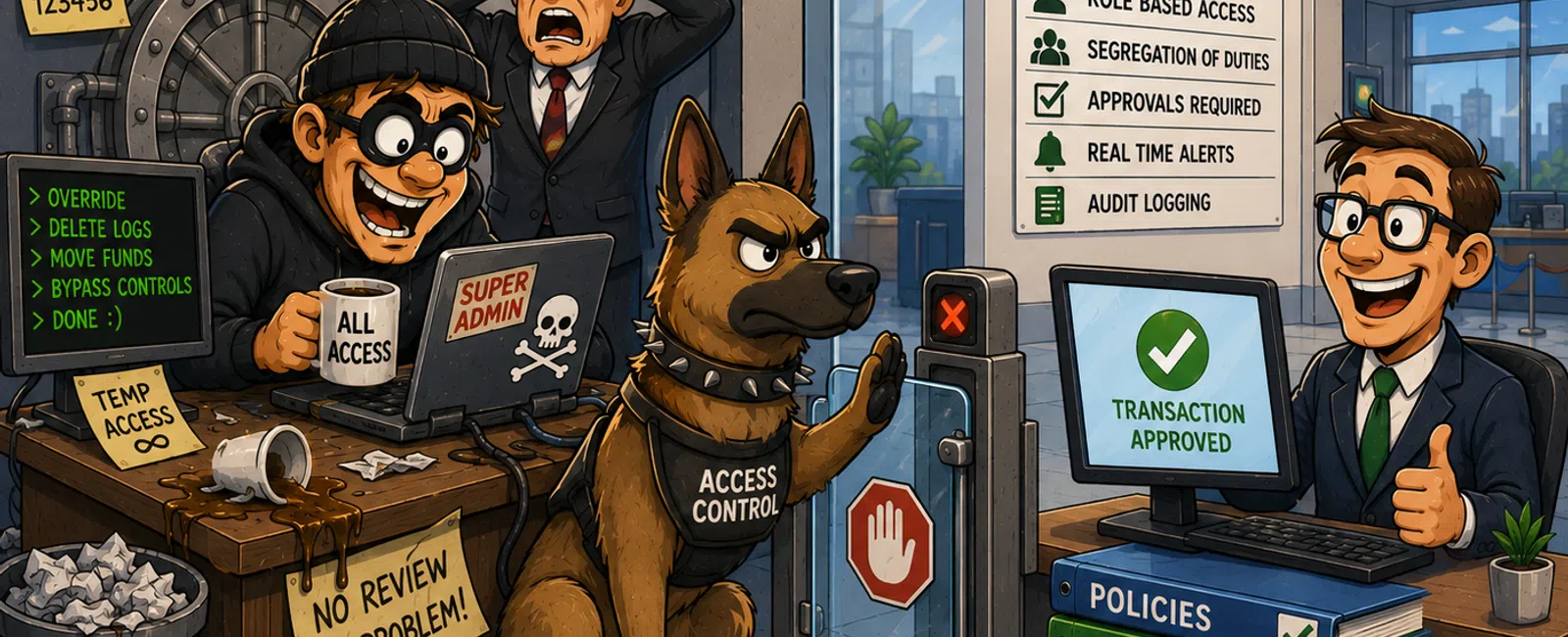
The Banking Failure No One Plans For — But Almost Every Institution Allows
If you work in banking long enough, you start to see the
same pattern.
It's not dramatic.
It's not always external.
And it rarely looks like a major security event at first.
It starts with access.
Someone has it.
They shouldn't still have it.
And the system doesn't stop them.
That's the difference between a control that exists… and a
control that actually protects the institution.
Most banks don't fail because they lack controls.
They fail because their systems still allow actions that
should never be possible.
What Actually Happens Without Control (Step-by-Step Failure)
Let's break this down to what actually happens inside a
bank.
Not policy. Not theory. Reality.
- An
issue occurs A transaction discrepancy, reconciliation gap, or flagged
exception.
- An
employee steps in to resolve it Someone with technical or operational
access.
- They
still have elevated permissions Granted during a prior project, issue,
or temporary assignment.
- System
allows the action No real-time check. No enforcement.
- Critical
action is executed
- Transaction
approved
- Data
modified
- Control
bypassed
- No
immediate detection Access reviews are delayed. Monitoring is not
real-time.
- Exposure
builds silently
- Funds
move
- Audit
trail becomes unclear
- Risk
escalates
At that point, it's no longer an access issue.
It's an operational loss event.
Hyper-Specific Example: One Access Gap, One Real Impact
A systems administrator is temporarily granted elevated
access to support a system upgrade.
After the project ends, the access remains active.
Weeks later:
- A
high-value transaction requires override
- The
administrator executes the override
- No
secondary approval is triggered
- Transaction
completes
From the system's perspective, everything is "valid."
From a risk perspective:
You now have one individual completing a control designed
for multiple approvals.
That is exactly how internal fraud and control failures
happen.
Not through hacking.
Through valid access used without restriction.
What the System Does When Controls Are Enforced
Now replay the same situation in a controlled environment.
- Issue
occurs
- User
attempts privileged access → System checks role and current
authorization
→ Expired access immediately revoked - User
attempts override → System blocks action
→ Requires dual approval - Alternate
attempt made → System enforces segregation of duties
→ Rejects single-user completion - Approved
path is followed → Correct roles engaged
→ Action logged and verified
The key difference is simple:
The system doesn't trust the process.
It enforces the outcome.
30-Second Scenario: Wrong vs Controlled
Uncontrolled Bank
- Employee
logs in
- Performs
high-risk transaction
- System
allows it
- Audit
catches it weeks later
- Exposure
already realized
Controlled Bank
- Employee
logs in
- Attempts
same transaction
- System
blocks action immediately
- Requires
approval path
- Risk
prevented in real time
Same people. Same situation.
Only one system stops the mistake.
Why Most Banks Think They're Protected (But Aren't)
Most institutions believe they're covered because:
- Access
policies exist
- Reviews
are scheduled
- Roles
are defined
That's controlled on paper.
But banking risk doesn't show up during audits.
It shows up:
- During
exceptions
- During
system issues
- During
time-sensitive decisions
And that's where most systems fall back to trust instead
of enforcement.
Typical Exposure Patterns in Banking
Across institutions, the same risks repeat:
- Temporary
access that never expires
- Employees
with more permissions than required
- Systems
operating independently without unified control
- High-risk
actions possible without real-time validation
- Access
reviews occurring long after activity
These are not edge cases.
They are operational realities.
What a Controlled Banking Environment Actually Looks Like
Real control requires layered enforcement:
- Identity
and Access Control → Only valid users, in valid roles, at valid times
- Real-Time
Enforcement → Every action evaluated—not just login
- Segregation
of Duties → No single user can execute end-to-end high-risk
transactions
- Transaction-Level
Restrictions → Risk-based controls applied per action
- Automated
Access Revocation → No lingering permissions
- Full
Audit Traceability → Every action tied to an identity and timestamp
Each layer reduces dependency on human behavior.
Allowed vs Blocked Actions (Real Control State)
|
Action |
Allowed |
Blocked |
|
System access |
Current, role-based user |
Expired or excessive permissions |
|
Privileged function |
Defined job scope only |
Actions outside role authority |
|
Transaction approval |
Multi-step validation |
Single-user approval |
|
Temporary access |
Automatically expires |
Persistent access |
|
Control override |
Logged + approved |
Silent or untracked changes |
This is the difference between visibility and control.
What an External Evaluator Sees Immediately
Auditors and regulators test reality, not intent.
They look for:
- Can
someone act outside their role?
- Can
a high-risk transaction be completed by one user?
- Do
permissions persist longer than necessary?
- Can
actions occur without immediate traceability?
If the answer is yes even once:
That becomes:
- A
regulatory finding
- A
control breakdown
- A
measurable risk
Not theoretical.
Documented.
Banking Control Enforcement Checklist
Run this internally against any critical system:
- Are
all privileges time-bound and automatically revoked?
- Does
every action require real-time validation?
- Are
high-risk transactions impossible without multiple approvals?
- Is
access limited strictly to role necessity?
- Are
outdated permissions removed continuously?
- Can
any user bypass or override a control undetected?
- Is
every action fully traceable immediately?
If you hesitate on any answer, the system is relying on
behavior—not control.
What To Do Next Week
Choose one system:
- Payments
- Core
banking
- Customer
data
Test three things:
- Can
a former or elevated user still access it?
- Can
one person complete a high-risk transaction?
- Can
changes happen without enforced validation?
That single exercise will expose more real risk than any
policy review.
What To Do Next
Schedule your 10 minute discovery call.
We will walk one system with you and validate whether your controls actually
block unauthorized actions in real time.
This helps you confirm whether this risk applies to your environment — and it
only takes 10 minutes.


