The Banking Risk Most Institutions Think They Control — But Don't
If you're responsible for risk, compliance, or operations in
banking, you already know the language.
Access control.
Segregation of duties.
Dual authorization.
Audit trails.
On paper, it all looks airtight.
But here's the reality:
Most institutions don't fail because controls are missing.
They fail because those controls don't stop the wrong
action in real time.
And in banking, that gap is where losses happen.
What Actually Happens Without Enforcement (Step-by-Step Failure)
This is not a cyberattack scenario.
This is everyday operational risk.
- An
exception occurs
A flagged payment, reconciliation mismatch, or system delay. - An
employee steps in to resolve it
Often someone experienced, trusted, and already busy. - They
still have elevated access
Temporary permissions from a past task were never removed. - System
allows the action
No real-time restriction. No secondary validation enforced. - A
high-risk action is completed
- Transaction
approved
- Controls
bypassed
- No
escalation triggered
- No
immediate detection
Reviews happen later. Monitoring is retrospective. - Exposure
compounds
- Funds
move
- Records
change
- Confidence
drops
At that point, the problem isn't access.
It's loss, compliance risk, and reputational damage.
Hyper-Specific Example: One Transaction, One Control Failure
A payments specialist is granted elevated privileges to
assist with a system backlog.
The work is completed.
Access is never removed.
Weeks later:
- A
large transaction requires manual override
- The
same specialist performs the override
- The
system accepts it
- No
second approval required
- No
restriction triggered
That's the failure.
Not because the policy didn't exist.
Because the system didn't stop the action.
What the System Does When Controls Are Enforced
Now run that same scenario again with real enforcement.
- Issue
occurs
- User
attempts elevated action
→ System checks permission status in real time
→ Expired access automatically invalidated - User
attempts override
→ System blocks action immediately
→ Requires secondary approval - Alternate
attempt made
→ System enforces separation of duties
→ No single-user completion allowed - Correct
process followed
→ Approved users engaged
→ Action logged and validated
The difference is simple:
The system doesn't rely on behavior.
It prevents mistakes from happening at all.
30-Second Scenario: Wrong vs Controlled
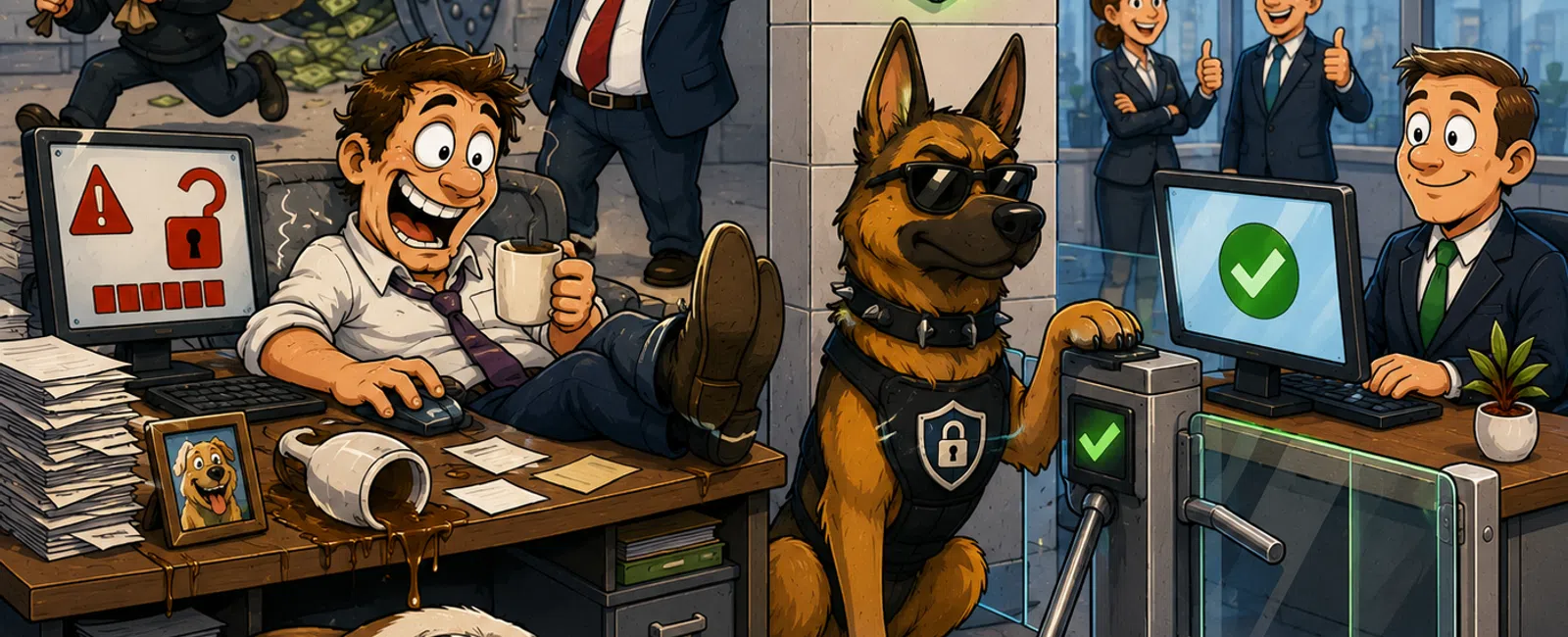
Uncontrolled Environment
- Employee
logs in
- Executes
transaction
- System
allows it
- Audit
discovers issue later
- Loss
already realized
Controlled Environment
- Employee
logs in
- Attempts
same action
- System
blocks immediately
- Forces
correct approval process
- Transaction
executed properly
Same situation.
Different outcome.
Why Most Banks Think They're Safe (But Aren't)
Most institutions are confident because:
- Access
controls are defined
- Roles
are documented
- Reviews
are scheduled
That's surface control.
But risk shows up under pressure:
- During
time-sensitive decisions
- During
system incidents
- During
exception handling
And if your controls don't hold in those moments,
they don't hold at all.
How Real Control Actually Works (System Interaction Layer)
Enforced environments don't depend on one control.
They rely on stacked enforcement layers working together:
- Identity
Control → Only valid users with active roles can act
- Real-Time
Validation → Every action evaluated, not just login
- Segregation
of Duties → Prevents single-user completion of critical actions
- Transaction
Controls → High-risk activity requires layered approval
- Automated
Access Lifecycle → Permissions expire automatically
- Audit
Logging → Every action is tracked instantly
Each layer reduces dependency on human judgment.
Allowed vs Blocked Actions (Real-State Enforcement)
|
Action |
Allowed |
Blocked |
|
System login |
Active, valid user |
Expired or unauthorized access |
|
Privileged action |
Role-approved function |
Out-of-scope action |
|
Transaction approval |
Multi-layer validation |
Single-user completion |
|
Temporary access |
Auto-expiring |
Persistent elevated permissions |
|
Control override |
Logged and approved |
Silent or direct override |
This is what real control looks like.
What an External Evaluator Sees Immediately
Auditors and regulators don't read policies first.
They test your system.
They ask:
- Can
one user complete a high-risk transaction?
- Do
permissions persist longer than necessary?
- Are
controls enforced in real time—or after the fact?
- Can
actions occur without immediate traceability?
If the answer is "yes" even once:
That becomes a finding.
Not a suggestion.
A finding.
Banking Control Enforcement Checklist
Use this internally—no assumptions:
- Are
all elevated permissions time-limited and auto-revoked?
- Does
the system evaluate every action in real time?
- Can
any high-risk task be completed by a single user?
- Are
access rights continuously validated—not periodically reviewed?
- Are
overrides always logged, restricted, and approved?
- Can
expired access ever still work?
- Is
every action traceable immediately?
If any answer is unclear, you have exposure.
What To Do Next Week
Pick one critical function:
- Payments
- Core
banking
- Customer
account management
Run a simple test:
- Can a
user with expired privileges still act?
- Can
one person complete a high-risk transaction?
- Can a
control be bypassed without being stopped?
You will find your real control gaps in under an hour.
What To Do Next
Schedule your 10 minute discovery call.
We will test one system with you and show exactly where your controls allow
action instead of preventing it.
This helps you confirm whether this risk applies to your institution — and it
only takes 10 minutes.