
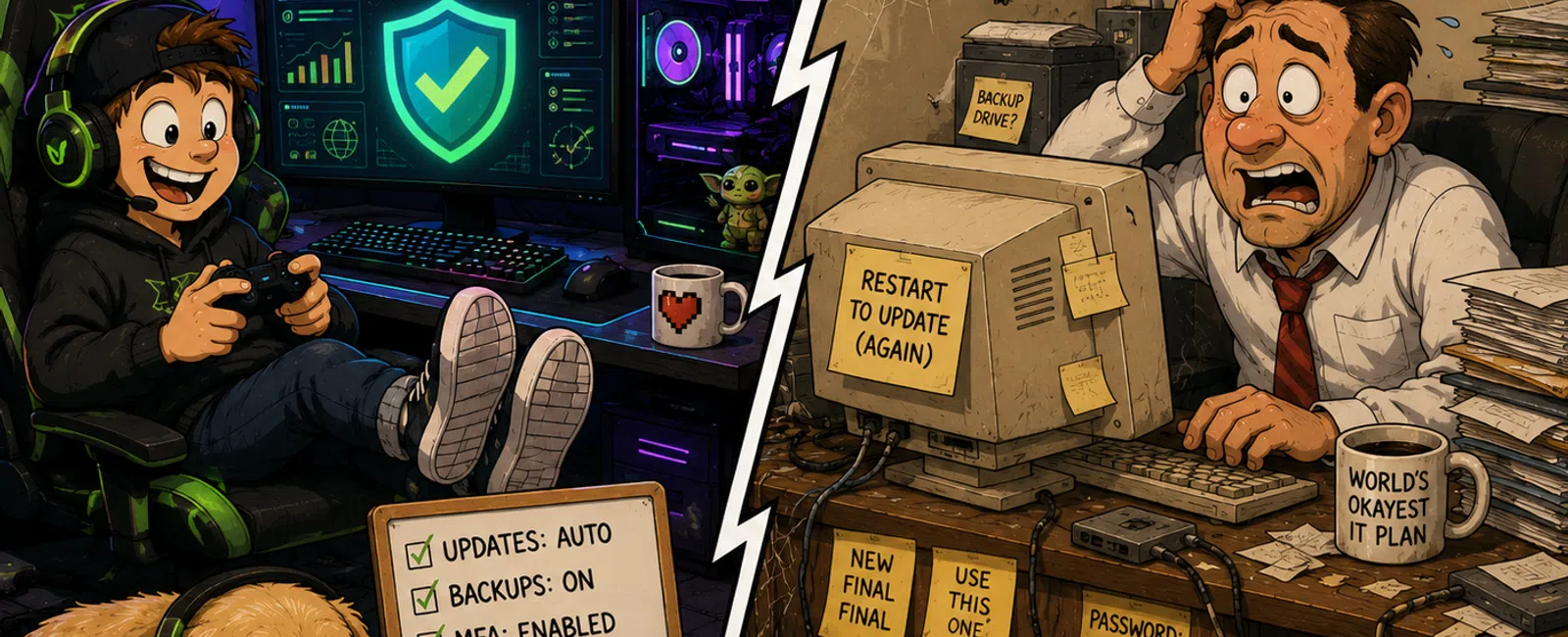
Your Kid's Gaming Rig Would Pass a Readiness Test
Would Your Community Bank's Office Systems?
I remember blowing into Nintendo cartridges because that's what we thought "IT support" looked like.
Cartridge won't load? Blow on it.
Still won't load? Blow harder.
If that failed, you smacked the console and hoped for the best.
Your kid doesn't live in that world.
Their setup is tuned. Updated. Watched. Protected.
Not because they're "more technical." Because they're paying attention.
Now look at most office environments inside a community or regional bank.
A workstation that was "temporary" in 2019.
A printer that fails so predictably no one logs it anymore.
Shared folders named "New Final FINAL."
A laptop with a "restart to update" prompt that's been dismissed for weeks.
Gamers optimize. Banks tolerate.
And tolerance is where risk quietly settles in.
This Isn't About Budget. It's About Proof.
In banking, "it works" is not the same as "it's controlled."
Examiners don't grade your effort.
They grade your controls.
They aren't asking, "Is it mostly fine?"
They're asking, "Is it designed, monitored, tested, and owned?"
That difference matters because regulated environments don't run on confidence.
They run on evidence.
Where Bank Systems Usually Break (And Why It's So Predictable)
The failure pattern I see most often is simple:
The backup exists. The restore proof does not.
Everything looks fine until someone asks for three things:
- When was the last restore test?
- What did you restore, and did it meet RPO/RTO?
- Who signed off that it worked and that gaps were fixed?
Here's the hyper‑specific place this breaks in real life:
Active Directory restore readiness.
When ransomware hits, one of the first real questions is:
"Can we rebuild identity cleanly, quickly, and in the right order?"
If your last "test" was checking that the backup job completed, you don't actually know.
That's not a moral failure.
It's an ownership gap.
The Cost You Don't See on a Balance Sheet
Most bank technology problems don't arrive as dramatic outages.
They arrive as friction.
Five minutes waiting on logins.
Three minutes searching for the right file version.
Two systems that don't reconcile cleanly, so staff re‑enter the same data.
"Workarounds" that quietly become policy.
Interruptions don't just cost the minutes you can see.
They break focus, reset context, and bleed productivity far beyond the moment.
Here's a simple way leadership can feel it:
- 25 staff
- 10 minutes of avoidable friction per person, per day
- More than four hours of paid time lost every day to waiting, retrying, or re‑doing
That's the hidden tax of tolerated systems.
The Third‑Party Risk Most Teams Under‑Document
Even strong internal controls can fall apart at vendor boundaries.
Many exam issues don't start with internal systems.
They start with unanswered questions about cloud platforms, SaaS tools, or outsourced infrastructure.
If you can't quickly answer these, exam prep slows down fast:
- Which critical systems are vendor‑hosted versus bank‑managed?
- Do you maintain current continuity and testing evidence for those vendors?
- If a vendor goes down, who does what—and how is that communicated?
This is often where "we're fine" turns into "we need time to explain."
Minimum Acceptable Readiness Snapshot
Print This and See What Breaks
At minimum, you should be able to answer yes to every item below without guessing.
Patch & Vulnerability Control
- Security updates deploy within a defined window
- Exceptions are documented and reviewed
Backup & Restore Proof
- Backup jobs are reviewed for success, not just completion
- At least one real restore has occurred in the last 12 months
Identity & Access Control
- Multi‑factor authentication is enforced consistently
- Privileged access is limited and reviewed
Monitoring & Performance
- Core network and internet health are monitored
- Basic uptime and availability evidence exists
Third‑Party & Continuity
- Critical vendors are documented
- Continuity evidence is available without a scramble
If any item triggers "I think" or "probably," you've found your next control gap.
The 15‑Minute Restore Test Playbook
Implementation, Not Theory
This is the part most banks skip.
It's also the part that changes confidence immediately.
Step 1: Pick the Right Target (2 minutes)
Choose one:
- A non‑production file share
- A safely isolated line‑of‑business server
- A high‑risk role workstation image
Not your biggest crown jewel. Proof comes first.
Step 2: Define "Pass" Before You Start (2 minutes)
Write success criteria in plain language:
- Restore starts within X minutes
- Restore completes within Y minutes
- Data meets stated RPO
- A named owner verifies functionality
If "pass" isn't written first, the result becomes a story—not evidence.
Step 3: Run the Restore (8 minutes)
Use real tools.
Real steps.
Capture real timestamps.
If it takes longer than expected, that's not failure.
That's visibility.
Step 4: Produce Examiner‑Ready Evidence (3 minutes)
Create one folder or ticket titled:
Restore Test Evidence - [System Name] - [Date]
Include:
- Start and end times
- Backup job confirmation
- Restore completion proof
- RPO statement
- RTO statement
- Named verification sign‑off
- If anything broke: remediation plan and retest date
That last line matters.
Fixes and retesting build trust.
Exactly What Examiners Expect to See
A clean continuity evidence pack usually includes:
- Inventory of critical systems and dependencies
- Testing cadence and governance visibility
- Restore test records with outcomes
- Open gaps, remediation plans, and retest confirmation
No explanations.
Just clarity.
Who Owns What (So Nothing Falls Through)
Clarity beats org charts. If ownership isn't explicit, gaps surface during exams.
Patch Deployment & Verification
- IT owns deployment and verification
- Compliance is consulted on policy alignment
- Vendors execute if outsourced
- Leadership is informed
Vulnerability Remediation Tracking
- IT drives remediation
- Compliance consults on prioritization
- Vendors remediate where applicable
- Leadership is informed
Backup Job Monitoring
- IT owns monitoring and validation
- Compliance is consulted for evidence
- Vendors monitor if outsourced
- Leadership is informed
Restore Testing Execution
- IT runs the test
- Compliance ensures expectations are met
- Vendors support execution
- Leadership is informed
Restore Evidence Quality
- IT produces technical artifacts
- Compliance is accountable for completeness
- Vendors consult where tooling is external
- Leadership is informed
Third‑Party Continuity Evidence
- Compliance owns collection and oversight
- IT supports technical details
- Vendors provide documentation
- Leadership is informed
Board‑Level Continuity Reporting
- Compliance prepares reporting
- Leadership is accountable
- IT is consulted
- Vendors are informed as needed
The most common failure isn't technology.
It's this sentence:
"We all thought someone else had it."
One Thing to Do Next Week
Run one restore test.
Produce one clean evidence packet.
Not a meeting.
Not a plan rewrite.
A real restore.
Don't Wait
Schedule a focused examiner‑readiness walkthrough right now and leave with a clear fix order and a practical evidence checklist you can actually use.


