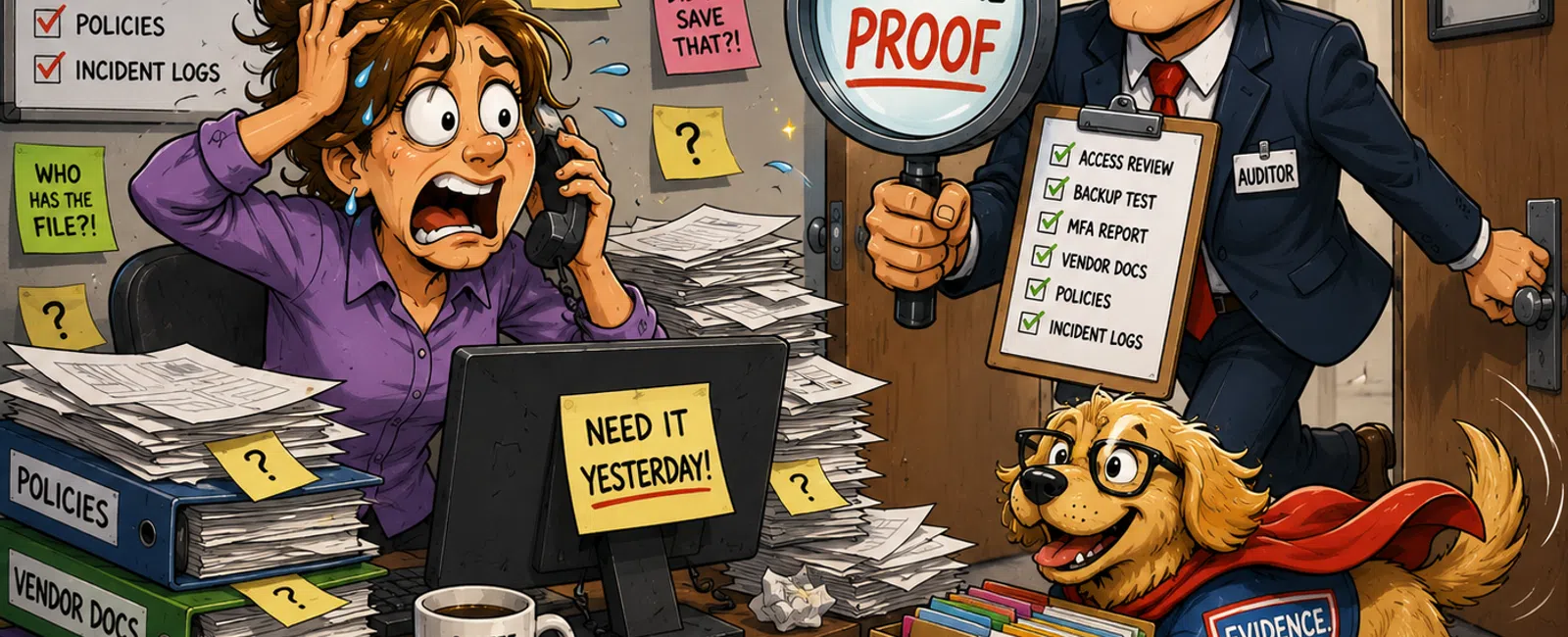
The Compliance Gap No One Told You About (Until It's Too Late)
You're already doing the right things.
MFA is on. Backups are running. Policies exist. Your MSP
says you're "covered."
And yet—when audit season gets close, your stress doesn't go
down.
It goes up.
Because deep down, you know this:
You don't need more controls.
You need control you can prove.
And those are not the same thing.
The Failure Condition Most Agencies Miss
Here's the rule auditors operate by—even if they never say
it out loud:
If you cannot produce evidence of a control within 5
minutes, that control does not exist in an audit.
Not "we have it."
Not "our MSP handles that."
Not "we've always done it this way."
Only proof counts.
That's the line between passing quietly… and scrambling
loudly.
Why Good Agencies Still Fail Audits
Lauren (operations + compliance) is not careless.
She's carrying the weight of GLBA, NAIC, and sometimes HIPAA
expectations—all while dealing with real business pressure and staff friction.
Her problem isn't effort.
It's fragmentation.
- Security
lives in Microsoft 365
- Workflows
and client records live in AMS360 or Applied Epic
- Backups
live somewhere else entirely
- Vendors
operate on their own documentation standards
Nothing connects cleanly.
So when the auditor asks:
"Show me your last access review and evidence of changes
made"
She doesn't have one document.
She has five systems and a rising heart rate.
That's the gap.
What Proof Actually Looks Like (Not Theory—Artifacts)
This is where most guidance falls apart. So let's make it
concrete.
When an auditor asks for proof, they expect physical
artifacts like these:
- Access
Review Report
- Last
review date
- Approver
name
- List
of users reviewed
- Changes
made (removed, modified, approved)
- Backup
Restore Test Log
- Date
of test
- System
tested (server, SaaS, endpoint)
- Success/failure
- Recovery
time achieved vs target
- MFA
Enforcement Report
- Users
covered
- Exceptions
documented
- Conditional
access policy applied
- Last
validation date
- Vendor
Risk File
- Signed
agreement (BAA where applicable)
- Security
questionnaire or attestation
- Review
date + risk classification
Notice what all of these have in common:
They're not tools.
They're records of accountability.
The Audit Evidence Table You Can Use Internally
This is the simplest way to align your team—and remove
ambiguity fast.
|
Control |
Required
Proof |
|
MFA |
Enforcement report + review log |
|
Backups |
Restore test record |
|
Vendor management |
Signed agreement + risk review file |
|
Access control |
Documented access review with changes |
|
Incident response |
Tested plan + exercise record |
If your team can't fill in one of these columns today,
that's your exposure.
A Real Audit Scenario (Traceable, Not Theoretical)
Let's walk it the way it actually happens.
Day 1 - Audit request lands
Carrier asks for:- Access
review documentation (last 90 days)
- Evidence
of backup testing
- Vendor
security documentation
Day 2-3 - Internal scramble begins
- Microsoft
365 shows users—but no documented review
- Backups
show "successful"—but no restore test logs
- MSP
says vendor compliance is "covered"—but nothing is packaged
Day 4-7 - Reconstruction mode
- Manual
CSV exports turned into "reports"
- IT
asked to confirm (retroactively) what was reviewed
- Backup
test performed under pressure
Outcome
- Audit
delayed
- Findings
issued for missing evidence
- Leadership
pulled into remediation
- Lauren
spends nights stitching documentation instead of leading operations
Nothing was broken.
But nothing was provable.
Where Your Systems Actually Fit (And Why That Matters)
This is where strong agencies quietly pull ahead.
Not by adding tools—but by connecting them:
- Microsoft
365
- Source
of truth for identity, MFA, and access
- Must
produce reviewable reports, not just live settings
- AMS360
/ Applied Epic
- Holds
operational workflows and client data
- Needs
governance and audit trails, not just usage
- Backup
platform
- Can
show status—but must prove recovery capability
- Only
restore tests count as evidence
- Vendor
layer (including MSP)
- Becomes
part of your compliance surface
- Must
provide documentation—not reassurance
When these stay disconnected, Lauren gets stuck bridging
them manually.
That's where burnout lives.
The Shift That Changes Everything
The agencies that pass audits without stress do three things
differently:
- Every
control is mapped to a requirement
- Every
control has a defined evidence artifact
- Every
artifact has a review cadence
That's it.
Not more security.
More clarity.
What "Success" Actually Looks Like
You know you're there when:
- Every
control is clearly mapped (no guessing)
- Every
piece of evidence exists before it's requested
- Every
review happens on a schedule—not during panic
- Every
vendor can produce their documentation on demand
Lauren doesn't feel reactive anymore.
She feels in control again.
Your Next Week Action (Do This in One Sitting)
Block 60 minutes.
Create one document titled:
"Audit Evidence We Can Produce Today"
Then fill in:
- Your
key controls (MFA, backups, vendors, access)
- The
exact evidence artifact for each
- Whether
it exists right now (yes/no)
Don't fix anything yet.
Just surface the truth.
Clarity first. Control second.
Your Next Step
Schedule your 10 minute discovery call. We'll compare what you can produce today against what an auditor will actually request. 911 IT will show you exactly where your gaps are—nothing extra, nothing hidden.