
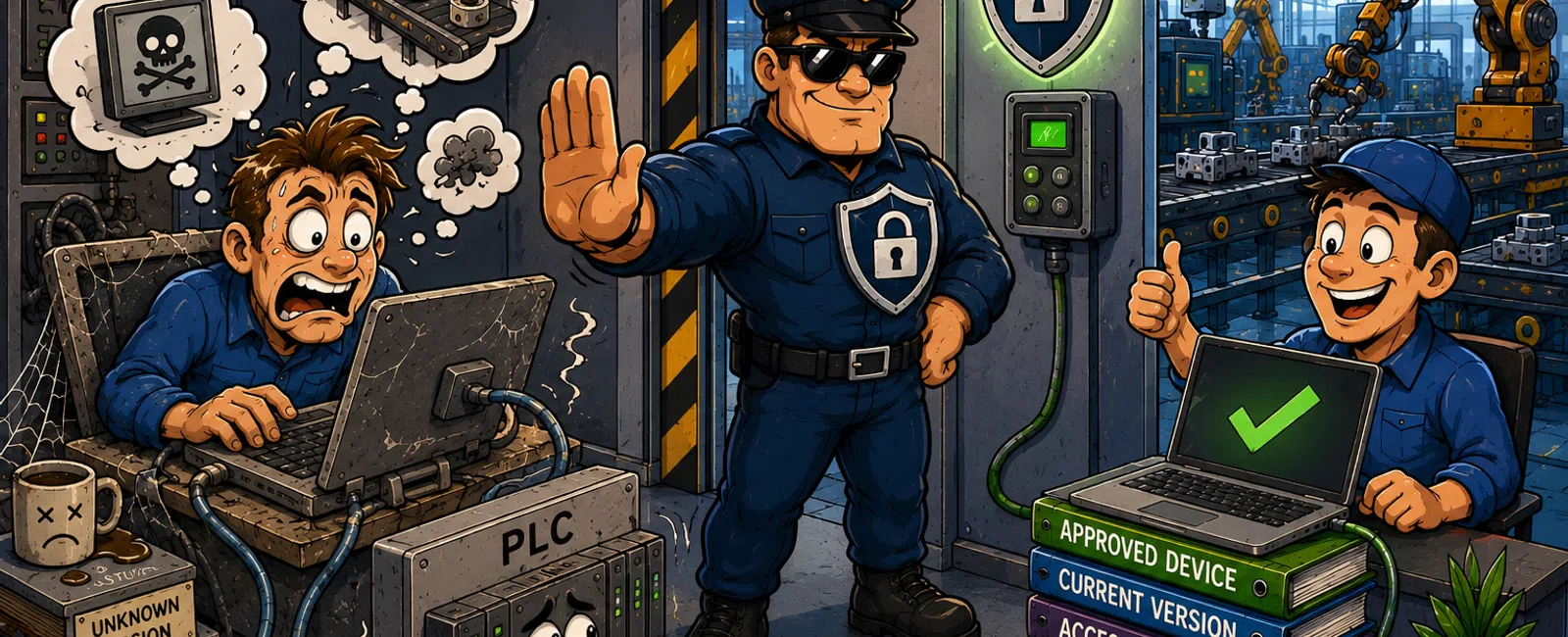
The Hidden Production Risk Most Plants Still Allow
When I walk through a plant, I don't just see machines.
I see paths.
Paths that let someone connect.
Paths that let someone change something.
Paths that nobody meant to leave open.
And most of the time, those paths lead back to the same
place:
Old technology that was never fully shut down.
If you're responsible for uptime, compliance, or both, this
is the risk that should keep you up at night. Not because you don't know it
exists—but because your system might not actually stop it when it matters.
What Actually Happens Without Controls (Step-by-Step Failure)
Let's strip this down to what actually happens on the floor.
Not theory. Not policy. Real sequence.
- A
production fault occurs
Line stops. Pressure builds immediately. - Technician
grabs the nearest working device
Old engineering laptop. Already set up. No delays. - Device
connects to the controller
No segmentation block. No access restriction. - Login
succeeds
Credentials still valid. System accepts it. - Old
logic gets loaded
No version validation. No rejection. - Line
restarts in the wrong state
Everything appears normal—for now. - Production
misalignment begins
- Timing
no longer matches equipment
- Tolerances
begin drifting
- Quality
issues surface hours later
At this point, the fault is no longer your problem.
Your problem is now traceability and trust—because
two versions of logic have existed in the same system.
And nobody can immediately prove which one caused what.
What the System Does With Controls (Step-by-Step Block)
Same scenario. Different environment.
- A
production fault occurs
- Technician
attempts to use old laptop
→ Blocked by segmentation
Device is not allowed on the control network - Attempts
to authenticate anyway
→ Denied by identity control
Device and user are not approved for access - Attempts
alternate connection path
→ Network rejects route
No unmanaged access paths exist - Engineer
switches to approved workstation
→ Access granted through controlled pathway - Logic
load attempt occurs
→ Controller rejects outdated version
Only approved versions are accepted - Correct
logic retrieved and deployed
→ Change is logged and tied to the event
The difference here is not process.
It's enforcement.
The system doesn't assume the right action. It forces it.
30-Second Fault Scenario (Wrong vs Controlled)
Uncontrolled Plant
- Laptop
connects
- Program
loads
- Line
runs wrong
- QA
flags hours later
- Multiple
shifts impacted
Controlled Plant
- Laptop
blocked
- Approved
system used
- Correct
logic loaded
- Line
stabilizes
- Issue
contained
Same people. Same fault.
Completely different outcome.
Typical Exposure Ranges We See
Across manufacturing environments, patterns repeat:
- Multiple
devices per production line still capable of controller access
- At
least one engineering workstation not tracked formally
- Logic
versions stored outside the approved system in most plants
- "Retired"
devices that still authenticate and connect
This isn't rare. It's what happens when retirement is
treated as a cleanup step instead of a controlled lifecycle.
Why Most Teams Think They're Covered (But Aren't)
Most teams are doing the work.
- Devices
removed from the floor
- Documentation
updated
- Processes
defined
On paper, everything looks controlled.
But under pressure?
They fall back to what works.
- Fastest
device
- Closest
access
- Least
friction
That's the gap.
Your system may be designed at a controlled level…
…but it behaves like an uncontrolled one when it's tested.
How the Stack Actually Works Together (Real Event Flow)
This only works when layers interact.
Here's what happens during a real fault in an enforced
environment:
- Asset
System identifies device as unapproved
→ triggers restrictions - Network
Segmentation blocks access to control systems
→ device cannot reach PLCs - Identity
Controls deny authentication
→ no valid credentials accepted - Controller-Level
Protection rejects unapproved logic
→ prevents incorrect state changes - Version
Repository provides correct logic
→ ensures single source of truth - Change
Control System logs the action
→ creates audit trail tied to event
Each layer reinforces the others.
No single failure creates exposure.
Allowed vs Blocked Actions During a Fault
|
Action |
Allowed |
Blocked |
|
Connect to controller |
Approved workstation only |
Legacy/untracked device |
|
Authenticate |
Role-based identity |
Unknown user/device |
|
Load logic |
Validated current version |
Outdated or local copy |
|
Execute change |
Logged + approved |
Direct, untracked write |
|
Remote access |
Controlled + monitored |
Open/unmanaged entry |
This is what enforcement actually looks like.
Retirement Enforcement Checklist (Use This)
Run this against any "retired" device:
- Device
is recorded in asset system
- Ownership
is assigned
- All
credentials are removed
- Network
access is fully blocked
- Device
cannot authenticate
- No
usable logic remains stored locally
- Isolation
is confirmed through testing
- Retirement
is documented and signed off
If any answer is unclear, it's still active.
What an External Evaluator Sees Immediately
An auditor or outside evaluator is not impressed by effort.
They look for proof:
- Is
every asset accounted for?
- Can
untracked devices still connect?
- Is
access consistently enforced?
- Is
there a single verified source of logic?
If a device exists outside that control structure—even
once—it becomes:
- An
audit finding
- A
production risk
- A
leadership problem
What To Do Next Week
Walk one production line.
Pick three devices everyone assumes are retired.
Test them:
- Can
they connect?
- Can
they authenticate?
- Can
they influence a controller?
That exercise will tell you more about your risk than any
report.
What To Do Next
Schedule your 10 minute discovery call.
We will validate one production line against real enforcement controls and show
exactly where your environment still allows failure under pressure. 911 IT will
help you confirm whether this risk applies to your operation.


