
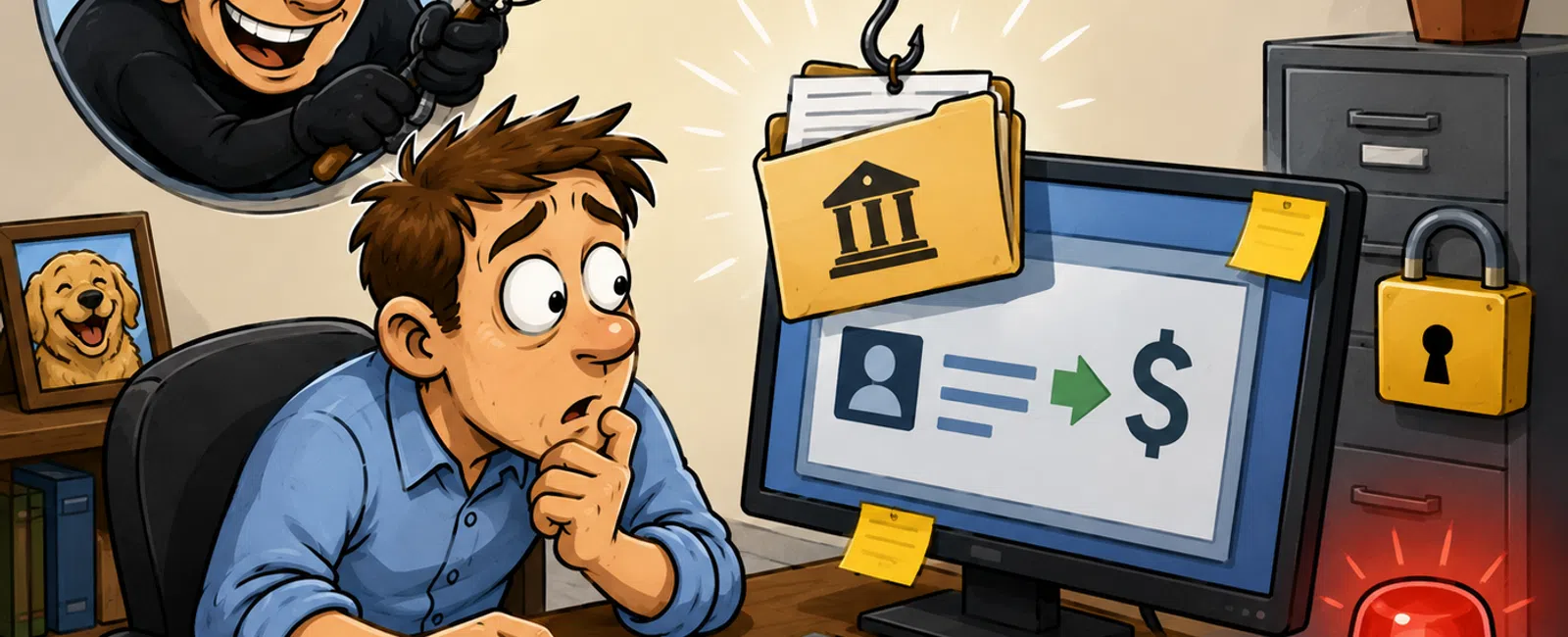
The Most Dangerous Risk in Your Business Is the Control You Think You Already Have
If you're responsible for keeping operations stable, this is the kind of
issue that stays invisible right up until it matters.
Payments move. Vendors get paid. Nothing breaks.
Then one request gets approved that never should have made it through.
That's not a cybersecurity failure. It's a control failure.
Most teams believe they're protected because people "know to verify
unusual requests." In practice, that's not protection. That's a habit. And
habits fail the moment the environment changes.
The Real Problem Isn't Awareness
Most teams already think they're doing the right thing:
"We double-check when something feels off."
"We're careful with payment changes."
That works—until it doesn't.
Because those decisions rely on judgment.
Judgment breaks when:
- The usual
approver is out
- The request
looks familiar
- The message
creates urgency
Real controls don't depend on people catching something. They remove the
ability to skip verification entirely.
If a payment can be approved without proof of verification, the control
doesn't exist.
What Actually Prevents This
A real control is simple, specific, and enforced.
Payment Verification Workflow
Step 1: Verify
Confirm any payment change using a known contact already on file.
Step 2: Log
Record who verified it, when it happened, and how it was confirmed.
Step 3: Approve
Approval only happens after verification is documented.
Step 4: Preserve
Keep that verification record attached to the transaction.
That is the difference between a recommendation and a safeguard your
business can rely on.
How This Is Enforced in Real Systems
This is where most businesses fall short.
They define the process—but don't enforce it.
A controlled system looks like this:
- You cannot
approve a payment until required verification fields are completed
- Every payment
automatically carries a verification and approval record
- Only specific
roles can change vendor payment details
- Vendor updates
and payment approvals are separated between different people
- Email alone
cannot be used to authorize payments
If someone can bypass the process with speed or familiarity, the control
is not protecting you.
Quick Check: Do You Actually Have This Control?
Run this fast:
- Can a payment
be approved without a logged verification?
- Do backup
approvers follow the exact same process?
- Can approvals
be completed entirely through email?
- Does every
transaction include proof of verification?
- Can vendor
payment details be changed without oversight?
If any answer is "sometimes," your control is inconsistent—and that's
where exposure lives.
Basic vs Strong vs Controlled
This is where most teams misjudge their position.
Basic
People verify when something feels off
Nothing is recorded
Backup coverage is inconsistent
Strong
The process is documented
The team understands expectations
Verification usually happens
Controlled
Verification is required
Verification is logged
Approval is blocked without it
Every transaction has proof
Most teams believe they are strong.
Most failures happen because they were still operating at basic when it
mattered.
What Failure Actually Looks Like
A payment request comes in from a known vendor.
The tone is right. The history looks familiar. The request references
real work.
The primary approver is out, so someone else handles it.
The request includes updated payment details and urgency.
It gets approved.
No one verifies the change independently.
A few days later, the real vendor follows up asking why they weren't
paid.
At that point, finance is investigating, leadership is involved, and what
started as a normal transaction becomes an audit-level issue.
The failure wasn't the employee.
The failure was allowing approval without proof.
Who Owns This
Controls break when ownership is unclear.
Finance owns transaction control
They ensure verification is completed and recorded before money moves
IT owns access control
They determine who can approve payments and who can change vendor details
Operations owns vendor accountability
They ensure every vendor has a clear owner and access is reviewed over time
If those roles aren't clearly defined, the process becomes
inconsistent—and inconsistency is where problems start.
Why This Matters in Audits
External reviewers don't evaluate intention. They evaluate proof.
They want to see:
- A consistent
process
- A repeatable
control
- A record
attached to every transaction
If documentation isn't there, the control is considered weak—no matter
how careful your team is.
The Pattern Behind Most Failures
Across real incidents, the pattern is consistent.
Verification was skipped.
Or it happened—but wasn't documented.
That's why these situations repeat across different companies. Not
because teams don't care, but because the system still allows them to move
forward without proof.
The One Rule That Changes Everything
If a payment can be approved without verification being logged, the
control does not exist.
That single rule removes ambiguity.
It replaces habit with structure.
It ensures the process holds up when things move fast.
What To Do Next Week
Start with reality.
Step 1
Review your last 10 payments involving changes, urgency, or exceptions
Step 2
Document how each one was verified
Step 3
Identify which have clear, attached proof
Step 4
Mark where approval happened without full verification
Step 5
Enforce a required verify → log → approve workflow
In less than an hour, you'll know whether your control actually exists—or
if it's been assumed.
Next Step
Schedule your 10 minute discovery call with 911 IT and walk through your last 10 payment approvals step by step. You will quickly confirm whether your verification process is enforced and documented or still dependent on habit. You'll leave with a clear answer on where your control holds up and exactly where it breaks.


