
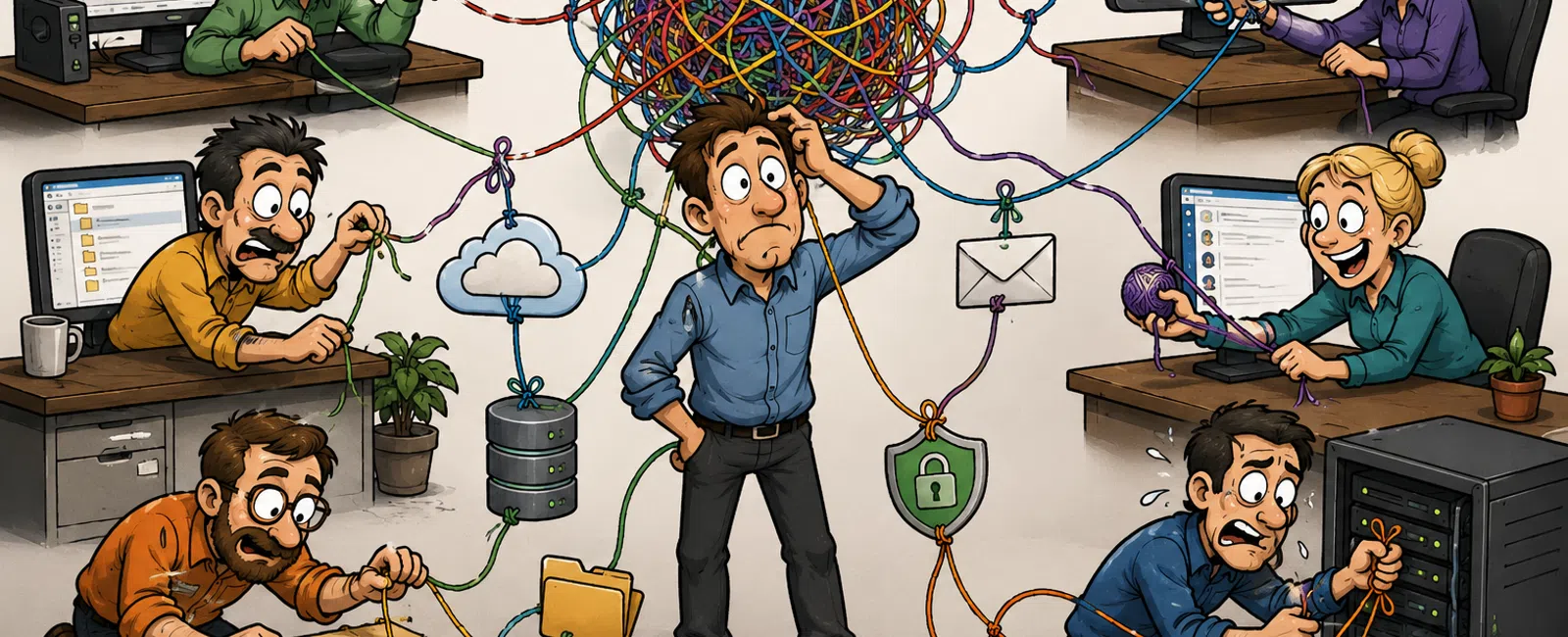
The Problem Isn't Your Systems. It's That No One Owns Them End-to-End
If you're responsible for an engineering firm, this will
sound familiar.
You have solid tools. Proven platforms. Systems that,
individually, do what they're supposed to do.
And yet something feels fragile.
A model loads slower than it should.
A file version isn't where someone expected.
A login issue delays a morning meeting.
A client asks a security question, and you're 80% confident in the answer.
Nothing is broken.
But nothing feels fully under control either.
That's not a technology problem.
It's ownership.
If no one owns how systems work together, then no one owns
whether they work at all.
Where the Gap Actually Lives
Most engineering environments are layered:
CAD/BIM platforms
Project management tools
ERP systems
File storage and collaboration
Security and compliance controls
Each was implemented for a reason.
Over time, ownership fragments.
One team owns the platform.
Another owns the data.
IT owns "support."
But no one owns what actually matters:
How data moves end-to-end
Where the authoritative version exists
How systems behave under pressure
What happens when something doesn't align
In most firms, this responsibility is either shared vaguely
or not assigned at all.
That's where instability starts.
The Risk You're Actually Carrying
From the outside, your firm isn't evaluated on effort.
It's evaluated on outcomes.
Clients, auditors, and partners expect clear answers:
Can you prove where sensitive data lives?
Can you demonstrate version integrity?
Can you show access controls are enforced?
Can you recover quickly when something fails?
When ownership is unclear, answers sound like:
"We believe so."
"That should be covered."
"That's handled by IT."
Ownership gaps show up precisely when your environment is
being judged.
That's not a failure moment.
That's an exposure moment.
A Hyper-Specific Failure That Happens More Than You Think
A structural model is updated in your primary design
platform.
At the same time:
The cloud repository sync is delayed
A PDF from an earlier version remains in a shared folder
A project manager pulls that version into a proposal
That version is sent externally
No alert triggers.
No system reports an error.
But now your deliverable doesn't match your current design.
The most common breakdown is not system failure.
It's misalignment between systems with no accountable owner.
What End-to-End Ownership Actually Means
Ownership is not per system.
It is per workflow.
One workflow → one owner.
That owner is responsible for:
Data flow across all systems in that workflow
System alignment and integrations
Exception handling when something breaks or diverges
Performance monitoring across the entire path
Not part of it.
All of it.
Don't assign ownership to "IT" broadly
Don't split ownership across departments
Don't rely on informal accountability
Ownership only works when it is singular and defined.
System Ownership Audit (with Outputs)
Use this exactly as written.
For each question, document:
Yes or No
System(s) involved
Assigned owner
If any answer is incomplete, log it as a gap.
- Source
of Truth
Can you name one definitive system for each critical dataset?
Failed answer: "We have two that usually match" - Data
Movement
Does data move automatically between systems?
Failed answer: "Someone exports and uploads it" - Update
Enforcement
Are updates scheduled and verified across all connected systems?
Failed answer: "Users update when prompted" - Access
Control
Are permissions role-based and consistently enforced?
Failed answer: "Managers adjust access as needed" - Monitoring
Do you detect issues before users report them?
Failed answer: "We hear about problems after they occur"
Output of this audit:
A list of ownership gaps
A mapped system path
A clearly identified failure point
If even one answer is uncertain, that is not minor.
It's unmanaged risk.
Before vs After: What Ownership Changes
Before:
Ownership is distributed
Systems "mostly" align
Issues require investigation
Responsibility is unclear
Resolution is slow
After:
One owner is accountable per workflow
Data paths are defined and monitored
Issues are identified immediately
Responsibility is obvious
Resolution is direct and fast
Speed improves.
Clarity improves.
Audit confidence improves.
Nothing new is added.
It's simply owned.
How to Fix One Ownership Gap in 7 Days
Day 1: Define the workflow scope from start to finish
Day 2-3: Map all systems involved in that workflow
Day 4-5: Assign one owner and document responsibilities
Day 6-7: Validate the workflow and communicate ownership
The key is constraint:
One workflow
One owner
One gap fully resolved
That's how control is built.
What a Controlled Environment Looks Like
Every dataset has one authoritative source
Data movement is automated and auditable
Updates are enforced consistently
Access is structured
Issues are detected early
Most importantly:
You can answer any external question without hesitation.
That confidence is not a feature of your tools.
It's the result of ownership.
Your Next Step This Week
Run the System Ownership Audit.
Write the answers down exactly as they are today.
Then choose one unclear answer and assign one owner to fix
it completely within seven days.
Where This Leaves You
If your systems rely on people to bridge the gaps between
them, you are operating on borrowed stability.
And borrowed stability eventually gets tested.
Schedule your 10 minute discovery call.
This will confirm whether ownership gaps exist in your environment.
911 IT will help you determine if your systems are actually controlled.


