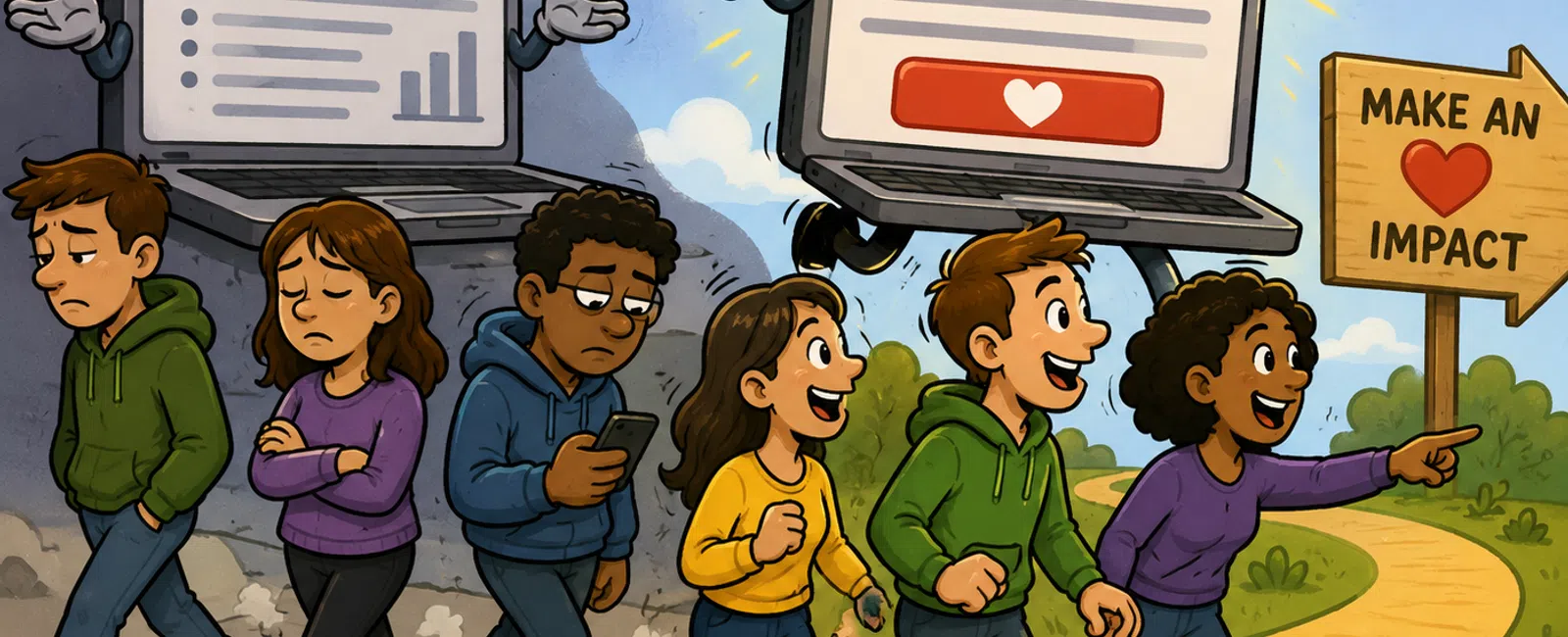
The Real Reason Your Nonprofit Blog Isn't Converting (And What to Fix First)
You're doing the work.
You're publishing updates. Writing blogs. Sharing your impact.
And still… nothing moves.
People read. They might even agree with everything you're saying.
But then they leave.
No action. No follow-through. No real traction.
If that feels frustrating, it's not because your work isn't valuable.
It's because your blog is asking people to understand—when it actually
needs to tell them what to do next.
Why "Good" Nonprofit Blogs Still Fail
Most nonprofit blogs look like this:
They explain what the organization does
They share outcomes or numbers
They describe programs clearly
But they stop short of direction.
So the reader is left with a quiet question:
"What am I supposed to do with this?"
And when that question isn't answered clearly, even the most supportive
reader does nothing.
That's the gap.
A Full Blog Transformation (Before vs After)
This is the highest-impact change you can make.
Weak Version
"Our organization provides counseling services to underserved families.
Over the past year, we've helped more than 300 individuals access care. Our
mission is to expand access to mental health support."
It's accurate.
It's responsible.
It's completely forgettable.
Rewritten Version
"Last Thursday, a mother sat in her car outside our building for 20
minutes.
She had already turned off the engine. Already walked to the door.
Already turned back once.
She wasn't sure she could ask for help—and she wasn't sure anyone would
understand if she did.
Two hours later, she walked out with a plan, a counselor, and something
she hadn't felt in months: relief."
Same organization.
Completely different experience for the reader.
One explains.
The other moves.
The Framework That Turns Blogs Into Action
Use this every time you publish.
Step 1: Start With a Human Moment
Not your mission. Not your services.
A real situation.
Use these templates: "Last week, someone faced…"
"On a recent afternoon, this happened…"
"She had to decide whether…"
This is what earns attention.
Step 2: Show the Transformation
Don't stay stuck in the problem.
People don't act because they fully understand need.
They act because they see change is possible.
Use this structure: Before → After → Why it matters
Example: Before: uncertainty, fear, hesitation
After: support, clarity, relief
Why it matters: stability for a family, not just a moment
Step 3: Make the Reader Part of the
Story
This is where most blogs quietly fail.
They tell impact—but never create a role for the reader.
You need one line that bridges that gap: "This is where people like you
come in…"
"Support like yours makes this possible…"
Now the reader knows where they fit.
Step 4: Give One Clear Action
No options. No vague language.
One next step.
Because when people are already busy, unclear choices feel like
friction—and friction kills action.
Quick Rewrite Formula
Use this every time:
Hook → Problem → Change → Reader Role → One Action
If your blog doesn't follow this flow, it will stall.
The 3 Types of Nonprofit Blogs (And How to Adjust)
Campaign Posts
Goal: immediate action
Use short, emotional stories and move quickly to a direct ask.
Impact Updates
Goal: build trust
Show clear transformations and connect outcomes to supporter involvement.
Awareness Blogs
Goal: education + connection
Take more time, but still anchor everything in a real human experience.
Where It Usually Breaks
Here's a real-world pattern:
A nonprofit publishes an update filled with: Program summaries
Yearly stats
Clear descriptions
Then ends with: "Learn more"
What's missing: No person
No visible change
No defined reader role
No clear next step
Result: The reader agrees… and leaves.
Bad vs Good CTA Examples
Bad: "Learn more"
"Contact us"
"Support our mission"
Good: "Rewrite your opening paragraph using this framework"
"Fund one counseling session this week"
"Turn your next blog into something that drives action"
The difference is specificity.
The Lens You're Being Judged Through
Donors, board members, and partners aren't just evaluating your work.
They're evaluating your clarity.
They're asking: "Do they understand their impact—and can they communicate
it in a way that drives action?"
Your blog isn't just content.
It's proof of leadership, direction, and confidence.
What to Do Next Week
Take your most recent blog post.
Do only this:
Rewrite the opening paragraph using a real human moment.
Don't touch anything else yet.
Just fix the entry point.
That single change will make the rest of the blog easier to improve.
The Next Step
Use this framework on your next blog post by rewriting the opening
paragraph today. Then compare it to your current version and look for where
action becomes clearer.
Schedule your 10 minute discovery call with 911 IT. We will review one
blog and show you exactly where it is losing action so you can fix it
immediately.