
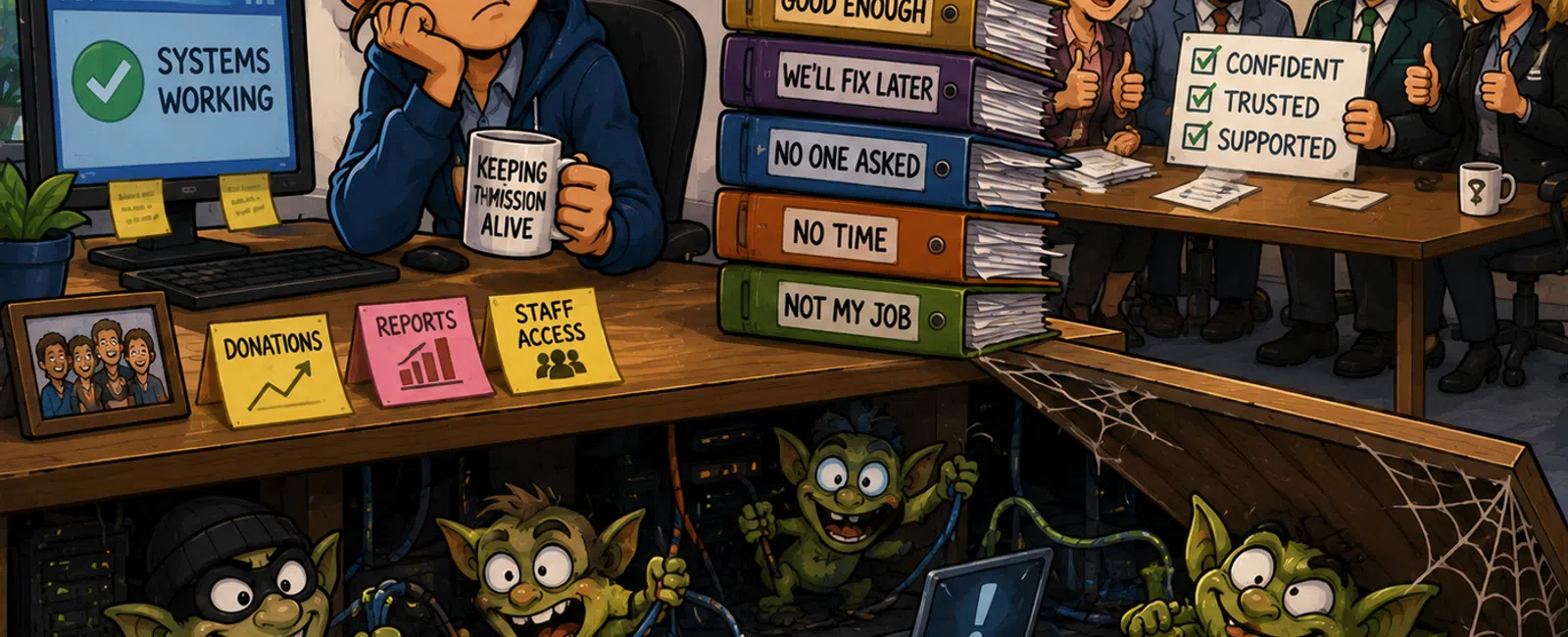
The Risk You Can't See in "Working" Systems
Everything looks fine right now.
Donations are coming in. Staff can log in. Reports get pulled when
needed. From the outside, your systems are doing their job.
But you already feel it.
That quiet, persistent question:
"What happens if something breaks… and I'm the one who has to explain
it?"
That question doesn't come from nowhere. It comes from knowing—deep
down—that "working" is not the same as "controlled, secure, and defensible."
And that gap doesn't show up during normal operations.
It shows up when someone starts asking questions.
The Moment You Stop Being "Operational" and Start Being Evaluated
There's a shift most people don't see coming.
Your systems stop being tools—and start becoming proof.
Proof for your board
Proof for funders
Proof for audits
Proof for donors
The standard changes instantly.
It's no longer:
"Did it work yesterday?"
It becomes:
"Can you clearly show this is controlled, secure, and intentional?"
Most organizations we talk to cannot answer that cleanly the first time
they're asked.
That's where the pressure begins.
What This Looks Like When You Can't Answer
This is where "we think it's fine" starts to break.
Not technically—organizationally.
Board confidence drops, even if nothing is broken
Funding conversations slow because risk feels unclear
Audits escalate into deeper reviews
Teams scramble to document things that should already exist
It's not because your systems are failing.
It's because you can't prove they won't.
And for nonprofits, trust is everything.
A Real Scenario We See Over and Over
Here's what this looks like in practice.
A nonprofit has a donation platform running on their website. It's been
stable for months. Money comes in. No visible issues.
Then an audit or board question hits:
"Who owns this system?"
No clear answer.
"Who has admin access?"
Uncertain.
"When was access last reviewed?"
Not tracked.
"What happens if something goes wrong?"
No defined process.
Nothing broke—but suddenly everything feels exposed.
Because the issue was never performance.
It was lack of ownership, visibility, and control.
This is one of the most common patterns across nonprofit
environments—especially where donation systems, CRM tools, and email platforms
overlap. [Nonprofit...ofile.docx | Word]
Why This Falls on You (Even If It Shouldn't)
You weren't hired to run IT.
But you are expected to:
Keep systems running
Protect donor and client data
Answer to the board
Make decisions without full clarity
You've been making it work through attention and effort.
But that creates a hidden cost.
Uncertainty.
And over time, uncertainty turns into quiet pressure you carry alone.
Protecting data, donors, and operations isn't just a technical
requirement—it's tied directly to trust, compliance, and mission continuity. [Nonprofit...ofile.docx | Word]
A Simple Way to See What's Actually Under Control
You don't need a full audit to get clarity.
You need a structured way to look at one system at a time.
The System Control Checklist (With
Execution Layer)
Go through one system—preferably your donation platform or CRM—and answer
each clearly.
Ownership
- One named owner
exists
- That person
explicitly knows they are responsible
- If unclear:
assign ownership in writing this week
Access
- Every login is
tied to a real person
- No shared
credentials exist
- Review access
quarterly (minimum) and after every staff change
Data Flow
- You know
exactly where data enters
- You know where
it is stored and exported
- You've
identified one "source of truth" system
Security
- Multi-factor
authentication is enabled everywhere possible
- Systems are
updated on a defined schedule (not reactively)
- Backups exist
and have been tested at least once
Response
- Your team knows
what to do if something fails
- You have a
simple escalation path written down
- You can explain
that process in under 60 seconds
If you hesitate on any of these, that's not failure.
It's visibility.
What Good Actually Looks Like
This is the part most blogs skip—but it's what your board expects.
A controlled system looks like this:
There is a clearly named owner
Access is documented and reviewed regularly
Data movement is intentional and understood
Security controls are consistent, not reactive
There is a defined, explainable response process
You don't need perfection.
You need clarity that holds up when someone else is evaluating it.
What Most Leaders Get Wrong About Risk
Risk doesn't feel urgent when things are working.
It shows up when you're under a spotlight:
A board meeting
A funding discussion
An audit request
A high-volume campaign
That's when "I think we're fine" becomes "I need to know."
And certainty is not something you can create under pressure.
What To Do Next Week (Keep This Simple)
Don't try to fix everything.
Start here:
Pick one system—your donation platform or CRM
Then:
- Assign a clear
owner
- Review who has
access
- Map where the
data goes
That's it.
You're not solving everything.
You're reducing uncertainty in the place that matters most.
The Shift That Changes Everything
You don't need more tools.
You don't need more alerts.
You need to be able to say:
"I know exactly how this system works, who owns it, and what happens if
it fails."
That's what builds trust.
With your board
With your funders
With yourself
What To Do Now
Schedule your 10 minute discovery call with 911 IT. We'll walk through
one system with you and show you exactly where you stand. If things are solid,
you'll know—if not, you'll finally see where the risk actually is.


