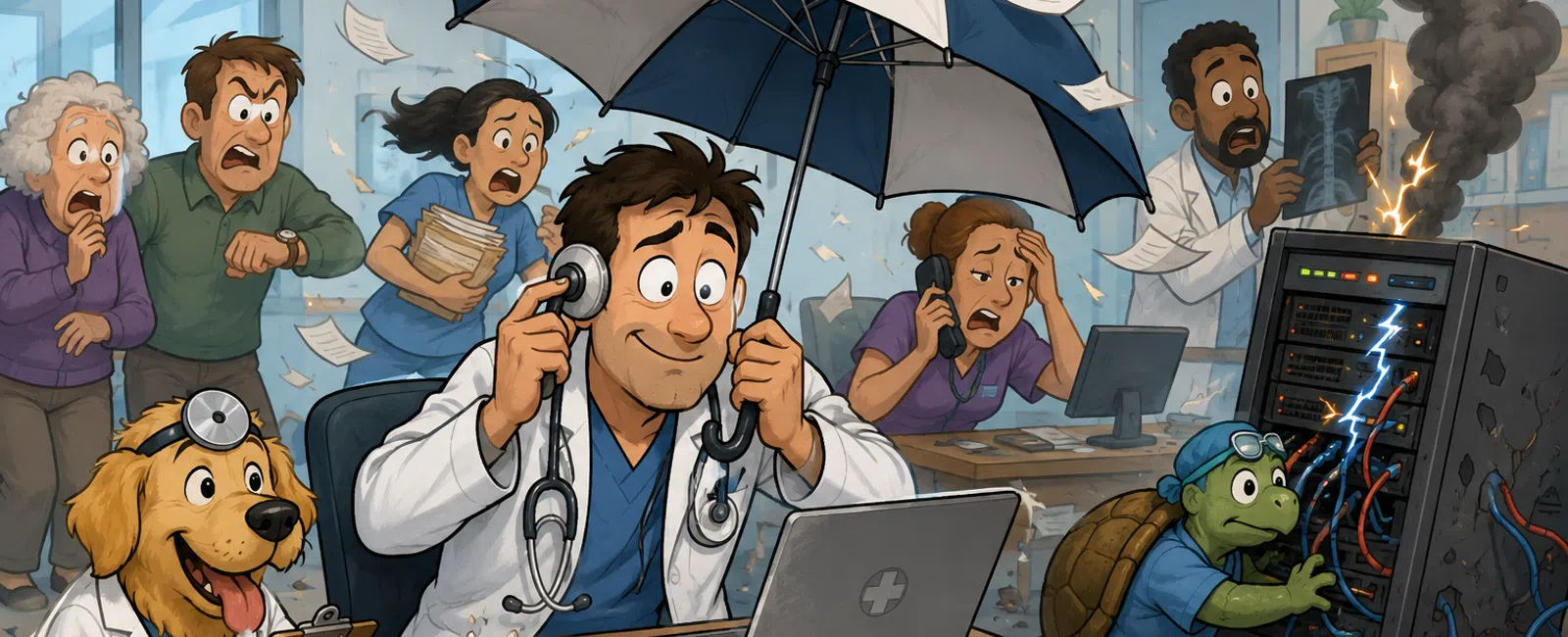
The Risk You Can't See Until Your Clinic Stops Moving
If you've ever been the one everyone looks at when systems
slow down, you already know this truth:
It doesn't matter who caused the problem.
It matters who's expected to fix it—right now.
And the most dangerous mistake clinics make today isn't a
lack of tools, security, or investment.
It's this:
Assuming recovery will work… because failure hasn't
happened yet.
Why "We Have Backups" Isn't Protection
Most clinics we work with have:
- Backup
systems in place
- Security
tools running
- Compliance
documentation filed
On the surface, everything looks responsible.
But when pressure hits, one question exposes everything:
"How long would it actually take to fully recover your
systems today?"
If the answer isn't exact—or worse, isn't known—then you
don't have protection.
You have uncertainty.
And in a clinical environment, uncertainty translates
directly into risk—operational, financial, and reputational.
What This Costs in a Clinical Environment
Let's remove abstraction and talk reality.
A typical outpatient clinic:
- 4-6
patients per provider per hour
- Revenue
tied directly to throughput
- Tight
scheduling with minimal slack
Now apply a disruption:
An 8-hour system outage:
- 5
patients/hour × 8 hours = 40 missed or delayed patients per provider
- Multiply
across providers → compounding backlog
- Add
staff idle time, rescheduling, and documentation recovery
What looks like "IT downtime" becomes:
- Lost
revenue
- Operational
gridlock
- Patient
dissatisfaction and trust erosion
And the worst part?
Most of this impact is preventable—not by more tools, but by
validated readiness.
A Real Scenario (What Actually Happens)
A clinic schedules a routine update.
During the update:
- EHR
access slows due to identity/authentication issues
- Imaging
stops syncing due to storage bottlenecks
- Staff
revert to paper workflows
Timeline:
- Hour
1: "Temporary slowdown"
- Hour
3: Providers frustrated, patients backing up
- Hour
6: Manual processes break down
- Hour
8+: Full disruption with cascading delays
Meanwhile:
- IT
investigates
- Vendors
deflect
- No one
has tested recovery recently
This isn't rare.
It's what happens when systems are built—but never
validated.
What Fails First in Clinics (From Experience)
Failures follow predictable patterns:
- EHR
latency spikes from identity or authentication breakdowns
- Imaging
sync failures due to bandwidth or storage misconfiguration
- Backup
chains fail silently because they were never fully tested
- Access
systems degrade, creating compounding delays across workflows
These aren't edge cases.
They're the first cracks that appear when systems are
stressed—especially in complex clinical environments.
What Acceptable Recovery Actually Looks Like in Clinics
This is where most content stays vague. Let's make it
concrete.
At a minimum, a prepared clinic should have:
- EHR
recovery timeline defined and tested (not estimated)
- Imaging
systems resync within predictable windows
- Full
restore testing performed quarterly with documented proof
- Backup
retention and isolation aligned with ransomware protection
- Clear
downtime thresholds established and communicated
If you cannot validate these with evidence, external
reviewers won't consider your environment reliable.
RTO and RPO: The Line Between Control and Guessing
Here's a simple rule:
If you don't know your recovery time within ±30%, you don't have control.
You're reacting—not managing.
Recovery Time Objective (RTO):
- How
long operations can be down
Recovery Point Objective (RPO):
- How
much data you can afford to lose
These are not compliance checkboxes.
They define whether your clinic can function under pressure.
Clinical Recovery Readiness Score (0-15)
Use this to assess where you really stand:
Score each category from 0-3
- Restore
tested recently
- Documented
recovery process exists
- Verified
recovery time known
- Backups
are isolated/immutable
- Monitoring
and failure alerts active
Total Score Interpretation:
- 0-5
→ High risk
- 6-10
→ Unstable
- 11-15
→ Prepared
If you're under 11, you're likely relying more on assumption
than evidence.
What Auditors, Insurers, and Regulators Actually Look For
From an external perspective, the standard is simple:
Not "Do you have safeguards?"
But:
"Can you prove they work under pressure?"
This directly ties to:
- Data
availability expectations
- Downtime
tolerance
- Recovery
validation under breach scenarios
Passing audits isn't about documentation.
It's about demonstrable operational resilience.
What You Should Do Next Week
Block 30 minutes.
Ask your IT partner one question:
"Show me the last full recovery test—proof, timeline, and
results."
Not a report.
Not a summary.
Proof.
This single step will expose your real level of risk faster
than any tool or dashboard.
You Shouldn't Be the Last Line of Defense
You're already balancing clinical urgency, vendor
coordination, and compliance pressure.
You shouldn't also be guessing whether your systems will
hold when it matters most.
The clinics that stay stable aren't the ones with the most
technology.
They're the ones that know—without hesitation—that recovery
will work.
Because they've proven it.
Schedule your 10 minute discovery call with 911 IT. This
helps you confirm whether your recovery readiness would actually hold under
real clinical pressure. It's a fast validation step with no disruption to your
day.