
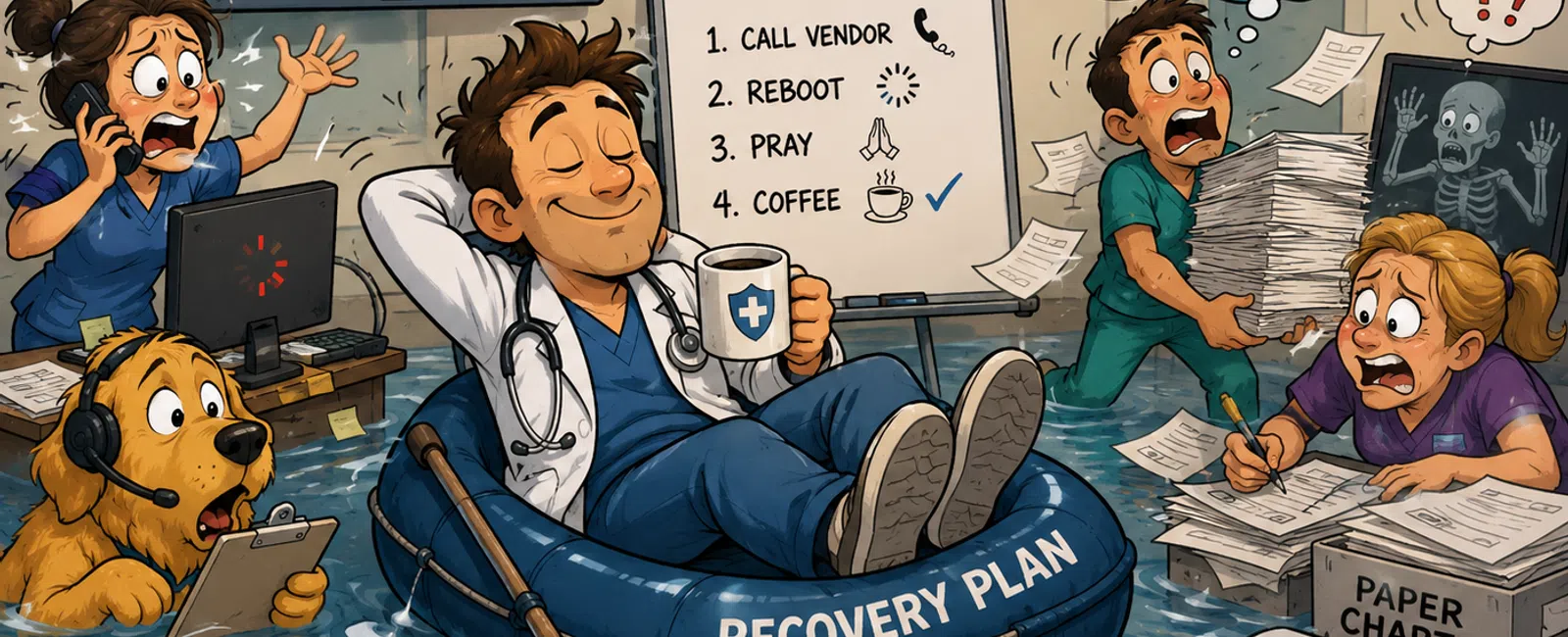
The Day Your Clinic Stops — And No One Knows Why
You don't notice the weakness when things are running.
Everything looks fine: Patients are moving
Providers are charting
Systems are responsive
Then something small breaks—and suddenly, nothing moves.
The nurse calls. Imaging lags. The EHR stalls. Staff fall
back to paper.
And within minutes, the entire clinic feels it.
Not because the failure was massive.
Because your recovery wasn't real.
The Mistake Even Well-Run Clinics Make
Most clinics don't lack tools.
They have:
- Backups
- Security
systems
- Compliance
reports
But they're built on a dangerous assumption:
"We're covered because nothing has gone wrong."
That assumption holds—until the moment it doesn't.
And when that moment comes, the real question isn't: "Do we
have backups?"
It's:
"Can we prove recovery will actually work under
pressure?"
What This Costs in a Clinical Environment
Let's make this real.
A typical outpatient provider sees about 4-6 patients per
hour.
Now imagine an 8-hour disruption:
- 5
patients/hour × 8 hours = 40 delayed or missed patients per provider
- Multiply
across multiple providers → cascading backlog
- Add
staff idle time, rescheduling burden, and manual documentation recovery
This turns into:
- Lost
revenue for the day
- Overtime
to catch up
- Patient
frustration and delayed care
And none of it comes from a cyberattack.
It comes from a system that couldn't recover fast enough.
What Actually Happens During Failure
This isn't hypothetical. It follows a pattern.
A routine system update triggers instability:
Hour 1: Slight EHR latency
Hour 3: Imaging delays and workflow slowdowns
Hour 5: Staff revert to paper processes
Hour 8: Full operational disruption
Under the surface:
- Authentication
issues create access delays
- Imaging
fails due to storage or sync bottlenecks
- Backup
systems exist—but haven't been tested recently
Now you're in the middle: Translating between vendors
Managing clinical frustration
Making decisions without clarity
What should have been contained in 30 minutes becomes an
all-day disruption.
What Fails First in Clinics
Patterns show up consistently:
- EHR
access breaks first—usually tied to identity or authentication strain
- Imaging
systems fall behind due to bandwidth or storage misalignment
- Backup
chains fail silently when no one has tested full restores
- Access
latency spreads across workflows, compounding delays
These aren't rare issues.
They're predictable outcomes when systems haven't been
validated end-to-end.
What Acceptable Recovery Actually Looks Like
This is where most teams lack clarity.
A prepared clinic can answer—without hesitation:
- How
long it takes to fully restore the EHR
- How
quickly imaging systems resync
- When
the last full restore test was completed
- What
systems are prioritized during recovery
- Whether
backups are isolated from ransomware risk
And most importantly:
They can prove it.
Not estimate it.
RTO and RPO: The Line Between Control and Guessing
Recovery isn't binary—it's measurable.
Recovery Time Objective (RTO):
How long you can operate without systems
Recovery Point Objective (RPO):
How much data loss is acceptable
Here's the reality:
If you can't define your recovery time within ±30%, you
don't have control.
You're reacting.
Not leading.
Clinical Recovery Readiness Score (0-15)
Use this to assess your environment right now.
Score each category from 0-3:
- Restore
testing has been performed recently
- Recovery
process is documented and repeatable
- Actual
recovery time is known and verified
- Backups
are isolated (immutable or protected)
- Monitoring
and alerting are active and reliable
Total Score:
- 0-5 →
High risk
- 6-10 →
Unstable
- 11-15
→ Prepared
Most clinics fall in the middle—believing they're prepared
when they're not.
What External Evaluators Actually Care About
Auditors, insurers, and regulators don't focus on what you
have.
They focus on what you can prove.
Specifically:
- Can
systems be restored reliably?
- Is
data availability maintained under disruption?
- Are
recovery processes tested and documented?
In a real audit or incident review, assumptions don't count.
Evidence does.
What To Do Next Week
Block 30 minutes on your calendar.
Ask your IT partner one direct question:
"Show me the last full recovery test—proof, timeline, and
results."
No summaries.
No dashboards.
Proof.
This one action will immediately tell you whether you're
operating on confidence—or guesswork.
You Shouldn't Be Carrying This Alone
You're already bridging clinical urgency, operational
pressure, and compliance expectations.
You shouldn't also have to wonder if your systems will hold
when it matters most.
The clinics that stay stable aren't the ones with more
tools.
They're the ones that have validated—under real
conditions—that recovery will work.
Schedule your 10 minute discovery call with 911 IT. This
helps confirm whether your recovery readiness would actually hold under
clinical pressure, using real benchmarks and proof. It's a fast way to validate
risk without disrupting your day.


