
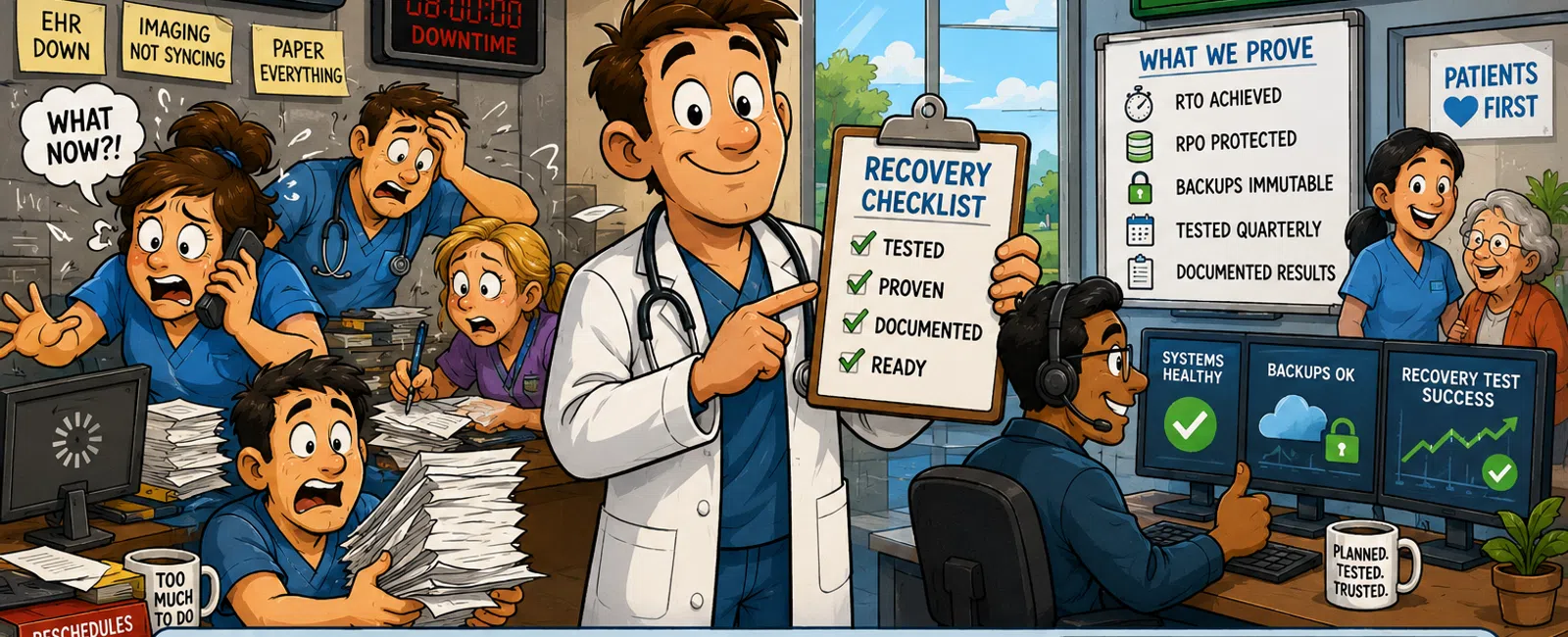
The Clinics That Recover Fast Aren't Lucky — They're Proven
If you're responsible for keeping your clinic running, you
already know this tension:
Everything feels fine… until it isn't.
And when something breaks, no one calls your vendor first.
They call you.
Because at the end of the day, you're the one expected to
keep care moving, systems stable, and risk under control—even when you don't
fully control the systems.
Here's the uncomfortable truth most clinics don't realize
until it's too late:
The difference between a minor issue and a full-day
disruption isn't the problem.
It's whether recovery has been proven.
What We See Across Clinics (And Why It Matters)
We see this pattern constantly:
- Clinics
with backups that have never been fully restored
- Environments
with defined RTO/RPO on paper—but not validated in practice
- Teams
relying on vendors who monitor systems but never test full recovery
What that looks like in reality:
- Restore
testing is inconsistent or skipped entirely
- Recovery
timelines are assumed—not measured
- Failure
points only appear during real incidents
And when pressure hits, everything becomes reactive.
Not because teams don't care.
Because no one forced validation before it mattered.
What This Costs When Systems Slow or Stop
Let's ground this in a real clinical scenario.
A 3-provider clinic averages 5 patients per hour.
An 8-hour disruption means:
- 120
delayed or missed patients
- Full-day
revenue loss
- Staff
overtime to recover
- Patient
trust taking a measurable hit
And this isn't from a major cyber event.
It often starts with something small:
- Authentication
lag
- Imaging
not syncing
- A
system update that didn't go as planned
The disruption grows because recovery wasn't ready.
Where Recovery Breaks Under Pressure
These are the failure points we see most often:
- Backup
chain integrity fails because restores were never fully tested
- Identity
systems (AD/Entra) become bottlenecks, slowing everything downstream
- Storage
and imaging dependencies create cascading delays
- Recovery
order is unclear, so teams waste time deciding what comes first
These are not edge cases.
They're predictable outcomes of systems that haven't been
validated end-to-end.
What Acceptable Recovery Actually Looks Like in Clinics
Prepared clinics don't guess.
They can prove:
- Recovery
Time Objective (RTO) is clearly defined and tested
- Recovery
Point Objective (RPO) aligns to clinical tolerance for data loss
- EHR
systems are restored first, followed by identity and imaging
- Backups
are immutable and protected from ransomware
- Full
restore testing happens quarterly—with documented results
If this isn't documented and repeatable, recovery isn't
reliable.
How This Maps to HIPAA Expectations
This isn't just operational—it's regulatory.
Healthcare environments require:
- Documented
contingency planning
- Proven
ability to maintain data availability
- Ongoing
validation of recovery processes
- Evidence
that safeguards work under real conditions
In other words:
"We have backups" is not compliance.
"Here is proof they work" is.
This is exactly where audits—and liability—get decided.
Clinical Recovery Readiness Score (0-15)
Use this to assess your environment today.
Score each from 0-3:
- Restore
testing completed and documented
- Recovery
process clearly defined
- Verified
recovery time measured
- Backups
isolated (immutable/protected)
- Monitoring
and alerting active
Total Score:
- 0-5 →
High risk
- 6-10 →
Unstable
- 11-15
→ Prepared
Most clinics sit in the middle—thinking they're ready, but
unable to prove it.
Where to Start (Highest Impact First)
If you're not fully confident yet, start here:
- Restore
validation
Run and document a full restore test—not partial, not assumed - Identity
and access stability
Ensure authentication systems won't bottleneck recovery - Backup
isolation
Confirm backups are protected from ransomware and corruption - Monitoring
and alerting
Detect failures before users feel them
These four areas do more to reduce real risk than adding new
tools.
How Long This Actually Takes
When approached systematically:
Most clinics can move from assumed recovery to validated
recovery in 30-60 days.
Not by replacing everything.
By proving what already exists—and fixing what breaks under
testing.
A Scenario You Should Recognize
A clinic schedules a routine update.
Within hours:
- EHR
latency slows providers
- Imaging
stops syncing
- Staff
shift to paper workflows
There's no recent restore test.
No validated recovery sequence.
What should take 30 minutes takes the entire day.
And you're left coordinating vendors, calming clinicians,
and making decisions without clear data.
This is where most operational leaders feel it:
You're responsible—but not fully supported.
The Difference Most Clinics Miss
Most IT providers monitor systems.
Few validate recovery under real conditions.
That's the line between:
- Seeing
issues
- And
being ready when they happen
And in healthcare, that difference doesn't just affect
uptime.
It affects patient care.
What To Do Next Week
Set aside 30 minutes.
Ask your IT provider:
"Show me the last full recovery test—timeline, results, and
proof."
Not a report.
Not an assumption.
Proof.
That single step will tell you whether your clinic is
operating on confidence—or risk.
You Shouldn't Have to Carry This Alone
You're balancing clinical urgency, compliance pressure, and
constant interruptions.
You shouldn't also be guessing whether your systems will
hold.
Schedule your 10 minute discovery call with 911 IT. This
helps confirm whether your recovery readiness meets real clinical and
regulatory expectations. It's a fast way to validate where you actually stand
without adding more to your plate.


